
01 · Site conditions
Check whether airflow is appropriate
EPA's guidance for clean-water damage includes fans after water removal, alongside dehumidification. It also says not to use fans until the water has been confirmed clean or sanitary. Where sewage or other contamination is suspected, EPA recommends a professional with relevant experience. [1]
If mold is already growing: EPA warns that fans may spread mold and advises removing visible mold before using them. Electricity must be safe to use after flooding. [2]
Water extraction and air-cleaning equipment are covered in the water-damage equipment guide.
02 · Evaporation and moisture removal
Air movement supports evaporation
An air mover moves air across a wet surface. In a system using a refrigerant dehumidifier, evaporated water is then collected as condensate and drained from the unit. EPA includes fans and dehumidifiers in its drying recommendations for suitable materials affected by clean water. [1]
Material
Water in material being retained
Air
Airflow supports evaporation
Dehumidifier
Water vapor becomes condensate
Drain
Collected water leaves the unit
Moisture movement in a system using a refrigerant dehumidifier. This diagram does not specify equipment placement or drying time.
03 · Examples of construction
Two fan types and a low-profile body
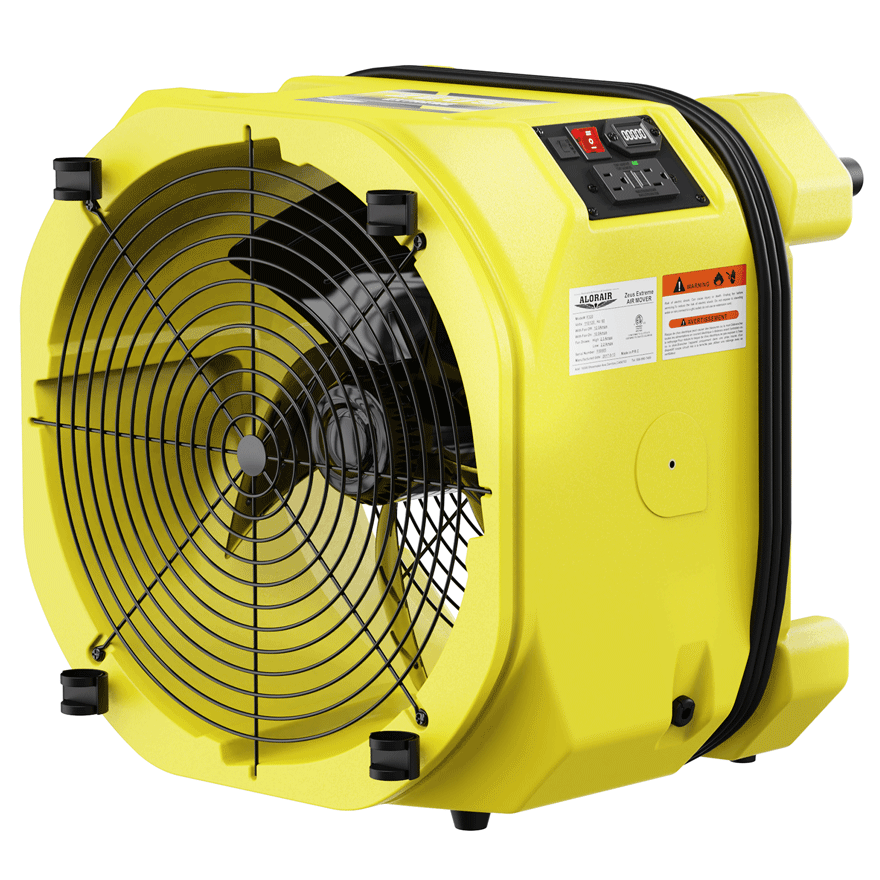
Axial: Zeus Extreme
A round grille and a straight passage through the body. The Zeus Extreme specification illustrates duct connections at the inlet and outlet, while the manual lists permitted operating positions. The unit has two speeds. [3][4]
If ducting is needed, confirm compatibility and whether it is included when ordering. A duct connection on the body does not establish that a duct is supplied with the fan.
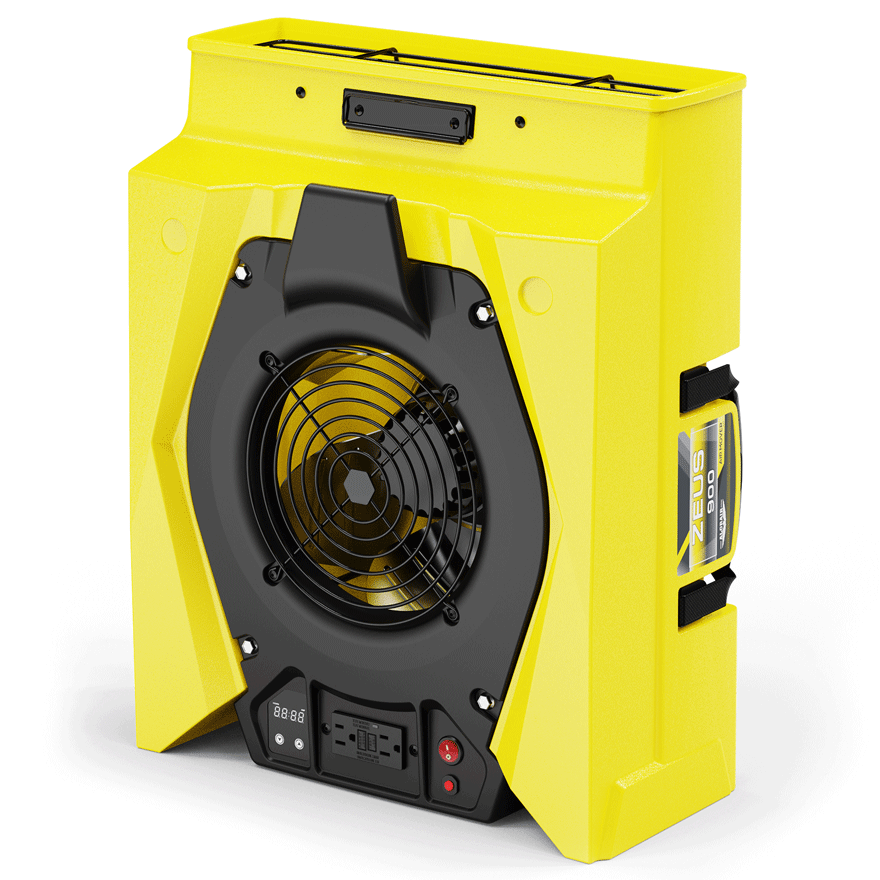
Low-profile: Zeus 900
Air enters through the top grille and leaves through the front opening. AlorAir describes Zeus 900 as a radial air mover. The manual shows five body positions, including horizontal and vertical, with speed adjusted using panel buttons. [5][6]
The shallow body helps where height is limited, but the air inlet must stay clear. Do not cover it with furniture or materials. [6]
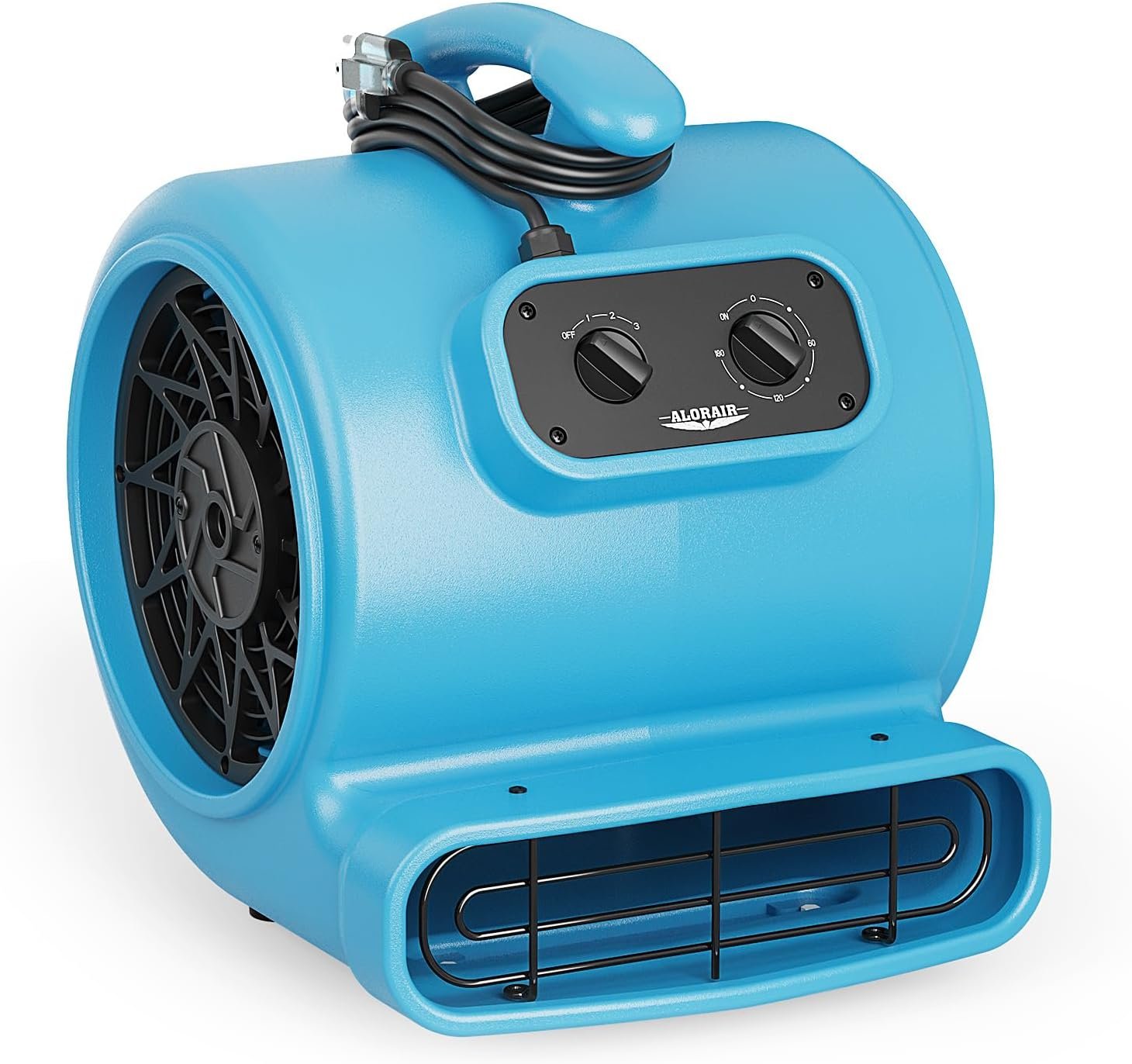
Centrifugal: GE3000T
A scroll-shaped body, side inlet and rectangular outlet near the floor. GE3000T has three speeds and a mechanical timer for up to three hours. The ON position provides continuous operation. [7][8]
The GE family manual covers several configurations. T identifies the timer, A denotes additional outlets, and F refers to filters. Features from those versions should not automatically be attributed to GE3000T. [8]
04 · Controls and positions
What each model includes
| Feature | Zeus Extreme | Zeus 900 | GE3000T |
|---|---|---|---|
| Speed control | 2 speeds | Panel-button adjustment | 3 speeds |
| Body positions | Tilted, inlet up or down; see manual for configurations | 5 positions | 0°, 45°, 90°, +10°, −10° |
| Mechanical timer | Not listed | Not listed | Up to 3 hours or continuous operation |
| Hour meter | Listed | Listed | Not listed |
| Additional outlets | GFCI, 115 V version | GFCI, 115 V version | Assigned to version A in the manual |
| Power cord length | 20 ft | 20 ft | 20 ft |
AlorAir specifications and manuals for US versions. “Not listed” means the feature is not stated in the documents used. [3][4][5][6][7][8]
How to read CFM
CFM means cubic feet of air per minute. The specifications list approximately 950 CFM for Zeus 900 and up to 3,000 CFM for Zeus Extreme and GE3000T. These figures describe airflow; they cannot be used to calculate how long a wall or floor will take to dry. That comparison needs tests using the same materials and conditions. [3][5][7]
The documents also differ: the Zeus Extreme manual gives a range of 3,000–5,000 CFM, while its specification lists approximately 3,000 CFM. Check the figure against the documentation for the version being supplied. [3][4]
05 · Buying or renting
Match the model to the job
Zeus Extreme has documented ducting configurations. Consider Zeus 900 where a shallow body with several operating positions is needed. GE3000T is an option when a mechanical timer is required. These are functional differences; suitable placement depends on the site.
Before connecting several units, check the electrical circuit load and the limits in their manuals. An outlet on a fan does not increase the circuit's permitted load. The Zeus manuals also prohibit operation in standing water and require unobstructed inlets and outlets. [4][6]
Affiliate links to TheDryAir. Check the selected model, included equipment and delivery on the seller's page.
Alternative: Dri-Eaz Velo
Velo has a low-profile body, four operating positions and two speeds. Legend Brands lists its weight as 18.6 lb (8.4 kg). Velo Pro has different controls; keep the full model name when comparing options. [9]
For a one-time job, also obtain a quote for renting a drying package, including air movers and a dehumidifier.
Sources and method
What this guide is based on
The Zeus Extreme, Zeus 900 and GE family manuals were read, along with the selected models' specifications. Figures come from manufacturer documentation. No hands-on airflow or drying-time measurements were performed.