

In an average year the air in Orlando is oppressive on 112 days, nearly the same as Tampa on the Gulf coast, and only about 40 fewer than Miami. And yet no water is in sight in any direction. I pulled the hourly records from Orlando International Airport and counted every day. The first finding is simple and unexpected: distance from the coast changes almost nothing.
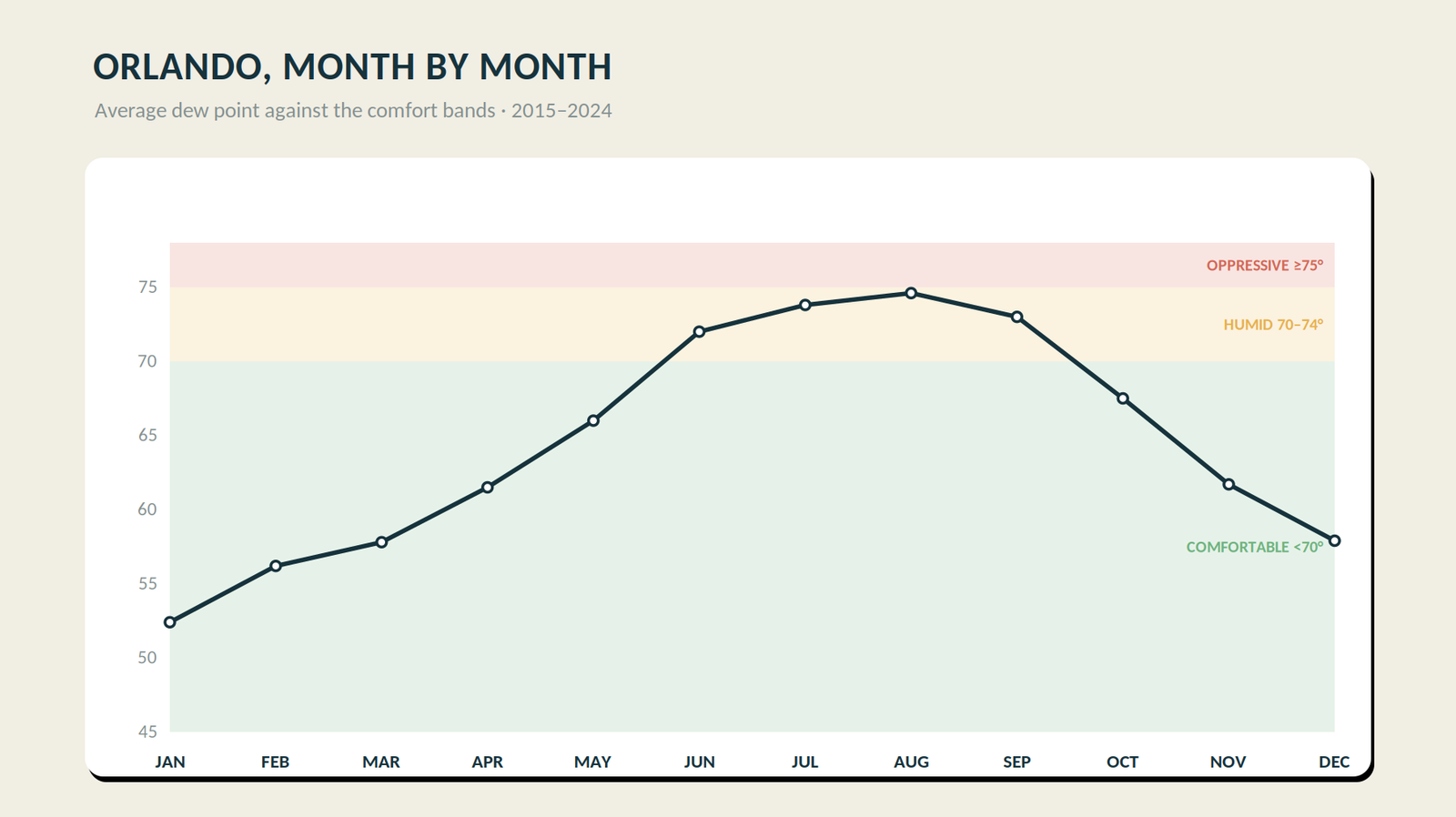
Orlando, Month by Month
Orlando’s year has a central-Florida shape. From June through September the dew point climbs to the top of the humid band and pushes into the oppressive line, peaking in July and August. The summer here is as heavy as the south’s.
Winter is a different, and better, story. By January the dew point drops to about 52°F, dry and light air. In its swing across the year Orlando is closer to Tampa than to Miami: a hard summer and a real dry winter. Think of it as the south’s brutal summer plus the center’s ordinary winter in one city.
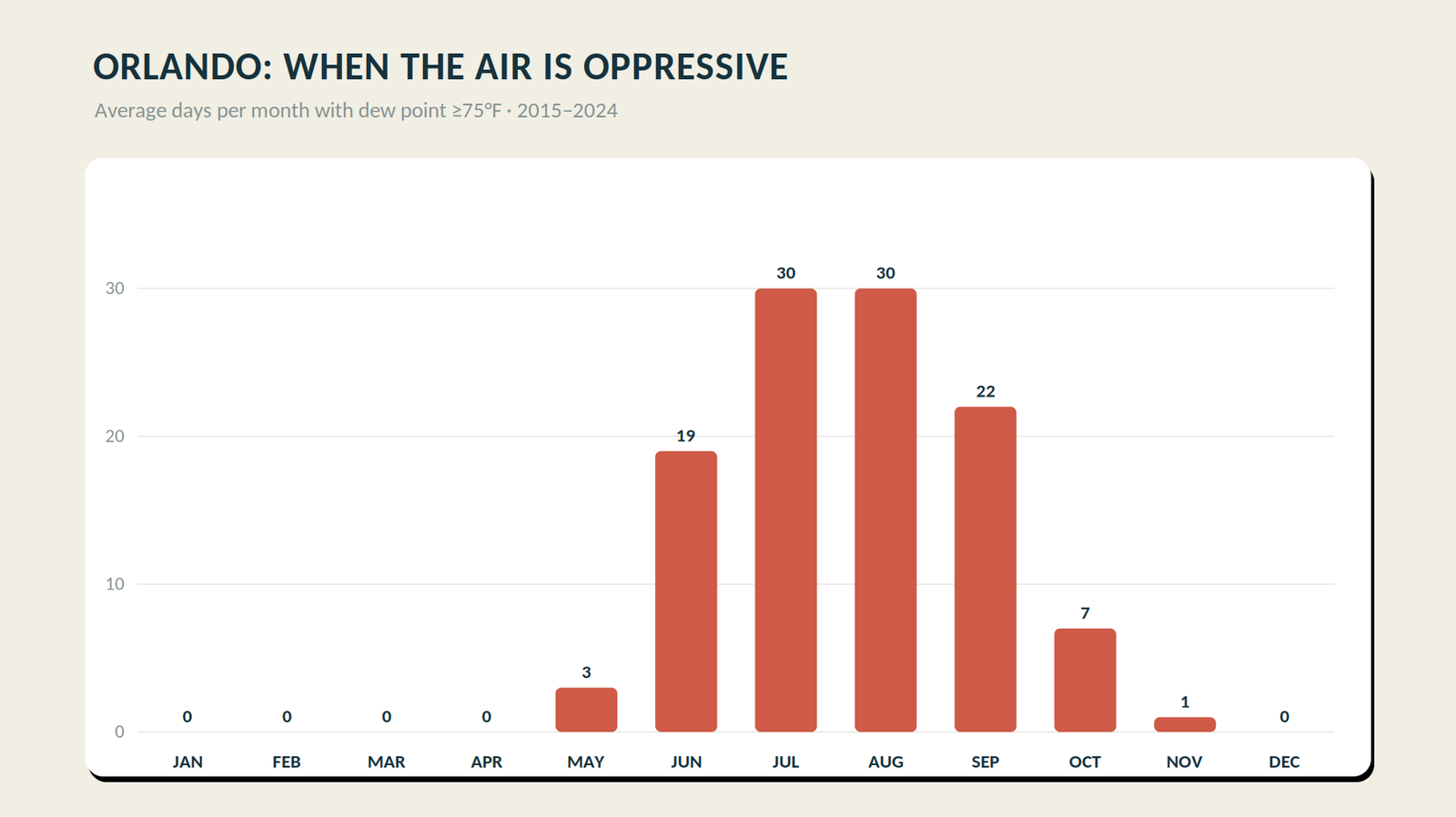
When the Air Is Worst
The oppressive days are packed tightly into summer. In July and August the dew point hits 75°F on 30 days out of the month, almost every single day, no milder than Miami. June and September are close behind, at 19 and 22. From December through April it is zero. Five dry months in a row.
For a house, that is convenient: the load runs cleanly from May through October, and in winter the dehumidifier can be switched off. The summer peak, though, is no lighter than the south’s.
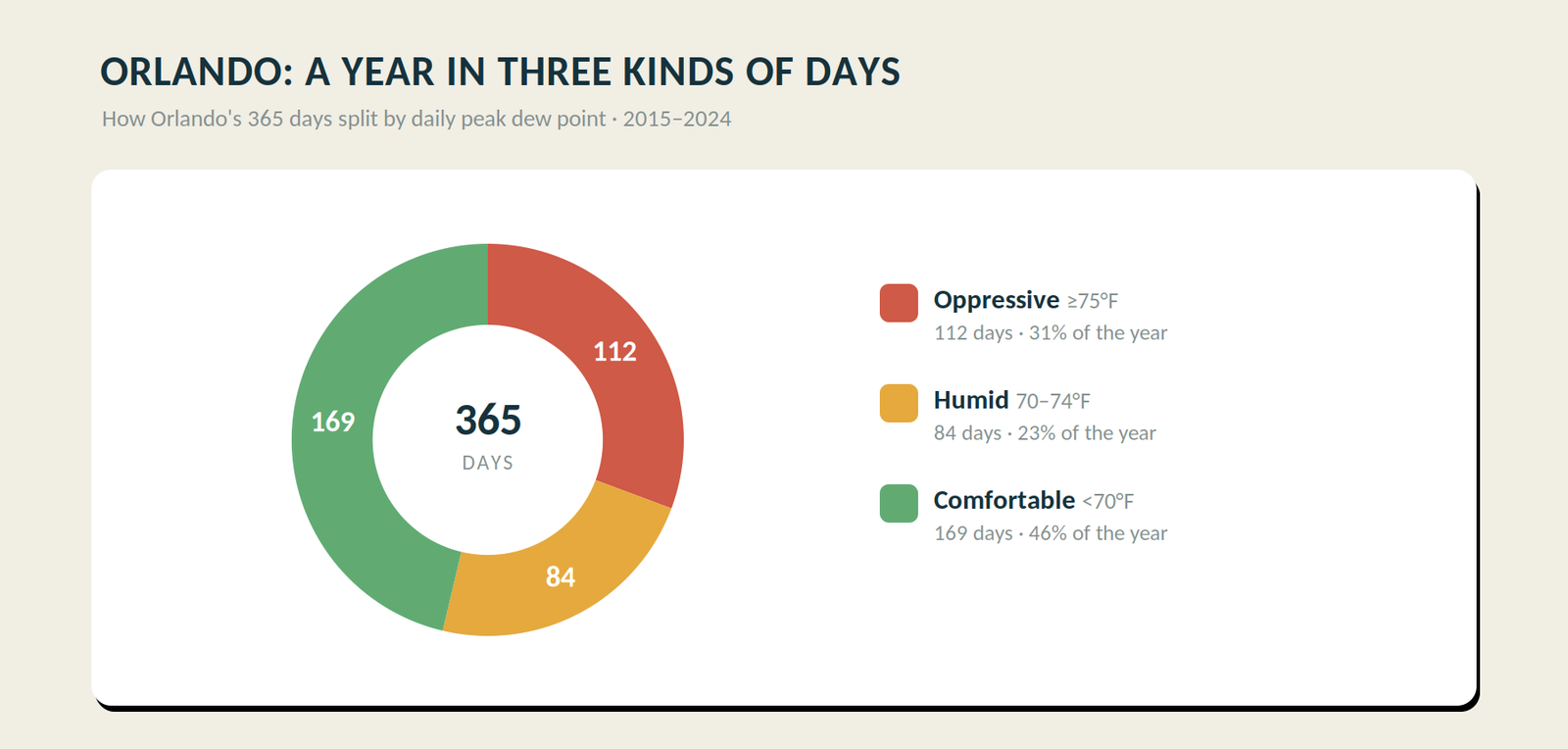
An Orlando Year at a Glance
Added up, the year splits into 112 days oppressive, 84 humid, and 169 comfortable. Comfortable days are nearly half the year, like Tampa. That is exactly where Orlando parts from Miami: an equally brutal summer, but Orlando has somewhere to breathe in winter.
The Inland Paradox: No Coast, Same Humidity as the Beach
Common sense says it is humid by the water and dry away from it. In Florida that does not hold, and Orlando is the proof.
Compare Orlando in the interior with Tampa on the Gulf coast. They are at the same latitude, but one is 50 miles from the water and the other is right on it. You would expect the coast to be clearly more humid. Instead their dew point matches all year: 52°F in January for both, 74°F in August for both, a tenth of a degree apart. Fifty miles from the water does not dry the air out at all.
The reason is that moisture arrives on the wind, not from a nearby shore. In summer humid air flows in over Florida from both sides, the Atlantic and the Gulf, and the peninsula is narrow enough that the air over the center saturates as easily as the air over the coast. How much water is in the air is set by latitude, further south is more humid. Nearness to the shore has almost nothing to do with it.
The interior does have one difference, and not in Orlando’s favor. On the coast a sea breeze knocks the daytime heat down, into the upper 80s in summer. Orlando has no such breeze, and on the same days it runs over 90°F. Same moisture, more heat. For the body that is worse: the heat index, how hot it feels once you account for humidity, is higher in Orlando than on the coast at the same dew point. Inland is not drier, inland is hotter.
The Lightning Capital, and Why They Launch Rockets Next Door
All of central Florida shares one trait: it is the most lightning prone place in the country, and Orlando sits at the heart of it. The numbers are serious. The corridor from Tampa Bay to the Space Coast takes about 56 lightning strikes per square mile a year, more than anywhere else in the US, and roughly 90% of them fall between May and October, from noon to midnight. By thunderstorm days, Orlando averages 84 a year and Tampa 87, the highest of any major cities in the country (from Vaisala’s lightning detection network and the NWS).
The mechanism is the same one we saw with the coasts. During the day the land heats faster than the water, and the sea breeze pushes inland from both sides, from the east off the Atlantic and from the west off the Gulf. Over the middle of the peninsula, right over Orlando, the two streams collide. The humid air is forced up, rises, cools, and the moisture gathers into a storm. For this the corridor from Tampa Bay to the Space Coast earned the nickname Lightning Alley, a popular one out of the weather reports, familiar enough that it named a hockey team, the Tampa Bay Lightning. Orlando is right in the middle of it, and the storms are near daily: they flare in the afternoon and clear by evening.
And here is a curious detail. About 50 miles east of Orlando, at the same latitude, on the Atlantic shore, sits the launch complex at Cape Canaveral. The eastern end of Lightning Alley runs straight into it. It was built there not because of the weather but in spite of it, for a purely physical reason: Florida is relatively close to the equator, and the Earth spins eastward, so a launch to the east gets a free boost from that spin, with open ocean to the east where spent stages and any failures fall safely. The weather is the obstacle: the same central-Florida lightning scrubs launches again and again, and the pads bristle with lightning rods. The same storm engine that makes an Orlando summer heavy also keeps the rockets waiting for a weather window.
Orlando Has a Winter
The center’s dry winter is the work of weather from the north, not of any water. Orlando is far enough north that in winter cold fronts from the mainland reach it. Each front sweeps out the humid air and drags dry, cool air in behind it. November through March is a run of these passages, and between them the air never fully saturates again. Those fronts mostly do not reach Miami, but they do reach Orlando, so the center of the state gets a dry season and the south does not.
What This Means for a House in Orlando
Orlando’s humidity is seasonal, and easier to work with than the south’s.
May through October the load is the same as Miami’s, and harder on the heat side: the air conditioning works on both cooling and drying, the air barely clears at night, and after every storm the mugginess returns. In those months a house is exposed to mold like everywhere in Florida: bathrooms, closets, still corners. If mildew shows up, whether you can clear it yourself or need to bring in a specialist comes down to how far it has spread: here is how to tell.
November through March it all lets go: the air is dry, the house dries out, the dehumidifier goes off. Orlando is mostly suburban single-family homes, many of them new, and for a whole house on seasonal duty one capable portable dehumidifier in the living area is usually enough. Aim to hold about 50% relative humidity from May through October.
How Orlando Compares to the Rest of Florida
Orlando sits in the middle of the state’s humidity range: clearly drier than Miami and Key West, and nearly level with Tampa. Central Florida as a whole gets the same summer from coast to coast, on the water or inland. I laid out the full five-city picture here: Florida humidity by the numbers.
What to Do About It
The goal is about 50% relative humidity in season. For Orlando that means a dehumidifier for the summer, not the whole year. The dehumidifier size calculator turns your square footage and humidity into a pint rating, and the best dehumidifiers for Florida covers the units built for this climate. Switch it on in May, shut it off in November.
Frequently Asked Questions
How humid is Orlando?
Very humid in summer: the dew point reaches an oppressive 75°F on nearly every day in July and August, about 112 such days a year, almost the same as Tampa. In winter Orlando dries out, adding up to 169 comfortable days, nearly half the year.
Why is Orlando humid if it is far from the ocean?
Because the moisture arrives on the wind from both sides, the Atlantic and the Gulf, and the peninsula is narrow. Humidity is set by latitude, not by nearness to the shore: inland Orlando and coastal Tampa have the same dew point all year.
Is Orlando hotter than the coast?
In the daytime in summer, yes. On the coast a sea breeze knocks the heat down into the upper 80s, while Orlando without that breeze runs over 90°F. The moisture is the same, but the heat is higher, so it feels worse.
Is Orlando really in Lightning Alley?
Yes. The corridor from Tampa Bay to the Space Coast, with Orlando in the middle, takes the most lightning in the US, about 56 strikes per square mile a year according to Vaisala. The cause is the daily collision of sea breezes over the center of the state.
Do I need a dehumidifier in winter in Orlando?
Usually not. From November through March the air is dry and the dehumidifier can be switched off. The main work runs May through October.
Does Orlando humidity cause mold?
In summer, yes, with the same risk as the coast: five months of high humidity is enough for mildew in bathrooms and closets. In winter the risk drops as the air dries out.