
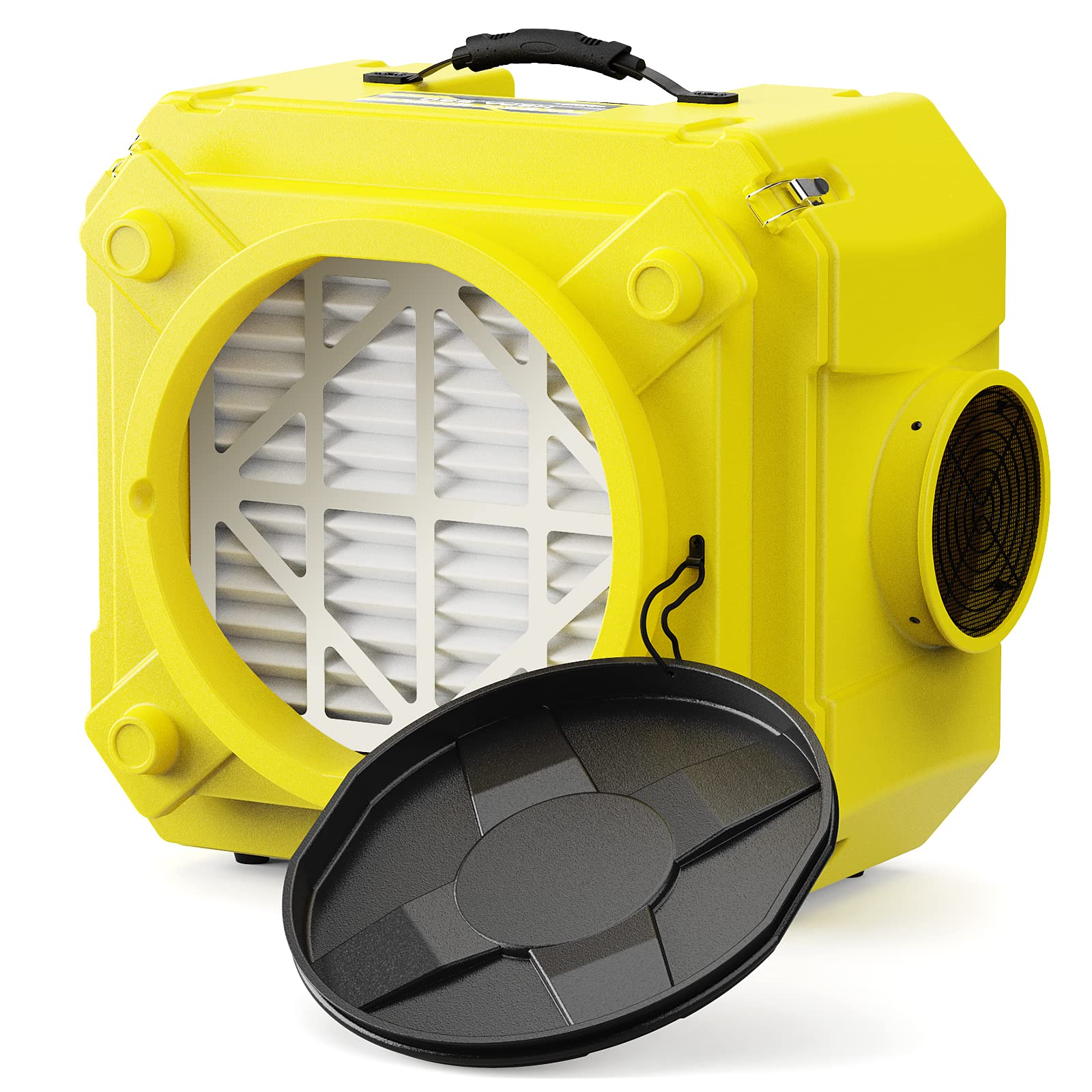
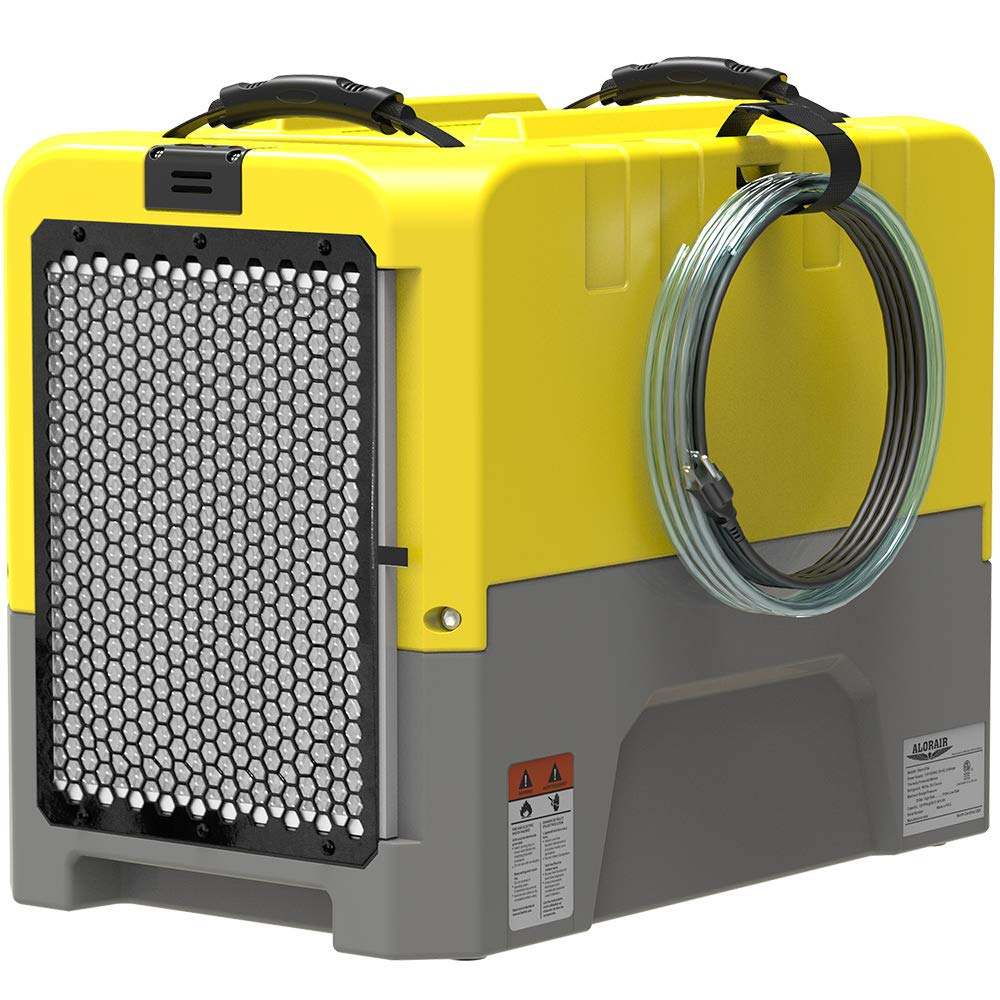
01 · Two processes
What stays in the filter and what goes down the drain
CleanShield draws air through a prefilter and a HEPA/activated-carbon filter. Captured particles remain in the filters. In Storm, moist air passes across a cold evaporator coil, where water condenses. The pump sends the collected water through a drain hose. [4][7]
These diagrams show the functions of the selected machines. The dehumidifier returns air to the room; the separate water path ends at the drain.
EPA describes filtration as a supplement to removing pollution sources. An air scrubber does not remove mold from a wall or fix a leak. Cleaning and drying damaged materials remain separate tasks. [1][2]
02 · Functions and measurements
Compare the work each machine does
| Parameter | Air scrubber | Refrigerant dehumidifier |
|---|---|---|
| What it removes from air | Particles captured by its filters | Water vapor |
| Where it collects | In the filters | In the reservoir, then the drain |
| Specifications to check | Filters and airflow | Water removal at a stated temperature and humidity |
| Maintenance example | Inspecting and replacing filters | Filter cleaning and drain maintenance |
| Example model | CleanShield HEPA 550 | Storm LGR Extreme |
Functions and maintenance are based on the two model manuals. [4][7]
CFM measures airflow in cubic feet per minute. Pints per day measures water removal. These units answer different questions: a higher CFM rating on an air scrubber does not make it a substitute for a dehumidifier.
The MERV-8 filter listed for the current Storm Extreme does not make that dehumidifier equivalent to CleanShield and its filter system. For more on dehumidifier test conditions, see pints, AHAM and saturation ratings. [6]
03 · Airflow direction
Room filtration and negative pressure
Air returns to the same area
In recirculation, the machine draws air from the room, filters it and returns it to that room. This arrangement alone does not establish negative pressure relative to adjacent rooms.
Air leaves the contained area
In a negative-pressure setup, air is removed from an enclosed work area. The pressure difference draws replacement air inward and limits the escape of contaminated air into adjacent spaces. [3]
The CleanShield manual describes negative-pressure use and calls for a manometer to monitor pressure. Containment and the exhaust path matter in this setup. A product listing labeled “negative air machine” does not establish that the required pressure exists on a job. [4]
EPA says the choice of containment for mold remediation should be based on professional judgment. Its design depends on the contamination and the building conditions. [3]
04 · Documented examples
CleanShield 550 and Storm Extreme
CleanShield: filters and duct connections
TheDryAir lists a MERV-10 prefilter and a HEPA/activated-carbon filter. Duct connections are 16 inches at the inlet and 8 inches at the outlet; ducts are not included. The control panel has variable airflow and a filter-change indicator. [5]
Claimed filtration efficiency: the current listing states 99.5% for particles larger than 0.3 microns. The linked specification sheet gives a different figure: 99.96%. The documents do not establish one consistent efficiency figure. Neither number represents the percentage of mold removed from a home. [5]
The manual calls for prefilter checks before use, replacement of both filters after remediation jobs and cleaning between jobs. Disconnect power before maintenance. [4]
The CleanShield manual excludes damage from use at humidity of 75% or higher from its warranty. Before using it in a humid space, confirm the permitted conditions and warranty for the supplied version with the seller. [4]
Storm: water collection and drainage
The basic Storm LGR Extreme is rated at 85 US pints per day at 80 °F and 60% relative humidity. Its built-in pump drains condensate automatically. A manual drain button provides an additional way to empty remaining water; it does not replace automatic pumping. [6][7]
Equipment and control details are covered in the Storm LGR Extreme review. These machines illustrate different equipment classes; the job's scope determines the equipment package.
05 · Water-damage work
Assess the water and damage first
EPA recommends removing standing water and materials that cannot be cleaned and dried. Use electrical equipment once power is safe. Ordinary fans can spread existing mold; EPA recommends cleaning visible mold before using fans. [2]
Where wet materials can be retained, a dehumidifier removes moisture from the air. If the work calls for particle filtration, an air scrubber handles that task separately. Assess containment needs before setting it up, especially when removing mold-damaged materials. [2][3]
For a one-time job, compare purchasing with equipment rental and restoration services. When ordering a package from a contractor, clarify each machine's purpose: what supports drying, what filters air and how containment is monitored if needed.
Water-damage equipment ↗
From water removal to drying checks.
Air movers for drying ↗
Fan types and airflow controls.
Sources and method
Based on documentation, without hands-on testing
Sources include EPA guidance, AlorAir manuals and TheDryAir listings. Photos show the named models. I have not measured filter efficiency or drying speed on a job.