

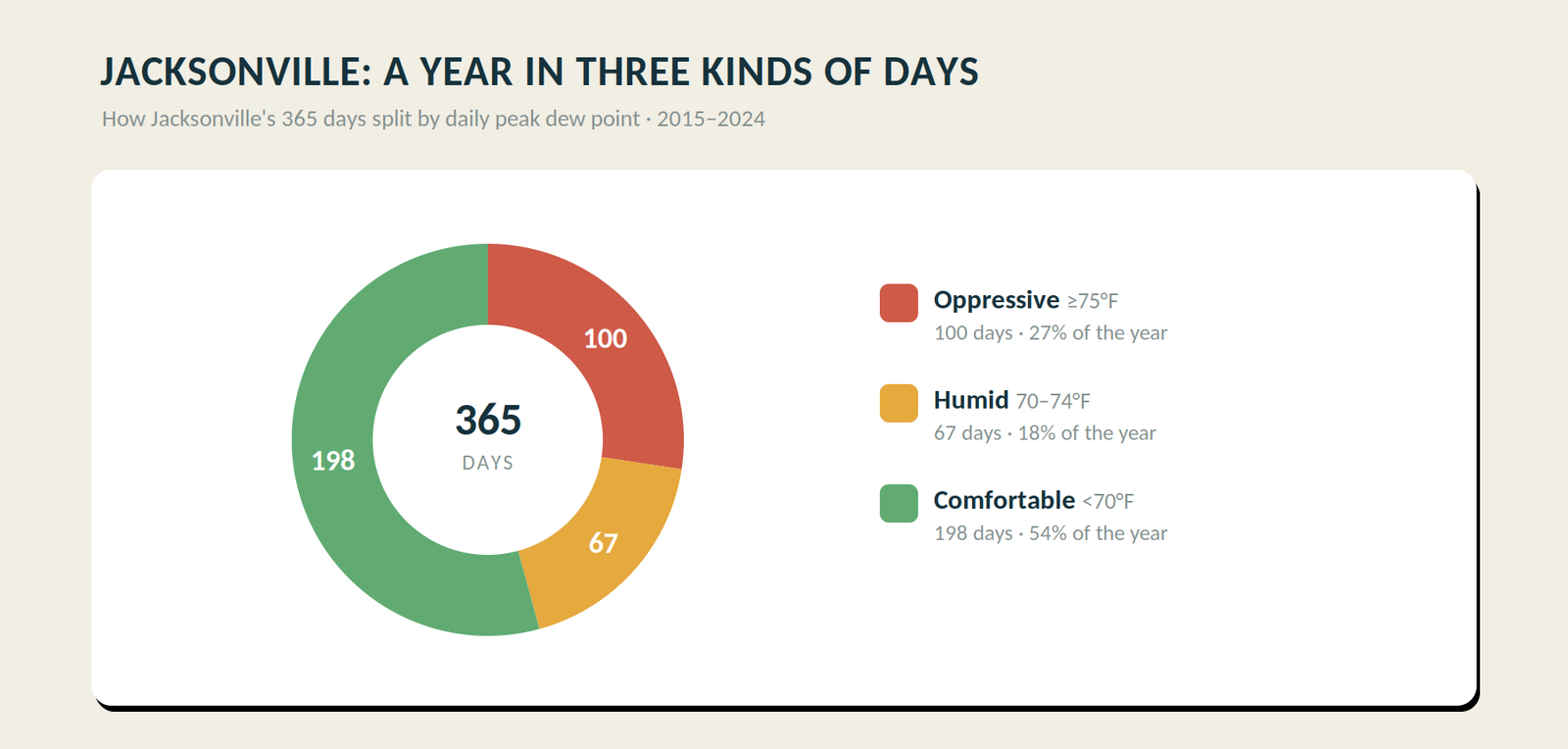
In an average year the air in Jacksonville is oppressive on 100 days, fewer than any other city in the five, and half as many as Key West down south. Comfortable days number 198, the most of any: more than half the year the air is pleasant. I pulled the hourly records from Jacksonville International Airport and counted every day. But there is a detail that surprises people: August here is no easier than in Miami.
Jacksonville, Month by Month
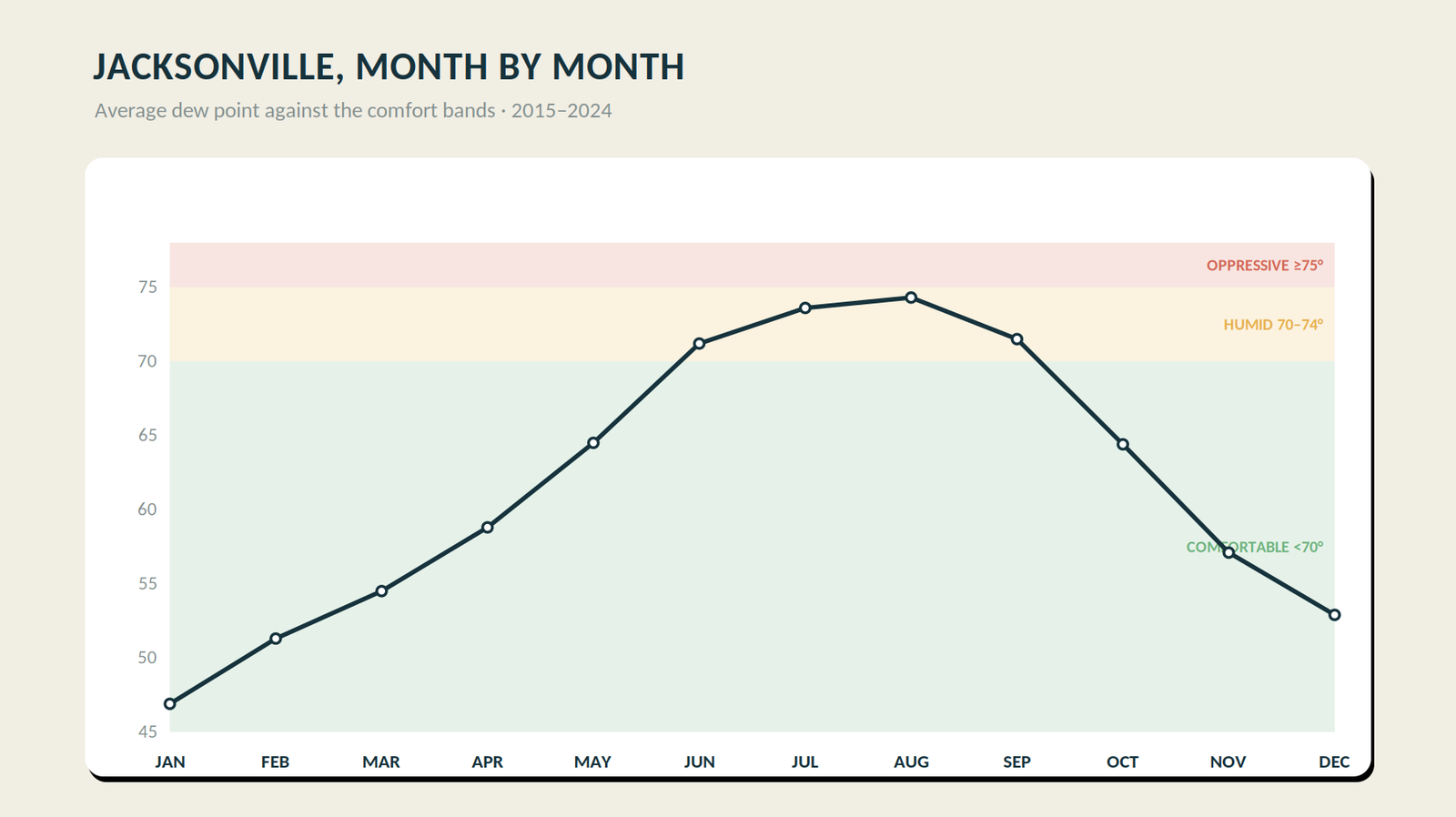
In summer the north concedes nothing to the south. From June through September the dew point climbs to the top of the humid band, and in July and August it reaches 74°F, the same as Miami, the same as Orlando. An August day in Jacksonville is just as oppressive, and any local will tell you so.
Winter is a different story entirely, and that is the whole of Jacksonville. By January the dew point drops to 47°F, the lowest of all five cities. That is genuinely dry air. Jacksonville’s swing across the year is the widest in Florida: the same heavy summer, but a winter the rest of the state does not get.
When the Air Is Worst
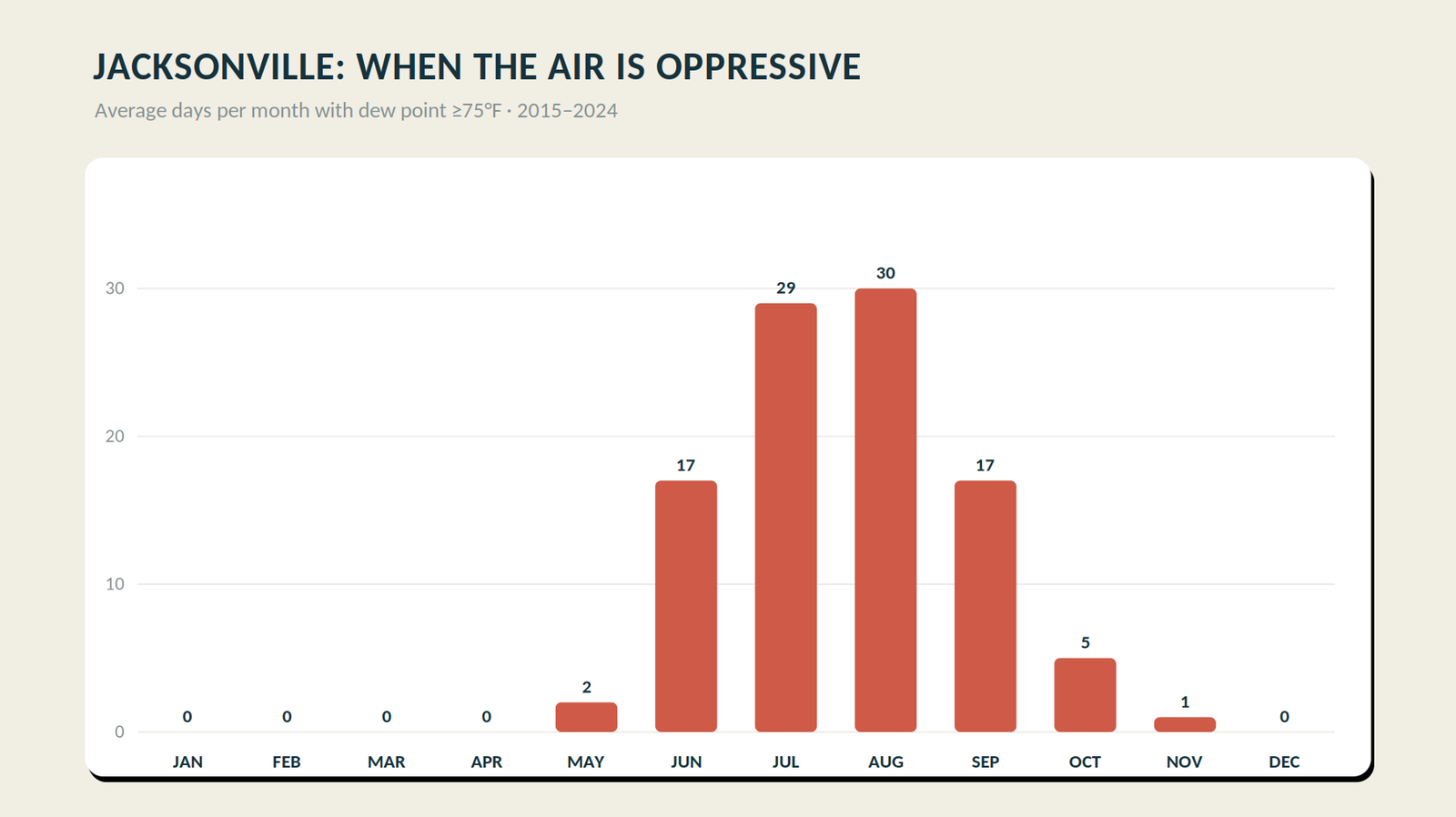
The oppressive days are packed into a short core. July and August post 29 and 30 days, almost every day, like the south. But the season cuts off sharply at the edges: June and September are only 17 each, and from December through April it is zero. Five full months without a single oppressive day.
For a house that is the most convenient pattern in Florida. The heavy season is short, June through September, and for half the year the air is dry and the dehumidifier simply is not needed.
A Jacksonville Year at a Glance
Added up, the year splits into 100 days oppressive, 67 humid, and 198 comfortable. Comfortable days are more than half the year, the largest green slice of all five cities. Where Key West’s chart is almost entirely red, Jacksonville’s is almost entirely green. They are two poles of one state.
The Two Ends of Florida: Jacksonville and Key West
Jacksonville and Key West are the far ends of the state, north and south, and the comparison is worth making. In August they are nearly identical: both average about 74°F dew point, both oppressive. Summer in Florida is shared, from Key West to the Georgia line.
In everything else they are opposites. The difference is the length of the season, and latitude sets it. Key West has 193 oppressive days and only 72 comfortable; Jacksonville has 100 oppressive and 198 comfortable. Between the two ends of one state is a hundred oppressive days, nearly three months. Key West never lets go all year; Jacksonville lets go for half of it. The same August, but two completely different years around it.
Jacksonville Has a Real Winter
The north’s dry winter is a direct result of latitude. Jacksonville is at the 30th parallel, furthest from the tropics, and cold fronts from the mainland reach it fully and often. Each front sweeps out the humid air and brings in dry, cool air, and the next arrives before the air can saturate again. November through March is a nearly unbroken run of these dry passages.
Real cold comes with them. Unlike south Florida, where frost never happens, Jacksonville catches the occasional winter freeze and frost, closer in winter to the rest of the Southeast than to Miami. For humidity this means one thing: the winter air here is genuinely dry, not “a little less oppressive” the way it is in the south.
What This Means for a House in Jacksonville
Of the five cities this is the easiest case, and you can take it more calmly.
The dehumidifier season is short, essentially June through September. In those months the load is the same as further south: in July and August the air does not clear at night, and a house is exposed to mold like everywhere in Florida, bathrooms, closets, still corners. If mildew shows up, whether you can clear it yourself or need to bring in a specialist comes down to how far it has spread: here is how to tell.
From October through May it all lets go for a long stretch. The air is dry, the house dries out completely, and the dehumidifier sits idle for half the year. Jacksonville is mostly single-family homes, like the rest of the Southeast, and for a short summer season one portable dehumidifier in the living area is usually enough. The target is the same, about 50% relative humidity, but you only need to hold it for a few months a year.
How Jacksonville Compares to the Rest of Florida
Jacksonville is the dry northern edge of the Florida spectrum: clearly drier than all the rest, the exact opposite of Key West in the south. Its summer, though, is no lighter, the difference is only the length of the season. I laid out the full five-city picture here: Florida humidity by the numbers.
What to Do About It
The goal is about 50% relative humidity in season, and here the season is short. The dehumidifier size calculator turns your square footage and humidity into a pint rating, and the best dehumidifiers for Florida covers the units built for this climate. Switch it on in June, shut it off by October; for most of the year you will not need it.
Frequently Asked Questions
How humid is Jacksonville?
Humid in summer: in July and August the dew point reaches an oppressive 75°F on nearly every day, about 100 such days a year. But it is the driest of Florida’s big cities, with 198 comfortable days, more than half the year, and genuinely dry winter air.
Is Jacksonville drier than south Florida?
Noticeably drier over the year, but not in summer. August here is just as oppressive as in Miami. The difference is the length of the season: Jacksonville’s warm humid period is shorter and its winter is real.
What months are the most humid in Jacksonville?
June through September, peaking in July and August. There are almost no oppressive days from December through April.
Does Jacksonville get a winter?
Yes, a real one. The January dew point drops to 47°F, the lowest of the five cities, and winter brings the occasional freeze and frost, which does not happen in south Florida.
Do I need a dehumidifier year-round in Jacksonville?
No. The heavy season is short, June through September, and for half the year the air is dry and the dehumidifier is not needed. It is the easiest of the five cities for humidity.
Does Jacksonville humidity cause mold?
In summer, yes, with the same risk as further south: in July and August the air is humid enough for mildew in bathrooms and closets. But the season is short, and in winter the risk fades to nothing.