

In an average year the dew point in Miami reaches an oppressive 75°F on 153 days. That is five months when the air feels like a wet blanket. Not hot air, wet air: the kind that leaves your shirt damp on an evening walk and never lets a house dry out. I pulled the hourly records from Miami International Airport and counted every day. The numbers below are what came back, and what sits behind them.
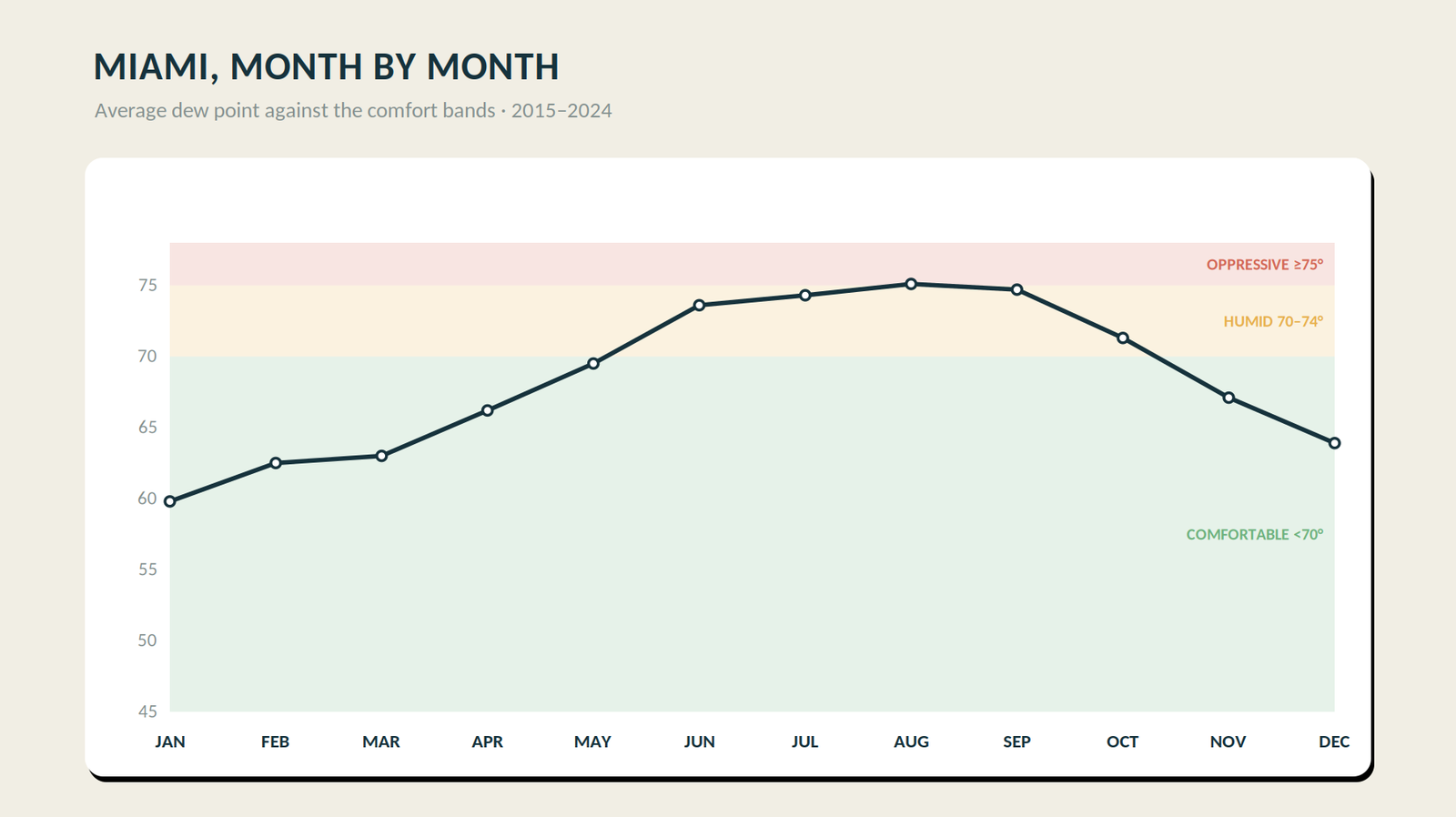
Miami, Month by Month
Miami’s humidity has a shape. From June through September the average dew point climbs to the top of the humid band and brushes the oppressive line, with August tipping over it at 75°F. Those four months are the hard season.
Winter eases off, but never all the way. Miami’s driest month is January, and even then the average dew point is about 60°F. That is still noticeable moisture. A dry-climate city would call a 60°F dew point a muggy day; in Miami it is the annual low. The air here does not have an off switch, only a lower gear.
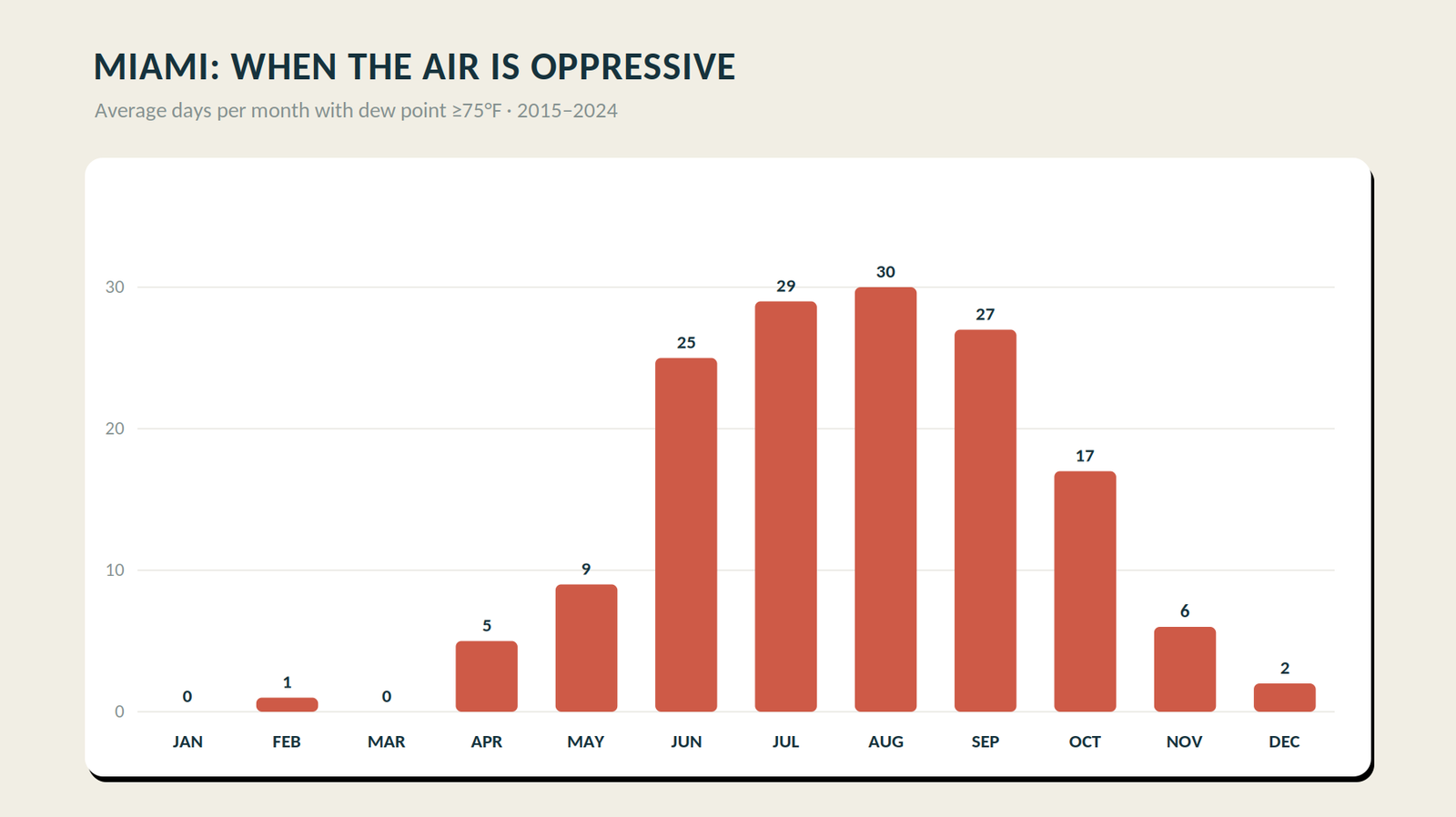
When the Air Is Worst
The oppressive days are not spread evenly across the year, they pile up in summer. In July and August the dew point hits 75°F on 29 and 30 days out of the month, almost every single day. June and September are close behind, at 25 and 27. Then it falls off a cliff: 9 oppressive days in May, 17 in October, and almost none from December through March.
So the practical picture is a five-month siege, May through October, with a brutal core in July and August, and a genuine break in winter. If you are deciding when your dehumidifier needs to work hardest, this chart is the answer.
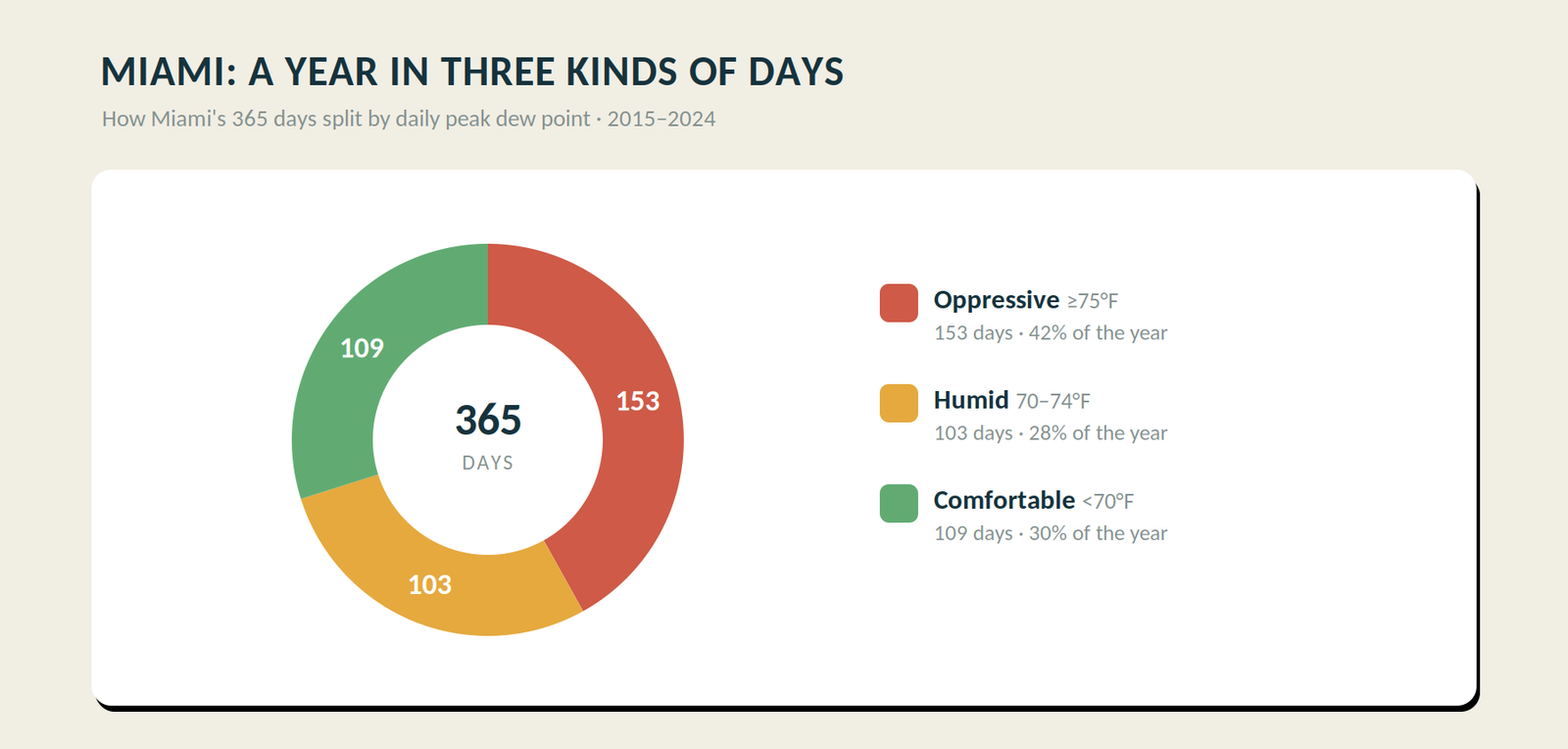
A Miami Year at a Glance
Add it all up and a Miami year splits three ways. 153 days oppressive, 103 days humid but not oppressive, and 109 days comfortable. That leaves under a third of the year, about three and a half months, when the air is genuinely pleasant. For two thirds of the calendar, some level of stickiness is the default state.
The Night Brings No Relief
In most places the heat breaks after sunset: the temperature falls, the air turns pleasant, you open a window. Miami summers cancel this, and the data shows just how literally.
I broke July and August down by hour. In the afternoon, 1 to 4 PM, the average dew point is 74°F. Before dawn, 2 to 5 AM, it is 75°F. The night is not lower, it is slightly higher than the day. The air does not clear at all: 96% of summer pre-dawn hours hold a dew point of 72°F or above, and it never once drops below 60°F across the whole summer. A window opened at 3 AM pulls in the same swamp as one opened at 3 PM.
The reason is the ocean next door, which does not cool off at night. By morning the temperature has dropped just enough to sit right against the dew point, with the air near saturation, which is why you get dew, fog by dawn, and condensation on anything cool. For a house it means the load runs around the clock rather than at an afternoon peak: the air conditioning and dehumidifier get no overnight break for five months straight, and a window in summer is not a way to ventilate but a way to let moisture in.
A City Without a Dry Season
In Tampa and Orlando the winter air dries out, because cold fronts from the mainland reach central Florida, each one sweeping out the humid air and pulling in dry air behind it. Miami mostly sits out of their reach. By the time the cold air works its way down to the southern tip it has run out of steam and often stalls before arriving. So the south stays humid even in January.
Geography does the rest. Miami is nearly tropical, with the warm Gulf Stream just offshore holding its heat year round, and a steady easterly trade wind carrying moist ocean air in off the Atlantic. That same trade wind makes Miami breezier than the west coast, and it often pushes the afternoon storms inland to the west. So Miami itself gets fewer daily downpours than storm-prone Tampa, but the air stays humid and washed with salt wind. The result is the same either way: Miami has no dry season, only a slightly less oppressive winter.
What This Means for a House: Life in a Tower
Miami is a vertical city. There are more high-rises and condos here than single-family homes, and humidity in a unit on the thirtieth floor behaves in its own way.
Sliding balcony doors are the main way in: they are rarely airtight, and humid air seeps through all day. The air conditioning chills the glass, and condensation settles on it, on the frames, on the ducts. Interior closets and windowless bathrooms are traps, where the air sits still, moisture does not leave, and mildew starts first. On top of that, coastal air carries salt, and salty moisture is not only mold but corrosion: electronics, metal, and air conditioner coils near the water wear out faster.
And the key difference from Tampa: in Miami this runs year round, not for a season. There, the dehumidifier goes on for summer and off for winter. Here it is needed almost always, because there is no dry window. In an apartment a compact dehumidifier in the living area or the air conditioner’s dry mode is usually enough; the goal is to hold about 50% relative humidity. If mildew shows up, especially in windowless closets and bathrooms, whether you can clear it yourself or need to bring in a specialist comes down to how far it has spread: here is how to tell.
How Miami Compares to the Rest of Florida
Miami is humid, but it is not the worst place in the state. That title belongs to Key West, down in the Keys, which logs about 193 oppressive days a year to Miami’s 153. Miami sits second, and comfortably ahead of the central metros and the north: it gets roughly 40 more oppressive days a year than Orlando or Tampa, and 50 more than Jacksonville. If you want the full state-by-state picture, I laid it out here: Florida humidity by the numbers.
What to Do About It
The goal indoors is to hold relative humidity around 50%, low enough that mold cannot get started and high enough to be comfortable. In Miami that means a dehumidifier that can carry the load for most of the year, not a small one bought for August. The dehumidifier size calculator turns your square footage and humidity into a pint rating, and the best dehumidifiers for Florida covers the units that hold up in this climate. For an apartment or condo, a compact unit is usually enough: dehumidifiers for condos.
Frequently Asked Questions
How humid is Miami?
Very. The dew point reaches an oppressive 75°F on about 153 days a year, and relative humidity averages around 80% in the morning and 65% in the afternoon. Miami is the most humid of Florida’s big metros, second in the state only to Key West.
Does Miami humidity drop at night?
In summer, no. In July and August the pre-dawn dew point averages 75°F, no lower than the afternoon. The air does not clear, so a window opened at night lets in as much moisture as one opened at midday.
What months are the most humid in Miami?
June through September. July and August are the worst, with oppressive dew points on nearly every day. The load eases from December through March.
Why is Miami humid even in winter?
The cold fronts that dry out north and central Florida mostly do not reach Miami. Combined with the warm Gulf Stream offshore and a steady sea breeze, that keeps the air humid year round, so even January averages a dew point around 60°F.
Does Miami humidity cause mold?
It makes mold a constant risk. With outdoor dew points above 70°F for most of the year, indoor surfaces stay damp unless a dehumidifier or air conditioning actively removes the moisture, so bathrooms, closets and walls are prone to mildew.
What humidity should I keep my Miami home at?
Aim for about 50% relative humidity indoors. In Miami that usually requires running a dehumidifier for most of the year rather than only in summer, given how long the humid season lasts.