

In an average year the air in Tampa is oppressive on 109 days, against 153 in Miami. But it is not that summer is milder here. In July and August the dew point in Tampa runs the same 74°F, oppressive on nearly every day, exactly like the south. The difference is that Tampa gets a real winter. From November through March the air genuinely dries out, and the year adds up to 166 comfortable days, almost twice Miami’s total. I pulled the hourly records from Tampa International Airport and counted every day. Below is what came back, and what sits behind the numbers.
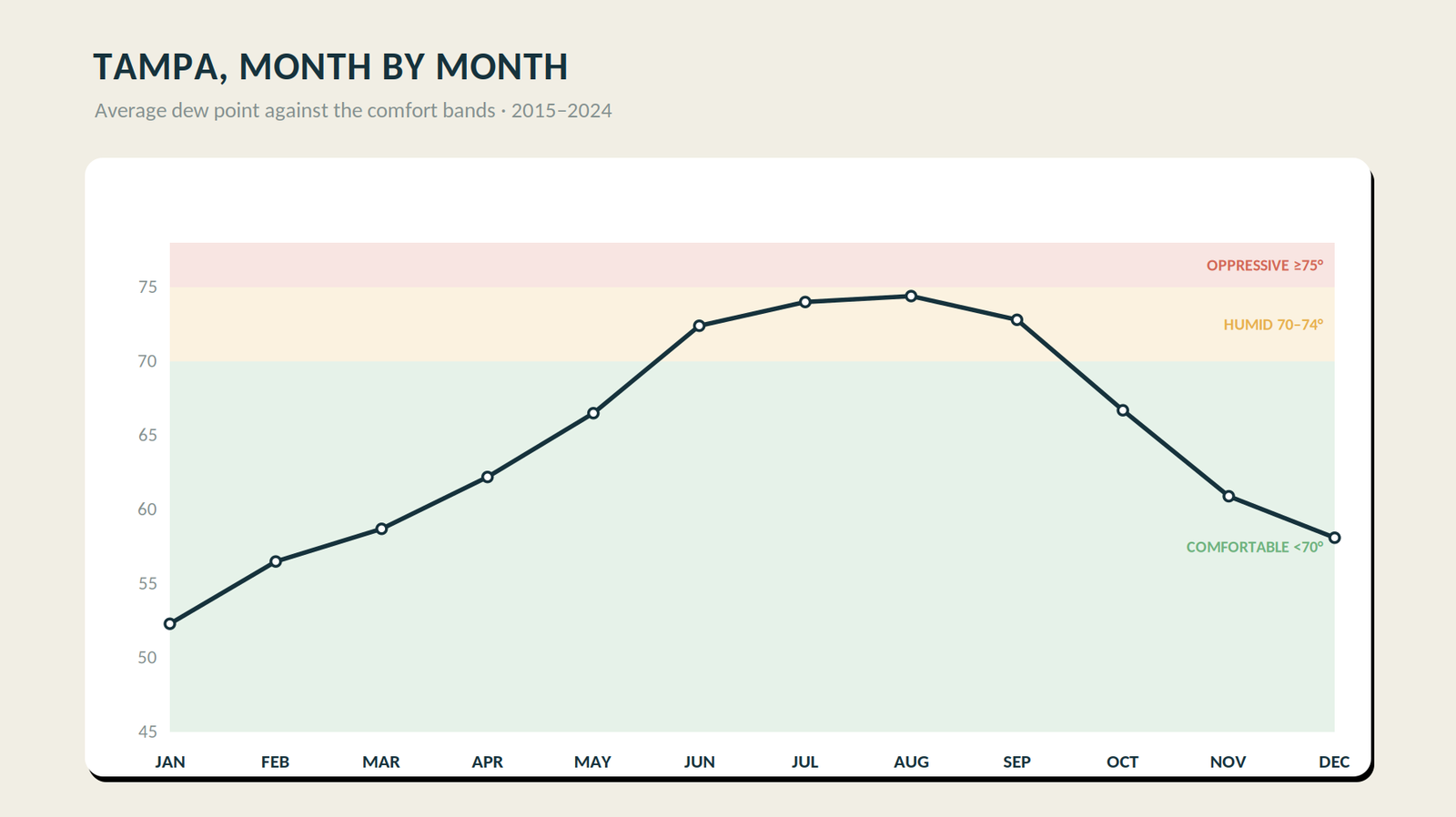
Tampa, Month by Month
From June through September the dew point sits at the top of the humid band and pushes into the oppressive line, peaking in August. Those four months are indistinguishable from Miami.
Then comes the part the south does not have. By December the dew point drops to about 58°F, and by January to about 52°F, dry and light air. Tampa’s swing across the year is wider than the south coast’s: the summer is just as heavy, but the winter is real, with cool dry days when you can forget the dehumidifier exists.
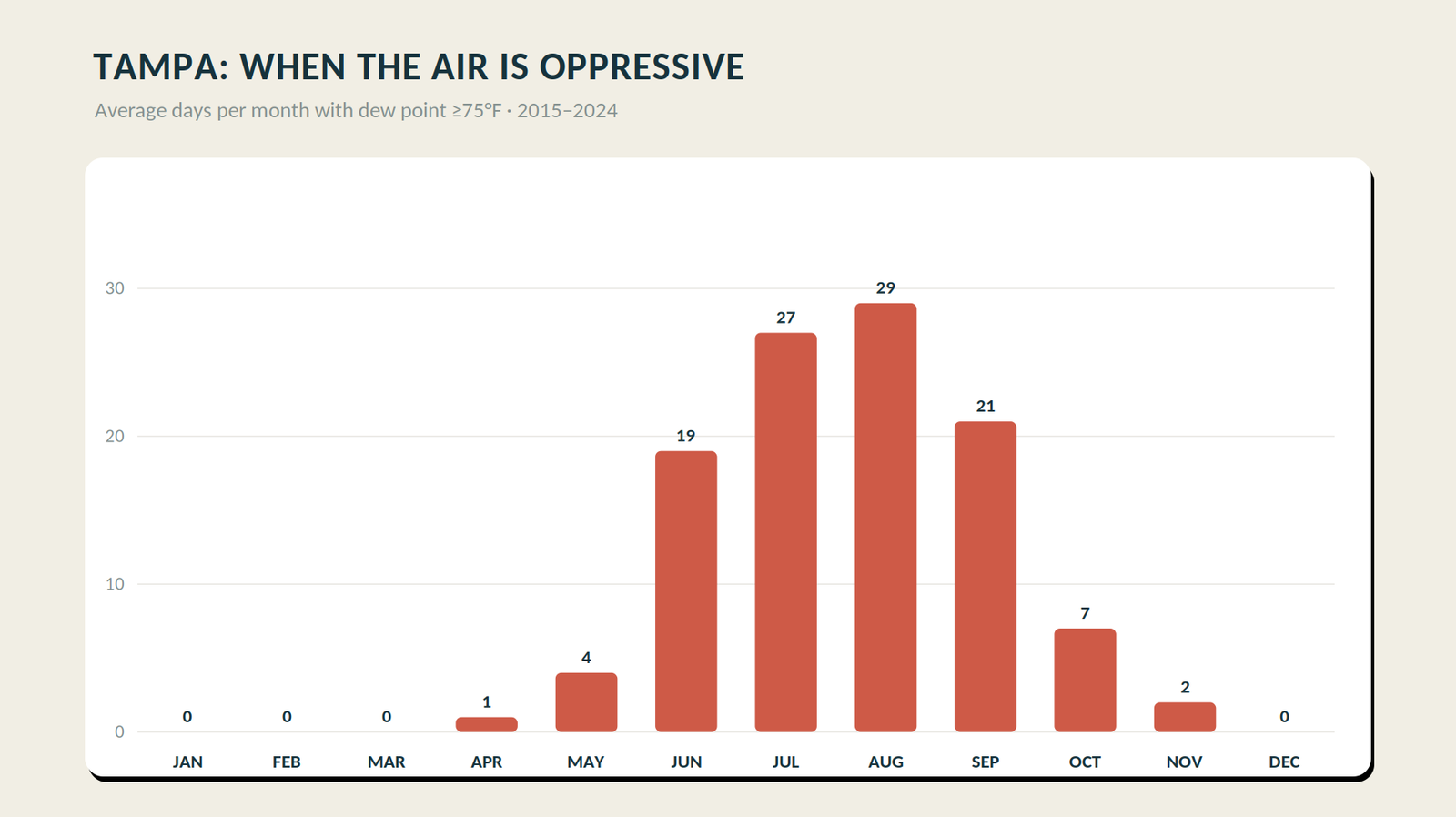
When the Air Is Worst
The oppressive days are packed into summer in a tight cluster. In July and August the dew point hits 75°F on 27 and 29 days, almost the whole month back to back. June and September are close behind, at 19 and 21. From November through March it is zero. Empty months.
For a house, that is rare certainty. The load runs May through October, and it is hard; in winter the dehumidifier can honestly be switched off. Miami has no such window, where the air never lets go.
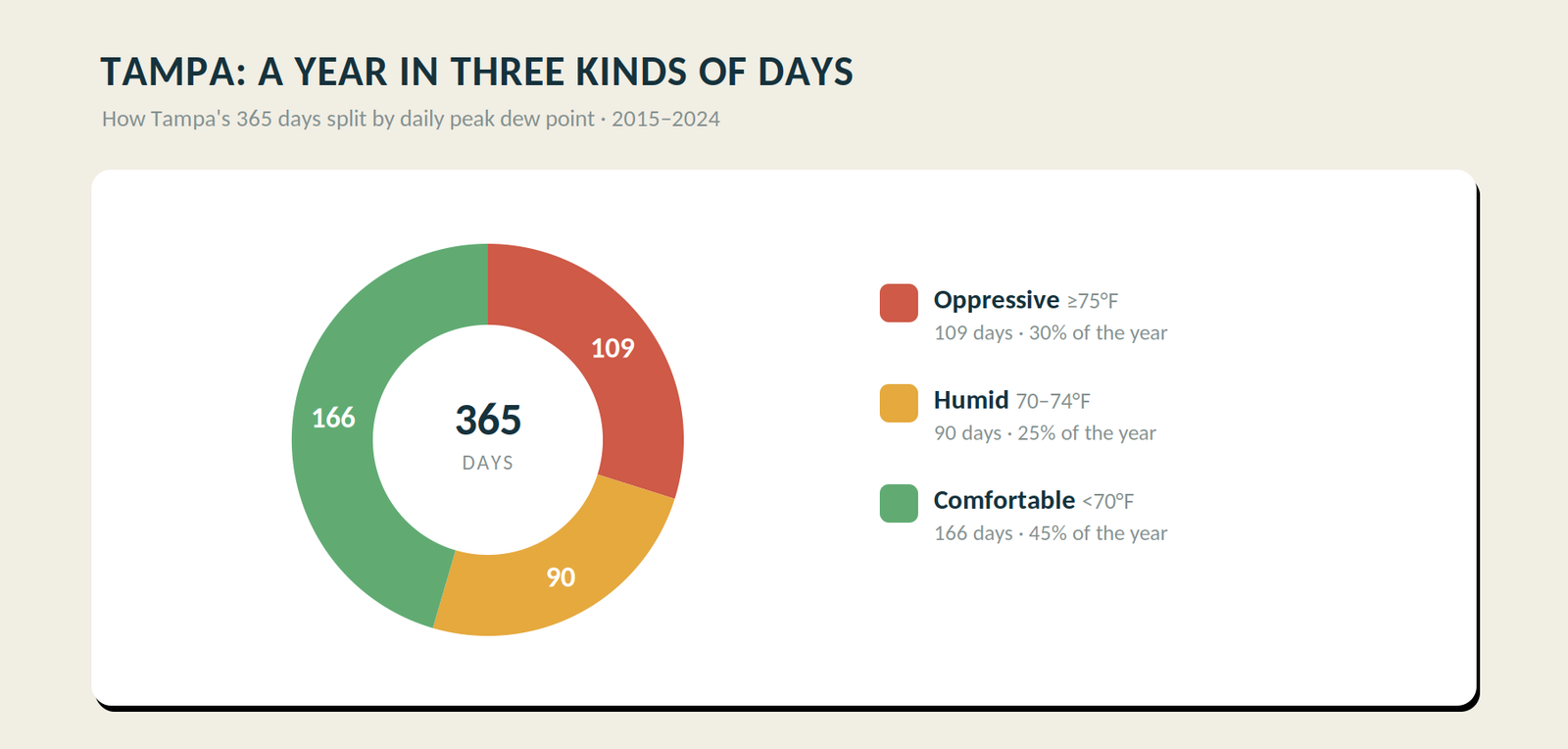
A Tampa Year at a Glance
Added up, the year splits into 109 days oppressive, 90 humid, and 166 comfortable. Comfortable days are nearly half the year. That is a different balance from Miami, where pleasant air is under a third. Tampa is not “a little drier than the south.” It has a fundamentally different profile: half the year tropical, half the year an ordinary climate.
The Four O’Clock Storm
Summer on the west coast keeps a schedule, and locals set their day by it. The morning is clear and already sticky. By noon towers of cloud build over the water and the land. By mid-afternoon a wall goes up, a short violent thunderstorm hits with thunder and sheets of water, and an hour or two later it clears and the evening is clean again. This happens on most summer days.
The cause is those sea breezes. During the day the land heats faster than the water, and cool moist air rushes onshore from both sides: from the east off the Atlantic, from the west off the Gulf. Over the middle of the peninsula the two streams collide, the air is forced up, it cools, and the moisture gathers into a storm. That is why the Tampa Bay area and the corridor over to Orlando are the most storm prone in the country, nicknamed Lightning Alley.
For indoor humidity this matters more than it seems. A storm does not cool things off for long. It dumps water onto hot ground, the sun comes back, the water evaporates, and half an hour after the rain the air is muggier than before. A summer house on the west coast lives in a cycle of baked, flooded, baked again, and the load on the air conditioning and dehumidifier runs all day, not just at the afternoon peak.
Gulf vs Atlantic: Does the Coast Matter?
A common question when people move here: is the Gulf side more or less humid than the Atlantic? I checked the data and the meteorology, and the answer is not the one most people expect.
The Gulf water is genuinely warmer. In summer the Gulf of Mexico runs 85 to 90°F, while the Atlantic at the same latitude sits at 75 to 85°F. The Gulf is shallow and nearly enclosed, so it heats faster and holds the heat longer. Warmer water at the shore means more evaporation.
But the air is about equally humid either way. By dew point, both coasts sit in the low to mid 70s all summer. The warmer Gulf water opens no real gap, because the whole peninsula is soaked in tropical moisture from both sides. The Gulf is a little warmer; it is sticky everywhere.
Our own numbers show it. Take Tampa on the Gulf and Orlando 85 miles inland, in the middle of the state. They are at the same latitude. You would expect the coast to be clearly more humid. Instead their dew point matches all year: 52°F in January for both, 74°F in August for both, a tenth of a degree apart. The coast adds no water to the air compared with the interior. Latitude sets the moisture, not nearness to water.
Where the Gulf does stand apart is storms and heat, not humidity. That warm water feeds the afternoon storms. And the Gulf breeze knocks down the daytime heat: the coast sits in the upper 80s in summer, while Orlando on the same days is over 90. Cooler and stormier by the water, but not drier and not wetter.
So the honest takeaway for a move. Two things drive the stickiness in Florida: how far south you are, further south is more humid, and how close you are to water at all, not the east coast versus the west and not coast versus inland. Which ocean is a question of storms, breezes and sunsets. The humidity the coasts share.
Why Tampa Has a Winter and Miami Does Not
Tampa’s dry winter is not the Gulf’s doing. It is a matter of latitude and weather from the north. Tampa is 150 miles further north than Miami, and in winter cold fronts from the mainland regularly reach central Florida. Each front sweeps out the humid air and drags in dry, cool air behind it. November through March in Tampa is a run of these passages, and between them the air never fully saturates again.
Miami mostly sits out of their reach. By the time the cold air works its way down to the southern tip it has run out of steam and often stalls before arriving. So the south stays humid even in January, while the center and the west get a true dry season. The same winter, two different states.
What This Means for a House in Tampa
The practical takeaway is simple: Tampa’s humidity is seasonal, and you can work with it on a calendar rather than holding the line all year.
May through October, the load is the same as Miami’s. At night in summer the dew point stays in the 70s, the air does not clear after dark, and after every storm the mugginess spikes again. In those months a house on the west coast is exposed to mold exactly like the south: bathrooms, closets, wood doors by late summer. If mildew shows up, whether you can clear it yourself or need to bring in a specialist comes down to how far it has spread: here is how to tell.
November through March, it all flips. The air is dry, the house dries out, the dehumidifier goes off. That saves electricity and wear on the unit. The point is not year round defense, but working the summer season and resting in winter.
Tampa’s housing helps. There are more single-family homes here than condo towers, and for a whole house on seasonal duty one capable portable dehumidifier in the living area is usually enough, rather than a built-in system. Aim to hold the house around 50% relative humidity from May through October.
How Tampa Compares to the Rest of Florida
Tampa sits in the middle of the state’s humidity range: clearly drier than Miami and Key West, but more humid than the north. By oppressive days it is nearly level with Orlando, since central Florida gets a similar summer from coast to coast. I laid out the full five-city picture here: Florida humidity by the numbers.
What to Do About It
The goal is about 50% relative humidity in season. For Tampa that means a dehumidifier for the summer, not the whole year. The dehumidifier size calculator turns your square footage and humidity into a pint rating, and the best dehumidifiers for Florida covers the units built for this climate. Switch it on in May, shut it off in November.
Frequently Asked Questions
How humid is Tampa?
Very humid in summer: the dew point reaches an oppressive 75°F on nearly every day in July and August, about 109 such days a year. But Tampa dries out in winter, adding up to 166 comfortable days, almost half the year.
Is the Gulf coast more humid than the Atlantic?
About the same. The Gulf water is warmer, but summer dew points sit in the low to mid 70s on both coasts. In fact Tampa on the coast and Orlando 85 miles inland have matching humidity all year. The coast changes the storms and the heat, not the humidity.
What months are the most humid in Tampa?
June through September, peaking in July and August. There are almost no oppressive days from November through March.
Do I need a dehumidifier in winter in Tampa?
Usually not. From November through March the air is dry and the dehumidifier can be switched off. The main work runs May through October.
Why is Tampa drier than Miami in winter?
Tampa is further north, and in winter cold fronts from the mainland reach it and dry the air out. Those fronts mostly do not reach Miami, so the south stays humid year round.
Does Tampa humidity cause mold?
In summer, yes, with the same risk as Miami: five months of high humidity is enough for mildew in bathrooms and closets. In winter the risk drops sharply as the air dries out.