
Mold Removal in Tampa: Two Counties, Costs and Licensing
Mold removal Tampa homeowners arrange starts at the same threshold as the rest of Florida: past 10 square feet, assessment and remediation are licensed work, carried out by a DBPR-licensed mold assessor or mold remediator, with an exemption for an owner working on their own home. What is local starts after that. Tampa is not one market for contractors but two sides of a bay.

Two counties, one bay
In the DBPR licensee download of 4 August 2026, Hillsborough holds 289 active licences across 223 individuals: 161 assessors and 128 remediators. Across the bay, Pinellas holds 235 licences across 176 individuals: 117 assessors and 118 remediators. Together the metro comes to 524 licences.
Adding them up is the right move here, and the reason is in the data itself. The county in the register is the mailing address on the licence, not a service area. Our DBPR data guide explains these fields and how we distinguish licenses from people. In Miami that caveat reads like a footnote; on the bay it decides the picture, because a contractor registered in St. Petersburg reaches Tampa across a bridge rather than across a market line.
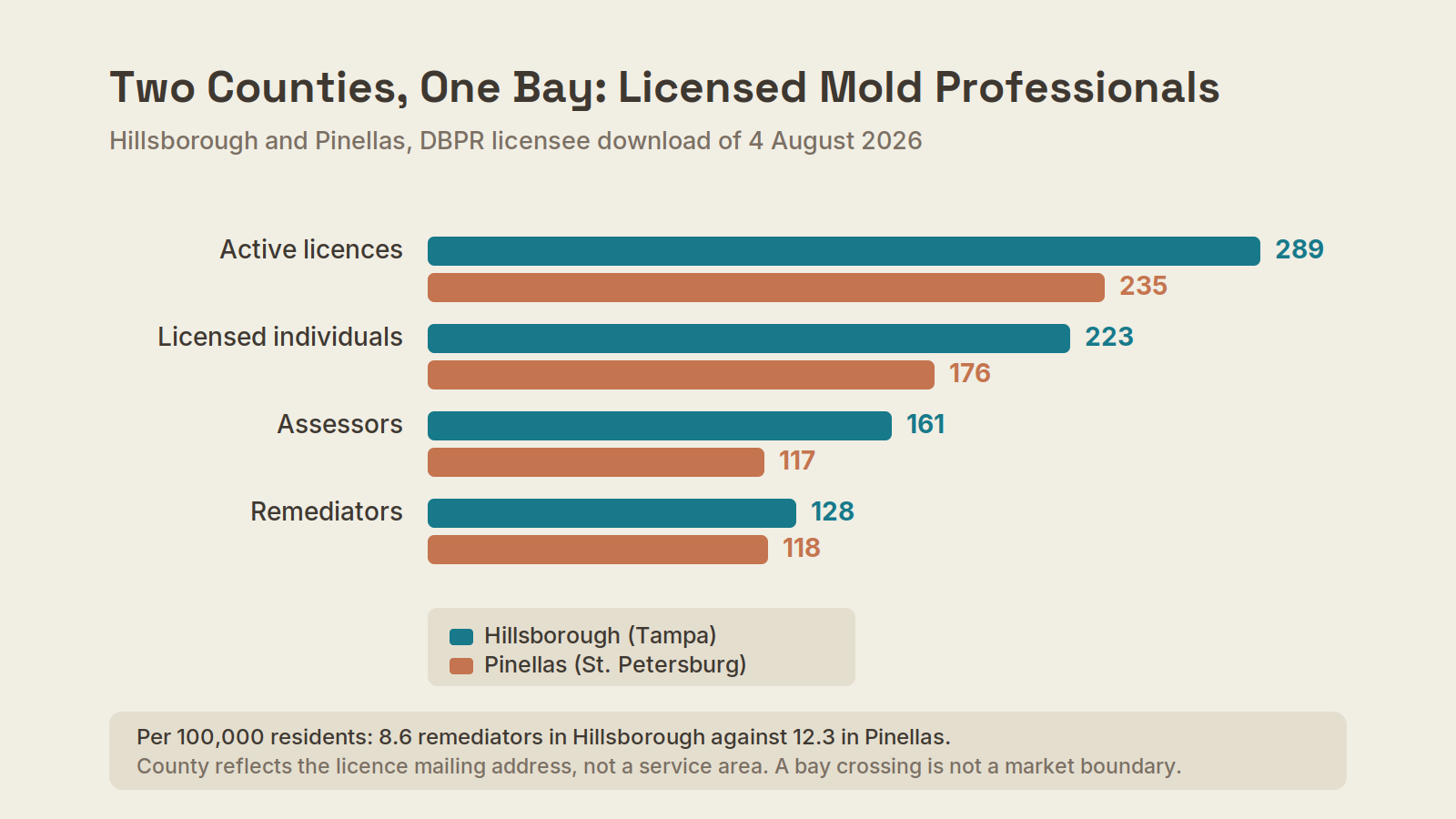
Per 100,000 residents, Hillsborough has 8.6 remediators. Pinellas has 12.3, and Broward, at the other end of the state, has 20.1. The data records the difference without explaining it.
The mix differs too. Hillsborough runs 1.26 assessors for every remediator; Pinellas runs 0.99, meaning slightly more remediators than assessors, which is unusual for the state.
Fewer people here hold both licences
66 of the 223 licensed individuals in Hillsborough hold both licences at once, or 29.6 percent. That is the lowest overlap among the state’s large counties: Miami-Dade runs 45.5 percent, Broward 40.6, Orange 37.2.
For a homeowner that changes the odds, not the rule. The rule is the same statewide: under §468.8419, an assessor may not perform or offer remediation on a structure where they or their company provided an assessment within the previous 12 months, and the same applies in reverse to a remediator. Penalties escalate from a second-degree misdemeanor to a first-degree misdemeanor to a third-degree felony.
There is one exception: a certified Division I contractor under §489.105(3), the licence class that covers building a structure as a whole rather than a single trade such as roofing or plumbing. For them the bar does not apply, and the law attaches no conditions to that. The statute lets the department adopt a rule requiring such a contractor to disclose the homeowner’s right to request competitive bids, but no such rule was ever adopted: the proposed rules 61-31.701 and 61-31.702 were withdrawn in 2014 and 2015. A number of sites, law firms included, describe that disclosure as a live requirement.
The same section closes off the arrangements next door to it. An assessor or remediator cannot work for pay on a property their company owns or holds a stake in. Neither can pay the other for a referral, or take money for sending a client across. And neither can take on an assessment whose fee depends on what the assessment finds, which would make finding more the profitable outcome.
What to check before signing
Licences in the DBPR register carry a status: Current, Probation or Suspended. The counts above are drawn from current ones only.
Licences in this field expire on 31 July of every even year, and over a two-year cycle a licensee must complete 14 hours of continuing education under Rule 61-31.504.
Insurance is set by statute. Under §468.8421, an assessor carries general liability plus errors and omissions of at least $1 million; a remediator carries general liability of at least $1 million with specific coverage for mold-related claims.
If asbestos or lead is likely in an older house, that is a separate licence and a separate contractor, under a different DBPR board.
Mold removal Tampa costs, line by line
Aggregated mold removal Tampa estimates run $1,075 to $4,075 per project, with a local average near $2,548, about 7.5 percent above the national figure. The South Florida premium of 15 to 30 percent does not apply here: Miami runs $1,225 to $4,700 and Orlando $1,050 to $4,000.
By area, the rate is $10 to $25 per square foot, or $15 to $30 for difficult work.
Inspection is billed separately: a visual check without sampling is $150 to $250, a visual check with two or three air samples $300 to $450, and a full inspection with lab analysis $400 to $900. A single air sample is $75 to $150, lab analysis of a sample $35 to $75, and a clearance test after the work $250 to $600.
The standard for air testing is two samples: one indoors and one outdoor control. A written protocol comes with the inspection fee, but an insurance dispute needs more: chain-of-custody documentation from the lab, photographs and moisture readings.
What pushes the number up: emergency call-outs and post-storm demand, hard-to-reach areas, removal of structural elements, crew size. Jobs run one to five days, large projects one to two weeks, and temporary housing during the work adds $150 to $250 a night.
All of these figures are aggregated estimates rather than a rate card. The Florida Department of Health’s mold recommendations carry no price guidance: they point to the EPA and to §468.84 through §468.8424, without figures. Our breakdown of what those ranges are built from is in Florida remediation costs, and the inspection side is in mold inspection cost.
The threshold where the law starts
Below 10 square feet, the EPA allows a homeowner to clean up with an N-95 respirator, gloves and eye protection. In Florida the same figure carries legal weight: §468.8411 of the 2025 Florida Statutes puts “greater than 10 square feet” in the definition of assessment and again in the definition of remediation. A property owner working on their own home is exempt under §468.841. Where that line falls in practice is the subject of DIY versus professional removal.
How Tampa differs from Miami
Summer is the same. In our analysis of NOAA records for 2015 to 2024, Tampa records 109 oppressive days a year, with 27 in July and 29 in August. Miami records 153, but the difference is not in July. It is in January: the winter dew point in Tampa holds near 52 °F against Miami’s 60 °F. The bay has a dry season; the south coast does not.
The practical reading is short. In Miami moisture works year round, while in Tampa it has a season, and the winter months hand the house a stretch to dry out.
Slab-on-grade is the state standard: 73.3 percent of Florida NFIP payouts go to properties on slabs, and basements make up under one percent of the housing stock.
The High Velocity Hurricane Zone does not reach Tampa. Under the building code it is exactly two counties, Miami-Dade and Broward. Envelope requirements on the bay come from a different mechanism: the code places an address in the wind-borne debris region if it lies within a mile of the coast where the design wind speed is 130 mph or higher, or anywhere the design speed reaches 140 mph. Inside that region, exterior openings have to be impact-rated or protected by approved shutters, and it is the local building department that applies the maps to a given address when it issues a permit.
What the flood record shows
Over 48 years of NFIP records, Hillsborough has logged 18,549 claims and $1,178 million in payouts, the third largest total in the state. Normalised, that is 41.4 claims per 1,000 residential structures and $2,628 per home, which drops the county to the bottom of the list: a straight effect of its size.
Pinellas, across the bay, looks nothing like it: 51,764 claims, $3,745 million, 132.2 per 1,000 structures and $9,560 per home. Three times as much per home as Hillsborough, in a county with half the population.
One caveat applies to both lines. Claims accumulated over nearly half a century, while the housing stock in the denominator is current, so the per-1,000 figure runs high for counties with a long record.
Flood insurance covers 12.3 percent of structures in Hillsborough and 19.8 percent in Pinellas. The local picture is in water damage in Tampa.
A hurricane does not bring new contractors
Milton crossed the bay on 9 October 2024, hitting Sarasota, Manatee, Hillsborough and Pinellas. The quarter after the storm produced 16 new licences, the highest count to that point. But a year earlier, before Milton existed, the third quarter of 2023 alone produced 13, and the full year 2023 produced 34 against 21 in 2021. The growth was already running before the storm and continued after it: 19 in the third quarter of 2025, 13 in the fourth, 13 in the second quarter of 2026.
The same holds for Ian, Irma and Michael: no spike in the quarter of impact. New licence counts have been rising statewide since 2016, in the counties that took a direct hit and in the ones that did not.
The data suggests its own explanation. Mold assessment and remediation licences are not the licences that post-storm work runs on. Extraction, drying and demolition belong to other trades. Mold appears weeks after the water, and a licence takes months to issue.
When to call
The EPA gives 24 to 48 hours to dry water-damaged materials after a leak, the only deadline a federal agency has put on this. What the standard does and does not say about water categories is covered in mold after a water leak.
What the sources do not contain
- Any reason why remediator density in Pinellas is higher than in Hillsborough.
- Any reason why the balance of roles differs between the two sides of the bay.
- Price guidance in the Florida Department of Health’s mold recommendations.
- The number of specialists actually working in the metro: the register records a mailing address.
We run no testing of our own and hold no mold assessor or mold remediator licences. This page reports what named sources say. The statutes described here are given for general information and are not legal advice.
Frequently asked questions
Do I need a licensed contractor for mold removal in Tampa?
Above 10 square feet, yes, under §468.8411. A property owner working on their own home is exempt under §468.841.
How much does mold removal cost in Tampa?
Aggregated estimates run $1,075 to $4,075 with a local average near $2,548, about 7.5 percent above the national figure. No state agency publishes official rates.
How many licensed mold professionals are in the Tampa Bay area?
289 licences in Hillsborough and 235 in Pinellas, or 524 across the metro, per the DBPR download of 4 August 2026. That is registration by mailing address, not a service area.
Can the same company inspect and remove the mold?
Not on the same property within 12 months, under §468.8419. The exception is a certified Division I contractor under §489.105(3).
Did Hurricane Milton bring more mold contractors to Tampa Bay?
Not according to the DBPR record. New licence counts were already rising before October 2024 and continued afterwards at the same pace.
Sources
- Florida Department of Business and Professional Regulation, mold licensee download, 4 August 2026
- Fla. Stat. §468.8411, §468.841, §468.8419, §468.8421, §489.105(3), 2025 Florida Statutes
- Florida Administrative Code, Rule 61-31.504; proposed rules 61-31.701 and 61-31.702, withdrawn 2014 and 2015
- US Census Bureau, American Community Survey 5-year estimates, 2023
- US EPA, mold cleanup guidance
- NOAA hourly records 2015 to 2024, Tampa International and Miami International, Aridalia analysis
- FEMA NFIP claims extract (OpenFEMA), Aridalia analysis
- Florida Building Code, wind-borne debris region provisions
- Cost ranges: home-services aggregators, 2026 editions