
Mold Remediation Cost in Florida: What a Quote Covers
Ask what mold remediation cost florida looks like and you get ranges from a few hundred dollars to thirty thousand. Those ranges come from home-services aggregators that survey homeowners or contractor networks. No agency publishes measured prices for residential mold work in Florida. State purchasing records and insurance filings with dollar figures do not cover private homes.
So before comparing any two numbers, it helps to know what each one counts.
What mold remediation cost florida figures actually cover
Aggregator ranges price a project. The same sources also give a per-square-foot rate, and that rate applies to the contaminated area, not the size of your house. A 90-square-foot patch in a 2,400-square-foot home is priced on the 90.
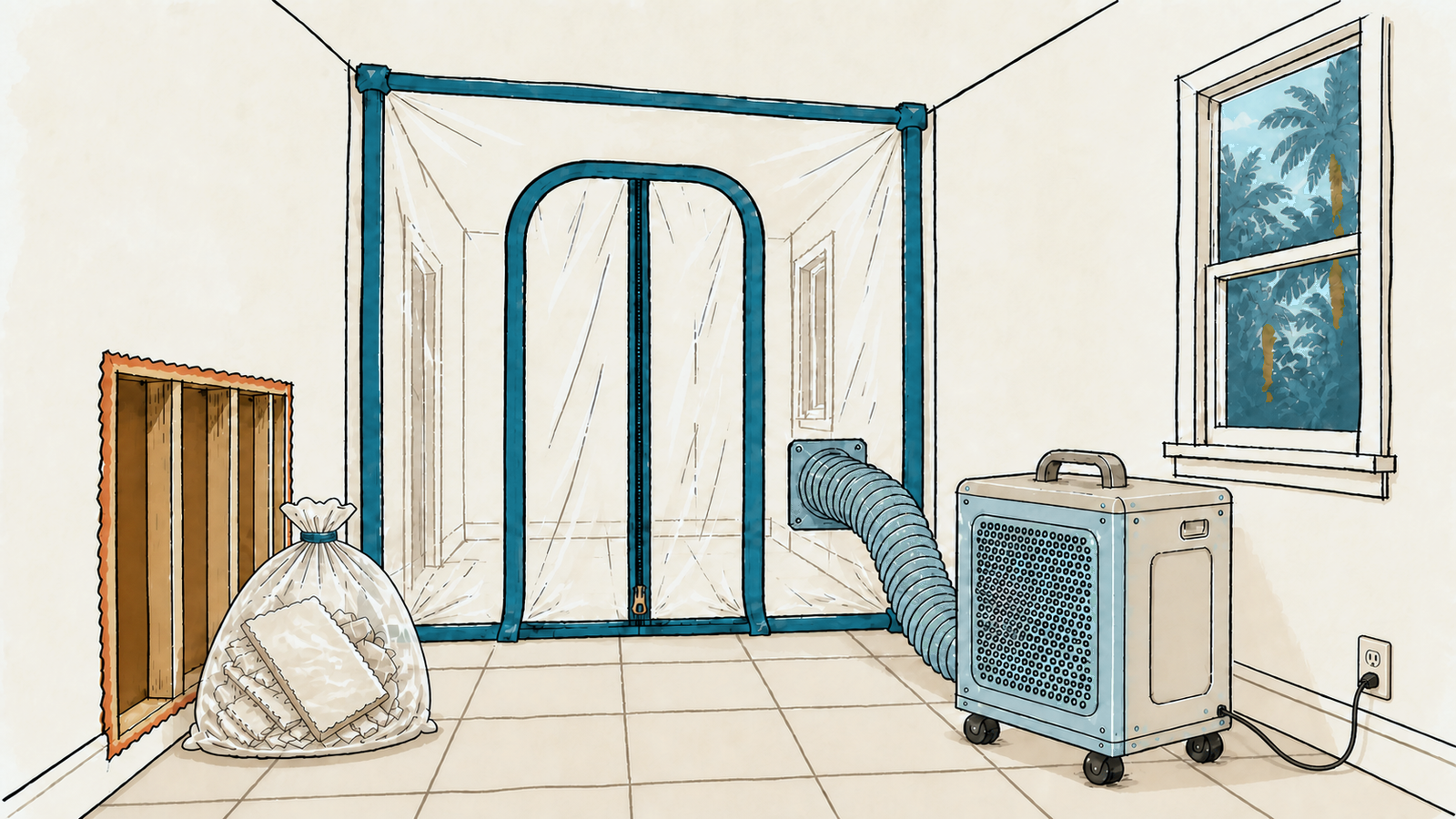
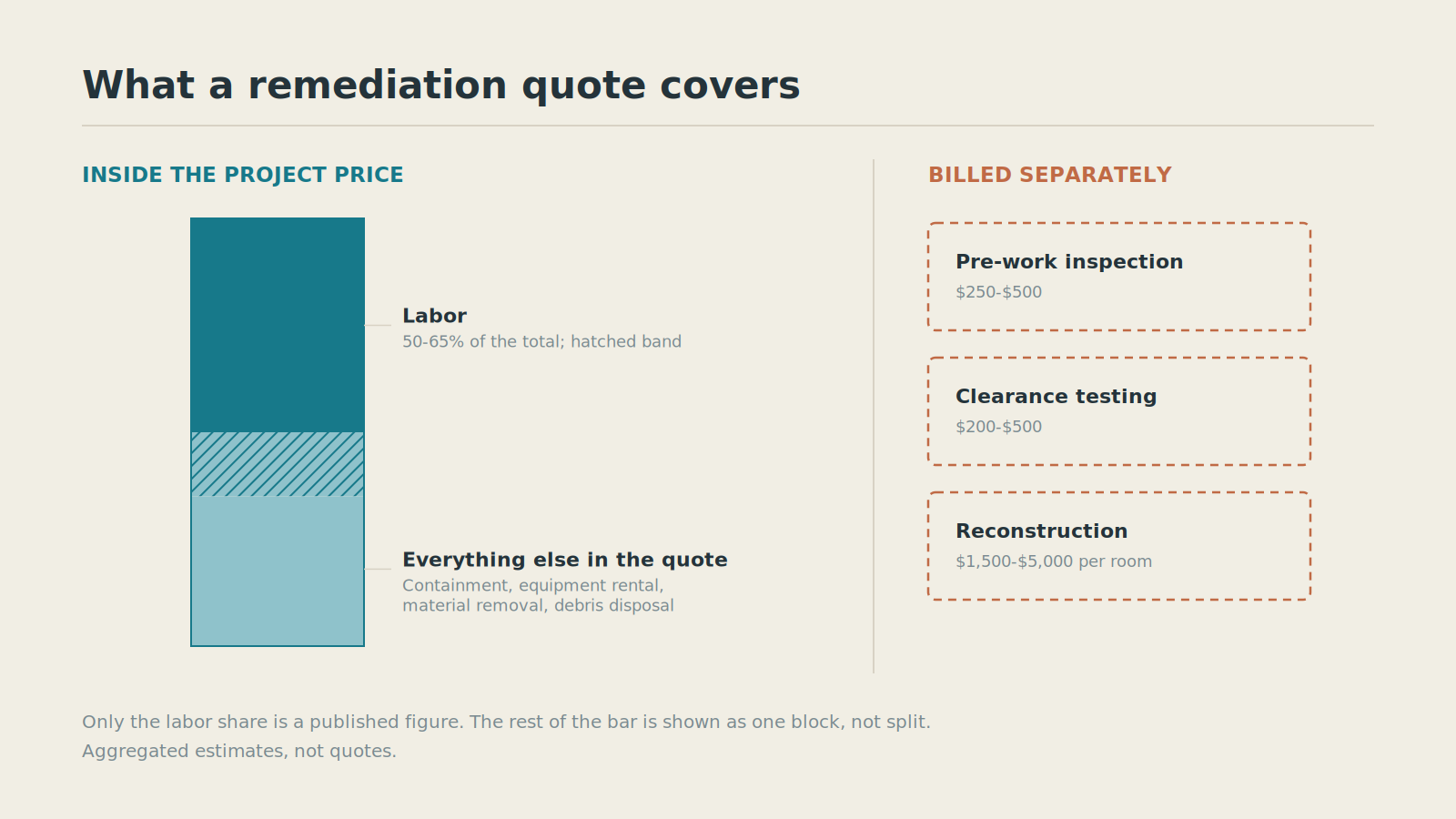
What the number usually includes: containment of the work zone, removal of affected material, cleaning, drying, and debris disposal. What it usually excludes: the inspection and sampling done before work starts, independent verification after work finishes, and any rebuilding. Those are separate invoices.
Terminology drifts between sources. Angi and HomeGuide treat “removal” and “remediation” as the same word. Verified Remediation and MoldVerified separate them: removal can mean surface cleaning alone, while remediation means containment, removal, antimicrobial treatment and post-work verification. When you read a quote, read the scope of work, not the heading. That distinction runs through everything else in the mold section of this site.
Statewide figures: Verified Remediation, updated 11 May 2026, puts Florida at roughly $3,000 average with a normal range of $1,500 to $4,500. Angi’s national page, updated 9 July 2026, gives $1,223 to $3,757 with an average of $2,369. Angi quotes $10 to $25 per square foot, HomeGuide $15 to $30. The gap between those two rates reflects different survey methods, not a mistake by either.
None of these sources discloses how many mold jobs sit behind the numbers. The sample sizes they publish cover all project types at once.
Priced by the size of the affected area
| Affected area, sq ft | Project cost |
|---|---|
| 10–100 | $500–$1,500 |
| 100–300 | $1,500–$6,000 |
| 300–1,000 | $6,000–$15,000 |
| Over 1,000 | $15,000–$30,000 |
HomeGuide, updated 5 February 2026. Priced per project by contaminated area, not by house size. Aggregated estimates, not quotes.
This grid explains the spread better than any average. An 80-square-foot job and an 800-square-foot job are different orders of money, not variations around a midpoint.
The 10-square-foot line at the top is not arbitrary. The EPA changes its guidance there: limited containment for 10 to 100 square feet, full containment above 100. In Florida the same threshold also carries legal weight, covered further down.
Where the growth sits changes the bill
| Location | Project cost |
|---|---|
| Bathroom | $500–$1,500 |
| Drywall and walls | $1,000–$2,500 |
| Attic | $1,000–$4,000 |
| Crawl space | $500–$2,000 |
| Ducts and HVAC | $3,000–$10,000 |
| Whole house after flooding or a storm | $10,000–$30,000 |
Angi and HomeGuide, 2026. Priced per project. Aggregated estimates, not quotes. Drywall work reaches $20,000 once removal and rebuild are included. A second estimate puts attics at $1,500–$6,000 and crawl spaces at $1,500–$4,000.
Ducts and HVAC is the costliest line on that list. Whole-house work, in the wording of the source, generally follows a catastrophic event: flooding or a hurricane.
The HVAC line deserves attention in a Florida house. Ducts run through a vented attic, and the air handler often sits up there too. In summer that attic passes 130 °F while the outdoor dew point sits at 75 °F and higher. Florida requires attic supply and return ducts to be insulated to at least R-8 under the Florida Building Code, Energy Conservation, 8th edition 2023. Damaged duct insulation in that environment is a moisture problem before it is an energy problem.
The crawl space line applies to a minority of readers. Florida crawl spaces belong to older housing, roughly 1950 to 1990, and to the north of the state. Basements are under one percent of the state’s housing stock.
The line items behind the total
| Line item | Cost |
|---|---|
| Pre-work inspection | $250–$500 |
| Containment and negative air | $400–$900 |
| HEPA scrubber rental | $75–$120 / day |
| Negative-air machine rental | $50–$90 / day |
| Drywall removal | $1.50–$4.00 / sq ft |
| Insulation removal | +$0.75–$1.50 / sq ft |
| Subfloor removal | +$2.00–$5.00 / sq ft |
| Debris disposal | $0.30–$0.60 / lb |
| Antimicrobial treatment, HEPA vacuum | $500–$1,500 |
| Structural drying | in equipment rental |
| Post-remediation verification | $200–$500 |
| Reconstruction | $1,500–$5,000 / room |
Aggregated estimates from home-services sources, 2026. Not quotes. Florida inspection pricing runs $200–$400 for a visual check and $450–$900 with 2 to 4 samples. Verification and reconstruction are billed separately from the remediation itself.
Labor takes 50 to 65 percent of the total. Equipment bills by the day, so the length of the job lands in the invoice directly.
Verification after the work is a separate line for a reason. ANSI/IICRC S520-2024, the industry standard for professional mold remediation, gives it its own section. The standard is voluntary, though contractors cite it when they price by the square foot. In Florida a second rule pushes the same way, and it is law rather than industry practice.
Tampa and Orlando: local figures
| Metro | Range | Midpoint |
|---|---|---|
| Tampa, Angi | $1,347–$3,778 | avg $2,548 |
| Orlando, Angi | $1,040–$4,228 | avg $2,634 |
| Tampa, MoldVerified | $1,075–$4,075 | median $2,225 |
Angi figures are local customer-reported samples; MoldVerified reports 25/50/75 percentiles. Priced per project, excluding inspection, independent verification and reconstruction. Neither source discloses its local sample size. Aggregated estimates, not quotes.
Angi’s Tampa average runs 7.5 percent above its national figure. In the same Tampa breakdown, labor is $75 to $120 per hour and inspection $300 to $1,025. City-level pages for Miami, Tampa and Orlando go into local conditions in more detail.
One more Tampa figure circulates that does not belong in the table above. A local contractor advertises $1,500 to $5,500 for “removal”, but in that company’s own breakdown it is one line inside a $1,500 to $6,000 estimate, with inspection and containment listed separately. The number looks comparable to the project ranges and describes something narrower.
Verified Remediation’s Florida metro figures, $3,250 for Miami and $2,750 for Tampa and Orlando, come from multiplying a national base of $2,500 by 1.30 and 1.10. Those are calculated, not observed from local invoices.
What Florida licensing adds to the price
What follows describes statutes for general information. It is not legal advice.
Mold services in Florida are licensed under Fla. Stat. Ch. 468, Part XVI. The law passed in 2007, licensing began in 2010, and enforcement against unlicensed activity started 1 July 2011.
The dividing line is area. In §468.8411 of the 2025 Florida Statutes, the phrase “greater than 10 square feet” appears in the definition of mold assessment and again in the definition of mold remediation. Both the evaluation and the work itself fall under licensing past that mark. The EPA’s identical threshold stays guidance; in Florida it is statute, and the two should not be swapped. Below it, the EPA allows a homeowner to clean up with an N-95 respirator, gloves and eye protection, without containment. A residential property owner working on their own property is exempt under §468.841. Doing it yourself or hiring a professional turns largely on that line.
Two statutory requirements sit visibly in the invoice.
Insurance. Under §468.8421, a remediator carries general liability of at least $1,000,000 with specific coverage for mold-related claims. An assessor carries general liability plus errors and omissions for preliminary and post-remediation assessment, also at least $1 million.
Separation of roles. Under §468.8419(1)(d), an assessor may not perform or offer remediation on a structure where the assessor or their company provided an assessment within the previous 12 months. Paragraph (2)(d) mirrors it for remediators. The exception is a certified Division I contractor under §489.105(3), and it applies without conditions. The statute lets the department adopt a rule requiring such a contractor to disclose the homeowner’s right to request competitive bids, but no such rule exists: the proposed rules 61-31.701 and 61-31.702 were withdrawn in 2014 and 2015. Penalties escalate from a second-degree misdemeanor to a first-degree misdemeanor to a third-degree felony. For your budget the effect is simple: the inspection before and the verification after come from a different company than the one cutting drywall.
The same rule explains the “free inspection” offer from a remediation firm. Whoever assesses the property cannot then do the work on it.
The size of the licensed market is public. In the DBPR download of 4 August 2026 there are 5,306 active licenses held by 3,936 licensed individuals: 2,724 assessors and 2,582 remediators, with 34.8 percent holding both. Registered by county: Broward 782 licenses across 556 people, Miami-Dade 739 across 508, Palm Beach 500 across 374, Hillsborough 289 across 223, Orange 258 across 188, Lee 251 across 193. Another 382 licenses, 7.2 percent, are not tied to any Florida county. The county-by-county breakdown covers the rest of the state.
Counts reflect active licenses in the DBPR public download as of August 4, 2026. NULL & VOID, delinquent and involuntarily inactive records are not included in that download, so the total pool of licenses is larger. County reflects the licensee’s mailing address, not a service area. A single individual may hold both an assessor and a remediator license.
How much insurance covers
No Florida statute requires an insurer to offer mold coverage. It arrives through an ISO endorsement, HO 04 26 or HO 04 27: a broad exclusion for fungi, wet or dry rot and bacteria, followed by limited coverage restored up to a stated sublimit that applies across the whole policy period. The base form sets $5,000 unless something else is written in.
Citizens publishes a specific figure. In its HO-3 comparison form, edition 11/25, Limited Fungi, Wet or Dry Rot, or Bacteria Coverage carries $10,000 under Section I and $50,000 under Section II. Where the form asks whether the coverage can be added, changed, excluded, or the limit raised, both rows read “No”.
A sublimit is a ceiling on payment for that category of damage over the policy period, not an estimate of your bill. How it applies to a particular claim depends on the policy, the deductible, and whether the loss is covered at all. The practical move is to hold two numbers side by side: the sublimit written in your own policy and the ranges in the tables above.
On the private market the endorsement commonly raises the Section I sublimit to $25,000 or $50,000, according to industry sources rather than filings.
Figures with a contract number behind them
Aggregators survey homeowners. Public purchasing publishes what a contract says.
The School Board of Miami-Dade County ran ITB-19-070-MV, a term contract for emergency cleanup and restoration services including mold restoration. Spending authority reached $500,000 for the initial term and up to $250,000 for each one-year extension. It took effect 21 April 2021, with 21 vendors awarded out of 27 that responded. The same document records $196,237 spent on emergency cleanup and restoration in fiscal year 2019 to 2020.
Those numbers are not a price for a house. This is a public contract for school facilities, with public bidding, bonding, insurance and licensing requirements that a private owner never faces. The $500,000 ceiling is a not-to-exceed authority spread across many possible task orders, not the cost of one job.
The Florida Department of Health publishes no price guidance of its own, only recommendations pointing to the EPA and to §468.84 through §468.8424.
What pushes the number up
Emergency response and post-hurricane demand. Access: attics, crawl spaces and HVAC cost more to reach. Removal of structural elements. Species that call for heavier protection add a premium of 15 to 25 percent for full-face respirators and extra HEPA capacity. Asbestos or lead in an older house brings in a separately licensed contractor under a different DBPR board. Crew size. Duration of 1 to 5 days, or 1 to 2 weeks on large projects. Temporary housing at $150 to $250 a night.
What these numbers cannot tell you
There are no official measured prices for residential remediation in Florida. Neither residential public purchasing nor insurance reporting produces them.
There is no average mold claim payout either. Florida’s Office of Insurance Regulation collects claims data by event, hurricanes above all, rather than by damage type.
Nobody publishes the density of licensed mold specialists by Florida county. We did not find such a summary and counted it ourselves from the DBPR download. We hold no mold assessor or mold remediator license and run no testing of our own. Everything here is open data, official documents, and a plain reading of both.
Common questions
What does mold remediation cost in Florida?
Aggregated estimates put the Florida average near $3,000, with a normal range of $1,500 to $4,500, or $10 to $25 per square foot of affected area. That covers the project itself, without inspection, independent verification or reconstruction.
Is the per-square-foot rate based on my home’s size?
No. The rate applies to the contaminated area only, not to the total square footage of the house.
Does the price include repairing the wall afterward?
No. Reconstruction is a separate line, commonly $1,500 to $5,000 per room.
Why does a different company do the inspection?
Fla. Stat. §468.8419 bars a person or company from assessing and remediating the same structure within 12 months. Certified Division I contractors are the exception.
How much will my insurance cover?
It depends on the policy. Citizens sets its Limited Fungi, Wet or Dry Rot, or Bacteria sublimit at $10,000 under Section I and states on the form that it cannot be raised. Private carriers commonly write $25,000 or $50,000, according to industry sources.
Sources
- Fla. Stat. §468.8411, §468.841, §468.8419, §468.8421, §489.105(3), 2025 Florida Statutes, via the Florida Legislature: Chapter 468, Part XVI
- Florida Department of Business and Professional Regulation, mold licensee download, 4 August 2026
- US EPA, mold cleanup guidance and containment levels
- ANSI/IICRC S520-2024, Standard for Professional Mold Remediation
- Florida Building Code, Energy Conservation, 8th edition 2023
- Citizens Property Insurance Corporation, HO-3 coverage comparison form, edition 11/25
- School Board of Miami-Dade County, ITB-19-070-MV, agenda item of 21 April 2021
- Cost ranges: Angi, HomeGuide, Verified Remediation, MoldVerified, 2026 editions
Counts reflect active licenses in the DBPR public download as of August 4, 2026. NULL & VOID, delinquent and involuntarily inactive records are not included in that download, so the total pool of licenses is larger. County reflects the licensee’s mailing address, not a service area. A single individual may hold both an assessor and a remediator license.
Cost figures on this page are aggregated estimates, not quotes. They describe a typical remediation project, also expressed as a per-square-foot rate for the contaminated area only, and generally cover containment, mold removal, cleaning, drying and debris disposal. They usually exclude the pre-work inspection and sampling, independent post-remediation clearance testing, and reconstruction. Ranges vary by source, methodology and date; they are not an industry standard or a guaranteed price. This page describes Florida statutes and industry standards for general information. It is not legal advice. Always obtain multiple written, itemized quotes from licensed professionals for your specific property.