
Crawl Space Mold in Florida: Why Venting Can Make It Worse
Crawl space mold is not a dirty-wood problem. It is a moisture problem, and it assembles from five things at once: a source of water, a path for air, a cold surface, wet timber and time.
Two things follow from that. A single reading on a hygrometer settles nothing. And a single operation, blocking the vents, cures nothing.
The rest of the material on this subject sits in the mold guides. This page is about the space under the floor. It draws on field studies by Advanced Energy and the Department of Energy, the USDA Forest Products Laboratory handbooks, EPA guidance, the building code and UF/IFAS material. I took no measurements myself.
First, honestly: this is not the typical Florida house
A modern Florida house sits on a slab. In the South Atlantic division, which includes the state, the share of new single-family homes on slab rose from 72.9 percent in 2018 to 85.7 percent in 2024. The national share of new homes with a crawl space fell over the same period from 14.3 percent to 9.2.
There is no separate Florida figure for foundation types in that data: the construction survey reports by division, not by state. The often-quoted “14 percent of Florida homes have a crawl space” does not trace to a source, so it is not used here.
Who this page is for: older housing stock, raised coastal homes, houses on piers and piles in flood zones, the Panhandle and North Florida. Factory-built homes with skirting and a belly board are a different anatomy, covered on the page about mobile home humidity.
Outdoor ventilation works against you here
Foundation vents entered the codes on a simple idea: outdoor air will come in and dry the space under the house. In a hot humid climate that reverses.
Summer air in Florida carries a dew point around 70°F and higher. The crawl space is cooler — ground and surfaces sit near 55 to 65°F. Warm humid air comes in, cools, and its relative humidity climbs. On any surface below the dew point it condenses. Even with no visible droplets, the humidity at the surface stays high long enough for mold to grow.
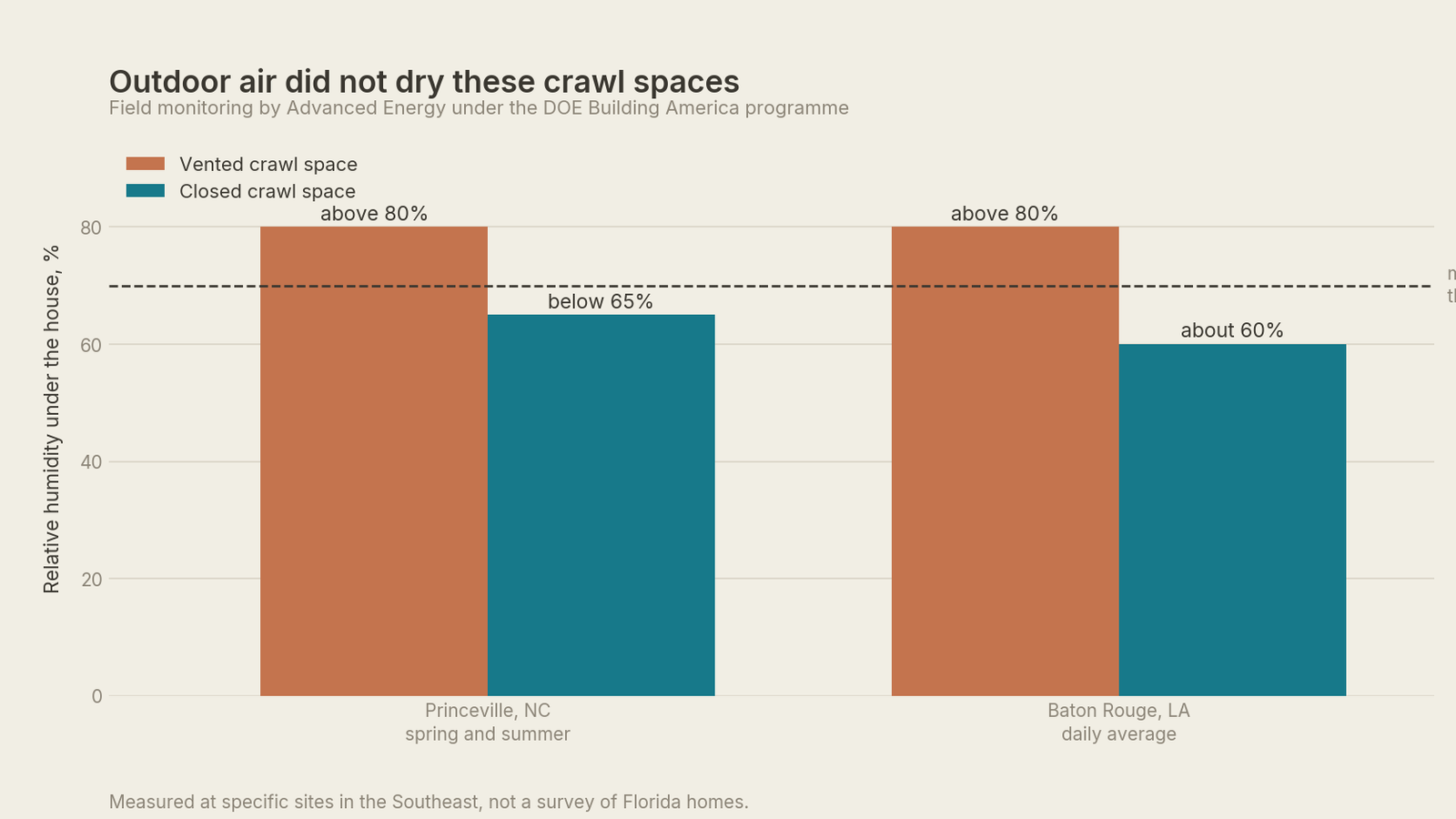
Advanced Energy monitored twelve comparable houses in Princeville, North Carolina, under Department of Energy funding: vented crawl spaces stayed above 80 percent relative humidity through most of spring and summer, closed ones below 65, with energy savings above 15 percent a year. In Baton Rouge, closed crawl spaces averaged around 60 percent against roughly 80 in the vented controls. The Department of Energy’s own summary of closed conditioned crawl spaces puts the humidity reduction above 20 percent and the energy reduction at 15 to 18 percent against a traditional vented design.
So the advice to add vents or a fan to dry the space out does not work in Florida. It works in a dry climate, and on the days when the outdoor dew point sits below the temperature of the surfaces under the house.
But blocking the vents is not the answer either
Here is the caveat without which this page would be giving dangerous advice.
A closed conditioned crawl space is an engineered system, not a set of plugged openings. The code calls for a continuous Class I vapour retarder over the ground, lapped and turned up the wall, plus one of several ways to manage air and moisture: mechanical exhaust at 1 cfm per 50 square feet, supply of conditioned air at the same rate, dehumidification with the unit sized to the manufacturer’s specification, or a shared-air arrangement for existing structures (Florida Building Code, Residential, R408.3).
| Strategy | What the code asks |
|---|---|
| Vented | 1 sq ft per 150 sq ft |
| Vented, ground covered | 1 sq ft per 1,500 |
| Closed | Class I retarder plus air handling |
Florida Building Code, Residential, R408.2 and R408.3. The code says Class I vapour retarder rather than “6 mil”: polyethylene of that thickness is one common way to reach the class, not the only one, and the class is the term to use with a contractor.
And the second caveat, the Florida one. For this state it does not belong in a footnote.
The Department of Energy guidance for hot humid climates states plainly that in flood-prone areas a closed conditioned crawl space can be a poor decision, and an open pier or flood-compatible arrangement can be preferable.
The reason is the physics of flooding. In a flood zone the space under the house has to let water in and out so that pressure does not destroy the foundation walls. Flood opening requirements run against the logic of encapsulation, where those same openings are what you want to close.
The rule for a house in a flood zone: do not seal the crawl space before checking the local floodplain requirements and the code. Moisture control and flood pressure equalisation are solved by different assemblies, and a crawl space like that is not rebuilt from a generic video. The assembly has to handle moisture, flood pressure, code, insulation and termite inspection access at the same time.
Where crawl space mold gets its water
Humid outdoor air is one item on the list, and not the only one.
| Source | Sign | First move |
|---|---|---|
| Bare soil | Even damp, earth smell | Cover the ground |
| Standing water | Puddles, wet soil | Grading, drainage |
| Plumbing leak | One wet joist bay | Repair, then assess |
| AC condensate | Wet near the line | Redirect the drain |
| Duct leakage | Sweating ducts | Seal and insulate |
| Flooding | Silt, water line | Flood recovery |
Flooding is not a humidity problem with a bigger number attached; it has its own recovery logic.
Mold and rot are different thresholds
These two get confused, and the difference decides whether you are repairing timber or washing it.
The EPA recommends keeping indoor humidity below 60 percent, ideally 30 to 50. But a sensor in the middle of the volume does not describe the humidity at the face of a joist, so “the crawl space reads 58 percent, therefore mold is impossible” does not hold.
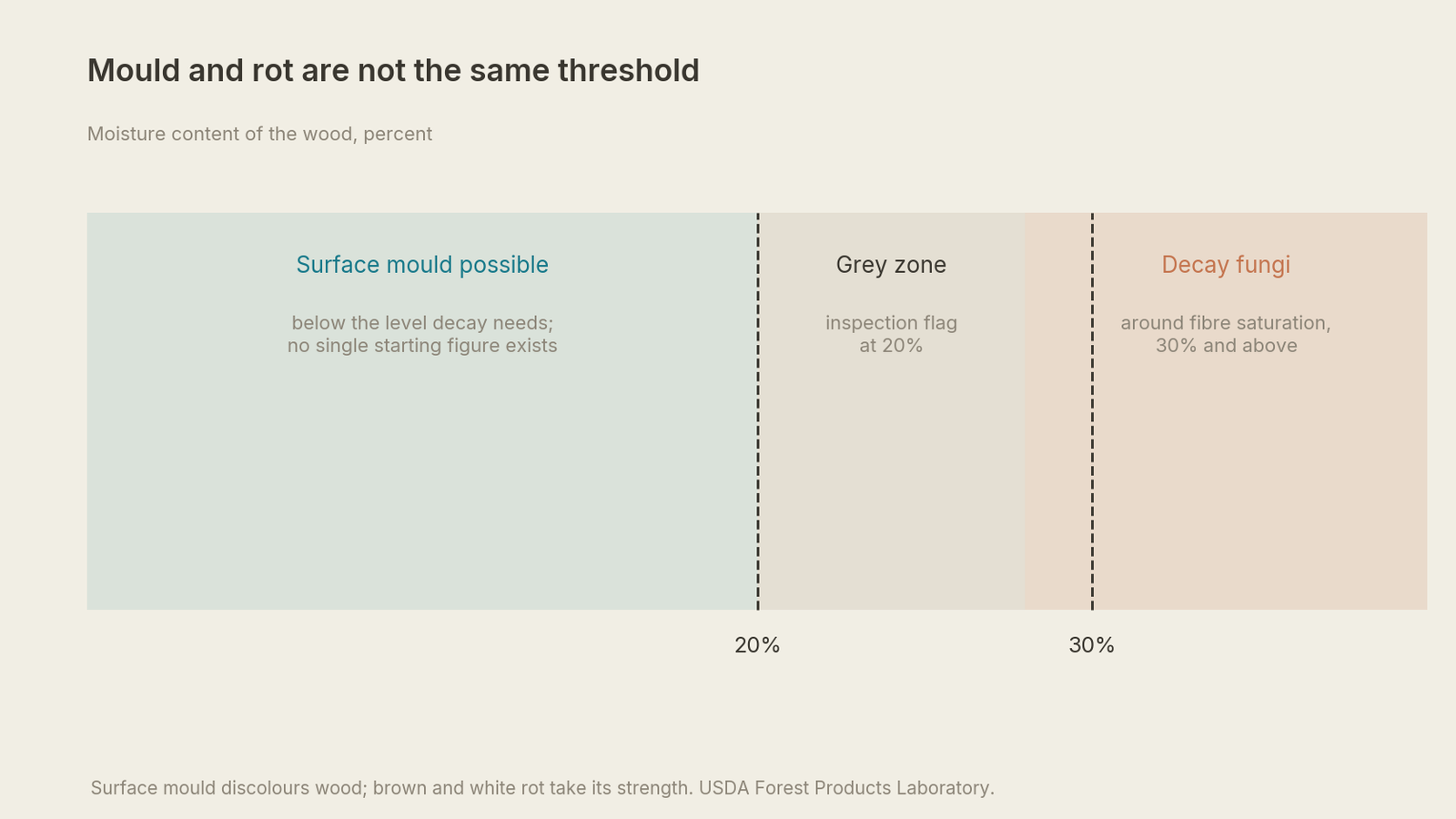
For timber the numbers run differently. The USDA Forest Products Laboratory treats 20 percent moisture content as an inspection safety margin, 20 to 30 as a grey zone, and around 30 as the fibre saturation point above which real decay proceeds. Surface mold develops at moisture levels below what decay fungi require, and no universal figure for where it starts appears in the sources. What is known more precisely: mold can spread at a surface humidity around 80 percent in a suitable temperature range.
Three things cannot be drawn from this: that mold starts exactly at 20 percent, that wood above 20 percent has rotted, or that visible mold proves decay. The circulating figures of “95 to 98 percent humidity for dry rot” and “23 to 25 percent moisture content for wet rot” trace to no primary source and are not used here.
What grows on the wood and how to tell it apart
Surface mold discolours timber and takes none of its strength.
Sapstain, or blue stain, colours the sapwood blue-grey to black. It does not weaken the structure; it affects appearance.
Brown rot destroys cellulose: the wood cracks across the grain and loses strength quickly. White rot breaks down lignin, leaving soft fibrous timber. Both need sustained wetting near fibre saturation, which is what separates them from crawl space mold on the surface.
“Dry rot” is a misleading name. Without available water wood does not rot; the term is two centuries old and misleads to this day.
Telling mold from efflorescence on concrete is simple. Efflorescence is a mineral crystal: it dissolves in water, crumbles to powder between the fingers, and has no smell. Mold does not dissolve and does smell musty.
Termites leave mud tubes along the foundation and galleries inside the wood rather than a coating on the surface. That is a separate inspection.
Diagnosis before cleanup
Liquid water first: standing water, leaks, drainage, flood history.
Then the air: temperature, humidity and dew point over several days rather than one reading.
Then the wood: a meter in the suspect joists and in a known dry spot for comparison. A cheap pinless meter gives you a comparison, not an exact moisture content by species.
Then the pattern of damage: perimeter against centre, near ducts, near plumbing, after rain.
Then the ground cover, the insulation, the ducts and the condensation.
Separately, the extent of visible growth before anything disturbs it. And separately again, signs of termites and structural trouble.
On safety: a crawl space adds confinement, wiring, standing water, sagging insulation, sharp fasteners, rodents and insects to ordinary mold work. The EPA is explicit that fans should not be run until the water is known to be clean, because airflow spreads contamination.
The order of work
Stop the standing and liquid water. Correct the exterior drainage, grade and runoff. Repair plumbing leaks and the air conditioning condensate. Close off the ground vapour source. Choose the strategy, vented or closed, with the flood zone and termite requirements in hand. Seal and insulate the ducts. Dry the framing and confirm the wood moisture is trending down. Remove the existing growth according to its extent and circumstances. Add dehumidification for the remaining load. Then monitor humidity, dew point and wood moisture.
The order matters. Drying changes the conditions for future growth, but what has already grown on the joists does not vanish in dry air: both operations are needed, the cleanup and the source.
Where the line runs between doing it yourself and calling someone
The EPA: below roughly 10 square feet a homeowner can usually handle it, absent contaminated water and special circumstances. Above that, and with major wetting, HVAC involvement or water from a contaminated source, professional guidance applies.
In Florida the same figure appears in law: statute 468.8411 defines mold assessment and remediation for areas greater than 10 square feet, and the DBPR licenses the professional services.
The wording matters. The law regulates professional services; it does not forbid a homeowner from touching 10.1 square feet of their own joist. The practical version: above roughly 10 square feet the EPA recommends professional-level work, and Florida regulates professional assessment and remediation in that same range.
The boundary itself is covered on the page about doing it yourself or hiring out, and the money on the page about remediation cost in Florida.
Termites: how remediation can create a second problem
A Florida crawl space has to stay inspectable for termites.
UF/IFAS on termite prevention: remove moisture, eliminate wood-to-ground contact, direct the air conditioning drain and gutters away, and keep the space where mud tubes remain visible. Damp conditions suit mold and termites equally well.
Hence the limit on sealing: membranes, foam and insulation must not cover the inspection paths. The six-inch inspection gap UF/IFAS cites comes in the context of mulch and exterior cladding, and I am not going to universalise that number to every geometry.
A dehumidifier belongs at the end, not the start
Picture a crawl space with bare earth, a puddle after rain, a dripping pipe, a sweating duct, open vents and an outdoor dew point near 75°F. A dehumidifier goes in. The machine dries the air while the space takes on new water and new humid air at the same time. There is no repair in that, only endless pumping of a symptom.
The unit earns its place once the liquid water is stopped, the ground source is closed, the crawl space strategy is chosen and the ducts and major air paths are in order.
A household portable dehumidifier is tested at 65°F and 60 percent humidity under the current Department of Energy method, and that is already the lower edge of what a crawl space lives in: 55 to 65°F year round. Below that its output drops and the coil frosts. What is needed is automatic hot-gas defrost, a continuous drain run to fall or a condensate pump, and a setpoint around 50 to 55 percent.
Over-drying is not the goal either: shrinkage and checking in the timber, and a larger power bill. Choosing the unit is covered on the page for crawl space dehumidifiers.
Frequently asked questions
Is crawl space mold common in Florida?
There is no statewide prevalence data. What is known is that the crawl space itself is uncommon here: 85.7 percent of new homes in the South Atlantic division are built on slab.
What humidity causes mold in a crawl space?
There is no single figure. The EPA recommends staying below 60 percent, ideally 30 to 50, but a sensor in the middle of the volume does not describe the humidity at the face of a joist.
Does mold on the joists mean the wood is rotting?
No. Surface mold and sapstain take no strength from the timber. Decay needs moisture content near the fibre saturation point, around 30 percent.
Should crawl space vents be open or closed in Florida?
There is no universal answer. Outdoor air adds moisture in summer, but a closed crawl space is an engineered system, and in a flood zone it can be ruled out by flood opening requirements.
Will a dehumidifier remove existing mold?
No. Dry air stops further growth; what has already grown has to be removed.
Can encapsulation hide termites?
It can, if a membrane covers the inspection paths. The strategy gets agreed against the termite requirements.
Sources
- NAHB analysis of the US Census Bureau Survey of Construction, foundation types by division, 2018–2024.
- Advanced Energy. Closed Crawl Spaces: field study, Princeville, North Carolina, under US Department of Energy Building America funding; Dastur et al., closed crawl space performance, Baton Rouge, Louisiana.
- US Department of Energy, Building America. Unvented, Conditioned Crawlspaces; hot-humid climate best practices.
- Florida Building Code, Residential, R408.2 and R408.3, crawl space ventilation and unvented crawl spaces.
- USDA Forest Products Laboratory. Wood Handbook, Chapter 16; Morris P., Winandy J., Limiting Conditions for Decay in Wood Systems, 2002; Carll C., Highley T., Decay of Wood and Wood-Based Products, 1999.
- US EPA. A Brief Guide to Mold, Moisture and Your Home; Mold Cleanup in Your Home; Mold Course, Chapter 4.
- Florida Statutes §468.8411; Florida Department of Business and Professional Regulation, mold-related services licensing.
- UF/IFAS. Termite Prevention and Control; Termites and Mulch.
- US Department of Energy, Appendix X1 test procedure for portable dehumidifiers.