
Crawl Space Dehumidifier: Why Venting Backfires in Florida
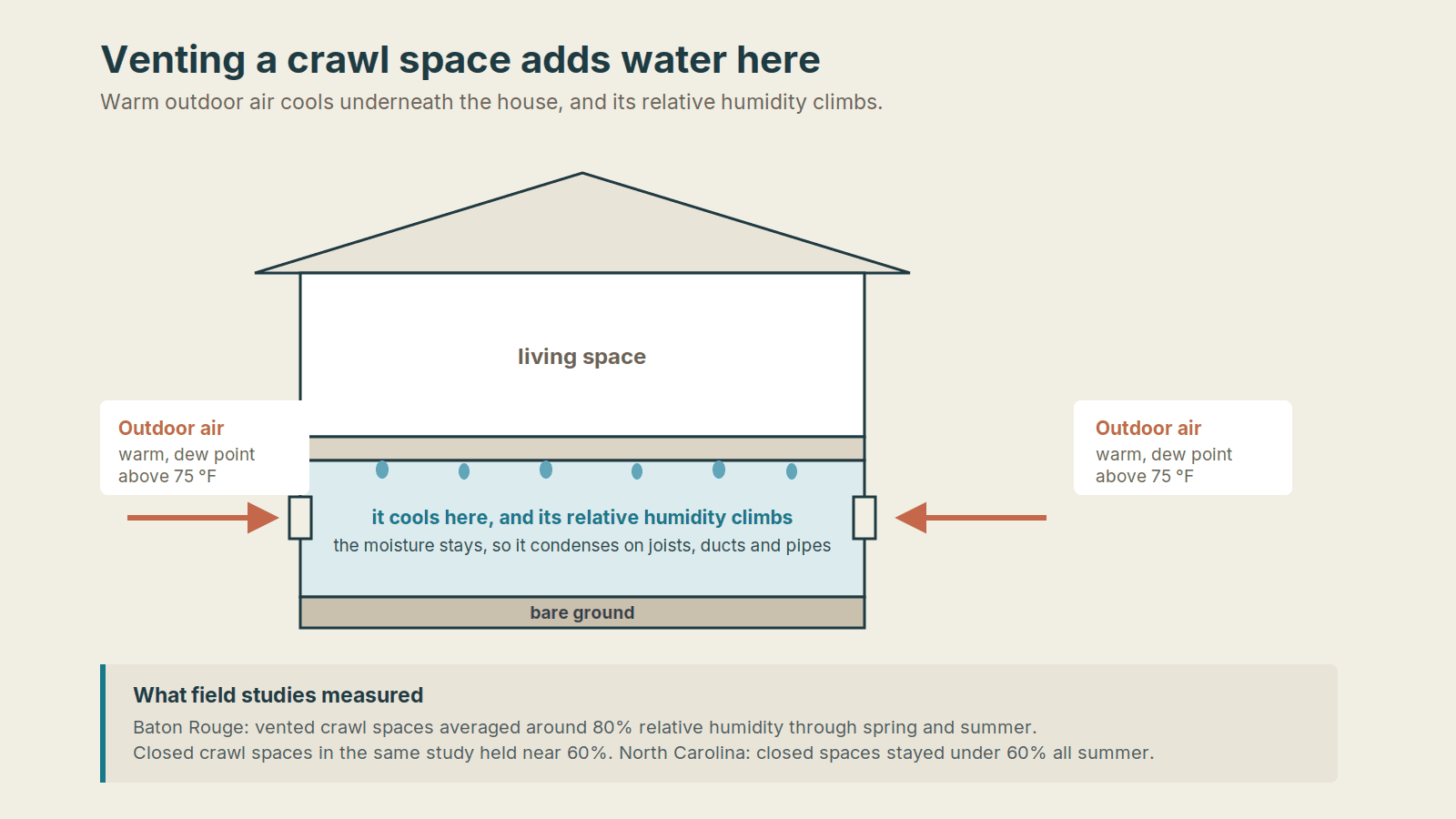
A crawl space dehumidifier in Florida solves a problem that ventilation does not solve but creates. Older Florida houses were built with foundation vents around the perimeter on the assumption that outdoor air would dry the space underneath. In a hot humid climate the opposite happens: warm air with a dew point above 75 °F enters the cooler crawl space and condenses on joists, ducts and pipes. Field measurements bear this out, and everything on this page follows from them.
Disclosure: This article contains affiliate links, including links to Amazon, Sylvane, and other partners. If you purchase through these links, we may earn a small commission at no extra cost to you. As an Amazon Associate I earn from qualifying purchases. Full disclosure: Affiliate Disclosure.
What the measurements showed
The case for a crawl space dehumidifier rests on field data. Advanced Energy studied 12 houses in North Carolina. In the eight with closed crawl spaces, relative humidity stayed below 60% all summer. In the four vented ones it tracked the outdoor humidity.
A second study in Baton Rouge sits closer to our climate. There the vented control group ran near 80% relative humidity through most of spring and summer, while closed crawl spaces held around 60% on a daily average. In the earlier 2005 North Carolina pilot, houses with closed crawl spaces averaged energy savings of more than 15% a year on heating and cooling.
The mechanism is simple and explains the rest of this page. Warm air carries more moisture. When it enters a cooler crawl space and cools down, its relative humidity climbs higher still, which is why a vented crawl space can read wetter than the air outside it.
Crawl spaces in Florida: how many, and what they cost
Most Florida houses on crawl space foundations were built roughly between 1950 and 1990, alongside older homes on piers.
In our analysis of the FEMA/NFIP claims database, 448,536 Florida records, crawl space foundations account for 8,061 claims, or 4.8% of the total. A small share, but the median payout is $25,223, second only to slab construction for severity.
Which sets the terms for choosing a machine: the space rarely floods, and when it does the bill is heavy. A dehumidifier down there works for the structure above it rather than for anyone’s comfort.
What the code requires
A closed crawl space is not an improvisation. Section R408.3 permits leaving out the foundation vents provided certain conditions are met.
Vapour retarder. A continuous Class I retarder over all exposed earth. Joints lapped at least 6 inches and sealed or taped. Edges carried at least 6 inches up the stem wall and fastened to it.
Plus one of two. Either continuously operated mechanical exhaust at 1 cubic foot per minute for every 50 square feet of crawl space, or conditioned air supply at the same rate. Both cases also call for an air pathway back to the living space and insulated perimeter walls.
Termite inspection. A separate requirement under R408.3.1. The vapour retarder and insulation stop short of the joint between the stem wall and the wooden sill above it, leaving a strip of wall visible, so that termite tubes can be seen during an inspection rather than hidden behind the membrane.
Local amendments vary, so the operative wording for your county is what governs.
The conflict nobody writes about
This is the part that matters most to a Florida reader.
If the house sits in a flood zone, the federal flood insurance rules require flood openings in the crawl space walls so that water can enter and leave freely and equalise the pressure that would otherwise push the walls in. The requirements are specific: at least two openings, on different walls, with the bottom of each no higher than one foot above grade, and water free to move in both directions.
Encapsulation calls for the opposite. The vents get sealed.
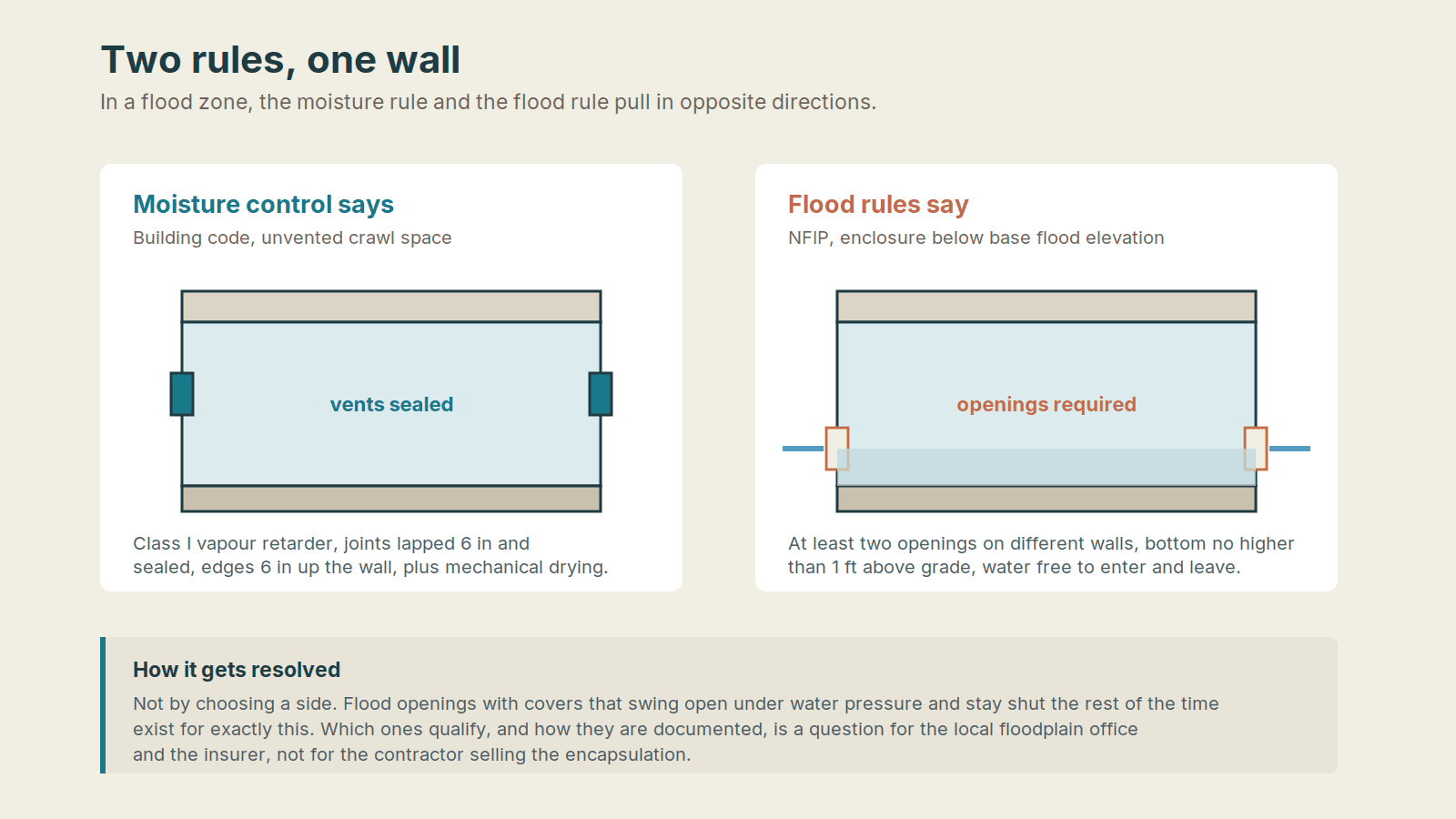
The resolution is not a choice between them. Flood openings exist with covers that swing open under water pressure and stay shut the rest of the time, which is exactly this situation. Which products qualify and how they are documented is determined by the local floodplain office, and that office also signs off on the result. A contractor will do the work; confirming compliance is not his to give.
One more consequence from the same rulebook: if the crawl space floor ends up below grade on all sides, the insurance programme treats it as a basement, with everything that follows for the premium.
Choosing a crawl space dehumidifier
A household portable is the wrong tool, for several reasons at once: operating temperature range, no protection against dust, a tank somebody has to empty, and unattended operation.
The whole-home class in the ENERGY STAR register holds 24 records with capacities from 52.09 to 172.13 pints per day. Crawl spaces draw on the lower and middle part of that range.
| Model | Brand | DOE capacity, pints/day | IEF, L/kWh | Case, ft³ | kWh/year | Refrigerant |
|---|---|---|---|---|---|---|
| DHM065R4000 | Honeywell Home | 52.09 | 2.23 | 2.0 | 503 | R-32 |
| DHM090R4000 | Honeywell Home | 64.17 | 2.22 | 4.9 | 556 | R-32 |
| E080 | Aprilaire | 65.00 | 2.35 | 3.3 | 632 | R-32 |
| Admiral W160 | MOISWELL | 65.00 | 2.25 | 4.4 | 628 | R-32 |
| 4047100 | Santa Fe | 85.62 | 2.45 | 5.4 | 419 | R-454B |
| 4047200 | Santa Fe | 102.69 | 2.63 | 5.4 | 565 | R-454B |
| 4047300 | Santa Fe | 127.51 | 3.26 | 5.6 | 842 | R-454B |
ENERGY STAR register, whole-home class. Capacity per DOE Appendix X1. Representative models: several records carry identical figures and differ only in brand name. AlorAir, widely sold for crawl spaces, holds no whole-home records in the register.
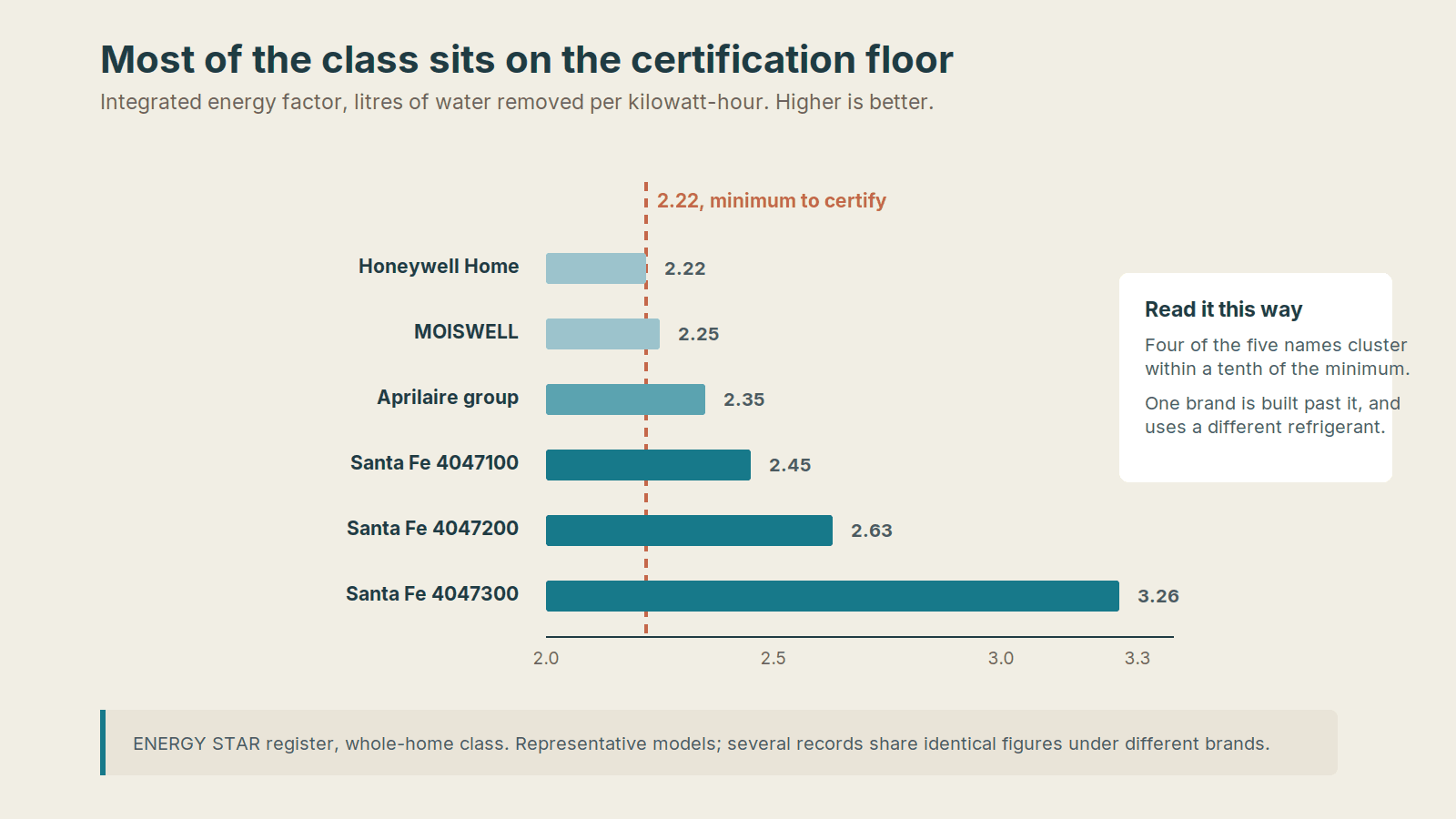
What the numbers show: the certification threshold for this class is 2.22 L/kWh at a case volume up to 8 cubic feet. Honeywell Home sits exactly on it. Aprilaire and the Healthy Climate group sit at 2.35. Santa Fe stands apart at 2.45, 2.63 and 3.26, on a different refrigerant.
The full breakdown of the class, including the rebadging and the inconsistencies in the register, is on the whole-house page. Brand detail sits in the Santa Fe review and the AlorAir review.
Our guide to Galaxy 60, 60P and 85P compared covers their capacity and drainage differences.
Target humidity, and what actually matters
The usual target for a closed crawl space is 50 to 60% relative humidity.
Underneath a floor, though, the figure that counts is the moisture content of the wood itself. The threshold generally cited for biological growth on timber is around 20% moisture content. Relative humidity matters because it sets that value: hold the air between 50 and 60% and the wood stays dry.
Practical consequence: a humidity sensor down there with a readout upstairs costs less than any repair and tells you whether the system is working.
Current retail options: Aprilaire E080, Santa Fe Ultra V100, Ultra V125, Ultra V155
The order of work
The dehumidifier is the last step, not the first.
Deal with liquid water first: standing water, leaks, ground sloping toward the house. Installing a machine before that is pointless.
Clear the space and remove fallen insulation.
Lay the vapour retarder to the code: Class I, lapped joints, carried up the walls, with the inspection strip left visible below the sill.
Seal the vents, subject to the flood zone caveat above.
Install the machine and arrange condensate removal: gravity to daylight where the fall allows it, or a condensate pump. Drainage options are on the drainage setup page.
For a model-level comparison of the two drainage routes, see HD55S vs HDi65S: gravity drain or pump.
Fit a humidity sensor with a readout you will actually look at.
What comes after
Mould already growing on the joists will not disappear once the air dries. Dry air stops further growth; it does not remove what is there, which is covered on the crawl space mould page.
Review data and recall history by brand are in the Florida scorecard, and the register itself is analysed in the ENERGY STAR breakdown.
Frequently asked questions
Should crawl space vents be open or closed in Florida?
Field measurements in hot humid climates show vented crawl spaces running wetter than closed ones and tracking the outdoor humidity. Simply closing the vents without a vapour retarder and mechanical drying traps the existing moisture and makes matters worse.
What size dehumidifier do I need for a crawl space?
The whole-home class starts at 52 pints per day under DOE. Sizing works from the area and moisture load of the crawl space itself rather than the floor area of the house.
Can I use a regular portable dehumidifier in a crawl space?
It is not built for it: a different operating temperature range, no dust protection, and a tank that somebody has to empty. A separate certified class of machines exists for under-floor spaces.
What humidity should a crawl space be kept at?
The usual target is 50 to 60% relative humidity. What matters underneath is keeping the timber itself dry; the threshold generally cited for growth on wood is around 20% moisture content.
Can I encapsulate a crawl space in a flood zone?
The requirement for openings that let floodwater in and out does not go away. Flood openings with covers that open under water pressure exist for this, and the specific solution is agreed with the local floodplain office.
Sources
- IRC and Florida Building Code, Section R408: crawl space ventilation, unvented crawl spaces, termite inspection. codes.iccsafe.org
- FEMA, NFIP Technical Bulletin 1, March 2020: requirements for flood openings in foundation walls and walls of enclosures. fema.gov
- Advanced Energy: field research on closed crawl spaces in North Carolina and Baton Rouge. advancedenergy.org
- ENERGY STAR Certified Dehumidifiers register, whole-home class, 24 records.
- Our own analysis of FEMA/NFIP claims: 448,536 Florida records by foundation type.
- Method notes: /methodology/