
Hisense vs Frigidaire: A Longer Warranty and a Shorter Life
Anyone weighing the hisense vs frigidaire dehumidifier choice is looking at two units the registry treats as equals. The Frigidaire FFAD5033W1 measures 50.00 pints per day under Appendix X1, the Hisense DH5021KP1W 49.52, and both carry an integrated energy factor of 1.8.
Disclosure: This article contains affiliate links, including links to Amazon, Sylvane, and other partners. If you purchase through these links, we may earn a small commission at no extra cost to you. As an Amazon Associate I earn from qualifying purchases. Full disclosure: Affiliate Disclosure.
They part company in two ways, neither obvious from the box. Hisense offers twice the warranty and fails in half the time. Frigidaire publishes what can be measured, and breakdown accounts for 59.2% of its low ratings.
I have not tested either unit. This draws on the ENERGY STAR registry, manufacturer spec sheets, bench readings from a third-party lab, and the Amazon Reviews 2023 dataset. Both sit on the same shelf at Lowe’s and both appear across the wider dehumidifier guides.
Warranty against time to failure
Hisense ships two years of coverage. Frigidaire ships one.
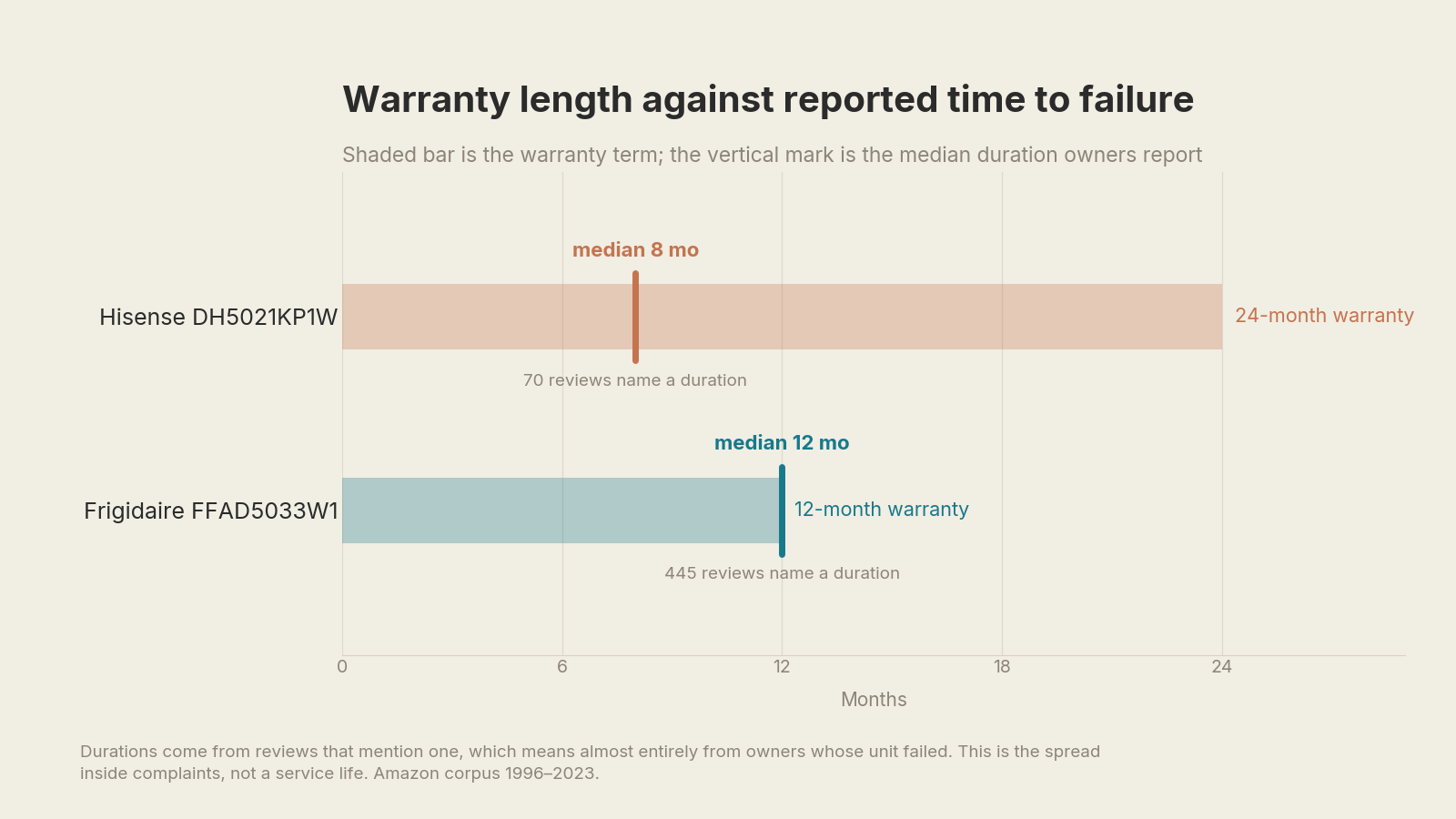
The reviews point the other way. Seventy Hisense owners named a running time before breakdown, with a median of 8 months. For Frigidaire that figure comes from 445 reviews at a median of 12 months, with 55% of the durations falling inside the first year.
The same bias applies to both: people who state a duration are almost entirely people whose unit failed. This is the spread inside complaints, not an average service life.
There is still something practical in it. Eight months falls inside a one-year term and well inside a two-year one, so on both brands the failures being described land during coverage. The question then becomes how each company handles a claim.
Ratings: 35.2% against 31.7%
One- and two-star reviews account for 35.2% of the Hisense cohort across 724 reviews, and 31.7% of the Frigidaire cohort across 4,002.
There is a reference point for both: the sample covers 711 household compressor dehumidifiers and 62,317 reviews. A brand is subtracted from that sample when it is being compared, which is why the two baselines differ: 17.4% without Hisense, 16.7% without Frigidaire.
Both brands run at roughly double their baseline. The 3.5-point gap between them sits on cohorts that differ fivefold in size, and reading it as one beating the other would be a stretch.
Drainage: the pump is there and the complaints are louder
Here the data runs against the hardware.
The DH5021KP1W has a pump built in and a 16-foot hose in the box. The FFAD5033W1 has no pump at all, since that is a separate model, the FFAP5033W1, and it ships no hose either.
Yet pump and drainage is the most frequent theme in Hisense reviews at 30.5%, against 19.8% across the rest of the sample. On Frigidaire the same theme runs below its baseline, at 19.0 against 20.0.
Inside the low ratings the gap holds: 31.4% for Hisense against 15.7% for Frigidaire.
Theme tagging does not separate praise from complaint, so some of those mentions describe a pump working as intended. The direction is consistent, though: where the part exists, it gets talked about twice as often.
What each publishes
Frigidaire gives noise at each fan speed at 47, 49 and 51 dBA, and airflow at 167, 194 and 229 CFM. Hisense publishes a 48–50 dB(A) range with no per-speed breakdown and no airflow figure.
Independent readings exist for the Frigidaire alone. Above the control panel it measured 70.2 dB on high and 64.8 on low; from ten feet, 54.6 and 49.8. Power draw came to 570 watts at 50% relative humidity, and the built-in humidistat landed within 2% of actual. I found no bench readings for the Hisense, and its published 48–50 dB(A) cannot be set against those numbers: the measurement conditions differ.
Thirty-eight degrees
The Hisense runs down to 38 °F against 41 on the Frigidaire, the lowest figure among the spec sheets covered in the build teardown.
In Florida that specification does not earn its keep. A compressor unit meets its lower limit when the surrounding air is cold, and frosting appears in 0.9% of the Florida review cohort against 1.5% nationally. Three degrees changes nothing here.
The figure starts to matter in an unheated space during winter: a northern garage, a boat cabin, a storage room with no heat.
Display errors
Sensor and error-code complaints stand out on both brands, in different measure.
On Hisense the theme appears in 6.2% of reviews against 1.8% across the rest of the sample, rising to 16.9% inside the low ratings. On Frigidaire it is 5.3% against 1.6%, and 14.4% inside the low ratings.
Both sit well above their baselines here. The Frigidaire humidistat measured accurate to within two points, which suggests the complaints concern codes on the display rather than the humidity reading itself.
What sits inside the Hisense cohort
Hisense reviews come from 38 product listings spanning 2013 to 2023. The capacity labels on them are the old ones, 25, 35, 50 and 70 pints, and a 70-pint class no longer exists after the test procedure changed: 50.0 pints is the ceiling for a portable unit.
One listing in the cohort is a model with a 1,200-watt heater built in. For a Florida house that is the wrong appliance, and the current Hisense lineup does not include it.
Today’s listings run 25, 35 and 50 pints plus a Lift-Up version with a pump, an 18-pint bucket and a quick-release hose. The older indexes from the cohort are marked unavailable.
Hisense vs Frigidaire dehumidifier: which suits which house
Frigidaire suits a buyer who wants the specifications before the purchase: noise at three speeds, airflow, and an independent bench reading are all on record, and the humidistat is accurate. Against it: 59.2% of its low ratings concern breakdown and warranty, and there is no pump in the base model.
Hisense suits a buyer who wants the pump and hose in the box and two years of coverage. Against it: a median failure report at 8 months, drainage as the leading review theme, and no independent measurements to check the claims. Detailed breakdowns sit in the Hisense review and the Frigidaire review, and both feed the Florida selection guide.
Current retail options: Hisense AHD5024K1W at Sylvane (no pump), Hisense 50-pint Lift-Up at Sylvane (pump), Frigidaire FHDD5033Y1 at Sylvane (no pump), and Frigidaire FHDP5033Y1 at Sylvane (pump). These are current retail models or successors, not the DH5021KP1W and FFAD5033W1 research models; the comparison figures above do not transfer to them.
Limits of this comparison
- I have not tested either unit, and there are no field measurements here.
- Bench readings exist only for the Frigidaire; the Hisense specification figures are not comparable to them.
- Registry figures come from a 65 °F / 60% RH test and understate performance in Florida conditions.
- The Hisense cohort comes from 38 listings under the old capacity labels; the current lineup is not represented in it.
- The 3.5-point rating gap rests on cohorts of 724 and 4,002 reviews.
- A low rating is not only about breakdowns; shipping complaints and awkward bucket handling land there too.
- Theme tagging does not separate praise from complaint, and themes overlap within a single review.
- The Amazon corpus ends in 2023.
- ENERGY STAR certification is neither a guarantee of quality nor a recommendation.
Frequently asked questions
Are the Hisense DH5021KP1W and Frigidaire FFAD5033W1 in the same class?
By the ENERGY STAR registry, yes: 49.52 and 50.00 pints per day under Appendix X1, both at an integrated energy factor of 1.8.
Which brand has the longer warranty?
Hisense, at two years against one for Frigidaire. The median duration owners report before failure runs the other way: 8 months for Hisense against 12 for Frigidaire.
Which unit has a pump?
The Hisense DH5021KP1W has one built in with a 16-foot hose included. On Frigidaire the pump is a separate model, the FFAP5033W1, and no hose ships in the box.
Which one is quieter?
There is no sound comparison to make. Frigidaire publishes 47, 49 and 51 dBA per speed and has an independent bench reading; Hisense gives a 48–50 dB(A) range with no breakdown, and I found no bench readings for it.
Does the Hisense 38 °F rating help in Florida?
No. A lower operating limit matters in a cold space, and frosting appears in 0.9% of the Florida review cohort against 1.5% nationally.
Sources
- ENERGY STAR Certified Dehumidifiers registry, Appendix X1 capacity and IEF values.
- Frigidaire FFAD5033W1 specification sheet, revision 02/23; Hisense spec sheet covering the DH-series.
- Independent bench readings for noise, power draw and humidistat accuracy, single third-party lab.
- Amazon Reviews 2023 dataset, household compressor dehumidifier subset, 1996–2023.