
Waykar vs Yaufey: Two Brands, One Certification Filer
The waykar vs yaufey question looks like a choice between two budget rivals on Amazon. In the ENERGY STAR registry, certifications for both brands, along with Kesnos and Fehom, are filed by a single legal entity, JHS INC.
The model numbering carries the same signal. Waykar sells a PD160B; yaufey sells a PD161D. One digit apart.
A shared filer does not mean identical hardware. It is a fact of registration, and past it the two brands diverge.
I have not tested either unit. This draws on the ENERGY STAR registry, manufacturer listings and manuals, an independent noise measurement, and the Amazon Reviews 2023 dataset. Both brands sit at the budget end of the wider dehumidifier guides.
Both sell half of what the label claims
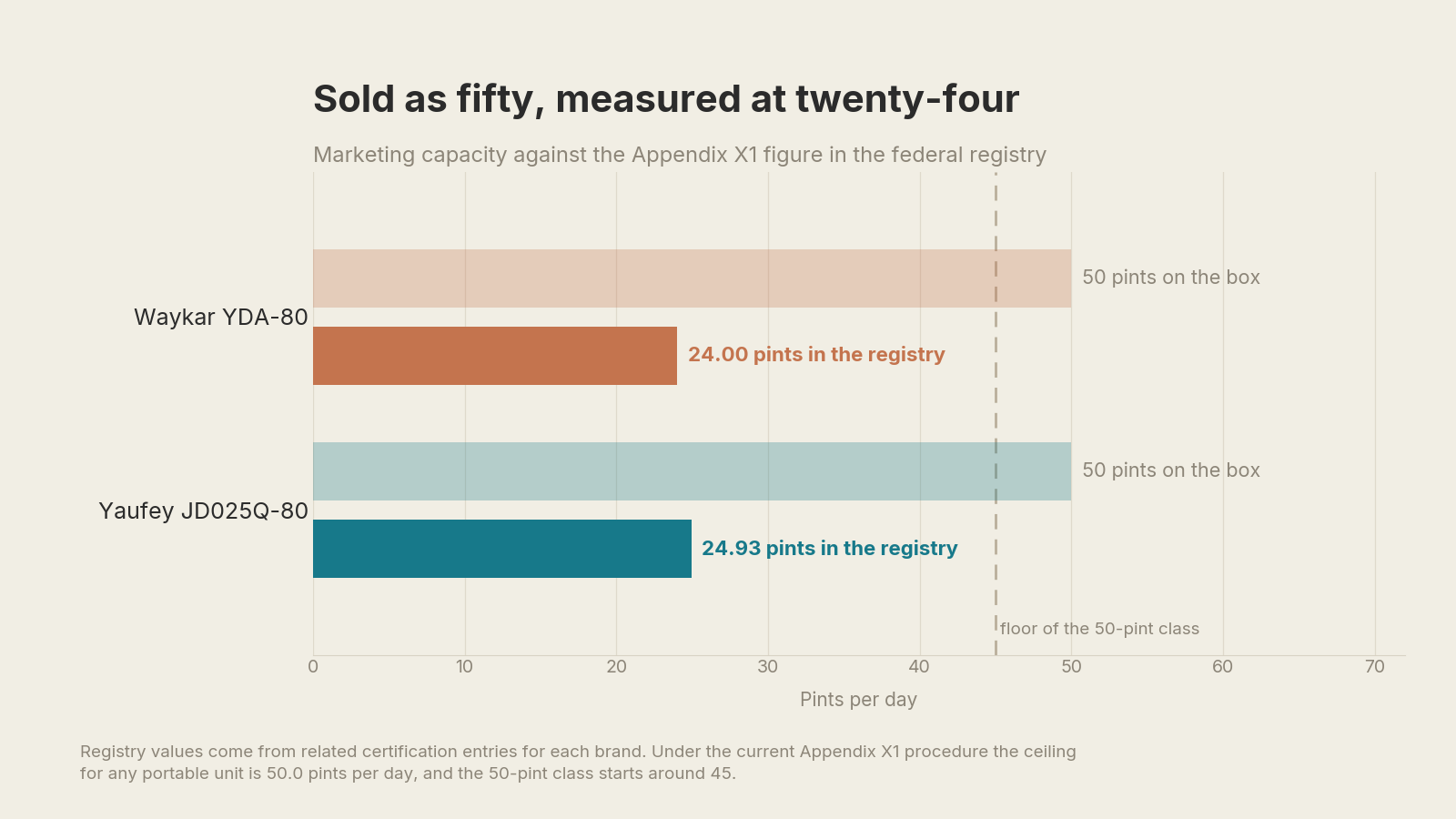
The number on the box refers to a different quantity than the one the registry measures.
The related Waykar registry entry, YDA-80, measures 24.00 pints per day under Appendix X1. The related yaufey entry, JD025Q-80, measures 24.93. Both models are sold with “50 pint” on the label.
Twenty-four pints is a lower capacity class. The 50-pint class in the registry starts around 45 pints, and none of the 511 portable entries rises above 50.0.
Waykar has a further wrinkle: the PD160B does not appear in the registry under its own name. The certified variant is the PD160B-PRO, and its Appendix X1 figure is 10.09 pints against marketing of 34 pints.
Yaufey has its own version of this with the AD1901, whose integrated energy factor of 1.42 falls below the ENERGY STAR threshold, leaving the model uncertified.
Thirty-three decibels
Waykar advertises a noise level of 33 dB.
An independent measurement of that model returned 53.9 dB on low fan and 59.1 dB on high. The gap runs to roughly twenty decibels. Published and measured figures diverge on other brands too, but there the difference is a few decibels.
I found no independent readings for yaufey, so there is no sound comparison to make between the two brands.
Ratings: 6.3% against 11.2%
One- and two-star reviews account for 6.3% of the yaufey cohort across 3,105 reviews, and 11.2% of the Waykar cohort across 4,830.
The rest of the sample sits at 18.2%, so both brands land well below that baseline. For comparison under the same counting rules: hOmeLabs 13.2%, Midea Cube 25.7%, Frigidaire 31.7%, GE 34.0%, Hisense 35.2%.
Five-star reviews run at 81.6% for yaufey and 74.9% for Waykar.
And both fail sooner than the rest
Here the figures on these brands argue with each other.
A running time before breakdown was named by 138 Waykar owners, with a median of 5 months and 88% of the durations falling inside the first year. For yaufey the figure comes from 36 reviews at a median of 6 months, with 86% inside the first year. That cohort sits below the reliability threshold, and the number carries that caveat.
By the same counting: Hisense 8 months, Frigidaire and hOmeLabs 12 each, GE 14, Haier 18.
The two brands with the lowest share of low ratings produce the shortest medians to failure among those calculated. I cannot explain that from the data at hand, and I am not going to smooth it over: both figures were counted by the same rules and they point in opposite directions.
The usual caveat on the measure still applies. Durations come from owners whose unit failed, so this is the spread inside breakdown reports rather than a service life.
What owners write about
| Theme | Waykar | Yaufey | Rest of sample |
|---|---|---|---|
| Size and footprint | 21.4 | 25.1 | 14.3 |
| Bucket, float, shutoff | 19.5 | 20.3 | 18.6 |
| Support and service | 18.7 | 10.1 | 8.7 |
| Pump, drainage, hose | 16.6 | 23.0 | 20.1 |
| Breakdown, repair, warranty | 12.5 | 9.3 | 15.0 |
| Noise | 9.9 | 12.1 | 13.4 |
| Coil frosting | 0.2 | 0.5 | 1.7 |
Share of reviews raising each theme, %. Counted across every review in the cohort, praise included; the tagging does not separate praise from complaint.
Size leads for both brands at 21.4% and 25.1% against 14.3%. That matches the dimensions. The Waykar cabinet measures 12.6 by 8.86 by 19.29 inches, the smallest among units sold as 50-pint machines that went into the build teardown. The yaufey YDY-32A bucket holds 0.48 gallons, the smallest among full-size models in that same teardown.
Support is where the two brands separate most. Waykar draws 18.7% against 10.1% for yaufey, and inside its low ratings that theme reaches 39.3%, second only to breakdown at 44.0%. On yaufey support sits third inside the low ratings at 21.4%.
The yaufey cohort has run dry
Yaufey reviews arrive unevenly: 8 in 2018, 450 in 2019, a peak of 1,578 in 2020, then 864, 177 and 28 in 2023.
The brand is still selling through its own site, Amazon and Home Depot, with a lineup of the YDY-32A, PD161D and JD025Q-120. But 1,578 of those 3,105 reviews come from 2020, so the 6.3% figure relates to today’s models only indirectly.
The Waykar cohort is younger, at 4,830 reviews running from 2020 through 2023.
Waykar vs yaufey: which suits which house
Both brands sell a compact lower-class unit under a number about twice what the registry measures.
Yaufey wins on ratings and on service complaints: 6.3% against 11.2%, and 10.1% against 18.7%. Against it: a cohort gathered largely in 2020, and only 36 mentions of a service duration.
The Waykar data is more recent, and the brand adds a second warranty year on registration. Against it: a twenty-decibel gap between the advertised and the measured noise, support standing second among the reasons for low ratings, and a five-month median to failure. Full breakdowns sit in the Waykar review and the yaufey review, with a third brand from the same budget tier in the Vremi review, and all of them feed the Florida selection guide.
Limits of this comparison
- I have not tested either unit, and there are no field measurements here.
- A shared registry filer is a fact of certification, not a conclusion about the hardware inside.
- The independent noise measurement covers Waykar only.
- The yaufey median to failure rests on 36 mentions, below the reliability threshold.
- The yaufey cohort was gathered largely from 2020 sales.
- Appendix X1 values come from related registry entries rather than from the specific listings on sale.
- A low rating is not only about breakdowns; shipping complaints and awkward bucket handling land there too.
- Theme tagging does not separate praise from complaint, and themes overlap within a single review.
- The Amazon corpus ends in 2023.
Frequently asked questions
Are Waykar and yaufey the same company?
Certifications for both brands, along with Kesnos and Fehom, are filed by a single legal entity, JHS INC. That does not establish identical hardware.
Why does the box say 50 pints when the registry says 24?
The box figure refers to the older test procedure or to extreme conditions. Under the current Appendix X1 procedure the related entries measure 24.00 for Waykar and 24.93 for yaufey, which places them in a lower capacity class.
Which brand has fewer low ratings?
Yaufey, at 6.3% across 3,105 reviews against 11.2% for Waykar across 4,830. The rest of the sample runs at 18.2%.
Does the Waykar really run at 33 dB?
That is the manufacturer’s claim. An independent measurement of the same model returned 53.9 dB on low fan and 59.1 dB on high.
How long do these units last?
Among owners who name a duration, the median is 5 months for Waykar across 138 mentions and 6 months for yaufey across 36. Durations come almost entirely from owners whose unit failed, so this is the spread inside complaints.
Sources
- ENERGY STAR Certified Dehumidifiers registry: Appendix X1 values, IEF, partner and brand fields.
- Waykar and yaufey product listings and manuals.
- Independent bench measurement of Waykar noise output, third-party lab.
- Amazon Reviews 2023 dataset, household compressor dehumidifier subset, 1996–2023.