

This page breaks down the dehumidifier reviews Florida owners left on Amazon, set against the reviews left everywhere else in the country. The sample is 62,317 reviews of 711 household dehumidifiers, written between 2002 and 2023, pulled from an open research dataset. The data is public. The analysis is mine.
What comes out of it is a gap. Owners in humid air rate these machines far higher than the country as a whole, and they complain about different things. The dehumidifier reviews Florida buyers wrote diverge from the national pattern on noise, on waste heat, and on frost. Below is how the sample was built, what it shows, and what it cannot show.
How the sample was built
The Amazon Reviews 2023 dataset was collected by the McAuley Lab at UC San Diego. It holds 571.54 million reviews written between May 1996 and September 2023, published for research use.
I pulled every product with the word “dehumidifier” in its title from three categories: Home & Kitchen, Tools & Home Improvement, and Appliances. That produced 213,539 reviews across 2,863 listings.
Then came the part most roundups skip. Over half of that pile is not a dehumidifier. Calcium chloride tubs. Portable air conditioners with a dry mode. Replacement filters. Rod heaters for gun safes. Humidistats. Every one of them carries the word in the product title, and every one of them lands in any keyword search.
After sorting by product type, 62,317 reviews remained, covering 711 compressor-based household units from 184 brands. Thermoelectric mini units went into a separate cohort, because they work on different physics and deserve a separate discussion.
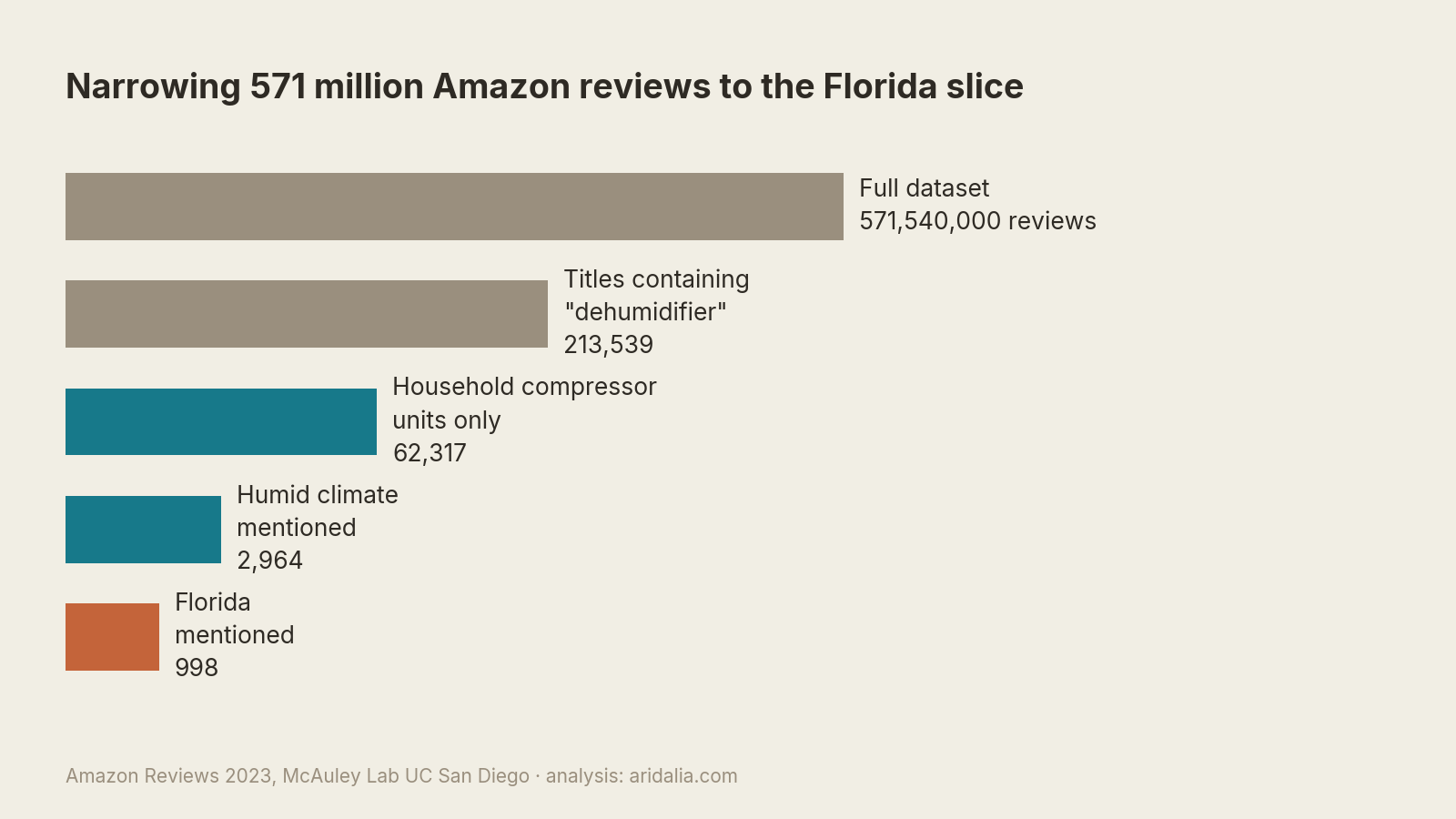
Inside that core I tagged two slices by what the reviewer actually wrote: 998 reviews naming Florida or a Florida city, and 2,964 naming humid conditions more broadly, including the Gulf coast, the southern seaboard, the tropics, and plain statements about high humidity.
One caveat governs everything below. A humid-climate tag means the person said so in the text. It is not the buyer’s location. Somebody in Miami who never mentioned the weather is not in the slice, so the Florida count is a floor, not a census.
Ratings run higher where the air is wet
Average rating across the full sample: 4.13. Humid-climate slice: 4.59. The dehumidifier reviews Florida owners wrote average 4.66.
The edges of the distribution show it better than the averages do. Five-star reviews account for 82.2% of the Florida slice against 65.7% of everything else. One- and two-star reviews account for 5.4% against 18.2%, a gap of more than three to one.
The explanation has little to do with build quality. In Florida a dehumidifier solves a problem the owner already has. Seventy percent indoor humidity is not an abstraction. It is a door that sticks, a smell in the closet, dark spots on the grout. Run the machine two days and the smell goes. The result is visible.
In a dry climate the same unit often gets bought as insurance, parked somewhere, and nothing perceptible happens. The rating follows the experience.
For a buyer here the consequence is direct. A high nationwide average says little about how a model behaves in August in Broward County, because the people who built that average were solving a different problem.
The gap is widening
From 2019 through 2023 the overall average slid: 4.38, then 4.33, 4.12, 3.99, and 3.90. The humid-climate slice across the same five years held at 4.69, 4.66, 4.57, 4.61, and 4.49.
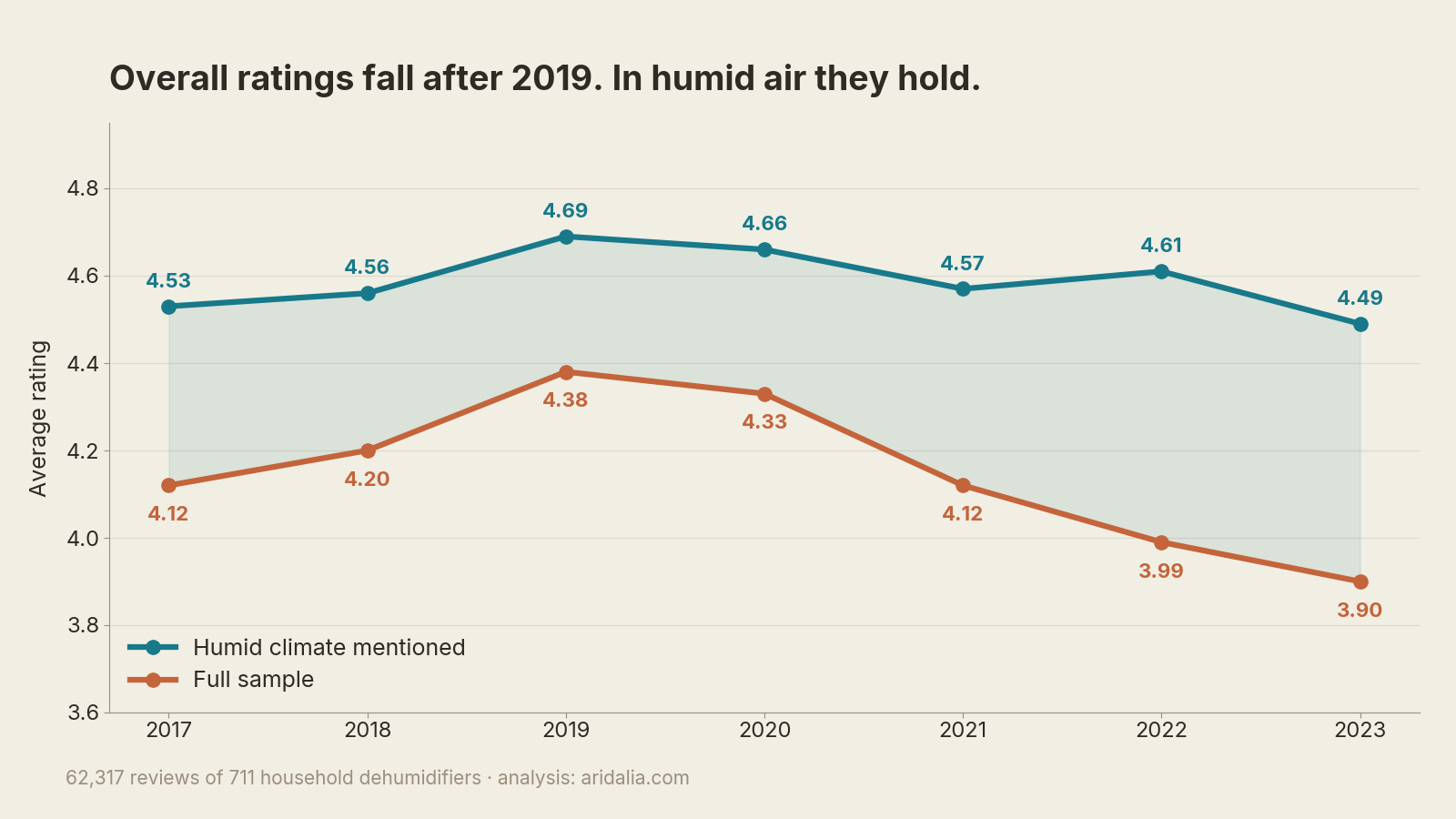
Cheap units flooded the category over those years, and the overall line records it. In wet air the decline is softer. A machine running in the conditions it was designed for separates itself from a bad one quickly, before buyer’s remorse has time to set the tone.
What the dehumidifier reviews Florida owners left actually complain about
I tagged review text by theme and compared the Florida slice against everything else. Shares below are of all reviews in each slice, not of negative reviews only.
On smaller screens, scroll the table to see every column.
| Theme | Florida slice | Rest of sample |
|---|---|---|
| Noise | 15.6% | 9.9% |
| Unit heats the room | 1.1% | 0.4% |
| Coil frosts over | 0.9% | 1.5% |
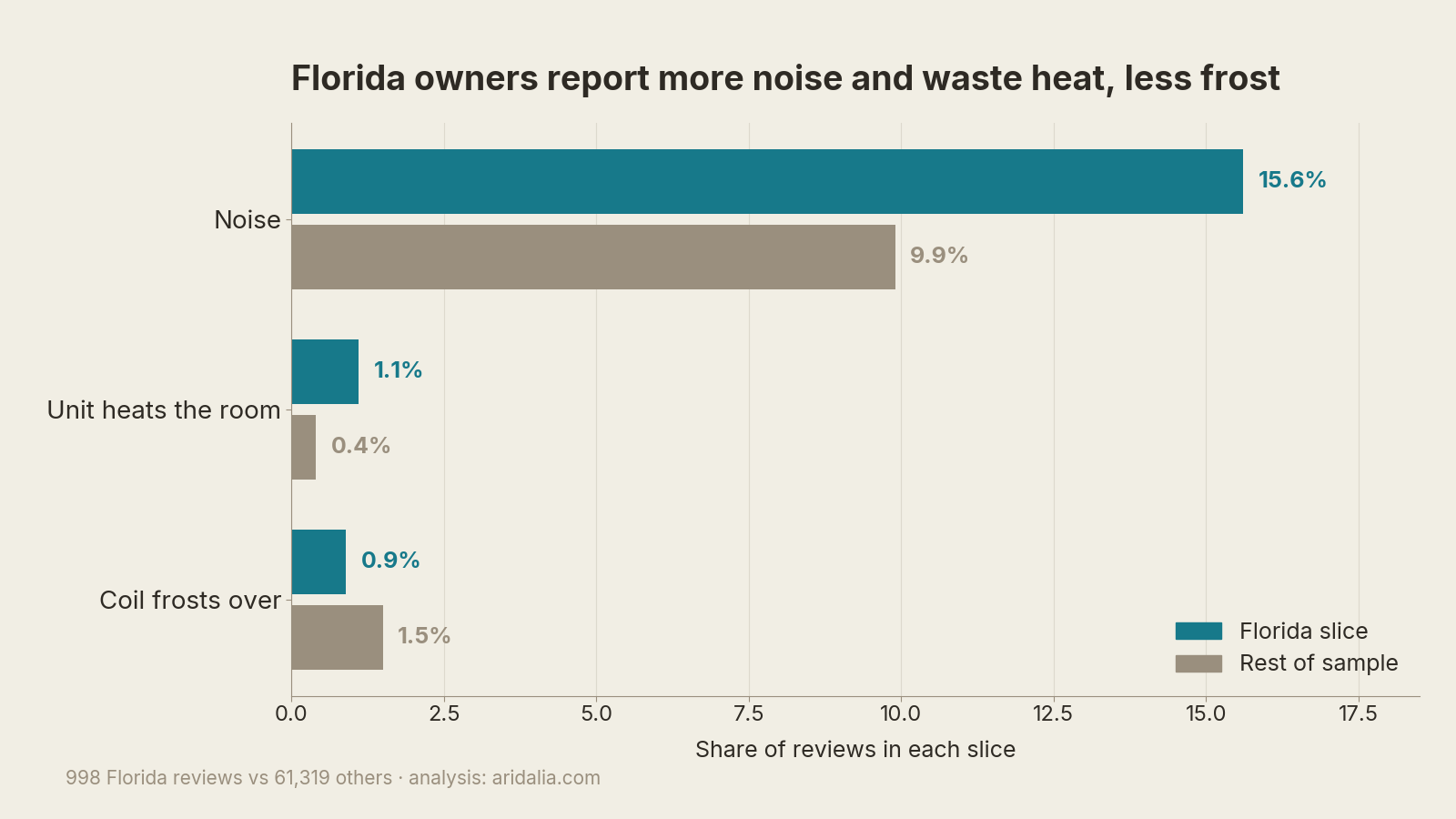
The first two rows come from one fact. In Florida the machine does not switch off. It runs in July and it runs in January, day and night. A unit that gets two months of duty in Ohio accumulates year-round hours here.
Noise follows from that. Six weeks of a loud fan is tolerable. Twelve months of it is not, and the reviews say so at one and a half times the national rate.
Waste heat follows too. The compressor dumps its heat into the room, and in a house where the air conditioner already runs most of the day, that shows up on the thermostat and on the power bill.
Coil frost is not a Florida problem
The third row runs backwards: 0.9% against 1.5%. Frost gets mentioned less often here than in the rest of the country.
The physics is straightforward. A compressor dehumidifier frosts when the surrounding air is cold. The coil drops below freezing and moisture locks onto it as ice instead of draining off. That is a cold basement problem and an unheated garage problem. Inside a Florida house the air stays warm all year, and the conditions for frost rarely arrive.
This is worth holding onto when you read reviews. Frost and auto-defrost occupy real space in most buying guides because most buying guides are written for a northern reader. For a slab house in Florida that specification is close to irrelevant.
The same skew sits inside the ratings printed on the box. Pint capacity is measured by the Department of Energy at 65°F and 60% relative humidity, a condition a Florida unit almost never operates in, which is covered in detail on our page about what pint ratings actually mean.
How long before it quits
In 1,608 reviews the owner stated outright how long the unit lasted before it failed. The median is 12 months. Of the stated intervals, 64.2% fall inside the first year and 88.2% inside two years.
Read that carefully. A duration gets stated almost exclusively by people whose machine broke, because nobody writes in to report fourteen uneventful months. This is not a service life and it is not a failure rate. It is the shape of failure timing inside complaints. The one solid conclusion: the failures people write about happen early, and a standard one-year warranty covers roughly two-thirds of them.
The spread between brands
Share of one- and two-star reviews, for brands with at least 700 reviews in the sample.
On smaller screens, scroll the table to see every column.
| Brand | Reviews | Share rated 1 or 2 stars | Certification applicant |
|---|---|---|---|
| yaufey | 3,098 | 6.2% | JHS INC / Waykar |
| Vellgoo | 1,159 | 6.8% | Invitop |
| Kesnos | 3,513 | 9.7% | JHS INC / Waykar |
| BUBLUE | 871 | 9.8% | Not matched |
| Waykar | 4,826 | 11.2% | JHS INC / Waykar |
| Vremi | 4,120 | 13.0% | Not matched |
| hOmeLabs | 11,512 | 13.2% | Aterian Group |
| TOSOT | 2,090 | 16.0% | Not matched |
| Keystone | 2,321 | 16.1% | Almo Corporation |
| Danby | 866 | 16.2% | Danby Products |
| Inofia | 1,406 | 16.6% | Not matched |
| AIRPLUS | 1,788 | 17.6% | Not matched |
| Ivation | 1,310 | 18.3% | Not matched |
| AlorAir | 746 | 18.8% | AlorAir Solutions |
| Midea | 2,365 | 24.8% | GD Midea |
| Shinco | 1,192 | 28.6% | HONGKONG YOAU |
| Honeywell | 1,576 | 31.1% | JMA North America |
| Frigidaire | 3,976 | 31.7% | Electrolux Consumer Products |
| BLACK+DECKER | 755 | 36.4% | W Appliance Company |
Applicant column from the ENERGY STAR certified product register, export of 28 July 2026. “Not matched” means the brand name did not appear in that export, not that the brand is uncertified.
The spread runs six to one. The first thing I checked was whether review age explains it, since older brands carry longer histories and older histories carry bad years. It does not. Median review year by brand falls between 2017 and 2022, and the correlation between that year and the share of low ratings is 0.03, which is no relationship at all.
What the table means and does not mean. A share of low ratings is a share of dissatisfied buyers. It is not a measured defect rate. People award one star for a loud fan, for an awkward tank, and for a late delivery. Concluding from this column that one manufacturer’s hardware breaks more often than another’s is not supported, and I am not concluding it.
Read the last column before you read the first two. The ENERGY STAR register records the legal entity that filed each model for certification, and three of the four brands with the lowest share of low ratings, yaufey and Kesnos and Waykar, were filed by one applicant. The fourth, Vellgoo, belongs to Invitop, which holds six more brand names. In 43 register entries the manufacturer lists its brands together in a single field, so this comes from the filing itself.
A shared applicant means a shared filing company. It does not prove the hardware is identical, and I am not claiming that it does. What it does mean is that the top of this table offers less choice than it looks like: setting yaufey against Kesnos sets one label against another. The ENERGY STAR register analysis lists 128 dehumidifier brand names filed by 75 companies.
Model-level detail sits in the individual writeups, including Frigidaire and the Midea Cube, and the shortlist built for this climate is on best dehumidifiers for Florida.
What this analysis does not show
The dataset stops in September 2023. Models released after that date are absent.
Reviews are not measurements. Nobody in this sample ran a hygrometer or weighed the water.
The dehumidifier reviews Florida residents wrote are identified by text, not by address, so the slice undercounts.
Coverage is uneven across time. Roughly three-quarters of the reviews land in 2019 through 2022.
No review text is quoted anywhere on this page, and none will be. Aggregates only.
How to check this
The dataset is openly available from the McAuley Lab and mirrored on Hugging Face. Categories used: Home & Kitchen, Tools & Home Improvement, Appliances, review files plus product metadata. Selection rule: the word “dehumidifier” in the product title, followed by classification by product type. Climate slices were tagged by geographic and climate terms appearing in review text. The full procedure is written up on our methodology page.
Frequently asked questions
Why do Florida owners rate dehumidifiers higher than the rest of the country?
Because the machine solves a problem they can perceive. In wet air the effect on smell, doors, and mold is obvious within days, so the rating reflects a visible result. In dry climates the same unit is often bought as insurance and nothing noticeable changes.
Do dehumidifiers freeze up in Florida?
Rarely. Frost forms when surrounding air is cold enough to drive the coil below freezing, which is a basement and unheated garage problem. Florida indoor air stays warm year round, and frost appears in 0.9% of Florida reviews against 1.5% elsewhere.
Where does this data come from and can it be verified?
From the Amazon Reviews 2023 dataset published by the McAuley Lab at UC San Diego, covering 571.54 million reviews through September 2023. It is open to anyone. The selection and tagging rules are described on our methodology page.
Does a 12-month median mean dehumidifiers last a year?
No. That median comes only from reviews where the owner stated how long the unit ran before failing, and those are written almost entirely by people whose machine broke. It describes the timing of reported failures, not service life.
Why are there no quotes from the reviews?
Republishing review text is not permitted under the terms that govern this material, and it adds nothing an aggregate cannot show. Every figure on this page is a count or a share computed across thousands of reviews.
Sources
- Hou, Y., Li, J., He, Z., Yan, A., Chen, X., McAuley, J. Bridging Language and Items for Retrieval and Recommendation. arXiv:2403.03952, 2024. Amazon Reviews 2023 dataset, McAuley Lab, UC San Diego.
- U.S. Department of Energy, test procedure for dehumidifiers, 10 CFR Part 430, Subpart B, Appendix X1.
Analysis by Vitalii Markov. Figures computed from the dataset described above, covering reviews written between 2002 and 2023.