
We pulled the full federal register of ENERGY STAR dehumidifiers: 535 certified models, 24 fields per record, retrieved 28 July 2026, with the newest certification dated 27 July. The register is public, maintained by the EPA and the Department of Energy; we took it directly from the source and did the counting ourselves.
The register answers two questions a store listing never does: what a unit’s tested performance actually is, and who stands behind the brand name. Below: why tested portable energy star dehumidifiers stop at 50 pints while stores are full of “70-pint” units, and a map of 128 brand names filed by 75 companies.
What you will find below
- Not one of the 511 portable models exceeds 50.0 pints per day under Appendix X1. Not a ban: a consequence of the test point.
- Whole-home is a separate class: 24 models, reaching 172 pints, where the “70-pint” machines are real.
- 128 brand names, 75 certifiers. Three of the five best-reviewed brands on Amazon were filed by the same company.
- Annual consumption by class: 181 to 520 kWh.
- R-32 versus propane: 453 models against 66, and why propane lives only in the small ones.
Method
Dataset resource mgiu-hu4z on data.energystar.gov, direct CSV export, no API key required. 535 records: 511 portable, 24 whole-home. Certification dates run from 20 September 2024 to 27 July 2026, with 216 issued in 2026. The full procedure sits on our methodology page.
Portables end at 50.0
On smaller screens, scroll the table to see every column.
| Capacity, pints/day | Models | IEF, median | kWh/year, median |
|---|---|---|---|
| Under 20 | 83 | 1.89 | 181 |
| 20–25 | 164 | 1.76 | 282 |
| 25–30 | 3 | 2.01 | 283 |
| 30–35 | 35 | 2.02 | 343 |
| 35–40 | 59 | 2.01 | 378 |
| 40–50 | 167 | 2.01 | 520 |
| Above 50 | 0 | - | - |
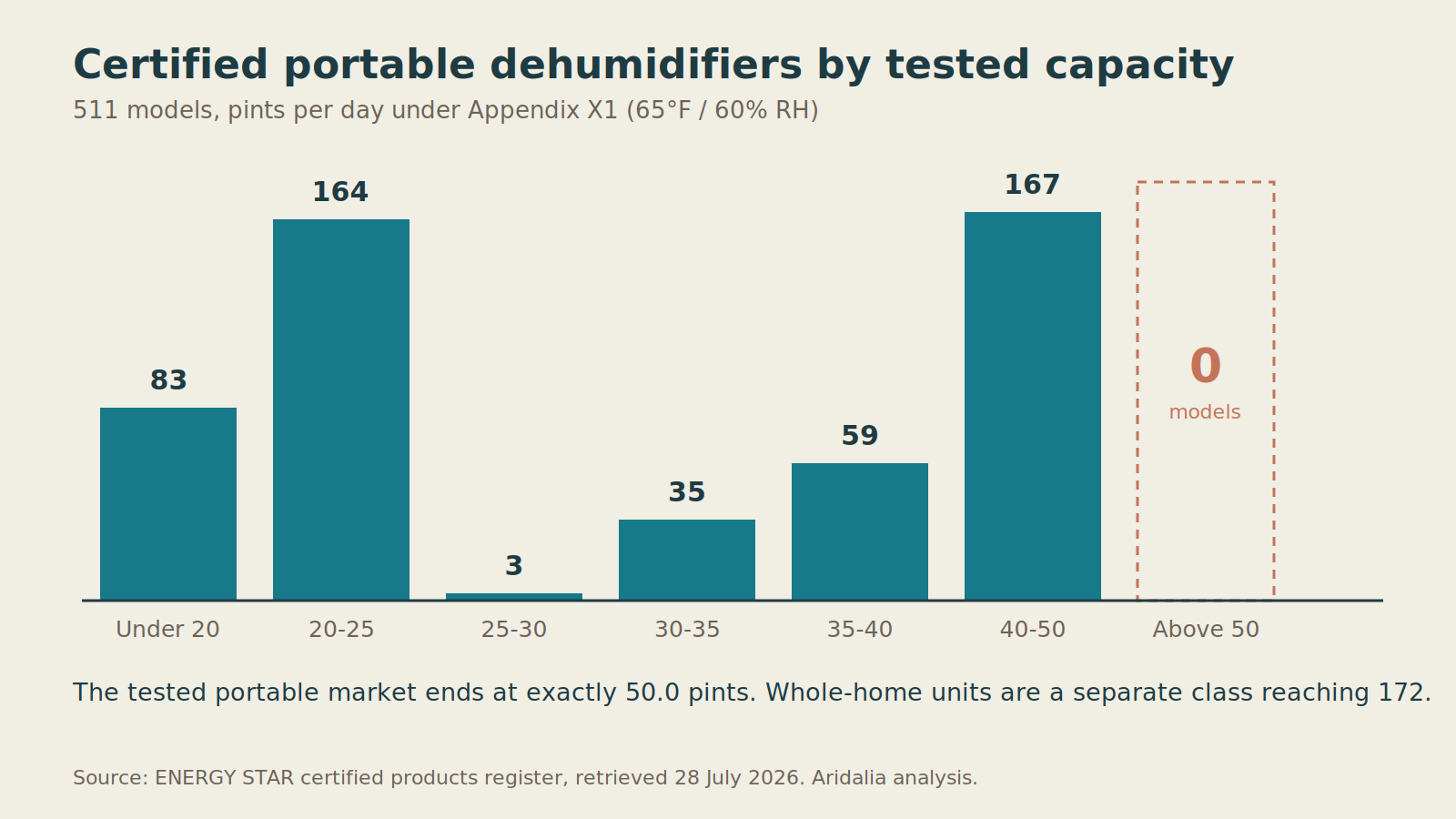
Exactly 32 models sit at 50.0. Above that, nothing.
This is not a prohibition. The DOE rule splits portable dehumidifiers into three product classes, and the class above 50.01 pints exists on paper; the program itself accepts units up to 155 pints. Zero above fifty is simply what the market looks like when measured at the federal test point of 65°F and 60% relative humidity. Cooler air holds less water: the same machine that pulled “70 pints” at 80°F shows about 50 at 65°F. The top of the consumer market, restated at the cold point, fits entirely under fifty.
So a “70 pint” label on a portable is a figure from the pre-2019 procedure, or from conditions warmer than the federal point. That is legal and it is not a lie, but two boxes can only be compared on numbers from the same procedure. The full story of the 2019 change is on our page about what pint ratings mean.
Whole-home: the class where 70 pints is real
24 models: median 65 pints, maximum 172.1, eleven of them at 70 pints or more. These are AprilAire, Santa Fe, AlorAir and their kind: machines for crawl spaces and whole houses, installed rather than plugged in, with ducting, drain lines and a different price bracket. Median consumption: 628 kWh per year.
If a search for “70 pint dehumidifier” returned a unit priced between $300 and $1,300, this is that class, and its numbers are tested ones. Who actually needs one is covered on our pages about whole-house dehumidifiers and crawl space dehumidifiers.
128 brand names, 75 certifiers
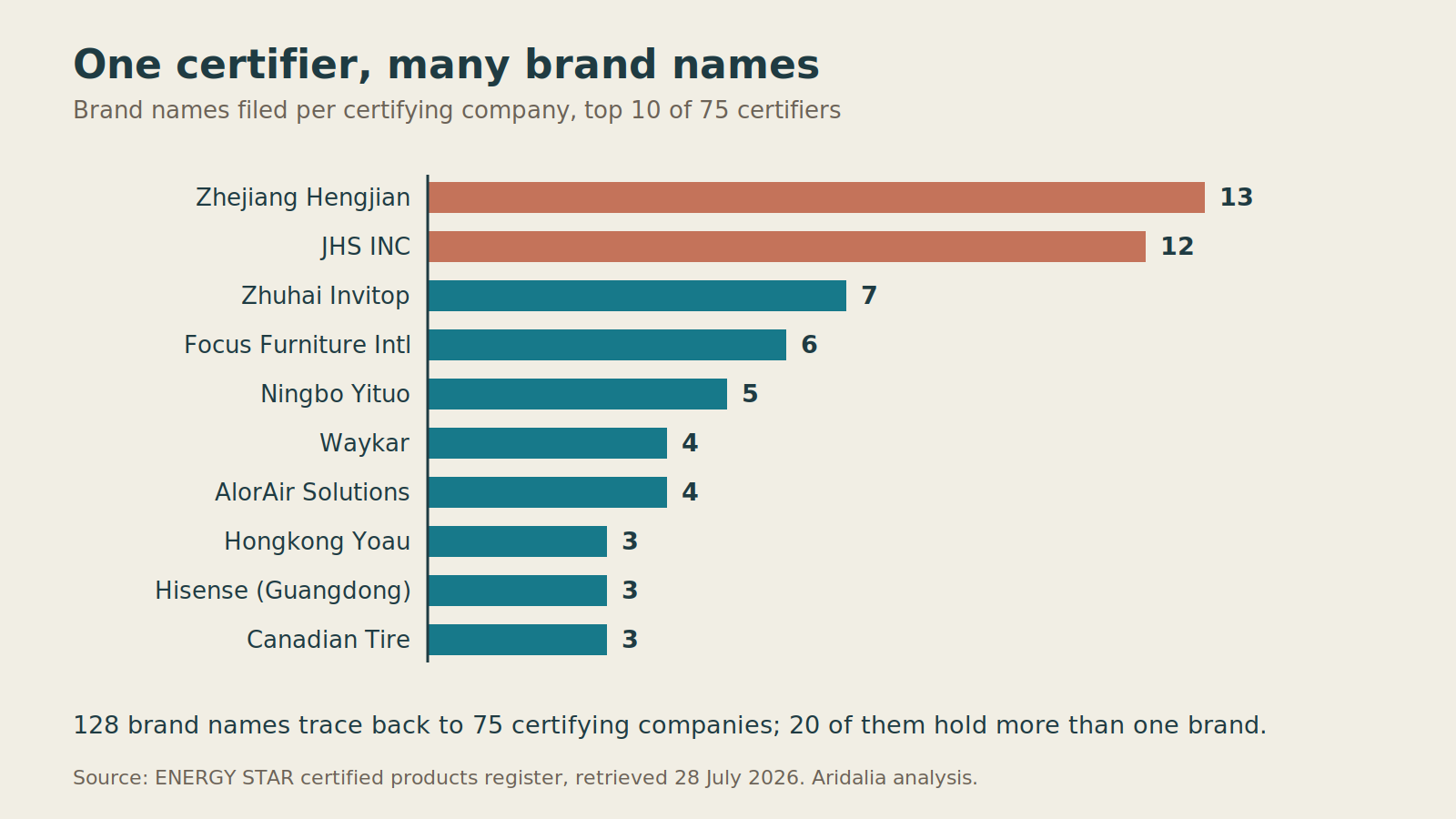
The certifier is the legal entity that filed the model into the program. The brand is the name on the box. They are not the same thing: 20 certifiers hold more than one brand, the ten largest account for 60 of the 128 brand names, and another 41 brands exist as a single model each.
On smaller screens, scroll the table to see every column.
| Certifier | Brands | Records |
|---|---|---|
| Zhejiang Hengjian Home Furnishing | 13 | 39 |
| JHS INC | 12 | 26 |
| Zhuhai Invitop Technology | 7 | 15 |
| Focus Furniture International | 6 | 7 |
| Ningbo Yituo Enterprise Management | 5 | 5 |
| Waykar | 4 | 144 |
| AlorAir Solutions | 4 | 6 |
| Hongkong Yoau International Trade | 3 | 100 |
| Hisense (Guangdong) Air Conditioning | 3 | 30 |
| Canadian Tire | 3 | 8 |
In 43 records, several brand names are listed inside a single filing - entered that way by the manufacturer itself, not reconstructed by us.
The illusion of choice
Setting the register against our analysis of Amazon dehumidifier reviews, here is the share of one- and two-star ratings next to the certifier of record:
On smaller screens, scroll the table to see every column.
| Brand | 1–2 star share | Certifier |
|---|---|---|
| yaufey | 6.2% | Waykar / JHS INC |
| Vellgoo | 6.8% | Invitop |
| Kesnos | 9.7% | JHS INC / Waykar |
| Waykar | 11.2% | JHS INC / Waykar |
| hOmeLabs | 13.2% | Aterian Group |
| Midea | 24.8% | GD Midea Air-Conditioning |
| Shinco | 28.6% | Hongkong Yoau |
| Frigidaire | 31.7% | Electrolux Consumer Products |
Three of the five brands with the least negative feedback (yaufey, Kesnos and Waykar) were filed by the same entity. A shopper picking “the more reliable one” among them is comparing two labels submitted by one applicant.
One qualifier matters here. A shared certifier means a shared filing entity, not necessarily identical hardware. “The same machine under two names” can only be claimed where the brands appear inside a single register record.
What they consume
Medians by class sit in the first table: from 181 kWh per year for the small units to 520 in the 40–50 class. The efficiency factor holds near 2.0 in every class from 25 pints up; the 20–25 class runs lower at 1.76: small machines are less efficient per pint of water removed. The Most Efficient tier covers 107 of the 511 portables, and in the workhorse 40–50 class just 7 of 167.
These are calculated figures under a standardized duty cycle. A Florida unit runs most of the year, so real consumption lands higher than the label. Use the numbers to compare models against each other, not to forecast a power bill; the cost side is worked through on our dehumidifier energy cost page.
Refrigerants
On smaller screens, scroll the table to see every column.
| Refrigerant | Models | GWP | Median capacity, pints |
|---|---|---|---|
| R-32 | 453 | 675 | 35.3 |
| R-290 (propane) | 66 | 3 | 16.0 |
| R-454B | 4 | 466 | - |
R-290 is a natural refrigerant with a near-zero global warming potential, but it is flammable, and the permitted charge mass is capped. Hence its concentration in small units: the big machines cannot carry enough of it.
What the register does not show
ENERGY STAR certification means compliance with energy-efficiency criteria. It is not a quality mark, not a reliability score, and not a purchase recommendation. Participation is voluntary: a model’s absence from the register says nothing about the model by itself, but it does mean nobody has independently verified its figures, which describes most of what is sold on Amazon.
Every value here comes from testing under the DOE procedure, not from field measurement, and the 65°F test point understates real Florida performance. The certifier field names the applicant, not necessarily the factory. The register changes as certifications are issued and expire; this extract is dated 28 July 2026. Which certified units are actually worth buying for this climate is the subject of our best dehumidifiers for Florida scorecard, and the safety history of the market lives in the CPSC recall analysis.
Sources
- ENERGY STAR Certified Dehumidifiers, dataset resource mgiu-hu4z, data.energystar.gov, retrieved 28 July 2026.
- 10 CFR 430.32(v), energy conservation standards for dehumidifiers: product class boundaries.
- ENERGY STAR Product Specification for Dehumidifiers, Version 6.0, effective 1 October 2025: eligibility criteria.
- 10 CFR Part 430, Subpart B, Appendix X1: test procedure conditions.
- Review-share figures: our analysis of the Amazon Reviews 2023 research dataset (McAuley Lab, UC San Diego), aggregates only.
Frequently asked questions
What is the most powerful portable dehumidifier in the ENERGY STAR register?
50.0 pints per day under Appendix X1; 32 models sit at that mark. No portable goes higher. Whole-home units reach 172.1 pints.
Why does the box say 70 pints if no such portable exists in the register?
Either it is a whole-home unit (that class is real and tested), or the portable is quoting a figure from the pre-2019 procedure or from conditions warmer than the federal 65°F test point.
Who banned portable dehumidifiers above 50 pints?
Nobody. The product class above 50 pints exists in the DOE rule, and the program accepts units up to 155 pints. The zero is what the market looks like when restated at the cold test point.
Does ENERGY STAR certification mean a dehumidifier is reliable?
No. The certificate confirms compliance with energy-efficiency criteria and says nothing about reliability or lifespan.
Is it true that different dehumidifier brands come from one maker?
The register lists 128 brand names filed by 75 companies, and 20 of those companies hold more than one brand. A shared filer does not automatically mean identical hardware.