
Santa Fe Dehumidifier Review: Deep Specs, Four Registry Entries
This santa fe dehumidifier review covers the Therma-Stor range in three parts: standalone units for crawl spaces and basements, ducted Ultra units for a whole house, and the in-wall UltraMD33.
Disclosure: This article contains affiliate links, including links to Amazon, Sylvane, and other partners. If you purchase through these links, we may earn a small commission at no extra cost to you. As an Amazon Associate I earn from qualifying purchases. Full disclosure: Affiliate Disclosure.
On published specifications the brand runs ahead of the others in this teardown: airflow at four static pressure values, separate figures for ventilation mode, refrigerant charge model by model. It also produced four discrepancies inside its own documents.
I have not tested these units. This draws on manufacturer specification sheets and manuals, the ENERGY STAR registry, CPSC recall records and retailer catalogues. The rest of the category sits in the whole-house guide, within the wider dehumidifier guides.
What is certified
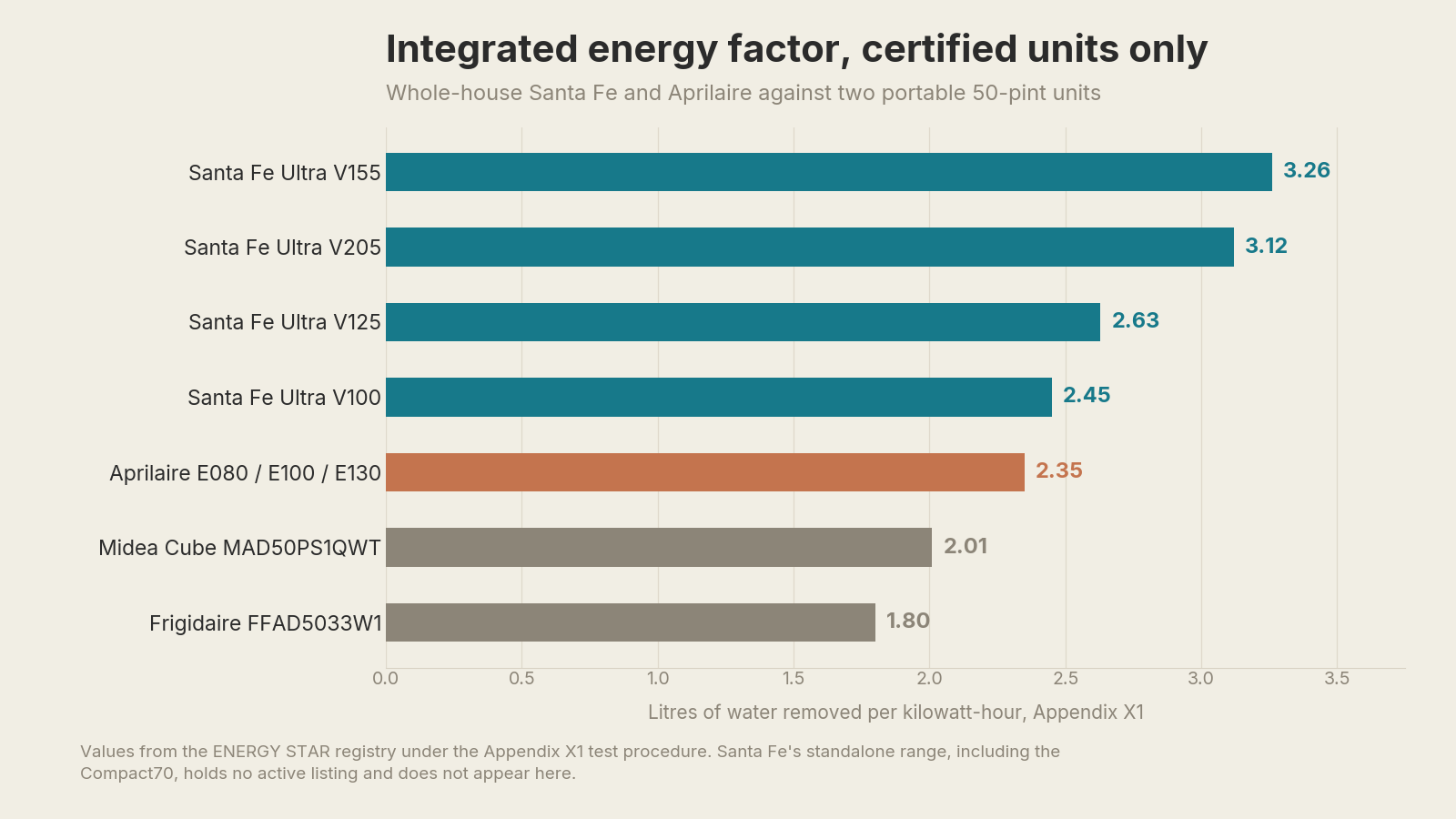
Four models hold active ENERGY STAR listings: Ultra V100, V125, V155 and V205. The partner is Therma-Stor Products, the category is Whole-home, and each carries the Most Efficient mark.
| Model | Appendix X1, ppd | IEF | kWh per year |
|---|---|---|---|
| V100 | 85.62 | 2.45 | 419 |
| V125 | 102.69 | 2.63 | 565 |
| V155 | 127.51 | 3.26 | 842 |
| V205 | 172.13 | 3.12 | 1,188 |
Registry values under the Appendix X1 test procedure. IEF states litres of water removed per kilowatt-hour.
The other eight models in the range hold no active listing. Not the Compact70, not the Oasis105, not the Advance Dry110, not the Classic: the entire standalone line sits outside the registry, and comparing those units against certified ones works only through manufacturer figures.
The V155 figure of 3.26 is the highest across every unit in this teardown. For comparison: certified Aprilaire models sit at 2.35, the Midea Cube in the portable 50-pint class at 2.01, the Frigidaire at 1.8.
Where the manufacturer’s own figures disagree
Discrepancies between a company’s own documents show up on most brands in this teardown: Waykar advertises 33 dB against a measured 53.9, hOmeLabs coverage grew from 4,500 to 7,000 square feet with no change of index, Aprilaire states five years of warranty in one place and six in another. On Santa Fe they concern the specifications themselves. I checked each against primary sources.
V100 refrigerant charge. Specification TS-2152 gives 34 ounces of R454B. The ENERGY STAR dataset for the same model 4047100 gives 24 ounces.
Energy factors in the shared manual. Manual TS-2157 carries a DOE registration table listing 2.63 for the V100 and 2.45 for the V125. The registry has it the other way round: 2.45 on the V100, 2.63 on the V125. The two models’ values appear transposed.
One claim that circulates in reviews does not survive checking: a V155 charge of 36 ounces against 48. The 48-ounce figure in the registry belongs to the V205.
I am not going to explain these cases. A registry entry draws on a test report for a particular unit while a specification draws on engineering documentation, and some of the difference may originate there. For servicing the circuit, the nameplate on the unit settles it.
V155 efficiency. Specification TS-2137 carries two columns. At 80 °F and 60% it prints 7.1 pints and 3.35 litres per kilowatt-hour, and that conversion holds. At 73 °F and 60% it prints 6.5 pints and 2.9 litres, while 6.5 pints converts to roughly 3.07.
Compact70 defrost. The manual dated January 2026 describes thermostat-controlled off-cycle defrost: dehumidification stops while the fan keeps running until conditions recover. The specification sheet for the same model calls it hot-gas defrost. These are different schemes, and the manual takes priority.
Temperature: where the line falls
The standalone range tops out at 95 °F on the inlet. That covers the Compact70, Oasis105, Advance Dry110, Classic, Impact155, Ultra70, Ultra98 and UltraMD33.
The ducted V100, V125 and V155 run from 34 to 105 °F, and the V205 from 40 to 104 °F.
In Florida the difference counts. An unconditioned attic in summer can exceed 95 degrees, and standalone models placed there fall outside their specification. The V-series carries ten degrees more headroom, which still does not turn such an attic into a valid location.
The lower limits of 34 and 40 degrees carry no weight inside a Florida house.
Airflow
Santa Fe publishes airflow at four static pressure values, and for the V-series separately in dehumidification and ventilation modes.
| Model | 0 | 0.2 | 0.4 | 0.6 in. w.c. |
|---|---|---|---|---|
| Ultra70 | 150 | 140 | 130 | not published |
| Ultra98 | 320 | 297 | 215 | not published |
| V100 and V125 | 385 | 350 | 305 | 260 |
| V155 | 435 | 395 | 360 | 322 |
| V205 | 550 | 515 | 470 | 430 |
Airflow in cubic feet per minute in dehumidification mode, at external static pressure in inches of water column.
In ventilation mode the same units move less: the V100 and V125 from 150 down to 100 CFM, the V155 from 170 to 125, the V205 from 215 to 167.
Standalone units come with a single figure at zero pressure: Compact70 150, Classic 275, Advance Dry110 370, Impact155 391. The Oasis105 stands apart with variable airflow up to 280 CFM at pressures to 1.0 inch of water column.
Drainage
Drainage runs by gravity across the range. The cabinet carries a 3/4-inch female port, and the connection goes through a male adapter. A hose ships in the box: eight feet on most models, six on the Classic, ten on the UltraMD33.
No Santa Fe model has a pump built in. An external pump lifts condensate 12 feet, less than the 22 feet of the external Aprilaire pump and less than the 19.6 feet of the integral pumps on AlorAir Sentinel HDi units.
The V-series includes a secondary float.
The Compact70 manual requires the unit to sit in a pan wherever a leak could damage finished space.
Filter
A replaceable MERV 13 with a three to six month interval across the current range, except the UltraMD33, where the filter is washable. The Compact70 adds a washable pre-filter.
That is a higher class than Aprilaire, which fits a washable MERV 8 serviced twice a year. The consumables differ too: a MERV 13 gets bought two to four times a year, a MERV 8 gets washed.
Refrigerant and generations
The current range runs on R454B. The exception is the Impact155, which uses 33 ounces of R410A.
R454B is an A2L refrigerant. From that follow requirements on room volume, absence of ignition sources, service clearances and local code.
This brand carries an extra difficulty: old documents. Santa Fe changed refrigerant generation, and specification sheets for previous models under the same names remain in circulation.
| Older index | Not to be confused with |
|---|---|
| Compact2 / 4033600 | Compact70 / 4044110 |
| Advance2 | Advance Dry110 / 4047010 |
| Ultra98 R410A / 4034240 | Ultra98 R454B / 4044300 |
| Ultra155 / 4031070 | Ultra V155 / 4047300 |
Part numbers from manufacturer documentation. Older sheets remain findable and describe different hardware.
The old Compact2 entry sat in the ENERGY STAR registry under the Portable category at 38.7 pints and an IEF of 2.01. It has no bearing on today’s Compact70.
The Ultra98 carries its own status: the R454B model page is live, but the manufacturer’s current document index lists the V100, V125 and V155 separately while the R410A version is filed as discontinued. Availability is worth confirming with a dealer.
Santa Fe dehumidifier coverage by model
At ceiling heights of eight to ten feet the manufacturer states: Ultra70 1,800 square feet, V100 2,300, V125 3,000, V155 3,500, V205 5,000.
Compact70 coverage splits by application: 1,800 to 2,600 square feet in a crawl space, 1,800 to 2,200 in a basement. The upper basement figure varies between manufacturer pages, where 2,600 also appears.
Aprilaire publishes coverage as a table by climate region, where humid-region figures fall by half for a tight house and by two thirds for a loose one. Santa Fe grades by tightness too, without the climate dimension: a Compact70 covers up to 2,600 square feet in a tightly sealed crawl space, 2,200 moderately sealed and 1,800 loosely sealed, and 2,600, 2,000 and 1,800 in a basement. Sizing for damp ground sits in the crawl space guide.
Installation and warranty
Manuals for the V100, V125, V155 and V205 require installation, service and maintenance by a qualified technician. For ducted work that covers duct sizing, external static pressure and ventilation; for the circuit it covers handling an A2L refrigerant.
The Compact70 can be free-standing or suspended, though the refrigeration side remains a technician’s job.
Warranty runs five years of replacement plus a sixth year on parts, for units manufactured from 1 January 2024. Portable alternatives sit in the Florida selection guide, and the two whole-house brands go head to head in the Aprilaire vs Santa Fe comparison.
Who owns the brand
Santa Fe became a Research Products Corporation brand, the same company that owns Aprilaire. Madison Air acquired Research Products on 6 May 2025.
Two brands a buyer compares against each other now belong to one company. That establishes nothing about shared hardware, compressors or warranty terms.
Recall history
No CPSC recall campaigns were found for Santa Fe or Therma-Stor dehumidifiers. The check was made on 1 September 2026 and applies to that date.
Where to buy and whether reviews exist
The brand sells through its own site with dealer matching and through Sylvane, where the Compact70 has accumulated hundreds of reviews. Amazon listings are confirmed for the Compact70 and Ultra70. The brand is not carried by Home Depot or Lowe’s: dealers state directly that much of its range is not supplied to those chains.
Current Sylvane listings: Compact70, Ultra V100, Ultra V125, Ultra V155, Ultra V205.
I found no laboratory measurements with published figures for this range. Searches covered the brand and the lab that publishes readings for portable units. Field testing does exist: Bob Vila ran five whole-house units for three days each in a basement at 65 to 70 percent humidity under a digital sensor, but publishes conclusions without numbers.
The one measurement with figures is NREL and Department of Energy work from 2011 and 2012, where an Ultra-Aire 70H delivered 77.1 pints per day and 2.6 litres per kilowatt-hour against a rated 70 and 2.3 at the same 80 °F and 60%. The unit beat its own specification, though that was a different generation of hardware.
Limits of this review
- I have not tested these units, and there are no field measurements here.
- No laboratory measurements with published figures were found for this range.
- Eight of twelve models are absent from the ENERGY STAR registry; their figures come from the manufacturer alone.
- V100 refrigerant charge differs between the specification and the registry; both values appear above.
- The 73 °F column of the V155 efficiency figures does not convert consistently.
- Compact70 defrost is described differently in the manual and the specification sheet.
- Coverage is a manufacturer recommendation, not a test result.
- Ultra98 availability needs confirming with a dealer.
- Figures reflect a data cut of 1 September 2026.
- ENERGY STAR certification is neither a guarantee of quality nor a recommendation.
Frequently asked questions
Which Santa Fe models are ENERGY STAR certified?
Four: the Ultra V100, V125, V155 and V205, each carrying the Most Efficient mark. The standalone range, including the Compact70 and Classic, holds no active registry listing.
Which Santa Fe model is the most efficient?
By the registry, the V155 at 3.26 litres per kilowatt-hour. That is the highest value among the units covered in this teardown.
Does Santa Fe have a built-in pump?
No model does. Drainage runs by gravity through a 3/4-inch port; an external pump lifts condensate 12 feet.
Will a Santa Fe work in a Florida attic?
The standalone range is rated to 95 °F, and an unconditioned attic in summer can exceed that. The V100, V125 and V155 top out at 105 °F, which adds headroom without removing the requirement to stay inside the range.
How does Santa Fe differ from Aprilaire?
A replaceable MERV 13 against a washable MERV 8, a higher energy factor on the V125 and V155, and airflow published at four static pressures. Aprilaire offers more lift on its external pump and a coverage table by climate region. Both brands belong to Research Products.
Sources
- Santa Fe and Therma-Stor specification sheets and installation manuals for the models listed.
- ENERGY STAR Certified Dehumidifiers registry, whole-home category.
- CPSC recall database.
- NREL and US Department of Energy field testing of whole-house dehumidifiers, 2011–2012.
- Madison Air announcement of the Research Products Corporation acquisition, 6 May 2025.