
Disclosure: This article contains affiliate links, including links to Amazon, Sylvane, and other partners. If you purchase through these links, we may earn a small commission at no extra cost to you. As an Amazon Associate I earn from qualifying purchases. Full disclosure: Affiliate Disclosure.
That establishes nothing about shared hardware. The units differ on every component: filtration, temperature range, how much gets published, how far the external pump lifts.
I have not tested these units. This draws on manufacturer specification sheets and manuals, the ENERGY STAR dataset, CPSC recall records and retailer catalogues. Individual reviews sit at Aprilaire and Santa Fe, with the wider category in the whole-house guide and the full set of dehumidifier guides.
What compares with what
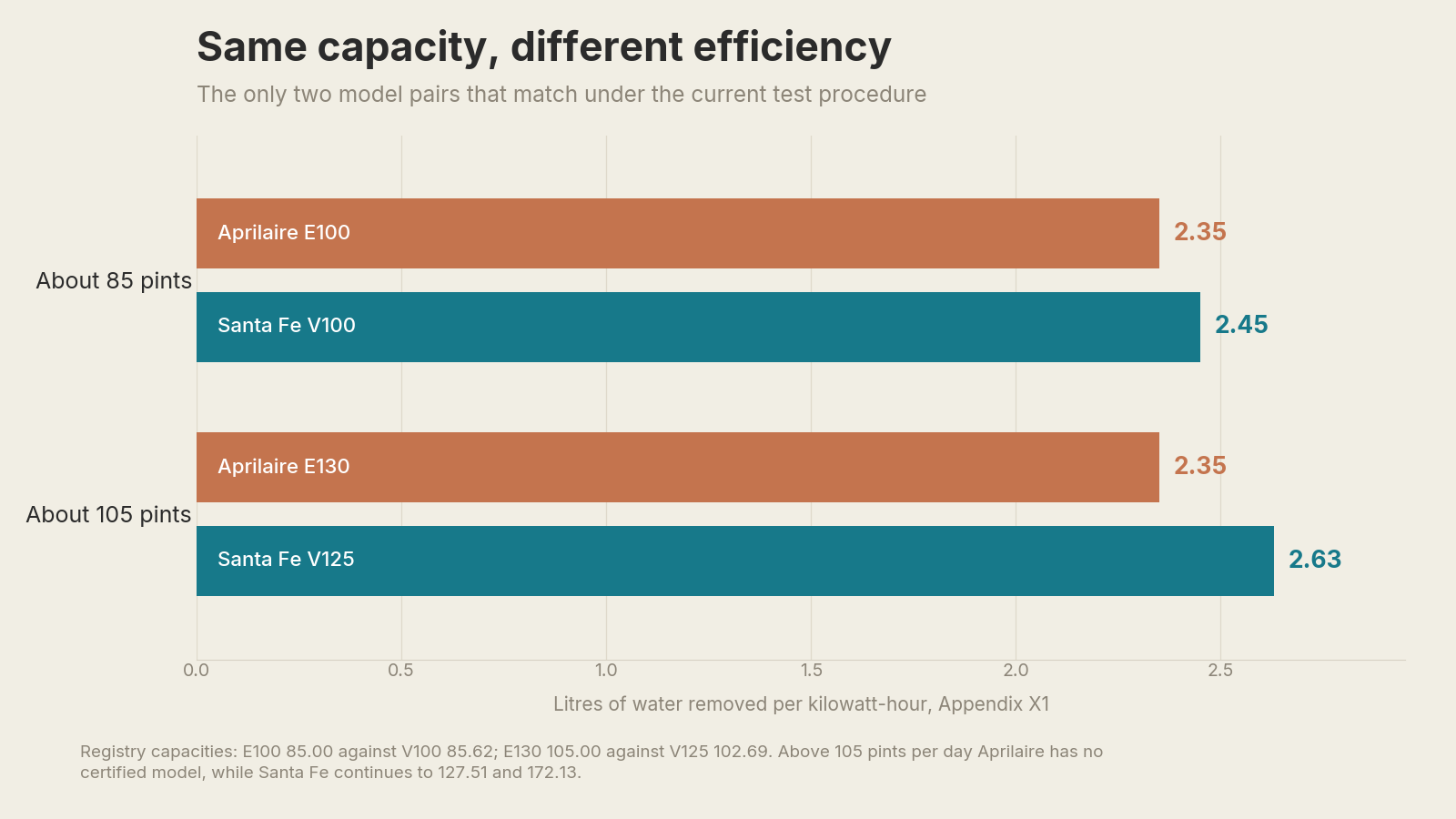
Headline numbers on the product cards cannot be set against each other: they come from a test at 80 °F and 60% relative humidity, while the federal registry measures under Appendix X1 at 73 °F. The second figure is the one to compare.
By that measure two pairs emerge.
On smaller screens, scroll the table to see every column.
| Pair | Aprilaire | Santa Fe |
|---|---|---|
| First | E100 at 85.00 pints, IEF 2.35 | V100 at 85.62 pints, IEF 2.45 |
| Second | E130 at 105.00 pints, IEF 2.35 | V125 at 102.69 pints, IEF 2.63 |
Capacity and energy factor from the ENERGY STAR dataset under Appendix X1.
Inside both pairs capacity is close to identical, and the energy factor runs higher on Santa Fe: 2.45 against 2.35 in the first, 2.63 against 2.35 in the second.
Above those pairs Aprilaire stops. Its largest certified model delivers 105.00 pints, while Santa Fe continues with the V155 at 127.51 and the V205 at 172.13. For a house needing more than a hundred pints under the current procedure there is no choice between the brands.
How much of each range is certified
Aprilaire holds three of five models in the registry: E080, E100 and E130. The E050 and E070 have no active listing.
Santa Fe holds four of twelve, the whole Ultra V series. Its entire standalone range, including the Compact70, Oasis105, Advance Dry110 and Classic, sits outside the registry.
In proportion Aprilaire covers more of its own range. In absolute terms Santa Fe carries one more certified model and spans a wider capacity band.
The 2.35 factor is identical across all three Aprilaire models. On Santa Fe it varies by model: 2.45 on the V100, 2.63 on the V125, 3.26 on the V155 and 3.12 on the V205. The highest value falls on the V155 rather than on the larger V205.
Temperature: the widest gap between the brands
On smaller screens, scroll the table to see every column.
| Range | Dehumidification |
|---|---|
| Aprilaire, entire E series | 50–104 °F |
| Santa Fe Ultra V100, V125, V155 | 34–105 °F |
| Santa Fe V205 | 40–104 °F |
| Santa Fe standalone range | 49–95 °F |
Inlet air temperature per manufacturer specifications.
Upper limits on the ducted models are effectively equal. The difference sits in the Santa Fe standalone range at 95 degrees against 104 on Aprilaire.
In Florida that is nine degrees of margin in Aprilaire’s favour wherever the unit goes into an unconditioned space. An unconditioned attic in summer passes both limits.
Aprilaire also carries a separate ventilation range, 40 to 140 °F, wider than its dehumidification range.
The lower limits of 34, 40 and 50 degrees carry no weight in a Florida house.
What each brand publishes
Both give airflow at external static pressure, and Santa Fe goes further on part of its range.
Aprilaire publishes three points across the series: 0, 0.2 and 0.4 inches of water column. Santa Fe publishes four points on the V series only, adding 0.6 and listing ventilation-mode airflow separately; the Ultra70 and Ultra98 come with three.
Aprilaire’s manual carries something I did not find on the Santa Fe side: a maximum allowable pressure. It is 0.4 inches for the E070 and E080 and 0.6 for the E100 and E100H, with total duct length capped at 100 feet.
The practical consequence: the 0.4 column on the E080 is already the boundary of validity, while the E100 has headroom past it.
Filtration
Aprilaire fits a washable MERV 8 with a six-month service reminder, part 5695, sized 8 by 11.75 by 1 inch. It consumes nothing.
Santa Fe fits a replaceable MERV 13 on a three to six month interval. The UltraMD33 uses a washable filter, and the Compact70 adds a washable pre-filter.
Filtration class is higher on Santa Fe. Consumables also appear on Santa Fe: a MERV 13 gets bought two to four times a year, while a MERV 8 gets washed.
Drainage
Neither brand builds a pump into any model. Both sell one separately.
The external Aprilaire pump lifts up to 22 feet, the external Santa Fe pump up to 12.
Aprilaire’s outlet is 3/4 inch with a male thread; Santa Fe uses a female port with a male adapter for the connection. Aprilaire ships a 10-foot hose with some configurations rather than all; Santa Fe ships 8 feet on most models, 6 on the Classic and 10 on the UltraMD33.
The Santa Fe V series includes a secondary float port.
Outside this pair, for context: AlorAir builds the pump into its HDi models with a 19.6-foot discharge line.
Coverage
Aprilaire publishes a table by climate region and house tightness. The headline area for an E100 is 5,500 square feet, while in humid region C the same model covers 3,000 in a tight house and 2,000 in a loose one.
Santa Fe also grades by tightness, without the climate dimension. A Compact70 covers up to 2,600 square feet in a tightly sealed crawl space, 2,200 moderately sealed and 1,800 loosely sealed; in a basement, 2,600, 2,000 and 1,800.
For the Ultra V series the manufacturer gives a single figure at ceiling heights of eight to ten feet: V100 2,300 square feet, V125 3,000, V155 3,500, V205 5,000.
Setting 5,500 on the Aprilaire against 2,300 on the V100 is not valid: the first belongs to a dry climate, the second to a method with no climate adjustment. Bringing them to a common basis is not possible from the published data.
Refrigerant
Aprilaire runs R32, Santa Fe runs R454B. Both are A2L refrigerants, so requirements on room volume, ignition sources and service clearances apply to either brand.
The exception on the Santa Fe side is the Impact155, which uses 33 ounces of R410A.
Charge quantities are published incompletely by both. Aprilaire omits them for the E050 and E070 in both the specification sheet and the manual. Santa Fe omits them for the Ultra98.
Where the documents disagree
Both brands have places where their own sources do not match.
On Aprilaire it is the warranty term: the shop listing promises six years, while the E070 manual and the whole-house section state five.
On Santa Fe the disagreements concern the specifications themselves. I checked them against primary sources, and two of the ones cited in reviews held up.
V100 refrigerant charge. Specification TS-2152 states 34 ounces of R454B. The ENERGY STAR dataset for the same model 4047100 gives 24 ounces.
V155 efficiency. Specification TS-2137 carries two columns. At 80 °F and 60% it prints 7.1 pints and 3.35 litres per kilowatt-hour, and the conversion holds. At 73 °F and 60% it prints 6.5 pints and 2.9 litres, while 6.5 pints converts to roughly 3.07.
Energy factors in the manual. The shared manual TS-2157 includes a DOE registration table listing 2.63 for the V100 and 2.45 for the V125. The registry has it the other way round: 2.45 for the V100 and 2.63 for the V125. The two models’ values appear transposed.
One claim from those reviews does not survive checking: a V155 charge of “36 against 48”. The 48-ounce figure in the registry belongs to the V205, not the V155.
I am not going to explain these cases. A registry entry draws on a test report for a particular unit while a specification draws on engineering documentation, and some of the difference may come from there. For servicing the circuit, the nameplate on the unit settles it.
Warranty and installation
Santa Fe gives five years of replacement plus a sixth year on parts, for units manufactured from 1 January 2024.
Aprilaire: the shop listing states six years on the same structure, while the manual and the whole-house section state five years from date of purchase. Coverage is void where a defect results from installation contrary to the instructions.
On installation the Santa Fe manuals are stricter: the V100, V125, V155 and V205 require a qualified technician in plain text. Aprilaire’s manual carries no blanket licensed-contractor requirement, though its safety section requires a qualified technician for installation, service and maintenance.
The Compact70 can be free-standing or suspended; the refrigeration side stays a technician’s job either way.
Where to buy
Aprilaire sells through the manufacturer’s shop, the Find a Pro contractor programme, HVAC distributors, Sylvane, Home Depot and Lowe’s. Home Depot listings for the series carry dozens of reviews, and an E070 listing on Amazon is confirmed.
Current Aprilaire listings at Sylvane: E050, E070, E080, E100, E130.
Current Santa Fe listings at Sylvane: Compact70, Ultra V100, Ultra V125, Ultra V155, Ultra V205.
Santa Fe sells through its own site with dealer matching, through Sylvane where the Compact70 has hundreds of reviews, and through specialist HVAC distributors. A Compact70 listing on Amazon is confirmed. The brand is not carried by Home Depot or Lowe’s: dealers state directly that much of its range is not supplied to those chains.
Recalls and independent measurement
No CPSC recall campaigns were found for dehumidifiers from either brand. The Research Products campaigns in the database concern the Model 5000 air cleaner in 2005 and steam humidifiers in the 800, 801, 865 and 866 series in 2023.
I found no laboratory measurements with published figures for either brand. Searches covered both brands and the lab that publishes readings for portable units.
Field testing does exist: Bob Vila ran five units of this class for three days each in a basement at 65 to 70 percent humidity under a digital sensor, but publishes conclusions without numbers.
The one measurement with figures is NREL and Department of Energy work from 2011 and 2012, where an Ultra-Aire 70H delivered 77.1 pints and 2.6 litres per kilowatt-hour against a rated 70 and 2.3. That was a different generation of hardware.
Aprilaire vs Santa Fe: which suits which house
Aprilaire earns its place on the climate-adjusted sizing table, a washable filter with no consumables, an external pump rated to 22 feet and a 104 °F ceiling across the whole series. Against it: an energy factor of 2.35 identical on all three certified models, and a ceiling of 105 pints under the current procedure.
Santa Fe earns its place on energy factors from 2.45 to 3.26, MERV 13 filtration, airflow published at four pressure points and models above a hundred pints that Aprilaire does not offer. Against it: a replaceable filter as a running cost, an external pump rated to 12 feet, a standalone range stopping at 95 °F, and two confirmed disagreements between its own documents. Portable alternatives sit in the Florida selection guide.
Limits of this comparison
- I have not tested these units, and there are no field measurements here.
- No laboratory measurements with published figures were found for either brand.
- Registry comparison covers certified models only: three on Aprilaire, four on Santa Fe.
- Coverage figures come from different methods and do not compare directly.
- A maximum static pressure appears in the Aprilaire manual; I did not find one on the Santa Fe side.
- Compact70 defrost is described two ways in secondary sources; I did not verify it against primary documents.
- Refrigerant charge is published incompletely by both brands.
- Figures at 80 °F / 60% do not compare with Appendix X1 figures.
- Data reflects a cut of 1 September 2026.
- ENERGY STAR certification is neither a guarantee of quality nor a recommendation.
Frequently asked questions
Are Aprilaire and Santa Fe the same company?
Both brands belong to Research Products Corporation, acquired by Madison Air on 6 May 2025. That establishes nothing about shared hardware or warranty terms.
Which models compare directly?
Under Appendix X1 two pairs form: Aprilaire E100 at 85.00 pints against Santa Fe V100 at 85.62, and Aprilaire E130 at 105.00 against Santa Fe V125 at 102.69.
Which brand is more efficient?
By the registry, Santa Fe. Its energy factor runs from 2.45 to 3.26, while Aprilaire sits at 2.35 across all three certified models.
Does either brand have a built-in pump?
Neither. Both sell an external pump separately: Aprilaire rated to 22 feet of lift, Santa Fe to 12.
Which brand suits a Florida attic better?
An unconditioned attic in summer exceeds the upper limit of both. For unconditioned spaces within specification, Aprilaire carries more margin: 104 °F across the series against 95 °F on the Santa Fe standalone range.
Sources
- Aprilaire specification sheets for the E-series and the E070 installation manual.
- Santa Fe data sheets TS-2137, TS-2152 and TS-2153, and the shared manual TS-2157.
- ENERGY STAR Certified Dehumidifiers dataset, whole-home category.
- CPSC recall database.
- NREL and US Department of Energy field testing of whole-house dehumidifiers, 2011–2012.
- Bob Vila field testing of whole-house dehumidifiers, conclusions without published figures.