
Mold Removal in Orlando: Costs, Licensing and Inland Damp
Mold removal Orlando homeowners arrange begins at the same threshold as everywhere else in Florida: past 10 square feet, assessment and remediation are licensed work, carried out by a DBPR-licensed mold assessor or mold remediator, with an exemption for an owner working on their own home. What is local starts after that. Orlando is the only major market in the state with no coastline, and water does not arrive here from the sea.

The metro is wider than the county
In the DBPR licensee download of 4 August 2026, Orange County holds 258 active licences across 188 individuals: 134 assessors and 124 remediators.
Greater Orlando does not stop at the county line. Seminole adds 115 licences across 85 individuals, and Osceola 84 across 56. Together the metro comes to 457 licences held by 329 people.
One caveat belongs with those numbers: the county in the register is the mailing address on the licence, not a service area. Our DBPR data guide explains these fields and how we distinguish licenses from people. A contractor registered in Seminole reaches Orlando without crossing anything at all.
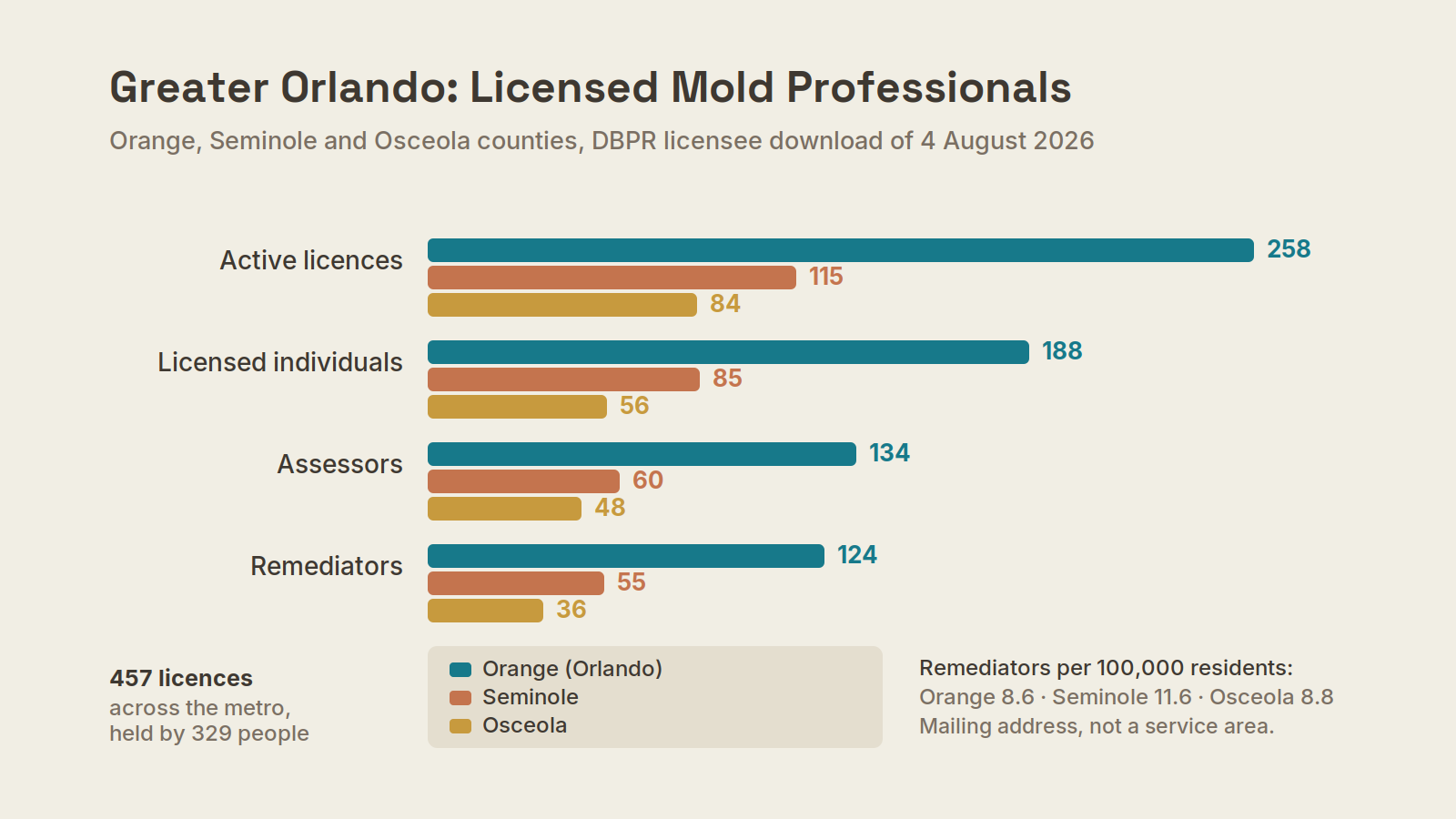
Per 100,000 residents, Orange has 8.6 remediators, the same rate as Hillsborough and well below Miami-Dade at 12.8 or Broward at 20.1. Seminole runs higher at 11.6, Osceola at 8.8. The data records these differences without explaining them.
The mix of roles in Orange is close to even: 1.08 assessors for every remediator. Osceola runs 1.33, the highest ratio in the state.
One of six counties, and the only inland one
Half of all licences in Florida sit in six counties out of sixty-seven: Broward, Miami-Dade, Palm Beach, Hillsborough, Orange and Lee, together holding 2,819 of 5,306. Orange is the only one of the six with no access to the sea.
Another feature shows up only when two rankings are compared. Orange places 26th in the state by population and 15th by housing units, a shift of eleven places. Seminole and Osceola shift six each.
The reason is the structure of the housing. Resort counties such as Walton, Monroe and Sarasota move the other way: they hold a lot of housing relative to their permanent population, because a sizeable share of it is second homes and seasonal rentals. Greater Orlando is the reverse, with a dense permanent population and little seasonal housing.
For a homeowner that means something practical. Measured per 100,000 residents or per 10,000 housing units, Orlando comes out much the same, while on the coast the two measures diverge. Working out how much housing a licensed professional covers is simpler here.
Who actually turns up
70 of the 188 licensed individuals in Orange hold both licences at once, or 37.2 percent. That sits between Miami-Dade at 45.5 percent and Hillsborough at 29.6.
The rule is the same statewide: under §468.8419, an assessor may not perform or offer remediation on a structure where they or their company provided an assessment within the previous 12 months, and the same applies in reverse to a remediator. Penalties escalate from a second-degree misdemeanor to a first-degree misdemeanor to a third-degree felony.
There is one exception: a certified Division I contractor under §489.105(3), the licence class that covers building a structure as a whole rather than a single trade such as roofing or plumbing. For them the bar does not apply, and the law attaches no conditions to that. The statute lets the department adopt a rule requiring such a contractor to disclose the homeowner’s right to request competitive bids, but no such rule was ever adopted: the proposed rules 61-31.701 and 61-31.702 were withdrawn in 2014 and 2015. A number of sites, law firms included, describe that disclosure as a live requirement.
The same section closes off the arrangements next door to it. An assessor or remediator cannot work for pay on a property their company owns or holds a stake in. Neither can pay the other for a referral, or take money for sending a client across. And neither can take on an assessment whose fee depends on what the assessment finds, which would make finding more the profitable outcome.
What to check before signing
Licences in the DBPR register carry a status: Current, Probation or Suspended. The counts above are drawn from current ones only.
Licences in this field expire on 31 July of every even year, and over a two-year cycle a licensee must complete 14 hours of continuing education under Rule 61-31.504.
Insurance is set by statute. Under §468.8421, an assessor carries general liability plus errors and omissions of at least $1 million; a remediator carries general liability of at least $1 million with specific coverage for mold-related claims.
If asbestos or lead is likely in an older house, that is a separate licence and a separate contractor, under a different DBPR board.
Mold removal Orlando costs, line by line
Aggregated mold removal Orlando estimates run $1,050 to $4,000 per project, the lowest range of the state’s three largest markets. By area, the common rate is $10 to $25 per square foot.
For comparison: Tampa runs $1,075 to $4,075 with a local average near $2,548, and Miami $1,225 to $4,700, carrying a South Florida premium of 15 to 30 percent over the centre and north of the state. The Florida average is $1,500 to $6,000, and the national average $2,368.
Inspection is billed separately: a visual check without sampling is $150 to $250, a visual check with two or three air samples $300 to $450, and a full inspection with lab analysis $400 to $900. A single air sample is $75 to $150, lab analysis of a sample $35 to $75, and a clearance test after the work $250 to $600.
The standard for air testing is two samples: one indoors and one outdoor control, and a written protocol comes with the inspection fee. An insurance dispute needs more than that protocol. It needs chain-of-custody documentation from the lab, photographs and moisture readings.
What pushes the number up: emergency call-outs and post-storm demand, hard-to-reach areas, removal of structural elements, crew size. Jobs run one to five days, large projects one to two weeks, and temporary housing during the work adds $150 to $250 a night.
All of these figures are aggregated estimates rather than a rate card. The Florida Department of Health’s mold recommendations carry no price guidance: they point to the EPA and to §468.84 through §468.8424, without figures. Our breakdown of what those ranges are built from is in Florida remediation costs, and the inspection side is in mold inspection cost.
The threshold where the law starts
Below 10 square feet, the EPA allows a homeowner to clean up with an N-95 respirator, gloves and eye protection. In Florida the same figure carries legal weight: §468.8411 of the 2025 Florida Statutes puts “greater than 10 square feet” in the definition of assessment and again in the definition of remediation. A property owner working on their own home is exempt under §468.841. Where that line falls in practice is the subject of DIY versus professional removal.
Inland is not drier, inland is hotter
The common assumption about Orlando is that distance from the sea means drier air. The records say otherwise. Humidity here is set by latitude rather than by nearness to a shore: inland Orlando and coastal Tampa run the same dew point all year.
The difference is temperature. On the coast a sea breeze knocks the afternoon heat down into the upper 80s °F. Orlando has no such breeze, and on the same days it runs past 90.
In our analysis of NOAA records for 2015 to 2024, Orlando records 112 oppressive days a year, with 30 in July and 30 in August. Winter, though, is genuinely dry: the January dew point sits near 52 °F, the same as Tampa and well below Miami’s 60 °F.
Slab-on-grade is the state standard: 73.3 percent of Florida NFIP payouts go to properties on slabs, and basements make up under one percent of the housing stock.
The High Velocity Hurricane Zone does not reach Orlando; under the building code it is two counties, Miami-Dade and Broward. Outside it, envelope requirements follow the design wind speed and whether an address falls inside the wind-borne debris region, and it is the local building department that applies the maps to a given address when it issues a permit.
Lightning Alley, and water that arrives from above
Orlando sits in the middle of the corridor running from Tampa Bay to the Space Coast, which takes roughly 56 lightning strikes per square mile a year, more than anywhere else in the United States. About 90 percent of them fall between May and October, from noon to midnight. By thunderstorm days, Orlando averages 84 a year and Tampa 87, the highest of any major cities in the country, according to the Vaisala lightning detection network and the National Weather Service.
The mechanism is the same one that cools the coast and leaves Orlando hot. During the day the land heats faster than the water, and the sea breeze pushes inland from both sides, off the Atlantic and off the Gulf. Where the two collide, air rises and storms build. The centre of the peninsula is that collision line.
For a house here, that means water from above. There is no tidal water in Orlando: it is about sixty miles to either coast, and storm surge does not physically reach this far. What is left is rain.
How large a cause that is shows up in the figures for the state as a whole. In the NFIP record, accumulation of rainfall accounts for 208,280 claims, 46.4 percent of all Florida claims, at a median payout of $5,136. Tidal water accounts for 138,514 claims, 30.9 percent, with a median of $14,801. Rain floods more often; the sea floods more expensively. Only the first of those two lines applies to an inland county; the second describes the coast.
One caveat: the cause code in the data combines rainfall and snowmelt, which in Florida means rain.
There are no separate figures for Orange County in our extract, and that absence says something about the county’s profile. Our normalised NFIP ranking covers fifteen counties with more than fifteen thousand residential structures, from Monroe at 720 claims per thousand homes down to Hillsborough at 41. Orange clears the size cut comfortably but does not reach the top of the list by claim intensity: all fifteen ahead of it are coastal or among the largest urban counties. The local picture is in water damage in Orlando.
When to call
The EPA gives 24 to 48 hours to dry water-damaged materials after a leak, the only deadline a federal agency has put on this. What the standard does and does not say about water categories is covered in mold after a water leak.
What the sources do not contain
- Any reason why density and the balance of roles differ between the three metro counties.
- NFIP figures for Orange County: our normalised ranking shows only the top of the list by claims per thousand homes, and Orange does not appear in it.
- Price guidance in the Florida Department of Health’s mold recommendations.
- The number of specialists actually working in the metro: the register records a mailing address.
We run no testing of our own and hold no mold assessor or mold remediator licences. This page reports what named sources say. The statutes described here are given for general information and are not legal advice.
Frequently asked questions
Do I need a licensed contractor for mold removal in Orlando?
Above 10 square feet, yes, under §468.8411. A property owner working on their own home is exempt under §468.841.
How much does mold removal cost in Orlando?
Aggregated estimates run $1,050 to $4,000, the lowest range among the state’s three largest markets. No state agency publishes official rates.
How many licensed mold professionals are in the Orlando area?
258 licences in Orange, 115 in Seminole and 84 in Osceola, or 457 across the metro, per the DBPR download of 4 August 2026. That is registration by mailing address, not a service area.
Is inland Orlando drier than the coast?
No. Orlando and coastal Tampa run the same dew point all year. The difference is temperature: without a sea breeze, Orlando runs hotter on the same days.
Can the same company inspect and remove the mold?
Not on the same property within 12 months, under §468.8419. The exception is a certified Division I contractor under §489.105(3).
Sources
- Florida Department of Business and Professional Regulation, mold licensee download, 4 August 2026
- Fla. Stat. §468.8411, §468.841, §468.8419, §468.8421, §489.105(3), 2025 Florida Statutes
- Florida Administrative Code, Rule 61-31.504; proposed rules 61-31.701 and 61-31.702, withdrawn 2014 and 2015
- US Census Bureau, American Community Survey 5-year estimates, 2023
- US EPA, mold cleanup guidance
- NOAA hourly records 2015 to 2024, Orlando International and Tampa International, Aridalia analysis
- Vaisala lightning detection network; National Weather Service
- FEMA NFIP claims extract (OpenFEMA), Aridalia analysis
- Florida Building Code, wind-borne debris region provisions
- Cost ranges: home-services aggregators, 2026 editions