
Mold After Water Leak: The 24–48 Hour Window in Florida
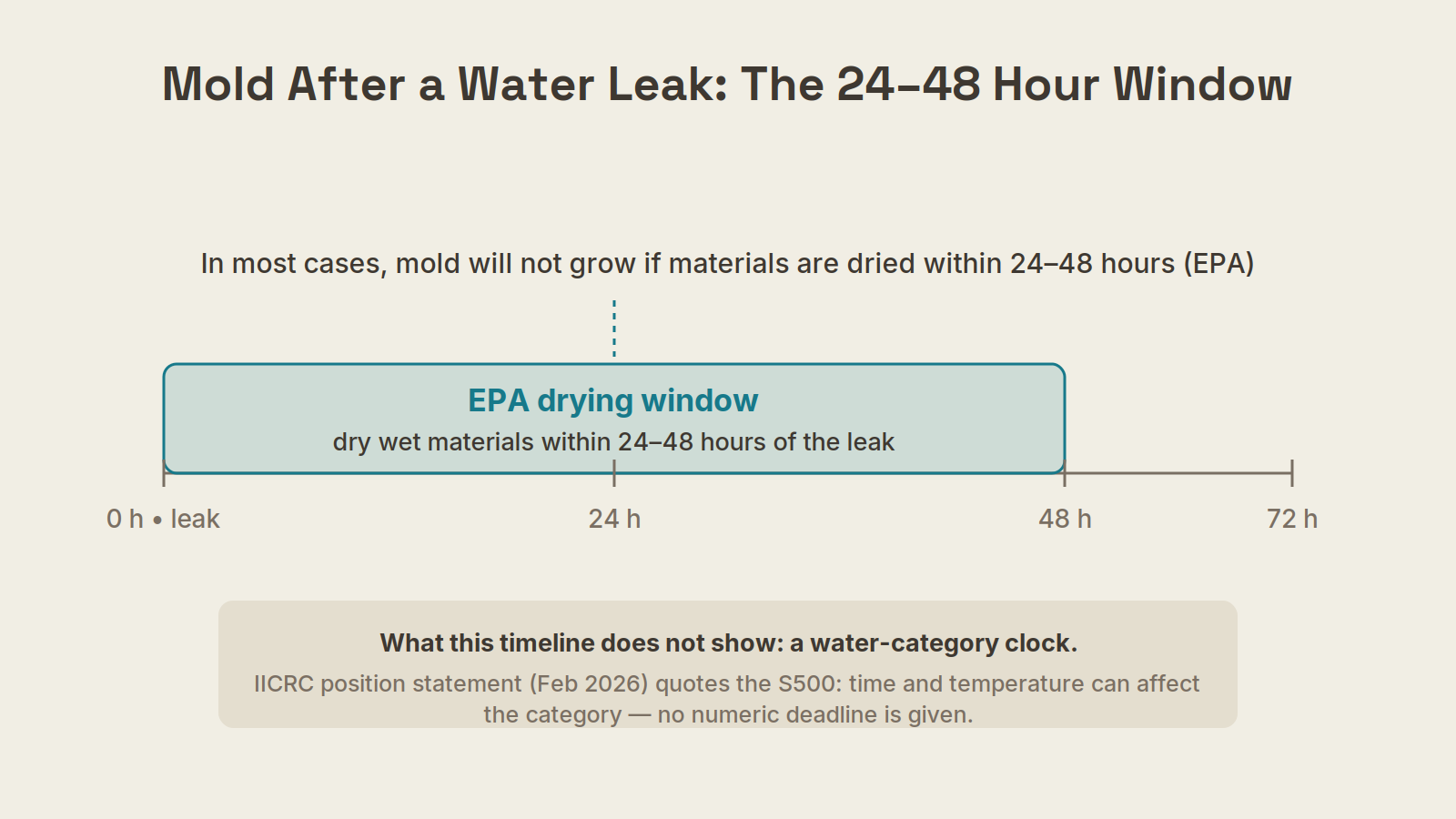
Mold after water leak damage has a deadline named by a federal agency. The EPA tells homeowners to dry water-damaged areas and items within 24 to 48 hours to prevent mold growth, and adds that in most cases mold will not grow if wet or damp materials are dried within that window after a leak or spill.

The clock the EPA actually set
The EPA counts from the leak or spill itself, not from the moment anyone notices it. That distinction matters in an empty house, where the count is already running while nobody is home.
First moves while the water is still standing
Before drying and before categories comes electricity. The CDC says that if there is standing water in the home and the main power can be turned off from a dry location, turn it off, even if that delays the cleanup. If reaching the breaker panel means stepping into standing water, do not go in. Call an electrician to shut the power off. An electrician should check the wiring before power goes back on.
The American Red Cross adds that you should never step or stand in water to reach the panel. A tripped breaker can point to damaged wiring, so do not reset it; call an electrician. If pipes are damaged, shut the water off at the main valve and call a plumber.
The second deadline that the standard does not set
There is no numeric deadline in the ANSI/IICRC S500 for clean water turning into contaminated water. An IICRC position statement published in February 2026 quotes §12.2.6 of the current fifth edition directly: time and temperature can affect or retard the amplification of contaminants, and thereby affect the category.
Numbers do appear in industry summaries, and they contradict each other: one source says 24 hours, another 24 to 48, a third gives 72 hours to Category 3.
The ANSI/IICRC S500 is the Standard and Reference Guide for Professional Water Damage Restoration. It is sold, not published openly. What is openly available is the IICRC position statement quoting it and summaries written by trade publications.
Three categories of water
Category 1
Sanitary water from a clean source: a supply line, a toilet tank without contaminants, falling rainwater before it contacts the building.
Category 2
Significantly contaminated water, carrying enough contamination to cause discomfort or sickness on contact. The examples are specific: dishwasher and washing machine discharge or overflow, toilet bowl overflow from the room side with urine and no feces, seepage under hydrostatic pressure, a broken aquarium, a punctured waterbed.
Category 3
Grossly contaminated water: sewage, sewer backflow from a trap, floodwater including seawater and rising rivers.
These definitions and examples come from the IICRC position statement and from matching industry summaries of the paid standard.
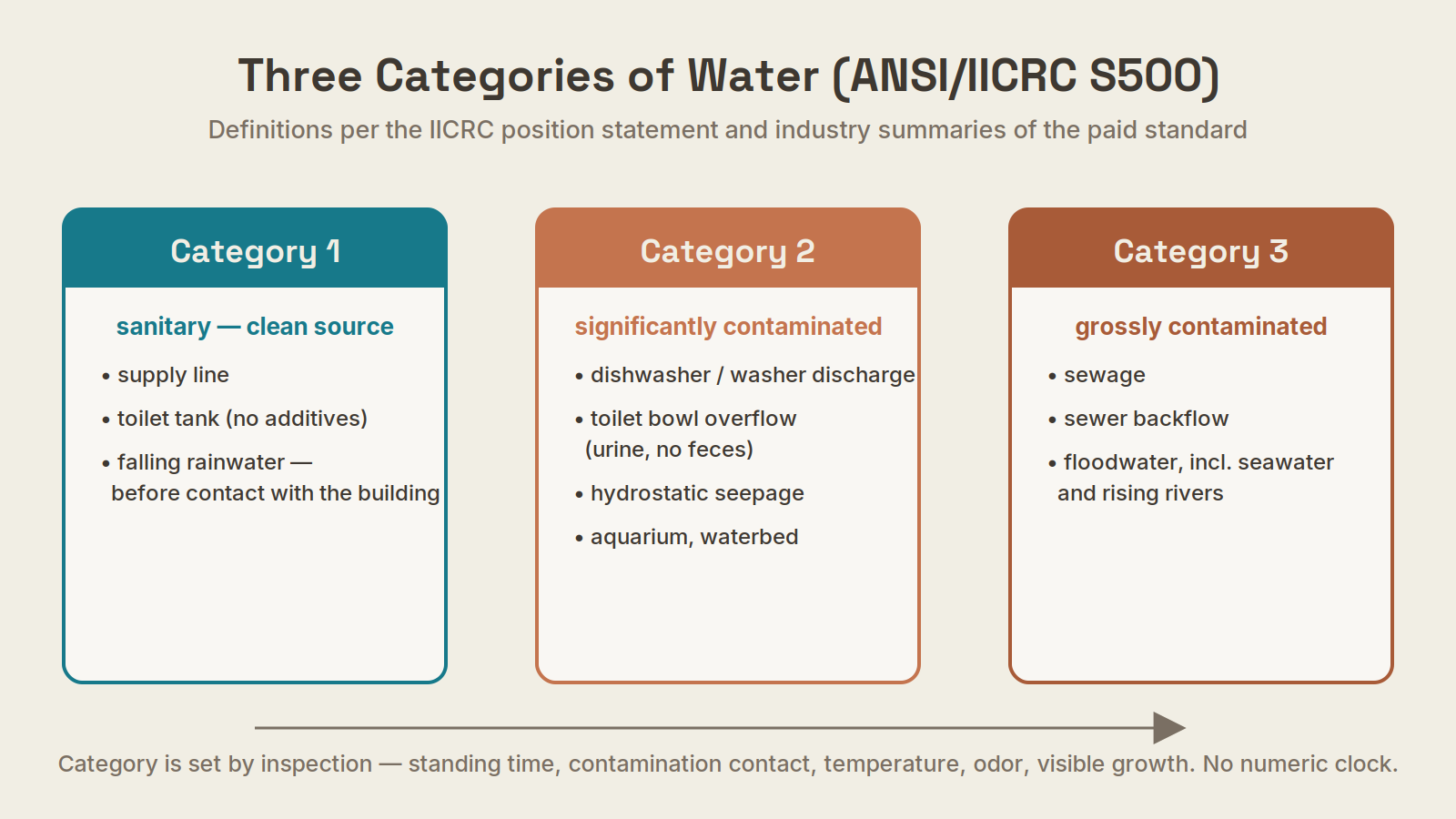
The signs used to determine a change of category are standing time, contact with contaminated materials, temperature, odor and visible growth. Category 2 water left untreated becomes Category 3.
The category sets the order of work. With a preliminary determination of Category 1, a restorer may work without contamination controls. With Category 2 or 3, remediation happens before restorative drying, with contamination controls and worker protection.
For a house on a slab, one Category 2 example is written for exactly that construction: seepage under hydrostatic pressure.
Hurricane water deserves its own note. The IICRC position statement says plainly that top-down water ingress, wind-driven rain and water from weather-related events are not automatically considered Category 3. The word “can” in the Category 3 examples is defined by the standard itself as an option rather than a required component of the accepted standard of care: the example does not apply when the water is not in fact grossly contaminated, whatever path it took inside.
Two Florida water sources are not listed among the standard’s examples at all: air conditioner condensate and a roof leak. Industry specialists disagree on both. A clean drain pan overflow found immediately is often treated as Category 1, while stagnant condensate carrying biofilm from the drain line, or rain that has passed through an attic full of dust and insulation, gets treated as Category 2. Inspection decides the category, not the label on the source. Our Florida mold hub collects the rest of the cluster.
What happens during those hours
Industry summaries of the standard describe the work in five phases.
| Phase | What happens |
|---|---|
| 1. Assessment | loss evaluation, water category and class assigned |
| 2. Extraction | standing water removed |
| 3. Drying | dehumidifiers, air movers and air scrubbers placed |
| 4. Monitoring | daily moisture readings, equipment adjusted |
| 5. Final inspection | dryness confirmed |
Sequence per industry summaries of the paid standard.
The placement principle is to bring the structure into the psychrometric drying zone within the first 24 hours. Too little equipment stretches the drying out and raises the risk of secondary damage.
Our guide to air movers for water damage explains the equipment types and operating limits.
Open sources do not give one number for when drying stops. Industry summaries name different criteria that contradict each other, and none is confirmed by the text of the standard. By those same summaries, the 2021 edition of the S500 states the goal qualitatively: return the structure, systems and contents to an acceptable condition and inhibit microbial growth.
Contractors advertise three to five days. We could not find a source for that number outside advertising: no agency, standard or peer-reviewed publication publishes drying times for a residential leak. The only published durations come from the FEMA and EPA advisory, and they are written for natural drying after flooding: exterior rooms with excellent ventilation dry in two to four weeks, interior rooms or those with minimal ventilation take four to six weeks or more. For a household leak with mechanical drying, that is not a benchmark.
What can be measured. The same FEMA and EPA advisory gives readings for wood framing taken with a penetrating moisture meter: above 20 percent is wet, 15 to 20 percent is partially dry, below 15 percent is dry. Non-wood materials count as dry when readings come within 5 percent of similar materials in unaffected areas. The IICRC S520 guide for professional mold remediation, in its 2008 edition, repeats one threshold for solid wood, plywood, OSB, engineered wood and particle board: above 16 percent moisture content, the material is more susceptible to mold growth. The USDA Forest Products Laboratory reports that mold growth is not supported on wood dried below 20 percent.
Read how to check whether materials are dry for measurement methods and drying records.
What mold after water leak damage means for a Florida house
In our NFIP extract, 73.3 percent of Florida payouts go to properties on slab foundations. Basements make up less than one percent of the state’s housing stock.
Carpet and pad on a slab. With Category 1 water, the IICRC technical advisory on in-place drying allows a qualified contractor to dry the assembly where it lies, which can spare detaching the carpet and replacing the pad. With Category 2, the wet pad is removed and the carpet itself is disinfected. With Category 3, both pad and carpet go.
Vinyl plank on a slab. The material itself is water-resistant and does not swell, but it works as a vapor retarder. Once water gets under the planks, evaporation slows sharply, especially over concrete, and trapped moisture can sit for days or weeks. Floating click-lock planks are usually lifted, the slab dried and the planks relaid; glue-down flooring, or planks with damaged locking edges, gets replaced.
CBS walls with furring. Moisture inside the assembly over concrete block, or behind the furring strips, dries more slowly than after an ordinary interior leak, and a wet block wall keeps feeding moisture into the drywall after the original leak is fixed. That is an observation from a South Florida trade source; no standard covers it.
How high to cut the drywall. Neither the Florida Building Code nor the openly available IICRC materials set a height. The familiar two feet and four feet are installation convenience for a full sheet, not a requirement. The only numbers from a government source belong to the FEMA and EPA advisory for flooded buildings: with a water line below 2.5 feet, wall material is removed to 4 feet; above 2.5 feet, to 8 feet or to the ceiling joint, whichever is higher. Fibrous insulation saturated with floodwater is removed entirely, while foam board can be left to dry. For the local picture of what leaks cost after the fact, see water damage in Miami.
What is known about where the water comes from
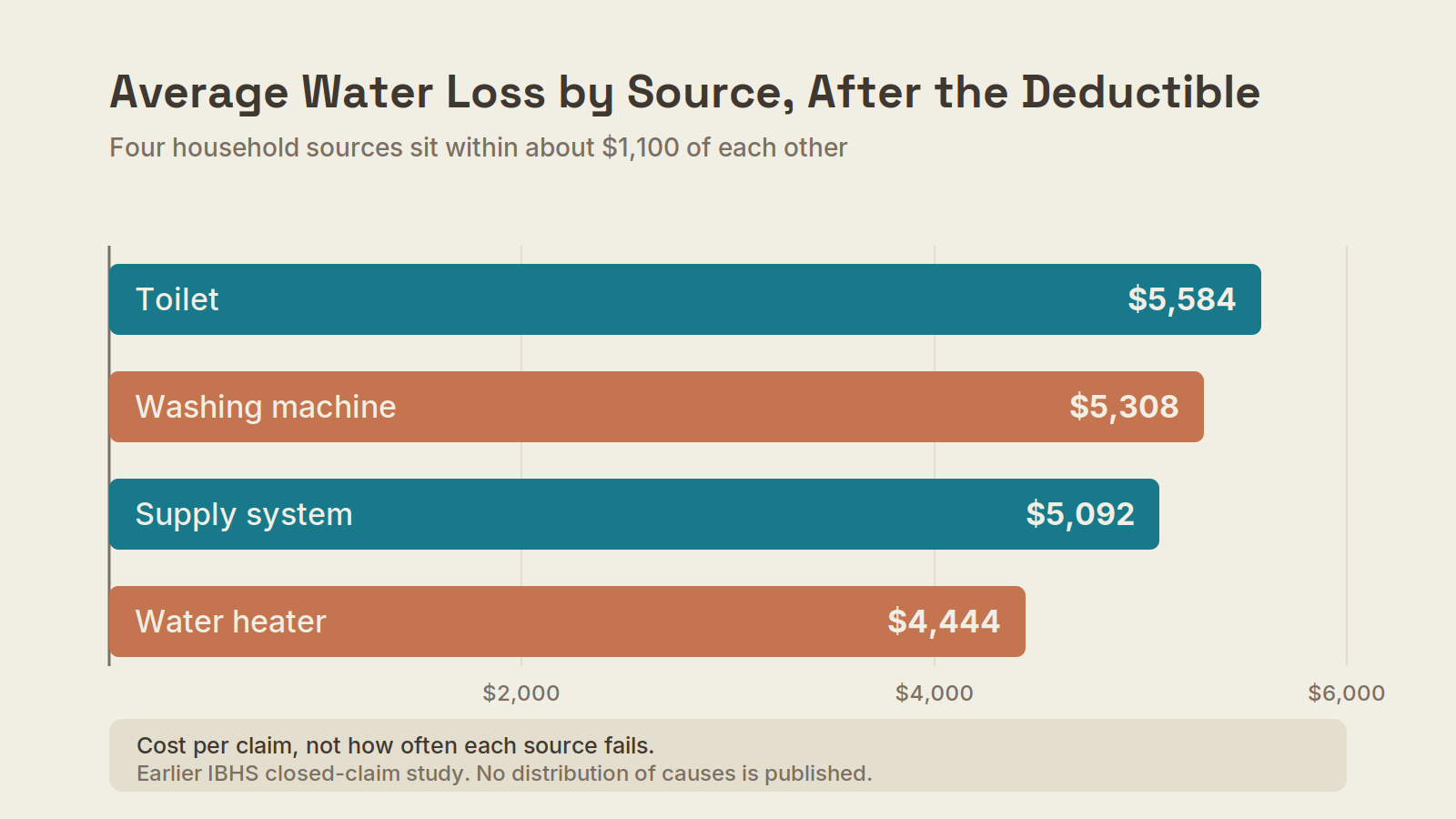
The figures below come from an earlier IBHS study of closed claims. As of our check, the original was not available publicly.
Average loss after the deductible: supply system $5,092; washing machine $5,308; water heater $4,444; toilet about $5,584. The average age of a failed water heater was 10.7 years. A third of toilet failures were overflow or clogging.
From the same study, a line about homes without basements, that is, nearly the entire Florida housing stock: 22 percent of all supply system material failures happened beneath the slab of such homes.
Frozen pipes, which account for 18 percent of failures, do not apply here. That is a cold-climate cause.
No separate share for air conditioner losses is published in national data. A typical residential system in Florida summer humidity produces 5 to 20 gallons of condensate a day, and the drain line grows algae and biofilm that narrow it and eventually block it. That is the mechanism behind mold on AC vents.
What to check in the house
- Washing machine supply hoses. More than half of washer claims involve rubber hose failure, and typical service life is three to five years.
- Water heater. The average failed unit was 10.7 years old.
- Toilet. A third of failures are overflow or clogging.
- Air conditioner drain line. Biofilm narrows it, and an overflowing pan means 5 to 20 gallons a day.
- Refrigerator ice maker line: a thin tube under full supply pressure; in the Hicks case, that line ran for five weeks in an empty house.
The second clock: insurance
What follows in this section and the next describes statutes and court decisions. It is not legal advice; a Florida attorney handles a specific situation.
Under Fla. Stat. §627.70132, a property insurance claim is barred unless notice is given to the insurer in accordance with the policy terms within one year of the date of loss; a supplemental claim gets 18 months. The count runs from the date of loss, not from the day you discovered it.
The statutory deadline is not the only barrier. The policy separately requires prompt notice, and that is an independent contractual obligation. In Bankers Ins. Co. v. Macias (1985), the Florida Supreme Court held that a presumption of prejudice to the insurer arises when the insured fails to give timely notice.
In Kramer v. State Farm Florida (2012), late pre-suit notice and a late sworn proof of loss created that presumption, the insureds did not rebut it, and recovery under the policy was foreclosed.
A long leak and the policy exclusion
The policy in the Hicks case excluded loss caused by constant or repeated leakage or seepage of water over a period of fourteen days or more.
That exclusion is not a universal part of a policy. According to Big “I” Virtual University, no such exclusion exists in ISO’s standard homeowners forms. It appears in insurers’ proprietary forms, while the fourteen-day threshold is written into the commercial ISO CP 10 30 form. Only the text of your own policy determines what applies to you.
In Hicks v. American Integrity (Fla. 5th DCA, 2018), a refrigerator supply line began leaking slowly and, by the time the owner returned, was discharging almost a thousand gallons a day. The insurer’s expert determined the pipe had been leaking for five weeks or longer, and the claim was denied.
The appellate court held that an exclusion for loss caused by leakage or seepage over a period of fourteen days or more does not unambiguously exclude loss caused by leakage or seepage over a period of thirteen days or less. The owner won partial judgment for the first thirteen days.
That thirteen-day split was calculated in dollars: Hicks sought $40,926.77 for damage within that window, supported by a forensic general contractor’s report that divided the damage to the house by time. The appellate court left the amount of loss for the trial court to determine.
The exclusion itself was not struck down. Its reach was limited to the initial period.
A related rule from the same decision: once the insured establishes a loss within the policy terms, the burden shifts to the insurer to prove that the particular loss arose from an excluded cause. What that means for a claim is covered in mold insurance in Florida.
How to document it
No state agency publishes an official checklist of what to photograph. Industry lists exist, but they are not binding.
What the state does publish: the Department of Financial Services issues a Homeowners’ Insurance Toolkit with printable pages for a household inventory and a section on the claims process.
Documents do one job in particular here: dating. Both clocks (the statutory year and the policy’s prompt notice) run from the date of loss, and in Hicks the thirteenth day separated the covered period from the excluded one, with the leak duration set by an expert and the damage split by day by a general contractor. Records that tie events to dates work on exactly that boundary: water bills, dated photographs, correspondence, repair receipts.
Florida also runs a state mediation program for residential property claims under Rule 69J-166.031 F.A.C., implementing §627.7015. Within five days of a first-party claim being filed, the insurer must notify the policyholder of the right to participate. Commercial coverage, auto and NFIP policies are excluded.
According to FLOIR data published in April 2025, for Hurricane Helene, claims closed without payment because damage fell below the deductible made up 33 percent, and denials for no flood coverage 20 percent. For Hurricane Milton, below-deductible closures reached 41 percent.
The sequence, briefly
- Notify the insurer promptly. Late notice creates a presumption of prejudice that you then have to rebut.
- Watch two deadlines: one year from the date of loss for the initial claim, 18 months for a supplemental one, both from the loss and not from discovery.
- Keep records that carry dates: water bills, dated photos, receipts, correspondence. In Hicks, the split by day was worth $40,926.
- Build a household inventory; printable pages come with the DFS Homeowners’ Insurance Toolkit.
- Know about mediation: the insurer must tell you about it within five days of the claim.
When it stops being a do-it-yourself job
The EPA allows homeowners to clean up growth of up to 10 square feet themselves, wearing an N-95 respirator, gloves and goggles.
In Florida, the same figure also carries legal weight. Section 468.8411 of the 2025 Florida Statutes sets a threshold of more than 10 square feet in the definitions of both mold assessment and mold remediation. An owner working on their own residential property is exempt under §468.841. Where the line falls in practice is the subject of DIY versus professional mold removal, and the money side is in Florida remediation costs.
Target humidity after drying: the CDC says no higher than 50 percent throughout the day; the EPA says below 60 percent, ideally 30 to 50 percent.
What the sources do not contain
- A numeric deadline for water moving from one category to another.
- A category for air conditioner condensate or a roof leak.
- A required height for cutting drywall.
- Professional drying times for a household leak from any non-advertising source.
- A share of losses attributable to air conditioners in national statistics.
- An official list of what to photograph.
We run no testing of our own and hold no mold assessor or mold remediator licenses. This page reports what named sources say.
Frequently asked questions
How long do I have before mold after water leak damage starts?
The EPA gives 24 to 48 hours. If the affected materials are dried within that window, in most cases mold will not grow.
Does clean water become contaminated after 48 hours?
The IICRC S500 sets no numeric deadline. The 2026 IICRC position statement quotes the standard: time and temperature can affect the category, with no number attached. Category is determined by inspection.
How high should drywall be cut after a leak?
Neither the Florida Building Code nor the openly available IICRC materials set a height. The 4-foot and 8-foot numbers belong to the FEMA and EPA advisory for flooded buildings, not to a household leak.
My insurer says the leak lasted too long. Is that final?
In Hicks v. American Integrity (Fla. 5th DCA, 2018), the court held that an exclusion for leakage over fourteen days or more does not unambiguously exclude loss over the first thirteen days. This is not legal advice.
How long do I have to file a claim in Florida?
Under §627.70132, one year from the date of loss for an initial claim and 18 months for a supplemental one. The policy separately requires prompt notice, and late notice creates a presumption of prejudice to the insurer.
Sources
- U.S. EPA, A Brief Guide to Mold, Moisture and Your Home
- IICRC, position statement on water categories, February 2026, quoting ANSI/IICRC S500 §12.2.6 and §10.6.7
- IICRC S520 Standard and Reference Guide for Professional Mold Remediation, 2008 edition
- FEMA and EPA, advisory on repairing flooded buildings
- USDA Forest Products Laboratory; Western Wood Products Association
- IICRC technical advisory on in-place drying of carpet and pad, 2004
- Insurance Institute for Business & Home Safety, study of closed water damage claims
- Fla. Stat. §627.70132; §627.7015; Rule 69J-166.031 F.A.C.; 2025 Fla. Stat. §468.841 and §468.8411
- Bankers Ins. Co. v. Macias, 475 So. 2d 1216 (Fla. 1985); Kramer v. State Farm Florida (Fla. 4th DCA 2012); Hicks v. American Integrity Ins. Co. of Fla., 241 So. 3d 925 (Fla. 5th DCA 2018)
- Big “I” Virtual University, on seepage exclusions in ISO forms
- Florida Department of Financial Services, Homeowners’ Insurance Toolkit; Florida Office of Insurance Regulation, April 2025 release
- CDC, Reentering Your Flooded Home; American Red Cross, flood safety guidance
- FEMA NFIP claims extract (OpenFEMA), Aridalia analysis