
Mold in Closet: What Causes It in a Florida Home
Mold in closet has two different explanations, and they belong to different climates. The Building Science Corporation paper devoted specifically to closets separates them outright.
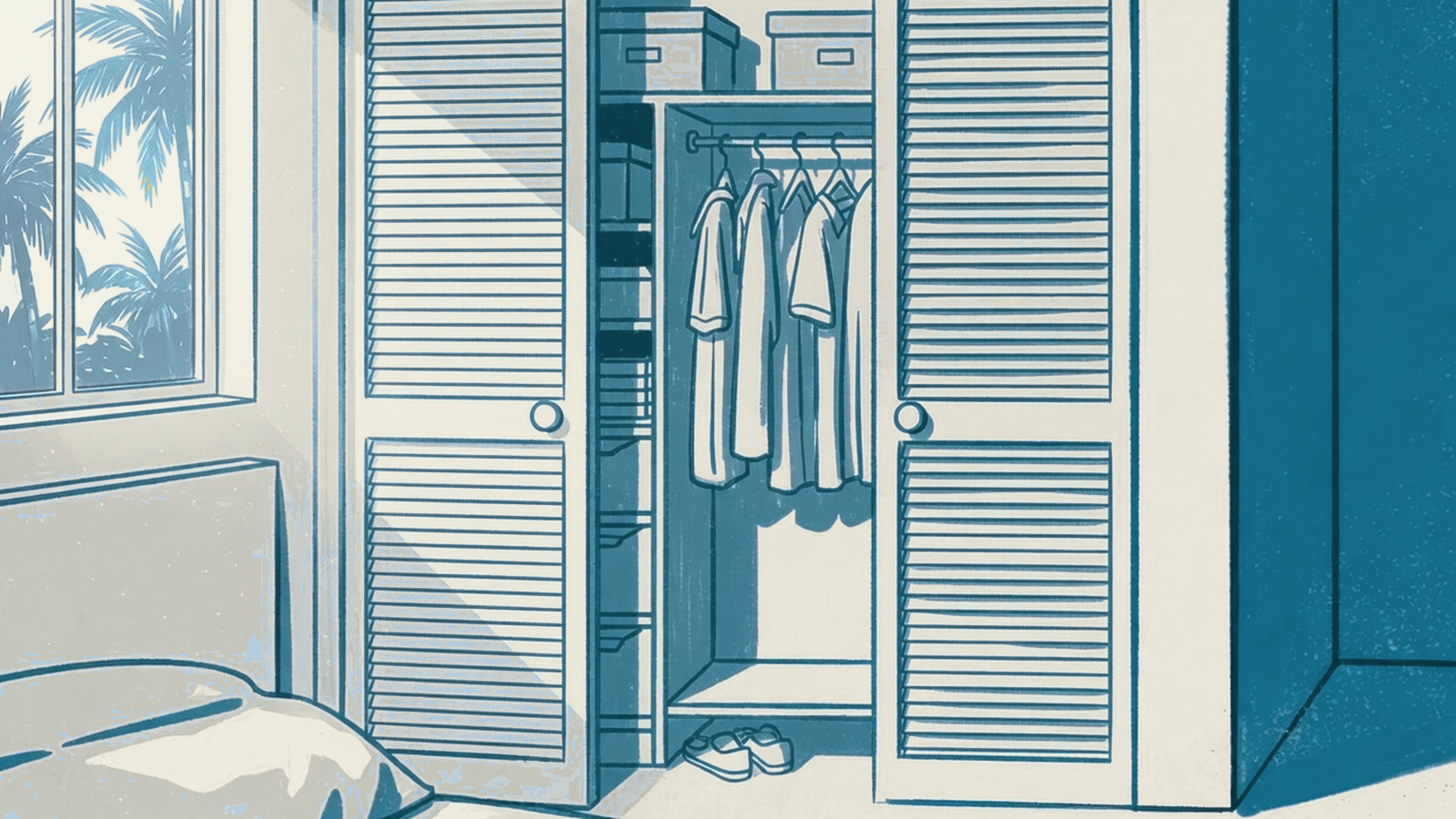
Why mold in closet spaces starts with a cold ceiling
Joseph Lstiburek, Building Science Corporation, BSI-139, January 2023. Raising attic insulation from R-30 to R-38 or R-49 makes the ceiling colder. The spaces with the least load in the house are the closets.
The second mechanism in that same paper is written for cold climates: a closet on an exterior wall has high heat loss and ends up colder than the bedroom, and at equal vapour pressure the colder closet carries the higher relative humidity.
There is a second half to the picture. Closets are rarely supplied with conditioned air as a standard part of an air conditioning system, in the wording of the Florida Solar Energy Center, which adds that it is not all that uncommon to have mold or mildew occur in closets, especially on leather. The rest of the mold section covers what grows and why.
At what humidity growth starts
By the FSEC’s wording, the vast majority of mold species require the material itself to take up moisture to equilibrium with air at 70 percent relative humidity or above.
Note that this is about the material, not the room. Lstiburek makes the point separately: relative humidity measured in the middle of a conditioned space and relative humidity found at surfaces are fundamentally different, because of the temperature difference between them.
What the sources do not give: how much higher humidity actually runs inside a closet than in the room. We found no such figure in any primary source. What a hygrometer can and cannot tell you is covered on the page about closet humidity.
What you can do
In order, from what can be done today to what needs a contractor.
Open the closet door, or leave the light on. The FSEC names both directly: an open door lets conditioned air circulate in, and a light left on behind a closed door raises the temperature, which lowers relative humidity.
Undercut the door or fit a transfer grille. Lstiburek’s wording: closets need active returns at the ceilings and undercut doors or transfer grilles to equalize the temperature and pressure between the closet and the rest of the house. On louvered doors he writes that the air circulation they provide carries heat into the closet, warming it and reducing its relative humidity.
Deal with humidity across the whole house. Here Lstiburek adds a caveat that matters specifically in Florida: transfer grilles and undercut doors without an active return do not work consistently enough, and while the approach works in marine and mixed-dry climates, it cannot be relied on in hot-humid ones. Target figures: the CDC says no higher than 50 percent relative humidity all day long; the EPA says below 60 percent, ideally 30 to 50 percent, with a working setpoint around 45 percent. Above 60 percent, growth starts on damp organic material within 24 to 48 hours.
An active return at the closet ceiling is contractor work rather than a weekend job.
Neither a mini dehumidifier nor a moisture absorber is the solution here: the primary sources point to whole-house dehumidification, air movement and fixing depressurization. What those products can and cannot do is set out further down.
Does the code require closet ventilation
No.
The light and ventilation requirements in the IRC and in the Florida residential code apply to habitable rooms. Closets are not habitable rooms and do not fall under them.
The numbers people quote for door undercuts and net free area sit in a different section. Florida Building Code, Mechanical 2023, and the IMC at §601.5 state that where return air is taken from a closet smaller than 30 square feet, the closet door shall be undercut a minimum of 1.5 inches, or the closet shall include a louvered door or transfer grille with a minimum net free area of 30 square inches.
The condition there is return air. In the model IMC, taking it from a closet is prohibited outright: return air shall not be taken from a closet, bathroom, toilet room, kitchen, garage, boiler room, furnace room or unconditioned attic.
So a louvered door in your closet is an engineering choice, not a code requirement.
What to do with items that grew mold
The EPA rule is short: non-porous hard surfaces such as plastics and metals are vacuumed or damp-wiped with water and mild detergent, then allowed to dry. Absorbent or porous materials may have to be thrown away if they become mouldy, because mold can grow into the crevices of porous materials and may be difficult or impossible to remove completely.
Leather falls on the porous side of that line. A CDC document from 2011 puts it this way: all porous, non-cleanable items that have been wet for more than 48 hours should be removed permanently from the building. The items it lists as non-cleanable are carpeting, carpet padding, upholstery, wallpaper, drywall, ceiling tiles and porous-backed floor tiles, insulation material, some clothing, leather, paper, wood and food. Current CDC pages no longer name leather specifically but keep the same logic.
Federal sources give no numeric laundering protocol. We checked six CDC and EPA documents: there is no procedure specifying water temperature, product concentration or cycle count. The only numeric formula the CDC gives applies to hard surfaces, a bleach solution of no more than one cup of household laundry bleach in one gallon of water.
Numeric recommendations exist only from university extension services, and they are not a federal standard. NC State advises pretreating stains with a non-ammonia detergent and washing at the hottest temperature the fabric allows with an appropriate bleach. UGA states separately that items with foam padding, shoes included, should be discarded. Where the job stops being a homeowner job is covered under DIY versus professional remediation.
Mini dehumidifiers for a closet
These units carry no rated capacity in the federal registry, and the reason is definitional. The federal definition of a dehumidifier in 10 CFR 430.2 requires a refrigerating system including an electric motor and a refrigerated evaporator surface that condenses moisture from the atmosphere. ENERGY STAR puts it more briefly: a mechanically refrigerated encased assembly.
Thermoelectric units do not meet that definition, since they have no refrigeration circuit. It is the class of device that excludes them, not a capacity threshold.
Which means the manufacturer’s own figures were not produced under the federal test method, and cannot be compared with the numbers in the registry.
What does exist is consumer testing. A lab test of one popular mini model measured around 0.4 pints per day at an airflow of 16 CFM; an industry write-up cites a range of 0.5 to 1.5 pints per day against 30 to 50 for household compressor units. These are uncertified consumer measurements and should be read as such.
For comparison, what does make it into the ENERGY STAR registry: of 511 portable models, the smallest class is up to 20 pints per day, 83 models, with median consumption of 181 kWh per year.
What the reviews show: an enclosed space, a closet, pantry or bathroom, is mentioned in 30.1 percent of Florida reviews for mini units against 11.3 percent for compressor units. A mini unit should not be counted on for a room. Sizing is covered in our review of a small closet unit.
Moisture absorbers
Calcium chloride, in the stable hexahydrate form, begins to deliquesce above roughly 30 percent relative humidity, which in practice means at almost any indoor humidity level.
Capacity: pure calcium chloride is theoretically able to absorb around 97 percent of its own weight in water. The process stops when the water activity of the saturated brine that forms equals the relative humidity of the surrounding air.
No certified laboratory measurements of the household product exist.
The manufacturer’s Safety Data Sheet classifies the material as a skin and eye irritant: H319, causes serious eye irritation, and H302, harmful if swallowed. As the crystals work they turn into a liquid brine, and the label directs users to avoid contact with eyes, skin and clothing, and to wear eye protection and gloves.
What the sources do not have
There is no minimum air change rate specified for a closet: the code regulates return air flow rather than air changes.
Thermoelectric units fall outside the federal test method, so no independent certified measurement of them exists to be found, and we found none. The same applies to laboratory measurement of household moisture absorbers.
We run no testing of our own and hold no mold assessor or mold remediator license.
Common questions
Why is there mold in my closet and nowhere else?
By the Building Science Corporation explanation for hot-humid climates: raising attic insulation makes the ceiling colder, and closets carry the least load in the house. Conditioned air is generally not supplied to closets.
Should I insulate the exterior wall?
That belongs to the cold-climate case. In the same paper the hot-humid mechanism is explained through the ceiling and the closet’s low load, not through an exterior wall.
Does the building code require a louvered closet door?
No. The 1.5-inch undercut and 30 square inches of net free area in the Florida Mechanical Code and the IMC apply only where return air is taken from the closet.
Do mini dehumidifiers work in a closet?
Thermoelectric units do not meet the definition of a dehumidifier in 10 CFR 430.2 or under ENERGY STAR, so no certified capacity data exists. Consumer testing measured around 0.4 pints per day.
Can I save leather shoes that grew mold?
A 2011 CDC document lists leather among porous, non-cleanable items to be removed when wet for more than 48 hours. Current CDC pages do not name leather specifically but keep the same logic.
Sources
- Joseph Lstiburek, Building Science Corporation, BSI-139: Coming Out of the Closet, January 2023; RR-0203, Relative Humidity
- Florida Solar Energy Center, University of Central Florida, “Mold Growth”, updated 17 June 2024
- International Residential Code and Florida Building Code, Residential, §R303; Florida Building Code, Mechanical 2023, §601.5; International Mechanical Code 2024, §601.5
- 10 CFR 430.2 and DOE Appendix X1 to Subpart B of Part 430; ENERGY STAR Program Requirements for Dehumidifiers; ENERGY STAR certified product registry, our own analysis
- US EPA, “Mold Cleanup in Your Home”; Mold Course Chapter 4; “Mold Remediation in Schools and Commercial Buildings”
- CDC, “Ask CDC – Mold” (2011); “Homeowner’s and Renter’s Guide to Mold Cleanup After Disasters”, reviewed 28 March 2024
- NC State Extension, “Cleaning Mold from Household Items”; UGA Extension B1585-02
- Nature Communications Chemistry (2018) on calcium chloride hydration capacity; manufacturer Safety Data Sheet and product label
- Amazon Reviews 2023 dataset (McAuley Lab, UCSD), our own analysis
This page describes published guidance, building code requirements and industry standards for general information. It is not legal, engineering or medical advice. We hold no mold assessment or mold remediation license and conduct no testing of our own. Consumer test figures cited for thermoelectric units are uncertified measurements.