
Closet Humidity in Florida: Why It Stays Damp
A Florida closet is already built against damp. Louvered doors so the air can move. Wire shelving so things breathe from every side. No particleboard, no sealed boxes. And still the leather bag has a bloom on it, the shoes smell, and there is a dark patch in the back corner.

Closet humidity here is not a design failure. It is a load problem. Here is what actually drives it.
How a Florida Closet Is Built
There is almost no freestanding furniture here, no wardrobes or armoires. A closet is a built-in niche, framed when the house went up. Three types:
Reach-in, a shallow wall-width niche with sliding or bi-fold doors. Standard in guest and kids’ bedrooms.
Walk-in, a dressing room with its own door off the master bedroom. Often double-hang rails, since the wardrobe here runs light, t-shirts and shorts stack in two tiers.
Linen closet, narrow with deep shelves, in the hallway between bathrooms. Towels, bedding, household supplies.
Louvered doors are common on all three. The gaps between the slats keep air moving, the local answer to what happens to fabric in a sealed space in this climate. Shelving is often white vinyl-coated wire: clothes breathe from every side, and the shelf itself takes on no moisture and cannot rot.
So Why Is It Still Damp
The build helps. Three things override it.
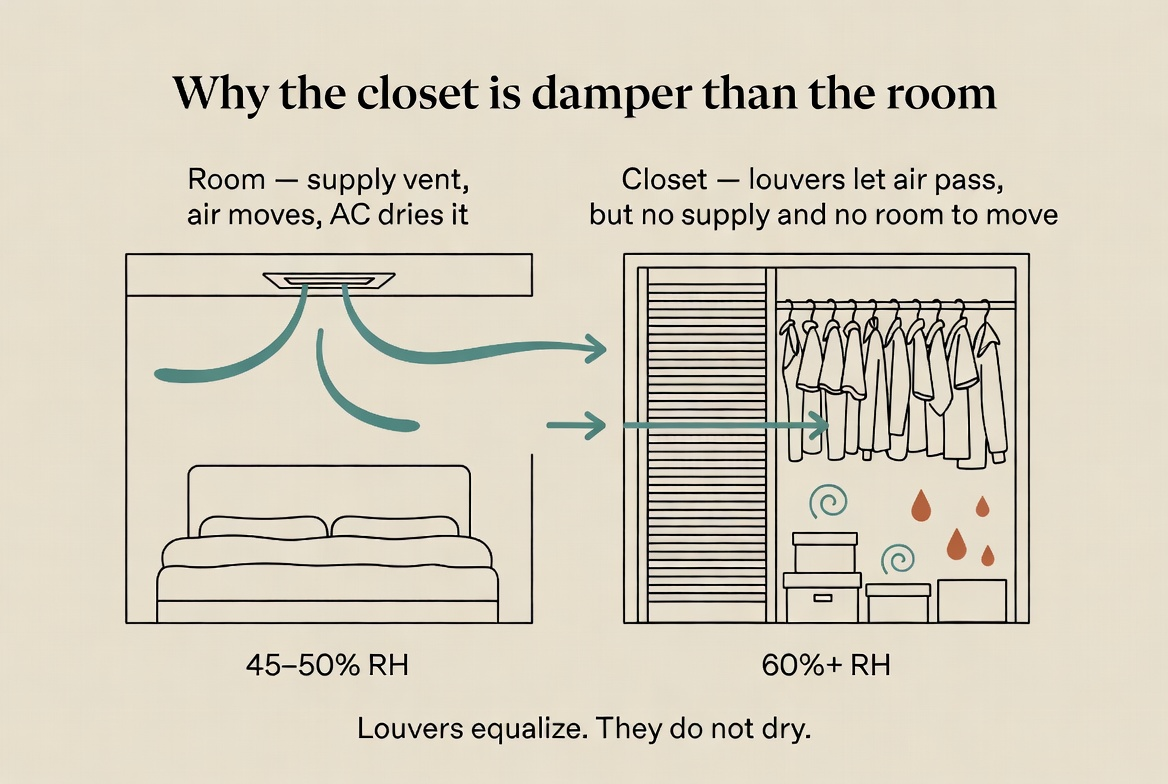
No supply reaches the closet. There is no register in there. Louvers equalize the closet with the room, they do not dry it. They let air pass, they do not move it. If the bedroom sits at 55%, the closet sits at that and then some.
Closets are overloaded. This is the Florida part. There is no basement. The attic runs past 130°F in summer. The garage is an oven with humidity in it. So everything, seasonal clothes, suitcases, boxes, supplies, ends up in the closets, and the linen closet gets packed solid. A dense wall of clothing passes no air at all, and inside that wall sits its own damp pocket. Louvers on the door do nothing for it. Behind stacked boxes in the far corner the air stands dead, and that is where the staining shows up.
Something went in wet. One damp jacket or a pair of sneakers off the street holds the whole closet humid for weeks.
A Walk-In Is a Different Problem
A walk-in is not a closet, it is a small room with no window. The volume of air is large and there is usually no supply into it. Close the door and several cubic meters of dead air sit there.
A moisture absorber will not carry that. It needs either its own supply from the system, an exhaust fan, or a real dehumidifier. For sizing, the dehumidifier size calculator works it out.
Not to Be Confused: the Utility Closet
Separate case: the closet housing the air handler. That one has its own water, a condensate line and a drain pan, and when the line clogs the pan overflows. Damp and a puddle in that closet is a drainage problem, not a storage problem.
Materials
Vinyl-coated wire shelving is the builder default for good reason. It absorbs nothing.
Particleboard and MDF swell with moisture: the shelf sags, the edge banding lifts. Custom closets use commercial-grade melamine or solid wood instead, often cedar. Cedar does hold up well to damp, but the claims about it absorbing odors and repelling insects are marketing. Do not build a plan around them.
What to Do
- Unload it. The main one. Clothes need a gap between them and shelves need to not be packed to the wall. If there is nowhere else to put it, then some of it has to leave the house rather than be pressed in tighter.
- Get things off the floor. Shoes and boxes sitting on the floor collect the dampest layer of air in the room.
- Nothing damp goes in. Do not put anything away before it is dry.
- Solid doors, swap them for louvered. If you have a reach-in with solid sliders, changing the doors does more than any bag of granules.
- Put a hygrometer inside. A cheap sensor gives you the real figure. Steady above 55 to 60% and you need hardware.
- DampRid and similar. Calcium chloride in a bag or tub pulls moisture out of the air, and the water collects below. Enough for a reach-in, replace the granules as they fill. A rechargeable mini dehumidifier is easier, nothing to spill and it lasts longer.
- For a walk-in, a fan or a dehumidifier, as above.
Where Mold Starts
Per the EPA, above 60% humidity mold grows on damp organic material within 24 to 48 hours. Leather holds moisture and feeds it, which is why bags, belts, and shoes go first. The target range for a home is the same 30 to 50%.
If the spots are already there, ventilation alone will not settle it. Clean or discard the items, wash down the surfaces, and only then deal with the air, otherwise it comes back. Breakdown: mold in the closet.
The Short Version
A Florida closet is built right and goes damp from being overloaded. There is no basement and no usable attic for storage, so everything lands in the closets and the ventilation chokes. Unload it, lift things off the floor, put a sensor in. Swap solid doors for louvered, and put a dehumidifier in the walk-in. For a small closet, a mini dehumidifier covers it.
Frequently Asked Questions
Why is my closet damp when the door is louvered?
Louvers equalize the closet with the room, they do not dry it. There is no AC supply inside, and if the closet is packed tight the air will not pass through the clothes either.
What humidity is normal for a closet?
The same 30 to 50% the EPA recommends for a home. Above 55 to 60% is the risk zone, and past 60% mold takes hold on damp material within a day or two.
Does DampRid work?
For a shallow reach-in, yes. Calcium chloride granules pull moisture from the air and need replacing as they fill. For a walk-in it is not enough, that needs a dehumidifier or ventilation.
What shelving is best in a humid climate?
Vinyl-coated wire: it breathes from every side and absorbs nothing. Particleboard and MDF swell, so custom builds use commercial melamine or solid wood.
Why do shoes get moldy in the closet?
Leather holds moisture and feeds mold, and shoes sit on the floor where the dampest layer of air collects. Boxed up right after being worn outside, the conditions are ideal.