
Musty Smell in the House: Where It’s From, How to Fix
A musty smell in house air is not dust or an old house. It is the smell of mold and microbes growing where it is damp, and your nose catches it before your eye sees a spot. It means there is hidden moisture somewhere. Here is where to look for it, and how to clear the smell for good instead of masking it.
A musty smell is chemistry. Mold and bacteria growing on damp material give off volatile compounds (called MVOCs), and that is what your nose reads as the damp, earthy, basement odor. The important consequence: the smell shows up before the mold is visible. While the patch has not surfaced yet, the colony is already at work and giving off odor. So a musty smell is not a “crack a window” problem, it is a signal that there is damp somewhere in the home, and most likely mold already growing.
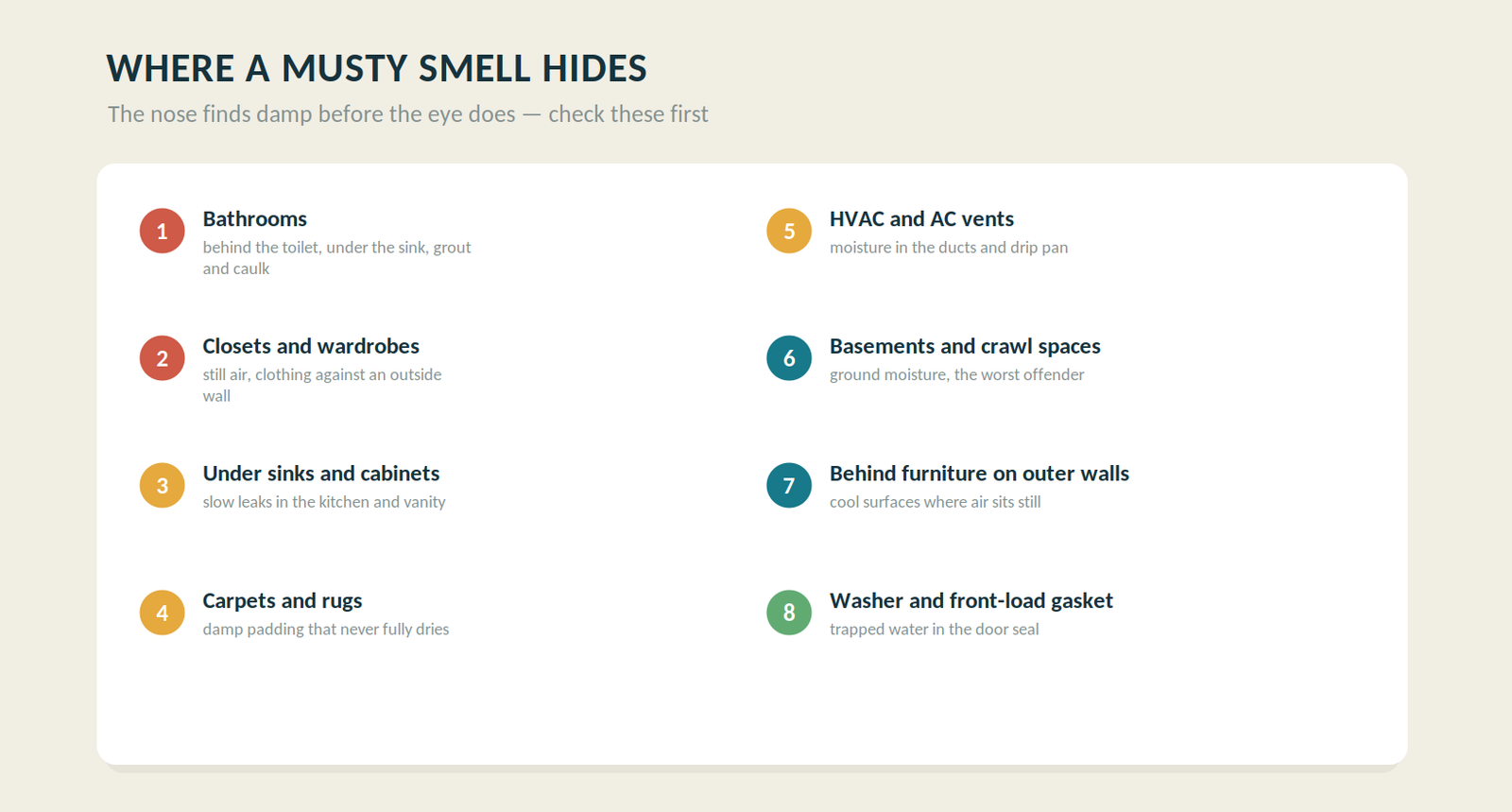
Where to Find the Source
The smell travels through the air, so it can feel like it is “everywhere.” But the source is almost always local, and there are places worth checking first.
Bathrooms. Behind the toilet, under the sink, along the grout and caulk, the dampest spot in the house, and the most common origin of the smell.
Closets and wardrobes. Still air and things that have soaked up moisture. In a humid climate, clothes, shoes, and cardboard boxes absorb water from the air, and in a closed closet with no air movement it has nowhere to go. A closed closet is a perfect chamber for damp.
Under sinks and in cabinets. A slow leak under the kitchen sink or in a bathroom vanity keeps the wood damp for months. Look inside, feel the base.
Carpets and rugs. Padding that got wet once and never fully dried holds the smell for years, especially on a ground floor or over a slab.
HVAC and AC vents. Moisture in the ducts and the condensate drip pan, and the system spreads the smell through the whole house. If it smells the moment the air kicks on, look here.
The crawl space. Moisture from the ground is the most common and most stubborn source. If the house sits on a crawl space, start there. Slab homes get their own version of the same problem: ground moisture works up through the slab, and the carpets and everything lying on the floor catch it first.
Behind furniture on outer walls. A sofa or wardrobe pushed right against the wall: the air behind it does not move, and the moisture that works in through the outer wall from outside never gets carried away. The dead zone stays damp, and that is enough for growth.
The washing machine. On front-loaders, water sits trapped in the rubber door gasket, a classic source of a musty smell near the laundry.
Why Air Fresheners Don’t Work
A scented candle, a spray, an odor absorber buys an hour, and then the smell comes back, because the source is still there and still working. Masking a mold smell is like painting over a damp stain: it is out of sight, but it keeps growing underneath. The only way to clear a musty smell for good is to find the damp, remove it, and take out the affected material.
How to Actually Get Rid of It
- Find the source from the list above, by smell, by touch, by sight. It often helps to work your nose along the walls and open up the closed-off spots.
- Remove the moisture. Fix the leak, clear the condensation, and bring the home’s overall humidity down. Without this, everything else is pointless.
- Clean or remove what’s affected. A small patch on a hard surface washes off; soaked padding, drywall, or insulation is usually replaced. If the mold has spread, here is whether you can handle it yourself or need a specialist.
- Keep humidity in range. The smell will not return if the home’s air stays in the 30 to 50% band, as covered in the piece on ideal home humidity. For what size dehumidifier you need, the calculator works it out.
Why It Smells More Often in Florida
A musty smell in a Florida home is almost a background condition, and the cause is the same as all the damp here. The outdoor air holds high humidity year round, indoor surfaces stay damp longer, and the microbes have somewhere to grow. Closets, bathrooms, and crawl spaces go damp more easily than they do up north, so the basement smell sets in faster. It is part of a wider picture, the signs of high humidity, and for how strong the push is in your city, see the Florida humidity data.
When It’s More Than a Nuisance
If the smell is persistent and you cannot find the source, mold may be growing out of sight: behind a wall, under the floor, in the structure, in the ductwork. The nose catches it while the eye cannot. In that case the finding and opening-up is a specialist’s job: a persistent musty smell with no visible cause is a reason for a professional assessment, not another air freshener.
Frequently Asked Questions
Why does my house smell musty?
It is the smell of mold and bacteria growing on damp material and giving off volatile compounds. It means there is hidden moisture somewhere, most often in a bathroom, closet, under a sink, in a crawl space, or in the ductwork.
Can I get rid of a musty smell with an air freshener?
No. A freshener masks the smell for a while, but the source keeps working. You can only clear it for good by finding the damp, removing it, and taking out the affected material.
Does a musty smell mean mold?
Usually yes, it is typically the smell of mold or microbes growing in moisture. And the smell often appears before the mold becomes visible.
Why does my AC smell musty?
Moisture collects in the ducts and the condensate drip pan, mold grows there, and the system spreads the smell through the house when the air runs. If it smells when the fan comes on, the source is likely in the system.
How do I keep the smell from coming back?
Keep the home’s humidity in the 30 to 50% range: at that level mold and microbes do not have the moisture they need to grow, and the smell does not return.