
Swollen Doors and Floors: Humidity or Water Damage?
Swollen doors and floors are a symptom that does not tell you where the water came from. It may be in the room air, in the slab under the floor, or in a leak behind the dishwasher. The answer decides whether the shape comes back on its own or the material gets replaced.
What follows comes from the USDA Forest Products Laboratory tables, the NWFA guidance, equilibrium moisture data for Florida and the manufacturers’ own documentation for doors and floor coverings. I took no measurements myself, and the rest of the humidity guides cover the household side of the same problem.
Why swollen doors and floors happen at all
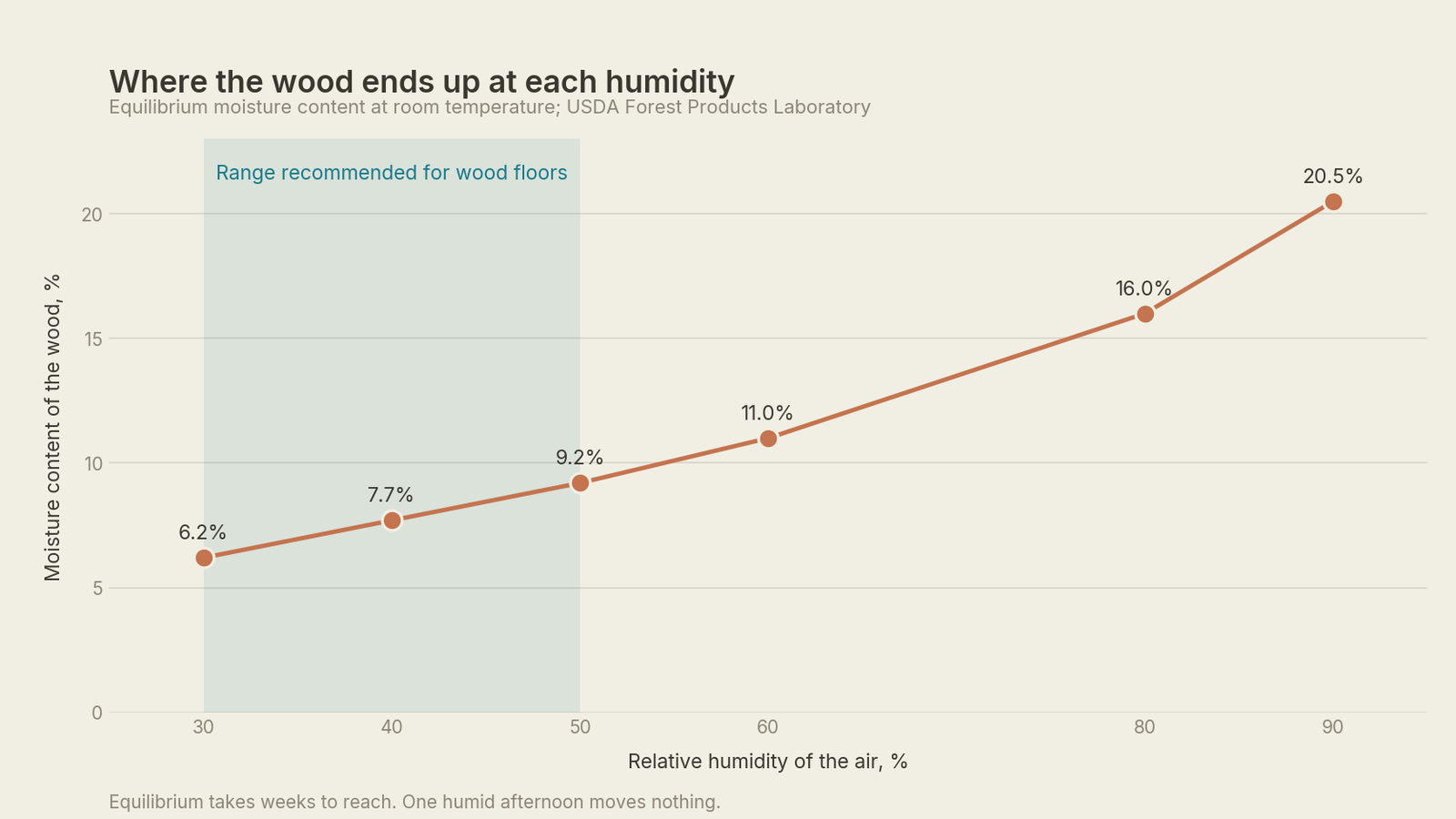
Wood is hygroscopic: it takes up and gives off moisture until it reaches equilibrium with the air around it. That figure is its equilibrium moisture content.
| Air humidity | Moisture in the wood |
|---|---|
| 30% | 6.2% |
| 40% | 7.7% |
| 50% | 9.2% |
| 60% | 11.0% |
| 80% | 16.0% |
| 90% | 20.5% |
Equilibrium moisture content at room temperature. USDA Forest Products Laboratory, Wood Handbook, Table 4-2. Sources disagree on the 70% row, so it is left out.
The fiber saturation point sits at around 30% moisture content. Below it the water lives in the cell walls and the dimensions move with it. Above it the water sits in the cavities and the size stops changing.
Movement is not even in every direction. Across the grain, tangential shrinkage runs about twice the radial figure; along the grain it is 0.1 to 0.2 percent, which is close to nothing.
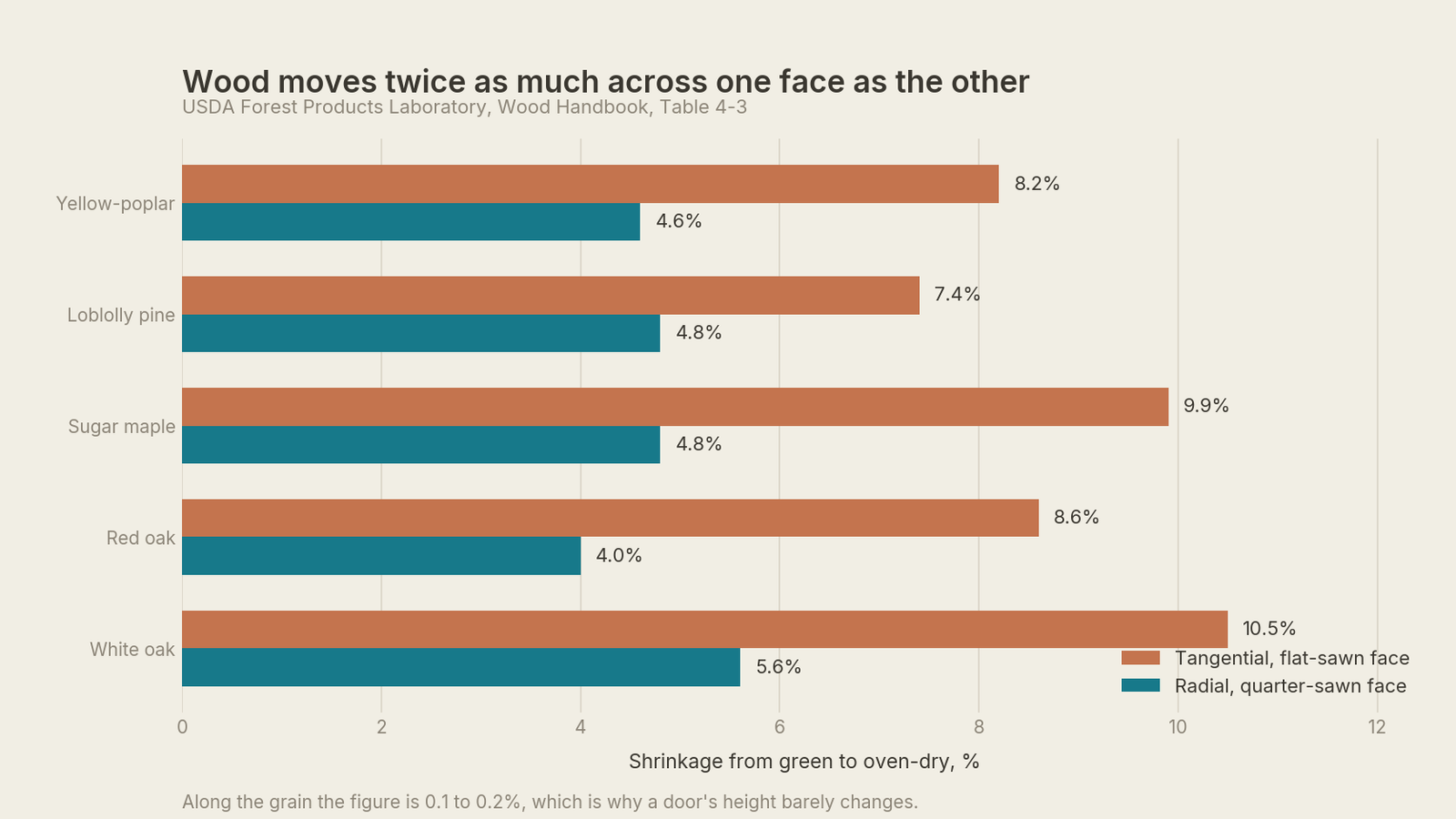
A wide board therefore moves a great deal while the height of a door barely does. There is a formula for it: the change in size equals the original size multiplied by the shrinkage coefficient and by the change in moisture content divided by the fiber saturation point. The worked example from Oklahoma State University: a white oak panel 3 inches wide gains 0.060 inches going from 5 to 15 percent moisture. The formula uses 28 percent as a working saturation figure while the USDA handbook gives 30, which is worth keeping in mind.
What that means in a Florida house
Outdoor equilibrium moisture here stays between 12 and 15 percent all year, and the annual swing is around two percentage points: lowest in April, highest in August and September. Those are North Carolina State University figures, a recalculation of the Simpson method against the climate normals.
Inside a conditioned house the wood settles at roughly 8 to 11 percent. That is an industry estimate and contractors’ field readings rather than a laboratory publication.
What causes damage here is the gap between house and outdoors, not the change of season. A door living at 9 percent moisture heads for 13 or 14 within a week of the air conditioning being switched off, and then it binds against the frame. A failed system or a hurricane without power does the same thing. The NWFA says plainly not to shut the air conditioning off entirely when you leave, because a floor needs a steady environment.
The other household signs that moisture has got away from you are covered on the page about signs of high humidity.
A door: movement or water
A solid door breathes with the climate. Simpson Door recommends leaving about 3/16 of an inch of clearance when hanging a fully dry slab, to allow for swelling in damp weather, and finishing all six sides including the top and bottom edges. An unfinished edge gives moisture a one-way route in, and the slab distorts.
| Sign | Seasonal movement | Water damage |
|---|---|---|
| Where it binds | Along the edge | One corner |
| Thickness | Even | Swollen at the foot |
| Finish | Intact | Bubbled or peeling |
| Dry season | Releases | No change |
Staining on the adjacent casing or baseboard points the same way as the right-hand column.
MDF is its own story. The Composite Panel Association reports that particleboard and MDF may not return to their original dimensions after drying, once they have been soaked or held at high humidity for long enough. For scale: MDF moves 0.03 to 0.06 percent per percent of moisture content lengthwise, and 0.3 to 0.5 percent in thickness. Thickness is what swells, and thickness is what does not come back.
Planing straight away is the wrong first move. If the door only binds in the wet season, wait for the dry one: wood does not go back on, and a gap will open later. The advice from Tom Silva of This Old House is to take off the minimum, with a reveal about the thickness of a coin.
Floors: identify the material first
| Floor | Symptom | Recovers |
|---|---|---|
| Solid wood | Cupping, tight joints | Often |
| Engineered | Ply separation, shear | Rarely |
| Laminate on HDF | Swollen joints | No |
| Vinyl, tile | Lifting, tenting | Depends on cause |
Vinyl, porcelain and terrazzo do not swell hygroscopically at all; lifting there points to the substrate, the adhesive, trapped moisture or movement joints.
Swollen doors and floors part company here. Solid wood takes on moisture and expands across the grain. Engineered board moves less thanks to its cross-laid plies, but that does not make it waterproof: the NWFA lists its own failure modes — dry cupping, ply separation and wood shear — and it needs acclimating like anything else. Laminate on an HDF core responds to humidity in the air and swells at the joints from liquid water; Pergo notes the core has to acclimate before installation.
Cupping is a gradient, not a hygrometer reading
Cupping says one thing: the underside of the board is wetter than the top. The edges take up moisture, rise and leave the centre sitting lower.
Measurements on a cupped floor show it directly: 6.5 to 7 percent moisture near the surface against more than 10 percent deeper in the same board.
The question after that is where the moisture below is coming from — a damp slab, a leak, spilled water, moisture trapped under the adhesive, or board laid without acclimation. The slab thresholds, 75 percent inside the slab and 3 pounds of emission per 1,000 square feet a day, are covered on the page about garage humidity.
The NWFA repair rule: do not sand a cupped floor until the moisture has evened out. Sanded edges end up below the centre once it dries, and the cup becomes a crown.
What comes back and what does not
Solid and engineered board return to shape once the source is dealt with and drying is slow, provided there is no delamination and the finish survived.
A delaminated engineered plank and sheared wood fibres do not recover.
A lifted floating laminate comes in two kinds. If the floor has simply run out of perimeter gap and pressed against the wall, restoring the gap fixes it. If the joints themselves have swollen from water, the core does not shrink back.
MDF swelling in thickness is the same: it stays.
A drywall ceiling that has sagged in humidity does not straighten either. The code requires half-inch board at 16-inch framing and five-eighths at 24-inch where a water-based texture is applied.
What to measure before cutting anything
Identify the material: solid, engineered, laminate, vinyl, tile, a solid door or an MDF one.
Log the room over several days rather than once. The reference for real wood is 30 to 50 percent humidity at 60 to 80°F, which holds the wood at 6 to 9 percent moisture. The EPA gives the same 30 to 50 percent for a house, with a ceiling of 60.
Look at the pattern: the whole edge of the door or one wet corner, the whole floor or a strip along one wall, boards across the room or boards by the dishwasher.
Take a meter to the wood itself, in the damaged area and in a sound one. A room hygrometer cannot tell you what is happening under the board.
If the pattern points downward, test the substrate by whatever method the flooring or adhesive manufacturer requires. A slab that looks dry proves nothing.
Target figures
For real wood: 30 to 50 percent humidity and 60 to 80°F year round, per the NWFA. At installation the difference in moisture content between board and subfloor should be no more than 4 percent for planks under 3 inches and no more than 2 percent at 3 inches and wider.
When you travel, leave the air conditioning on at 78 to 80°F with the fan set to AUTO. The Florida Solar Energy Center has published 85°F in some material; the disagreement is unresolved, but at a setting that high the system barely runs and therefore barely dries.
The 30 percent floor of that range is not a Florida problem. Here the work is at the top end: holding below 50 to 55 percent. Capacity for a dehumidifier, if you need one, comes from the sizing calculator, and the models are on the page for the best units for Florida.
Frequently asked questions
Can humidity make a door stick?
Yes. Solid wood takes on moisture and expands across the grain. Localised swelling at the bottom edge usually means liquid water rather than humid air.
Will a swollen door shrink back?
Solid wood generally does once the humidity returns to where it was. MDF may not return to its original thickness after a soaking.
What humidity is bad for hardwood floors?
There is no instant threshold. The NWFA recommends 30 to 50 percent and 60 to 80°F year round; the risk is in long periods outside the range, not in a single reading.
Will a cupped floor flatten out after drying?
It can, once the source is fixed and the moisture has evened out. Sanding before that produces a crown instead.
Why did my laminate lift?
Either the floating floor has pressed against the wall with no expansion gap, in which case the gap is restored, or the HDF core has swollen from water, in which case it is permanent.
Sources
- USDA Forest Products Laboratory. Wood Handbook, FPL-GTR-282, Chapter 4, Tables 4-2 and 4-3.
- Mitchell P. The Equilibrium Moisture Content of Wood in Exterior Locations in the United States: An Update. NC State University, 2016; after Simpson WT, FPL-RN-0268, 1998.
- Oklahoma State University Extension. Dimensional Changes in Wood.
- National Wood Flooring Association. Problem Prevention; Types of Wood Floors; Installation Guidelines.
- Hardwood Floors Magazine. Measuring Moisture on a Cupped Floor, 2025; Failures Unique to Engineered Wood Flooring, 2018.
- Composite Panel Association. Balance of Moisture in Wood and Air, technical bulletin.
- Engineered Wood Products Association of Australasia. Facts about Particleboard and MDF.
- Simpson Door Company. Care and Finishing.
- Pergo. Laminate installation guidance: acclimation and rising floors.
- This Old House. How to Fix a Door That Sticks.
- US EPA. A Brief Guide to Mold, Moisture and Your Home; Care for Your Air.
- International Residential Code, R702.3.5, gypsum board thickness and framing spacing.