
What follows comes from field measurements by the Florida Solar Energy Center and NREL, the EPA moisture control guidance, the ASTM standards for concrete moisture and the corrosion literature. I took no measurements myself, and the rest of the humidity guides cover the house side of the same problem.

Four different things people call a damp garage
On smaller screens, scroll the table to see every column.
| Mechanism | What you see | First move |
|---|---|---|
| Humid air | High reading, nothing wet | Measure, then dry |
| Surface condensation | Wet slab or duct | Compare dew point |
| Vapour through the slab | Damp in any weather | Test the concrete |
| Liquid water | Puddles, wet edge | Fix the source |
A dehumidifier addresses the first, helps dry the aftermath of the others, and repairs none of them.
Why garage humidity runs higher than the house
Three reasons at once.
In an unconditioned garage, air does not routinely pass through an air conditioner’s cooling coil to remove moisture.
The envelope leaks far more than the house does. NIST measurements found an attached garage at least twice as leaky as the house by air change at 50 pascals, and between two and a half and eleven times leakier by effective leakage area.
The slab is coupled to the ground, which changes temperature slowly. Measurements at the research site in Cocoa, Florida: soil at twenty feet holds around 77.6°F on an annual average, soil at five feet drops to 68.4°F in February, and the underside of a bare slab to 74.3°F.
The air in an unconditioned garage, meanwhile, runs hotter than outdoors: summer measurements in Cocoa Beach gave a mean of 88.1°F with a maximum of 99.8°F, while the floor surface stayed below the indoor air temperature.
Dew point explains condensation; relative humidity does not
The EPA gives a Florida example directly. In Miami, humid outdoor air carries a dew point above 70°F through much of a typical year. A supply duct carrying air near 55°F has a surface at roughly that temperature. When 70°F-dew-point air reaches it, condensation follows.
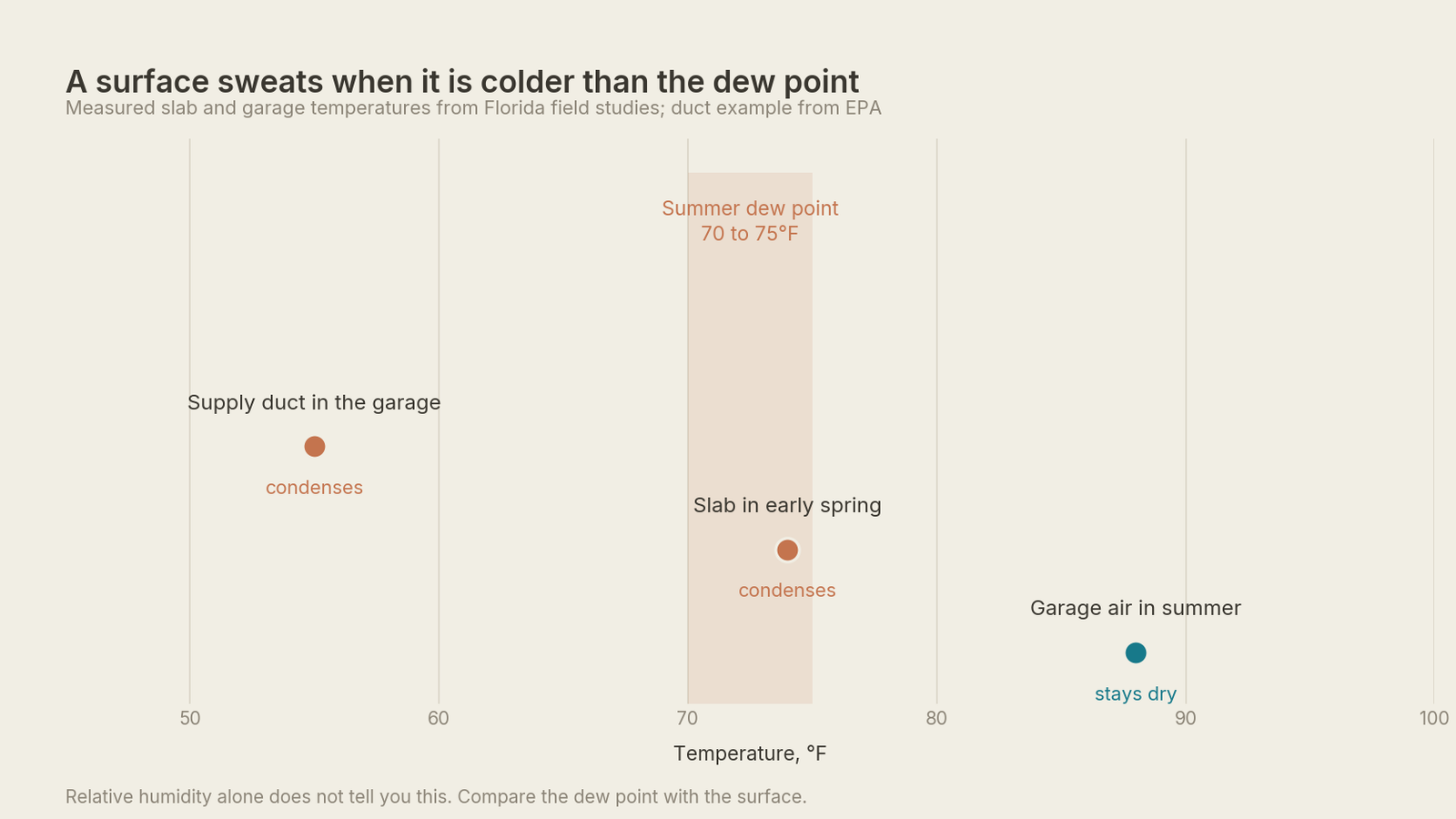
Summer dew points across the peninsula sit at 70 to 75°F for weeks. Nights cool the air without taking the water vapour out of it - the page on dew point in Florida goes through that in detail.
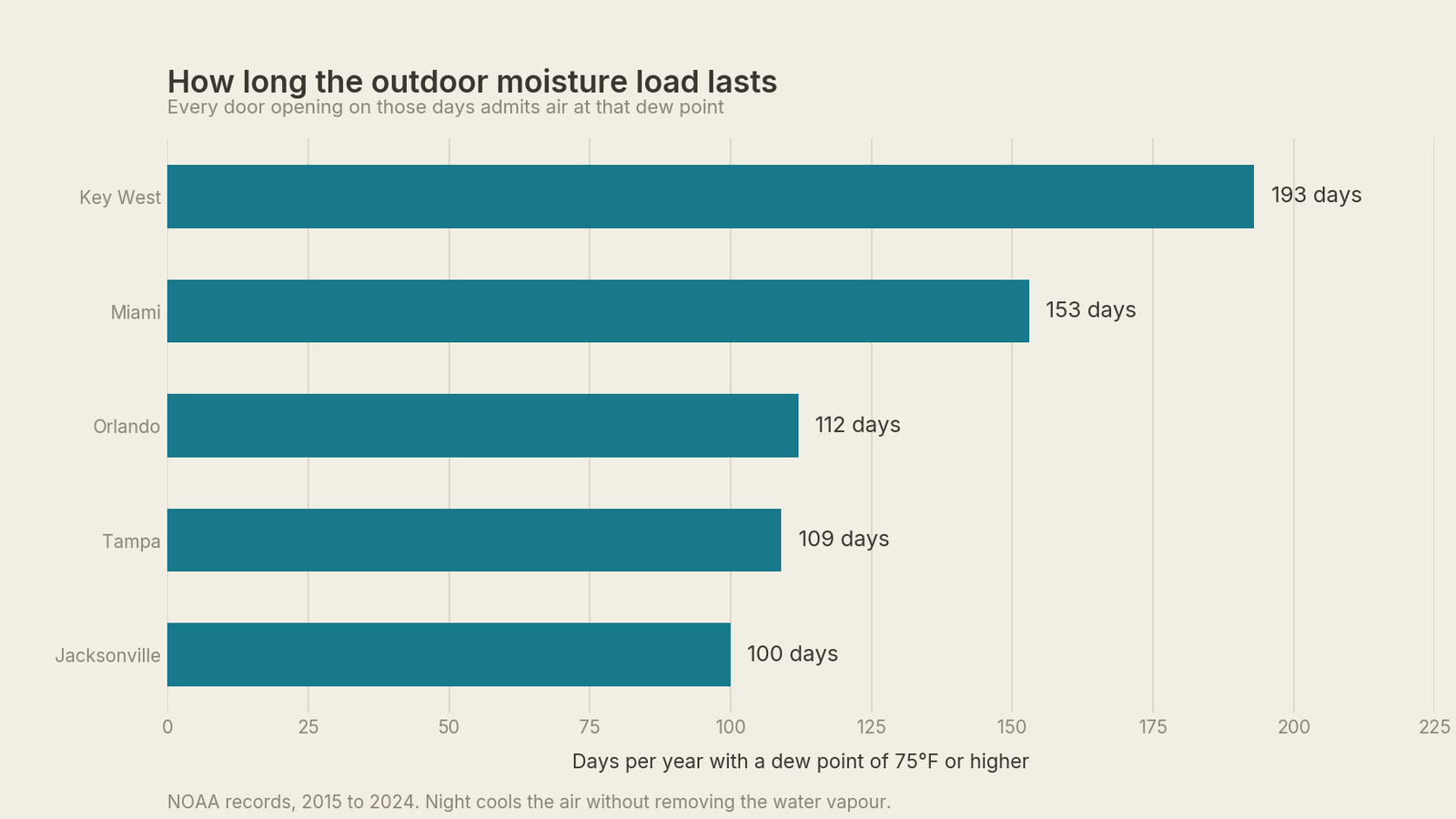
The door
The overhead door is what separates a garage from a room. While it is open, part of a wall has been replaced by outdoor air.
What I will not claim: that one opening exchanges the whole volume, or that a given number of minutes open equals a given amount of moisture. I found no measurements for that.
What holds: after the door closes, equipment needs time to remove what came in. The job in a garage is recovery after each opening rather than holding a steady state.
The slab: condensation on top or vapour from below
Two different diagnoses that household articles routinely merge.
Condensation on top means the slab is colder than the dew point of the air above it. In spring and early summer that is the standard situation: the air is already warm and humid while the slab still holds winter ground temperature. The EPA explicitly recommends designing slab-on-grade assemblies to avoid condensation in warm humid weather.
Vapour from below means moisture is moving through the concrete out of the ground. That is not diagnosed by eye but by measurement.
On smaller screens, scroll the table to see every column.
| Test | What it measures | Acceptance limit |
|---|---|---|
| ASTM F1869 | Vapour emission rate | Specified by the flooring or coating system |
| ASTM F2170 | Humidity inside the slab | Specified by the flooring or coating system |
F1869 reports moisture vapour emission; F2170 measures in-situ relative humidity. Follow the applicable test procedure and the selected product’s written moisture limits. These are not universal pass/fail thresholds for every garage floor.
On the vapour barrier under the slab: the Florida code requires one, but makes an exception for garages and unheated accessory buildings. So there may legally be none under a garage slab. I will not claim there is none under older Florida garages - construction history varies and it is checked against the documents.
A taped plastic sheet can indicate moisture at the concrete surface. It is a qualitative check, not a reliable way to establish the source or approve a slab for coating. Compare surface temperature with air dew point and use the moisture tests required by the selected flooring or coating manufacturer.
An attached garage: moisture against air quality
Here the goals conflict, and safety outranks dryness.
The EPA treats an attached garage as its own source of indoor air pollutants: carbon monoxide, benzene and other fuel-related compounds, solvents and paints. The recommendation is to find and seal the leaks between garage and house so that none of it goes inside.
That yields a rule which contradicts the usual household advice: do not run a supply or return from the home’s air conditioning into an attached garage. The EPA Indoor airPLUS requirement for new construction is not to place equipment or ducts serving the dwelling in garage space.
If an air handler does sit in the garage, it carries two problems at once. UF/IFAS warns that a leaking return pulls hot humid air and garage vapours into the house. The EPA adds the moisture side: suction onto cold surfaces and leaking cold supply air chill nearby materials below the dew point.
A separate boundary is a natural-draft gas water heater. A powerful exhaust fan or tight air sealing can depressurise the garage and backdraft it. Changes like that follow a combustion safety check, not an article on the internet.
Ventilation does not always work
The generic advice to air out the garage holds in Florida only when the outdoor dew point is lower than the indoor one. In summer it is not: outside air will bring moisture in even as it cools the space.
For an attached garage, exhaust may still be needed for a different reason - to clear exhaust fumes and chemical vapours. Then it adds latent load, and that is a deliberate trade rather than a mistake.
What gets damaged
Corrosion is where garage humidity does real damage. The classic threshold for steel is around 60 percent relative humidity; in clean air iron barely rusts even at 99 percent, and it is pollutants and salts that start the process. ISO 9223 uses time of wetness instead of a threshold - hours when humidity exceeds 80 percent above freezing - and accounts for airborne salinity separately.
For a coastal garage that changes the arithmetic. Sea salt moves thresholds down: in tests on steel under artificial seawater droplets, corrosion was recorded down to 11 percent humidity. Salt on surfaces sheltered from rain is never washed off and stays on tools and hardware.
Wood. The USDA Forest Products Laboratory gives a material threshold: decay does not proceed below about 20 percent wood moisture content, proceeds readily above 30, and the range between is grey. That is moisture in the material, measured with a meter, not humidity in the air.
Cardboard, fabric, paper, furniture. Here the general mould figure applies: the EPA recommends staying below 60 percent.
A refrigerator in the garage
Garage-ready models are rated by their manufacturers for 38 to 110°F; ordinary ones for roughly 55 to 110°F. In Florida the heat is the constraint: with the garage near 100°F the compressor works at its limit. Condensation forms on the cold cabinet in a humid garage by the same mechanism as on the slab.
What to do, in order
Measure first. A thermo-hygrometer in the garage and a few days of notes: temperature, humidity, outdoor dew point, when the door was open, whether it rained or the car came in wet. A single afternoon reading proves nothing.
Then remove liquid water: leaks, the air conditioning condensate drain, rain under the door, the grade outside.
Then cut the inflow: door seals, threshold, gaps, the air barrier between garage and house. Not at the expense of ventilation or combustion air.
Then protect cold surfaces: insulate ducts and refrigerant lines, seal the air handler cabinet, keep the condensate draining.
Only then a dehumidifier. It earns its place if you store tools, timber, textiles or a car that rarely moves. Compressor models lose output below roughly 65°F and frost up below 41°F, which does not matter in a Florida summer and might on a winter night. A drain hose removes the bucket. Capacity comes from the sizing calculator, and the models are covered on the page for garages.
On numbers: the general EPA figure for indoor spaces is 30 to 50 percent with a ceiling of 60. For a garage holding tools, a working target of 50 to 55 percent is reasonable. That is an editorial figure rather than a standard - no federal number exists for garages.
What this will not do
A dehumidifier will not stop rain under the door, a water heater leak or vapour out of the ground.
An epoxy floor coating does not cure a sweating slab: the coating sits at the same temperature, below the dew point. Worse, an impermeable coating over a slab with active vapour below it delaminates. Emission or slab humidity gets measured before the coating goes down.
Calcium chloride tubs absorb 200 to 300 percent of their own weight, which suits a cabinet or a safe and not a garage with a door in it.
Frequently asked questions
What humidity is normal for a garage?
No federal figure exists for garages. The general EPA range for indoor spaces is 30 to 50 percent with a ceiling of 60. For stored tools a working target of 50 to 55 percent is reasonable.
Why is the floor wet when nothing is leaking?
Either condensation, with the slab colder than the dew point of the air, or vapour coming through the concrete from the ground. A plastic-sheet check alone does not establish which mechanism is responsible. Compare surface temperature with dew point and investigate slab moisture where needed.
Will opening the door help?
Only when the outdoor dew point is lower than indoors. In a Florida summer it sits at 70 to 75°F, so an open door adds moisture.
Why does the air handler in my garage sweat?
Its surface is colder than the dew point of the garage air. The EPA uses Miami as the example: air above 70°F dew point and ducts near 55°F.
Can I run an air conditioning vent into the garage?
No. The garage is kept isolated from the house because of carbon monoxide and fuel vapours, and EPA guidance for new construction keeps dwelling equipment out of garage space.
Sources
- US EPA. Moisture Control Guidance for Building Design, Construction and Maintenance.
- US EPA. Care for Your Air; Energy Savings Plus Health, attached garage pollutants; Indoor airPLUS Version 2.
- Emmerich SJ, Gorfain J, Howard-Reed C. Air and pollutant transport from attached garages to residential living spaces. International Journal of Ventilation, 2003;2(3). NIST.
- Parker D et al. Measured slab and ground temperatures, Cocoa, Florida. NREL/FSEC report 65355, 2016.
- Parker D. Monitored residential energy and temperature data, Cocoa Beach. FSEC-RR-158-91, 1991.
- ASTM D4263: plastic-sheet indication of moisture. ASTM F1869 and ASTM F2170: concrete moisture testing. ASTM F710: floor covering installation.
- 2020 Florida Building Code §1907.1; Florida Residential Code R506.2.3, under-slab vapour retarder exception.
- UF/IFAS. Energy Efficient Homes: The Duct System, FY1024.
- ISO 9223:2012. Corrosivity of atmospheres: classification, determination and estimation.
- Vernon WHJ. Transactions of the Faraday Society, 1931; National Physical Laboratory, Atmospheric Corrosion.
- Schindelholz E, Kelly RG, Risteen B. Effect of relative humidity on corrosion of steel under acidified artificial seawater particles.
- USDA Forest Products Laboratory. Limiting conditions for decay in wood systems.
- GE Appliances; Whirlpool. Garage-ready refrigerator and dehumidifier operating conditions.