
Dew Point in Florida: The Number That Tells the Truth
The forecast says 55% humidity, and the air outside is soup. In the evening, same temperature, 90% humidity, and it breathes easier than it did at noon. The humidity percent is not lying because the forecasters got it wrong. It lies because it is an inconvenient number. There is a more honest one — the dew point Florida summers actually run on. Life here gets simpler once you read that number instead.
Why the Humidity Percent Misleads
Relative humidity is not “how much water is in the air.” It is how much water is in the air relative to how much the air could hold at its current temperature. And warm air holds far more water than cold air, roughly twice as much for every 18°F of warming. So the same water gives you 90% humidity in the cool morning and 55% by noon once the air heats up. Same water. Same feel. Different number.
Hence the classic Florida trap: glance at “50% humidity” in the afternoon and decide the air is dry. It is not dry. It is just hot.
What the Dew Point Is
The dew point is the temperature the air would have to cool to for its moisture to start falling out as droplets. The more water in the air, the higher that temperature. It does not care how much the air heats up during the day: however much water there is, that is the dew point, morning, noon, and night. That is why forecasters judge mugginess by the dew point and not by the humidity percent.
The feel scale is simple:
| Dew point | What it feels like |
|---|---|
| below 70°F | tolerable — humid by the standards of the rest of the country |
| 70–74°F | humid, sticky |
| 75°F and up | oppressive |
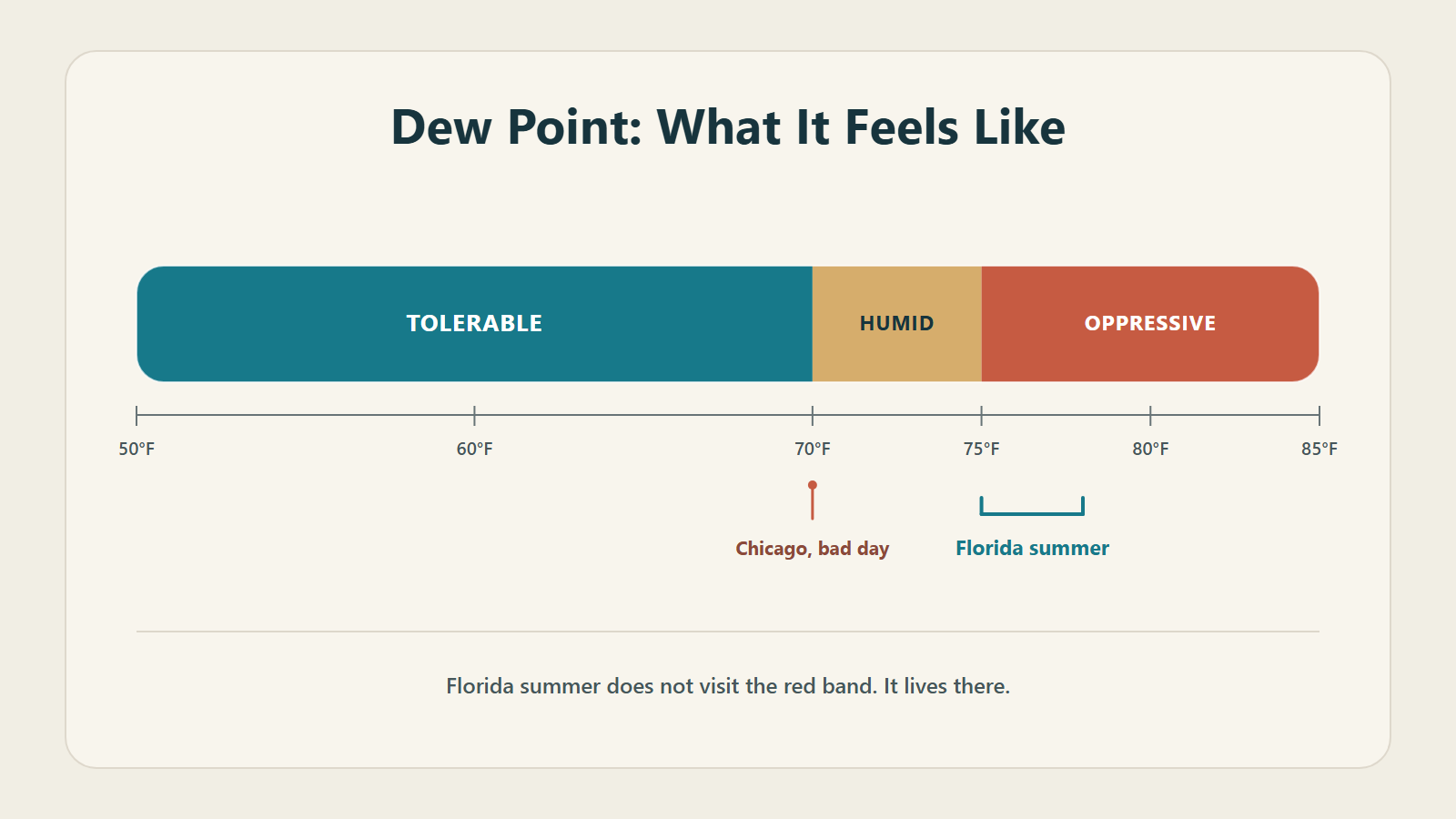
For comparison: in Phoenix in early June, before the monsoon rains arrive, the dew point sits at 20–30°F — with the heat past 100°F, the air is nearly empty. In Chicago, a bad summer day means 70°F, and it makes the news. In Florida, 75°F and up is not a bad day. It is June through September.
The Florida Summer in Numbers
From our 30 years of NOAA data: in summer, the dew point across the peninsula holds at 75–78°F for weeks at a stretch. Miami logs 153 days a year with an oppressive dew point of 75°F or higher. Five months. And here is the part newcomers do not expect: the night does not save you. The air cools toward 78–80°F by dawn, but the water in it goes nowhere — the dew point stays at 75–76°F. Before sunrise the air sits within two or three degrees of saturation. That is where the wet grass, the wet cars, and the wet outside of your windows come from every morning: the outer surface of the glass cooled overnight below the dew point of the outdoor air, and dew fell on it. That is normal, not a sign of trouble with the house.
The spread across the state is real, and it is wide: Key West never lets go all year, while Jacksonville gets a genuinely dry winter. City by city, it is all in our 30 years of Florida humidity data.
What This Has to Do With Your House
The outdoor dew point is the moisture pressure on your home. Every door opening, every gap, every breath of ventilation pulls in air carrying the outdoor dew point. The air conditioner does a job almost nobody notices: it drags the indoor dew point down from the outdoor 76°F to about 55°F — which is what 75°F at 50% humidity works out to. Twenty degrees of difference, held against the outdoors all summer, month after month.
When the outdoor dew point runs past 75°F, that is the season the AC needs help: a dehumidifier takes the moisture load onto itself. The target range and the order of moves are in ideal home humidity, and the size is a quick calculation in the dehumidifier size calculator. And what happens to this number when a tropical system rolls up from the south is its own story: hurricane season humidity.
Frequently Asked Questions
What dew point is uncomfortable?
Above 70°F feels humid and sticky, above 75°F feels oppressive. In a Florida summer, 75–78°F is the ordinary background.
What is the difference between dew point and humidity?
Relative humidity depends on the air temperature and swings through the day with the same amount of water in the air. The dew point measures the water itself and does not move with the heating.
Why is the dew point so high in Florida?
The peninsula sits between two warm waters — the Gulf and the Atlantic. The air arrives off the water already loaded, and the land is too narrow to dry it out.
Does air conditioning lower the dew point?
Yes, that is its second job. Moisture condenses on the cold coil and leaves through the drain, and the indoor dew point drops to about 55°F when the system works properly.
At what dew point do you need a dehumidifier?
When the outdoor number holds at 75°F or higher for weeks, that is the hardest season for a home. If the AC cannot hold the indoor air near 50%, a dehumidifier carries the moisture load.