
Hurricane Season Humidity: What It Does to a Florida Home
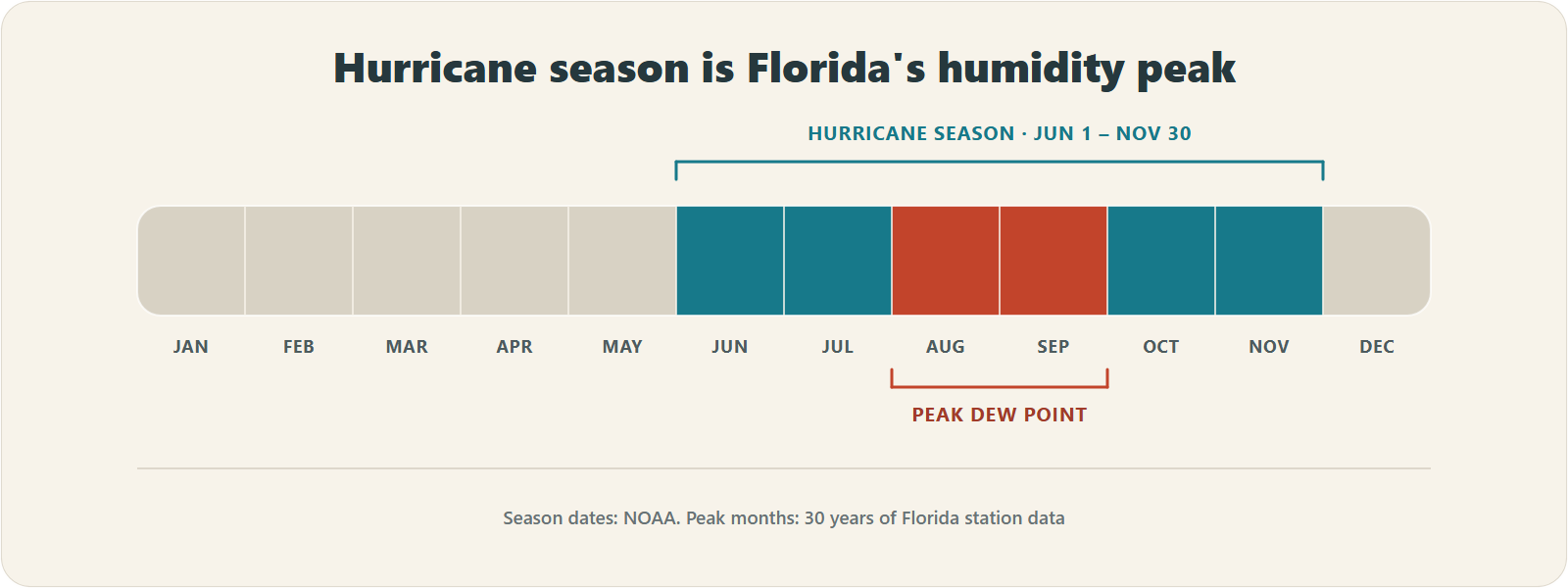
Hurricane season runs June 1 through November 30. For a Florida home, those six months mean more than storm risk. They are the humidity peak of the year: across 30 years of station data, the heaviest dew point months are August and September, the heart of the season. What dew point is and why it matters more than the number on a thermometer is covered here: dew point in Florida.
This page is about the part hurricane checklists skip: what the season does to the air inside your house.
The main threat to your house is not rain. It is the power outage
As long as there is power, the house is defended: the AC pulls water out of the air on every cycle. A hurricane cuts that defense in one place — electricity.
No power, no drying. The house is sealed, the outdoor dew point sits above 75°F, and moisture works in through every gap and off every person inside. The house gains humidity fast, on a scale of hours. Outages after a serious storm run on a scale of days.
How fast your specific house climbs depends on how tight it is, where the humidity started, and how many people are inside. Nobody can give you an exact number. The direction is the only certainty: up, without stopping, until it matches the outside.
Before the storm: build a buffer
Dry the house down in advance. The everyday target is below 60% RH. Ahead of a storm it makes sense to push to the low end, 45–50% RH. Every percent of buffer buys hours before the house crosses into the risk zone with nothing left to dry it.
Seal the house. Windows, doors, everything. In these days, every exchange with the outside lets in air with a higher dew point than your rooms.
Do the generator math. Central AC is beyond a typical portable generator. A portable dehumidifier draws a few hundred watts — a load almost any generator carries alongside the refrigerator. If you own a generator, the dehumidifier is its second job after the fridge.
During the outage
Keep the house closed. Opening up “for some air” feels like relief from the stuffiness. The air outside carries a higher dew point, and every opening speeds up the climb.
Generator priority: refrigerator first, then the dehumidifier or a window AC unit if the wattage allows.
No generator — then the honest picture is this: you will not hold the humidity, the house will gain. The job changes from holding the line to recovering fast when power returns. That is what the pre-storm buffer was for.
After: dry on purpose, not on schedule
Power is back, and the house is sitting above 60% RH. Every day in that zone works for mold. The AC on its normal setting will bring humidity down slowly, because that is not its main job. Dry deliberately: dehumidifier on maximum, interior doors open, let the air move. Size the dehumidifier to the space, not by eye: dehumidifier size calculator.
And one line you do not want to blur: everything above is about humid air. If water got into the house — roof, windows, flooding — that is not humidity anymore, that is water damage, and the clock there runs on the first day: mold after a water leak.
FAQ
Why is hurricane season so humid?
The season covers the wettest months of the year. Across 30 years of Florida station data, the peak dew point months are August and September.
How fast does a house gain humidity without AC?
On a scale of hours. The exact speed depends on how tight the house is, the starting humidity, and how many people are inside. The direction is always up, toward the outdoor level.
Can a generator run a dehumidifier?
A portable dehumidifier draws a few hundred watts, so a typical portable generator runs it alongside the refrigerator. Central AC — no.
What should you do about humidity after a hurricane?
Dry immediately and deliberately: dehumidifier on maximum, interior doors open. If water got in, that is water damage — a different playbook, and the clock runs on the first day.
When is the peak of hurricane season?
The season runs June 1 through November 30, and the statistical peak of activity falls from mid-August through October.
Sources: NOAA National Hurricane Center (season dates and activity peak) · Aridalia: 30 years of Florida humidity, NOAA station data (peak dew point months).