
At What Humidity Does Mold Grow? 60% — With a Catch
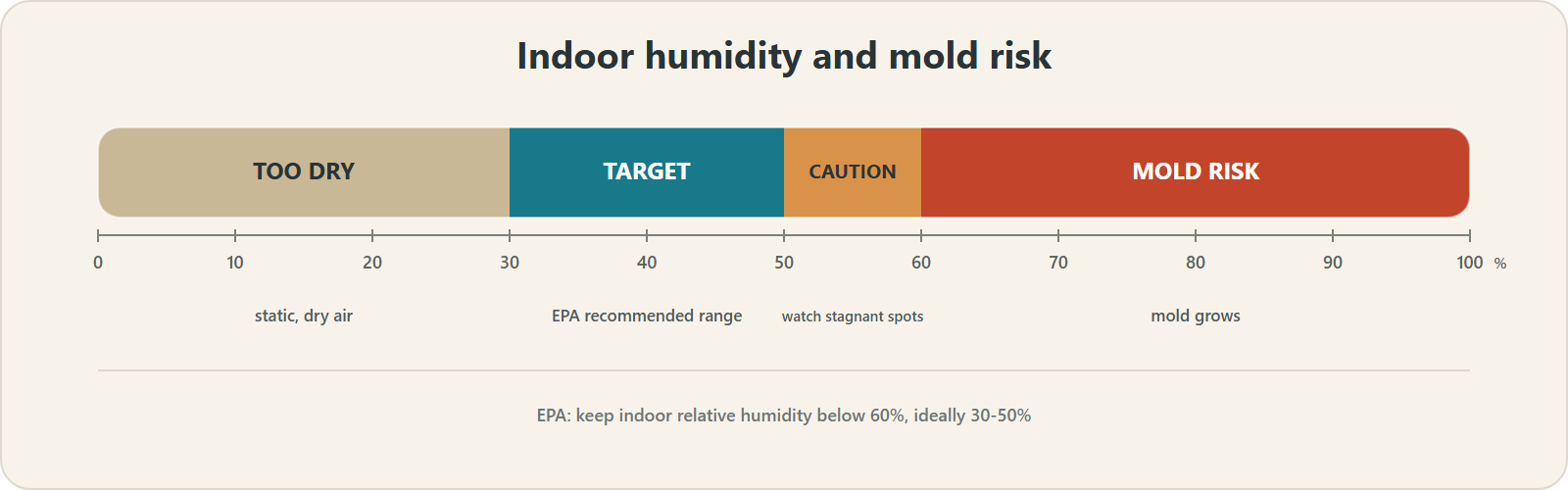
The short answer: above 60% relative humidity. The EPA recommends keeping a home below 60% RH, with a working target of 30 to 50% RH. Those are the numbers for the house as a whole.
The hygrometer on the wall measures the air of the room. Mold does not grow by that number. What matters to it is how much moisture sits at the surface it lives on. The two figures part ways wherever the air stands still: behind furniture, in a corner, in a closed storage room. And the higher the humidity across the house, the less it takes in a spot like that to push past 60% RH.
The Numbers
| Relative humidity in the home | What it means |
|---|---|
| Below 30% RH | Too dry: static, wood shrinking and cracking |
| 30–50% RH | The EPA recommendation, the working target |
| 50–60% RH | The borderline zone, watch the stagnant spots |
| Above 60% RH | The risk zone, mold gets what it needs |
Two clarifications, without which the table lies.
First, mold needs time. A forty-minute spike after a shower grows nothing. It grows where the humidity holds steady. If a material is soaked through, the clock runs in days. If only the air is damp, longer, and the faster the higher the humidity at the surface and the softer the material: the paper face of drywall, dust on a shelf, a leather belt.
Second, temperature is not a lever. Mold grows across the whole range people keep their homes at, and 72–78°F suits it completely. You cannot walk away from it with degrees. Cooling harder does not help either: the colder the air with the same amount of moisture in it, the higher the relative humidity. There are two levers. Moisture and time.
Why the Hygrometer Reads 55% RH and There Is Still Mold
The gauge hangs on an open wall where the air from the AC moves. It honestly measures the spot where it hangs. The mold sits somewhere else.
The air stands still and the house is under-dried
The main cause. Behind a dresser, deep in a storage room, in a corner packed with boxes, the air does not move. Moisture that gets in there does not leave: nothing carries it away. And if the whole house dries poorly and the rooms hold 60–65% RH, those pockets run higher still.
A house usually dries poorly not because of a dehumidifier but because of the air conditioner. A system too powerful for the space shuts off before it has time to pull the moisture out. The full breakdown is in two separate reads: an AC that cools but will not remove humidity and an oversized AC.
The moisture comes from the material itself
Block and stucco hold water inside them. If there was a leak through the stucco, or moisture wicks up from the slab, the surface stays damp for months at any number on the hygrometer. The air humidity has nothing to do with it, and a dehumidifier will not close the problem. Repairing the place the water comes from will.
The tell: the patch sits in one spot, does not spread across the room, and comes back after you scrub it off.
The supply stream hugs the ceiling
Air out of a supply register at 55–58°F does not mix into the room right away. It clings to the surface and runs along the ceiling or the wall, chilling the strip it travels over. At normal indoor humidity nothing happens. At elevated humidity, moisture settles on that strip, and then a dark halo shows up around the register with streaks tracing the flow.
The tell is unambiguous: the grime starts at the register and follows the direction of the stream. Turning the louvers stops the surface wash, but the cause stays the same: the humidity in the house.
What to Do About It
Measure where it grows. Move a hygrometer behind the furniture or into the storage room, leave it for a day, read the number. That one is real, not the one on the living room wall.
Bring the humidity down across the house. The target is the same: below 60% RH, better 45–50% RH. What does that and in what order: ideal home humidity. If it comes to a dehumidifier, the size is calculated from the space, not guessed: the dehumidifier size calculator.
Let the air move. Pull furniture a couple of inches off the wall. Do not pack a storage room into a solid wall of stuff. In dead closets, a cheap fan on a shelf does the job. Clothes closets are a separate breakdown: closet humidity.
If it is already growing. Humidity and cleanup are both done, not one instead of the other. Drop the number and the growth stops, but what has grown does not vanish on its own: the material stays colonized, the moisture returns, and it all starts again. And if the water comes from inside the wall, the number in the room plays no role, the leak comes first. What that black on the wall can be and how to read it: black mold signs.
Frequently asked questions
At what humidity does mold grow?
Above 60% relative humidity at the surface it sits on. The EPA recommends keeping a home below 60% RH, with a target of 30 to 50% RH.
Can mold grow at 50% humidity?
By the room reading, yes, if the humidity at the surface itself is higher. That happens behind furniture and in stagnant corners the dried air never reaches.
Does mold grow at 60% humidity?
60% RH is a boundary, not a switch. If it holds for a long time and there are stagnant spots, growth will start.
Does lowering humidity stop mold?
Growth stops below 60% RH, but the mold does not die. The material stays colonized, and when the moisture returns it all starts again. Cleanup still has to happen.
My hygrometer reads 55%, so where is the mold from?
The gauge measures the air where it hangs. Behind furniture, in storage rooms, and in corners the air stands still, and the humidity at the surface runs higher than the room.
Sources: EPA, A Brief Guide to Mold, Moisture and Your Home; EPA Mold Course. This is reference material, not medical advice.