
Eva-Dry and the Mini Dehumidifier Class: 63,907 Reviews
This eva-dry dehumidifier review covers a brand that makes two different kinds of device, and the difference matters. Thermoelectric units run from a wall socket, condense water on a chilled plate and collect it in a tank. Silica-gel units need no power at all while working: they absorb moisture until saturated, then get dried out. Eva-Dry cartridges plug into a socket for 10 to 12 hours; Wisesorb and Dry & Dry cartridges go into a household oven at 200–250 °F.
The class is larger than it looks. In our Amazon review sample, thermoelectric units account for 63,907 reviews across 600 product listings, close to a third of all ratings in the corpus, while the compressor core across 711 listings accounts for 23.1%.
I have not tested these units. This draws on that sample, manufacturer manuals and product pages, bench readings from DehumidifierBuyersGuide, DOE and ENERGY STAR documents, CPSC records, NOAA data and field material from the Florida Solar Energy Center. Room-sized alternatives sit in the Florida selection guide, part of the wider dehumidifier guides.
Eva-Dry dehumidifier review data: Florida scores run higher
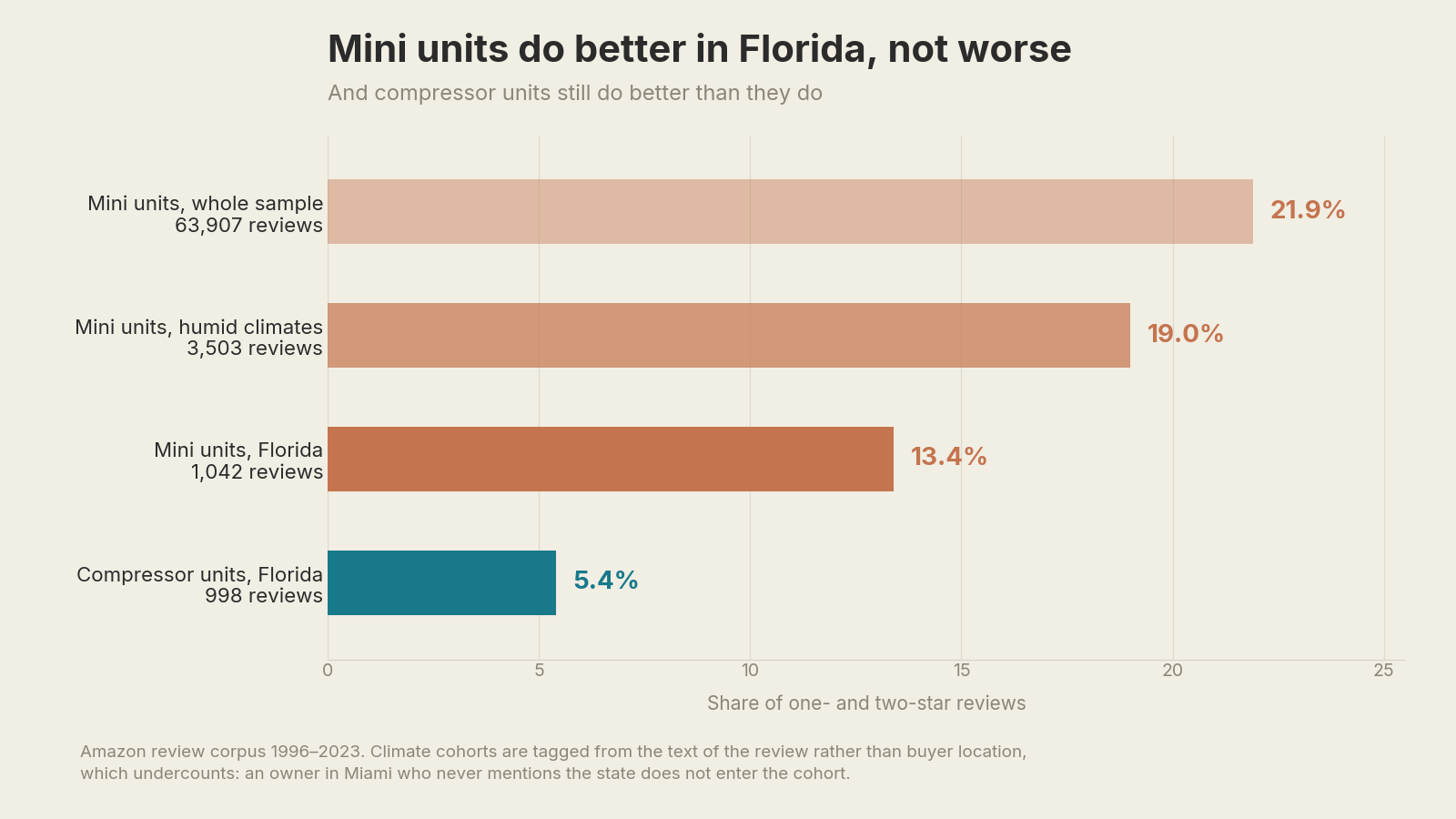
The expectation ran the other way. A device that removes a cup of water a day should struggle in a humid climate.
| Cohort | Reviews | Rating | One- and two-star share |
|---|---|---|---|
| Whole mini cohort | 63,907 | 3.96 | 21.9% |
| Humid climates | 3,503 | 4.09 | 19.0% |
| Florida | 1,042 | 4.36 | 13.4% |
| Everything else | rest of cohort | 3.95 | 22.1% |
Amazon review corpus 1996–2023, 600 thermoelectric product listings.
The Florida cohort rates these units well above the sample average: 4.36 against 3.96, with a low-rating share of 13.4% against 21.9%.
Cohorts are tagged from the text of the review rather than from buyer location. That is a proxy and a deliberate undercount: an owner in Miami who never mentions the state or a city does not enter the cohort.
Compressor units still come out ahead in Florida
| In Florida | Compressor | Mini |
|---|---|---|
| Reviews | 998 | 1,042 |
| Rating | 4.66 | 4.36 |
| One- and two-star share | 5.4% | 13.4% |
Comparable cohort sizes within the same corpus.
Negative ratings run two and a half times higher on the mini units.
The trade is quiet against water
| In Florida | Mini | Compressor |
|---|---|---|
| Praise the quiet | 26.2% | 19.9% |
| Complain about noise | 5.0% | 13.5% |
| “Barely collects water” | 3.5% | 1.7% |
Share of all reviews in each cohort raising the theme, praise included.
Inside negative reviews specifically, the complaint that a unit barely collects water appears at 8.4% on the mini cohort against 4.7% on the compressor cohort.
Noise is the most frequent theme in Florida reviews of compressor units, at 15.6% of mentions against 9.9% nationally. Mini units close that complaint entirely, at the cost of capacity. That is the whole choice between the two types in this climate.
Where owners put them
Mentions of an enclosed space in the review text, meaning a closet, bathroom, storage room, RV or safe:
| Cohort | Share of reviews |
|---|---|
| Mini units in Florida | 30.1% |
| Mini units elsewhere | 22.2% |
| Compressor units in Florida | 11.3% |
Tagged from review text; the same proxy limitation applies.
Florida owners mention an enclosed space in 30.1% of reviews against 22.2% elsewhere. The rating gap between those same cohorts is 4.36 against 3.96. These figures do not establish that one causes the other. Sizing for a closet sits in the closet humidity guide, and what happens when a closet stays damp in the closet mould guide.
One cut I am leaving out: room against closet produced a contradictory result, with the variables tangled up with device class.
Tank size as a class marker
| Class | Reviews | Models | Rating | Low-rating share |
|---|---|---|---|---|
| Micro, up to 20 oz | 16,799 | 88 | 3.93 | 22.4% |
| Small, 21–40 oz | 15,423 | 170 | 4.01 | 21.0% |
| Large, 41 oz and up | 13,793 | 190 | 4.13 | 18.7% |
| Capacity not stated | 17,892 | 152 | 3.81 | 24.8% |
Tank capacity as listed on the product page.
The Florida cut of the same classes gives 4.39, 4.36, 4.46 and 4.23, above the overall figure in every row.
The gradient from micro to large is worth reading with caution: tank size correlates with price, with capacity and with intended use, and these data cannot separate those variables.
What the bench test showed
DehumidifierBuyersGuide ran three units of this class. A sealed 50-square-foot room at 82 degrees, humidity raised artificially, three runs per model.
The control measured how long that room takes to fall from 80% to 75% on its own once the moisture source is removed.
| Unit | Time 80→75% | Noise nearby |
|---|---|---|
| Empty room, control | 18 minutes | not applicable |
| Ivation IVADM10 | 12 minutes | 47.2 dB |
| Eva-Dry EDV-1100 | 18 minutes | 50.9 dB |
| Gurin DHMD-210 | 18 minutes | 44.5 dB |
Bench test dated 2015; two of the three models are out of production.
The Ivation cut the time by a third on the lab’s own calculation. The other two returned the same 18 minutes as the empty room.
The lab could not run its usual procedure, a fall from 90% to 40%, because this class cannot complete it. A 70-pint compressor unit covers that span in the same room in about 11 minutes.
The lab’s recommendation is to avoid these three units in any space larger than 50 square feet. The makers of the IVADM10 and the EDV-1100 claim coverage up to 100.
Three caveats attach to the test. It dates from 2015. The three units belong to a light subclass weighing one to two pounds; the lab tested eight thermoelectric units in total, and larger ones such as the EDV-2200 or the Ivation IVADM35 weigh around five pounds. The Gurin recorded the lowest noise of all eight.
The figure on the box comes from 86 degrees
Manufacturers publish capacity in millilitres or ounces per day, and nearly all of them measure at 86 °F and 80% relative humidity.
The one exception found is Vellgoo. Its DryBox 200 lists 240 millilitres at 86 degrees and 80%, and 132 millilitres at 80.6 degrees and 60%. A drop of 45% at a more domestic humidity level.
Nobody publishes the 70-degree, 50% point, which is what a conditioned Florida house actually runs at.
| Model | Water removal at 86 °F / 80% | Tank | Power | Lower limit |
|---|---|---|---|---|
| Eva-Dry EDV-1100 | 237 ml | 473 ml | 22.5 W | above 59 °F |
| Eva-Dry EDV-1200 | 237 ml | 887 ml | 22.5 W | above 59 °F |
| Eva-Dry EDV-2400 | 739 ml | 1.8 l | 60 W | above 45 °F |
| Ivation IVADM10 | 177 or 237 ml | 503 ml | 13.5 or 22.5 W | not published |
| Pro Breeze PB-02 | 250 ml | 500 ml | 22.5 W | 59–86 °F |
| Vellgoo DryBox 200 | 240 ml | 670 ml | 23 W | 41–122 °F |
| Afloia Q10 | 750 ml | 1 l | 45 W | not published |
| SEAVON, 27 oz tank | 350 ml | 800 ml | 22.5 W | best 59–104 °F |
Manufacturer figures. Two values on one row mean the same page states both.
The Ivation figures sit on the same manufacturer page, which also states both 1,100 and 2,200 cubic feet of coverage. That page cannot be used as a clean specification.
The EDV-2400 is alone in this group with a humidistat covering 40 to 80% and a hose for continuous drainage. On the others water goes to the tank only, and the unit shuts off once it fills.
Why these units are absent from the ENERGY STAR registry
DOE defines a household dehumidifier as a device with a cooled surface, a mechanical refrigeration system driven by an electric motor, a fan, and condensate collection. ENERGY STAR version 6.0 uses the same definition and additionally requires an adjustable humidistat and refrigerant data.
A Peltier element has no mechanical refrigeration system. It carries no refrigerant either, and a humidistat is not fitted to every model.
No separate written DOE decision excluding this type turned up; the conclusion follows from the wording of the definition.
For a sense of scale: water removed per unit of energy, calculated from the published maxima, comes to between 0.24 and 0.69 litres per kilowatt-hour. The ENERGY STAR minimum for a portable compressor unit up to 25 pints per day is 1.70. This is not a like-for-like comparison, since compressor units are tested at 65 degrees while mini units are rated at 86 and 80%.
Silica gel: capacity per cycle, not per day
A different unit of measure applies here, and substituting days for cycles is wrong.
The Eva-Dry E-333 holds 4 to 6 ounces of water per cycle by the 2025 catalogue and the card in the box. That is 118 to 177 millilitres. The maker states 3 to 5 weeks to saturation, noting the dependence on humidity, and 10 to 12 hours to regenerate from a socket. Claimed coverage is up to 333 cubic feet.
The E-500 holds 6 to 8 ounces by the same catalogue and regenerates in 10 to 16 hours.
Vellgoo’s X1 states 80 to 100 millilitres without giving conditions, on a 45-watt base.
Wisesorb does not publish a capacity for its 900-gram canister at all. What exists is a raw-material standard: at least 34% of mass in water at 77 degrees and 90% humidity. That does not transfer directly to the whole canister.
Cycle life
Manufacturers give no consistent answer.
Eva-Dry promises a service life of up to ten years without publishing a cycle count or a residual-capacity curve. Vellgoo claims more than 300 cycles. Wisesorb warns outright that each cycle gradually reduces absorption capacity.
An industrial study gives the order of degradation: after roughly 5,000 cycles at 250 degrees Celsius, different silica gels lost between 19% and 52% of capacity. That temperature exceeds household instructions, and those percentages do not transfer to an E-333.
No controlled multi-year test of household cartridges with repeat weighing after hundreds of cycles was found.
On heat separately: in a controlled study, raising temperature from 27 to 40 degrees Celsius reduced the equilibrium capacity of silica gel by 34%. In a closed heated space that means less useful capacity than the cartridge nominally holds.
Where Eva-Dry’s own materials disagree
The brand fields the most models in this class, and carries the most inconsistent figures.
E-333. The 2025 catalogue and the card in the box give 4 to 6 ounces per cycle. The current single-unit product page states 13 ounces. The Home Depot listing manages both 6 to 8 ounces per cycle and an erroneous “6–8 oz per day”, when silica gel has no daily rate as a quantity.
E-500. The catalogue gives 6 to 8 ounces; current listings appear with 20 ounces and varying regeneration times.
EDV-1200. The current manual states a 30-ounce tank and a 59-degree lower limit; the older manual states 20 ounces and 45 degrees.
EDV-1100 noise. The maker states around 33 decibels without a method, while the same lab measured 50.9 decibels nearby. Those do not contradict each other without matching distance and background, but they show what a published figure without a method is worth.
Calcium chloride absorbers: the third option
DampRid, Star brite No Damp and DRI-Z-AIR work on calcium chloride. Crystals absorb moisture and turn into brine, which gets poured off before fresh salt goes in.
In the Amazon listing classification this class holds 400 listings and 25.3% of all ratings in the corpus, comparable to the mini units.
DampRid in a 10.5-ounce tub claims up to 45 days and up to 250 square feet without stating conditions; how much water the tub collects is not published. DRI-Z-AIR recommends one unit per 10 by 10 feet with a refill lasting 30 to 60 days.
These should not be grouped with silica gel. Brine is corrosive and damages wood and leather, and the salt is consumed for good. Silica gel stays dry to the touch and regenerates.
The Florida closet
Before putting anything in, it helps to know the humidity in there.
FSEC writes that closets rarely receive conditioned air, and that an open door or air movement lowers the risk. In their experiments the air handler fan set to ON produced 65–75% humidity against 55–74% on AUTO.
The EPA benchmark is below 60%, preferably 30 to 50%. FSEC adds that with air conditioning running, daytime humidity should not regularly exceed 55%.
No single measured figure exists for Florida closets: it depends on room humidity, surface temperatures, exterior walls, air leakage and how frequently the door opens.
An unconditioned space is a different matter. Moisture content in the air does not fall overnight: NOAA data for 2015–2024 puts the pre-dawn dew point in Miami during July and August at 75.1 °F against 74.2 °F in the afternoon. Temperature drops while that holds, so relative humidity climbs towards morning. Passive absorbers saturate faster under those conditions.
Where the class runs out
The ENERGY STAR sizing table recommends 20 to 30 pints per day for a space under 2,000 square feet starting at 50 to 75% humidity.
The maximum anywhere in the mini table is 0.50 to 1.56 pints per day, and that at a warmer 86 degrees and 80%.
This compares orders of magnitude rather than like-for-like tests. Together with the 50-square-foot ceiling from the bench test and the 13.4% low-rating share against 5.4% on compressor units, it marks out what the class is for: a safe, a tool case, a closet, a small enclosed compartment.
Safety and unattended operation
No CPSC recall campaigns were found for the mini models listed here. The Ivation brand does appear in the New Widetech recall of 2021, but the models named there are the compressor IVADH30PW and IVADH70PW at 30 and 70 pints, not the IVADM10.
A negative search result is not proof of safety.
The Pro Breeze PB-02 manual prohibits leaving the unit unattended. The EDV-1100 and EDV-1200 have no continuous drain and shut off once the tank fills. The EDV-2400 has a hose, but automatic restart after a power loss is not described in the available manual.
Which one suits what
Silica gel earns its place where the space is small and closed and there is no socket: a safe, a case, a locker, a wardrobe. Capacity is finite, but it makes no noise, needs no power while working and produces no liquid.
A thermoelectric unit earns its place in a space under 50 square feet with persistently high humidity and a socket within reach. The data supports that: in Florida these units appear alongside a mention of an enclosed space in 30.1% of reviews, and the same cohort rates them 4.36 against 3.96 across the whole sample. Of the models covered, only the EDV-2400 has a humidistat and a hose, meaning it can run longer than it takes to fill the tank.
A calcium chloride absorber suits seasonal storage where a consumable is acceptable and the brine can be poured off on schedule.
A room needs a compressor unit: in the Florida cut it returns 5.4% low ratings against 13.4% on the mini cohort. A boat is its own problem, where power, drainage and weeks of absence enter the calculation, and that sits in the boat dehumidifier guide.
Limits of this review
- I have not tested these units, and there are no field measurements here.
- Cohorts are tagged from review text rather than buyer location: a proxy and a deliberate undercount.
- The Amazon corpus ends in 2023.
- The mini cohort is not split between true thermoelectric units and compact compressor units.
- The bench test dates from 2015 and covers three of the eight units tested.
- No manufacturer publishes measurements at 70 °F and 50%.
- Silica-gel cartridge capacity after hundreds of regeneration cycles has not been measured.
- Water removal per unit of energy is calculated from published maxima and is not an Appendix X1 value.
- No single measured humidity figure exists for Florida closets.
- Claimed area and volume are marketing limits rather than test results.
- Absence of CPSC recalls does not prove absence of incidents.
Frequently asked questions
Do mini dehumidifiers work in a humid climate?
Across 63,907 reviews the Florida cohort rates them above the sample average: 4.36 against 3.96, with a low-rating share of 13.4% against 21.9%. Compressor units in the same cohort return 4.66 and 5.4%.
How much water does a mini dehumidifier actually remove?
Published figures of 237 to 750 millilitres per day are measured at 86 °F and 80% relative humidity. The one manufacturer publishing a second point shows a 45% drop at 80.6 °F and 60%.
Will a mini unit replace a regular dehumidifier?
No. In the bench test in a 50-square-foot room two of three units matched an empty room, and the complaint that a unit barely collects water appears twice as often in negative mini reviews as in compressor ones.
How does a silica-gel unit differ from an electric one?
Silica gel needs no power while working and is measured by capacity per cycle: 4 to 6 ounces on the Eva-Dry E-333, or 118 to 177 millilitres. An electric unit runs continuously from a socket and collects water in a tank.
Why are mini dehumidifiers absent from the ENERGY STAR registry?
The DOE definition requires a mechanical refrigeration system driven by an electric motor, which a Peltier element does not have. ENERGY STAR additionally requires an adjustable humidistat and refrigerant data.
Sources
- Amazon Reviews 2023 dataset, thermoelectric subset: 63,907 reviews across 600 listings, 2003–2023.
- Manufacturer manuals and product pages for Eva-Dry, Ivation, Pro Breeze, Vellgoo, Afloia, SEAVON, Wisesorb and Dry & Dry.
- DehumidifierBuyersGuide bench testing of thermoelectric units and its published methodology.
- DOE Consumer Dehumidifiers definition and Appendix X1; ENERGY STAR version 6.0 criteria and sizing guidance.
- CPSC recall database.
- NOAA Local Climatological Data, hourly dew point, five Florida stations, 2015–2024.
- Florida Solar Energy Center field material on mould growth and indoor humidity; EPA guidance on mould and moisture.
- Published research on silica-gel adsorption isotherms and desiccant degradation under temperature cycling.