
Aprilaire Dehumidifier Review: What the E-Series Numbers Mean
This aprilaire dehumidifier review covers the E-series in five sizes: E050, E070, E080, E100 and E130. There is no bucket on any of them. Water leaves through a threaded outlet by gravity or through an external pump bought separately, and installation means either a dedicated space or a connection to ductwork.
Disclosure: This article contains affiliate links, including links to Amazon, Sylvane, and other partners. If you purchase through these links, we may earn a small commission at no extra cost to you. As an Amazon Associate I earn from qualifying purchases. Full disclosure: Affiliate Disclosure.
Each model carries two rated capacities: one at 80 °F, one under the Appendix X1 procedure. Coverage depends on climate region and how tight the house is, and between the extremes the difference runs to nearly three times.
I have not tested these units. This draws on manufacturer specification sheets and the E070 installation manual, the ENERGY STAR registry, CPSC recall records and retailer listings. Portable alternatives sit in the wider dehumidifier guides.
Two capacity figures
The E100 is sold as a hundred-pint machine. Tested at 80 °F and 60% relative humidity it removes 100 pints per day. Under Appendix X1, at 73 °F and 60%, it removes 85. Both are manufacturer figures and both are correct for their test point.
| Model | At 80 °F / 60% RH | Under Appendix X1 |
|---|---|---|
| E050 | 50 | 42 |
| E070 | 70 | 53 |
| E080 | 80 | 65 |
| E100 | 100 | 85 |
| E130 | 130 | 105 |
Pints per day. The Appendix X1 column is the one that enters the federal registry and allows comparison between brands.
What is in the registry and what is not
Three models hold active ENERGY STAR listings: E080, E100 and E130. The partner on all three is Research Products Corporation, the category is Whole-home, and each carries the Most Efficient mark.
The E080 measures 65.00 pints with an integrated energy factor of 2.35 and 632 kWh a year. The E100 measures 85.00 at the same 2.35 and 821 kWh. The E130 measures 105.00 at 2.35 and 926 kWh.
The smaller E050 and E070 have no active listing. They cannot be called certified, and their efficiency compares to the rest of the range only through manufacturer figures.
The integrated energy factor states how many litres of water the unit removes per kilowatt-hour. At 2.35 the three certified models beat anything in the portable 50-pint class, where the Midea Cube sits at 2.01 and the Frigidaire at 1.8. At 80 °F and 60% the manufacturer publishes different numbers: 2.8 for the E080, 2.6 for the E100 and 2.9 for the E130. The matching 2.35 belongs to the Appendix X1 test point.
Aprilaire dehumidifier coverage: the headline and Florida
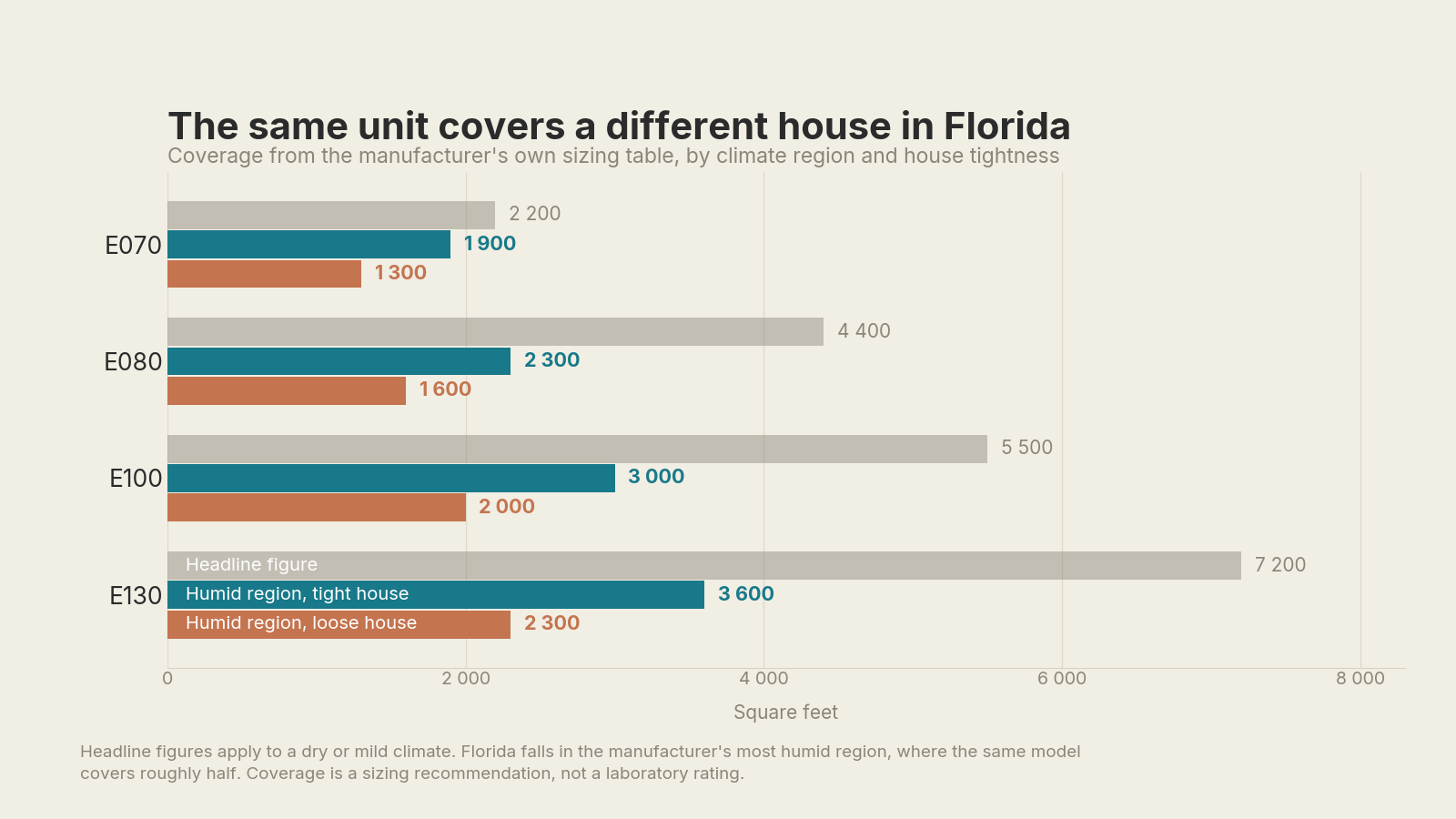
The headline coverage for an E100 is 5,500 square feet. That figure belongs to a dry or mild climate and a tight house.
Aprilaire publishes a table where coverage varies by climate region and by how tight the house is. Florida falls in region C, the most humid in that classification. There the same E100 covers 3,000 square feet in a tight house and 2,000 in a loose one.
The manufacturer states separately that coverage is a sizing recommendation rather than a test result: model selection follows from the moisture load of the house.
One hundred and four degrees
The upper inlet air limit across the range is 104 °F. The lower is 50 °F with a minimum dew point of 40 °F. Those apply to dehumidification; in ventilation mode the unit operates from 40 to 140 °F.
In Florida the upper limit is the one that matters. An unconditioned attic in summer can exceed the rated maximum, and where it does, that attic is not an installation location.
A sealed attic is a different matter, and the manufacturer plans for it: the installer menu has a dedicated mode for crawl spaces and sealed attics, and the manual recommends suspending the unit to keep noise out of the structure.
The 50 °F lower limit carries no weight inside a Florida house. It starts to matter in an unheated crawl space or garage in the north of the state.
Airflow and static pressure
The range publishes airflow at three values of external static pressure. Among the portable units in the build teardown, airflow came as a single number or not at all.
Zero corresponds to a unit with no ductwork attached. The 0.2 and 0.4 inches of water column represent the resistance of a connected duct system: the longer it runs and the more turns it takes, the higher the pressure and the less air moves through the unit. The manual caps total duct length at 100 feet, but converting a specific run into inches of water column is a design calculation, not something the published figures support.
| Model | 0 | 0.2 | 0.4 in. w.c. |
|---|---|---|---|
| E050 | 145 | 125 | 105 |
| E070 | 200 | 170 | 140 |
| E080 | 185 | 135 | 85 |
| E100 | 280 | 245 | 210 |
| E130 | 310 | 270 | 225 |
Airflow in cubic feet per minute at external static pressure in inches of water column.
The E080 falls off hardest, from 185 down to 85 cubic feet per minute, more than half. The E100 loses a quarter across the same span. Comparing models on free airflow alone therefore misses the point.
The table also has a limit of validity. The manual sets a maximum allowable static pressure of 0.4 inches for the E070 and E080, and 0.6 for the E100 and E100H. The 0.4 column on the E080 is already the boundary; on the E100 there is headroom past it.
Drainage
Gravity works when the drain sits below the unit’s outlet with a continuous fall to it. The outlet is 3/4 inch with a male thread, and a 10-foot hose ships with some configurations rather than all.
Where no such drain is nearby, the condensate has to be lifted, which means adding a pump: Aprilaire part 4856, rated to 22 feet of lift. No model in the E-series has a pump built in.
That is a decision by the brand rather than a trait of the class. On the AlorAir Sentinel HDi90, HDi100 and HDi120 the pump is integral, lifting 19.6 feet.
Installing above living space is its own case: an attic, or a second floor. In normal operation condensate leaves the unit’s internal drain pan straight into the drain line. If that line clogs or the pump stops, water goes into the ceiling, so the manual requires the unit to sit in an external pan with a float switch wired to shut the dehumidifier down.
Filter and controls
The filter is washable MERV 8 with a service reminder every six months. It consumes nothing. Santa Fe fits a replaceable MERV 13 in the same role, changed every three to six months.
Controls run from the onboard humidistat, the external Model 76, or an IAQ thermostat. W versions add Wi-Fi and an app.
Index suffixes mean the following: W for wireless, H for hardwired instead of a plug, C for casters, V for a ventilation kit. The ENERGY STAR registry folds some of these under the base model, but their contents, power connection and installation scenario differ.
Warranty: five years or six
The E070 manual states five years from date of purchase. The whole-house section of the manufacturer’s site says five as well.
The same manufacturer’s shop listing promises six: five years of replacement plus a sixth year on parts.
This is a discrepancy between live documents from one company rather than an old file against a new one. The term needs checking against the specific model, manufacturing date and serial number.
Separately: the manual carries no blanket requirement that a licensed contractor perform the installation for the warranty to hold. But the warranty text voids coverage where a defect results from installation contrary to the instructions, and the safety section requires installation, service and maintenance by a qualified technician.
Recall history
No CPSC recall campaigns were found for E-series dehumidifiers.
Research Products campaigns do exist in the database but concern other products: the Model 5000 air cleaner in 2005 and steam humidifiers in the 800, 801, 865 and 866 series in 2023.
The check was made on 1 September 2026 and applies to that date. Portable recall history sits in the CPSC recall research.
Who owns the brand
On 6 May 2025 Madison Air announced the acquisition of Research Products Corporation, which owns Aprilaire. Santa Fe subsequently became a Research Products brand as well.
Aprilaire and Santa Fe now sit in one corporate family. That establishes nothing about shared hardware, compressors, control algorithms or warranty terms: those compare model by model and document by document.
Where to buy and whether reviews exist
The range sells through the manufacturer’s shop, the Find a Pro contractor programme, HVAC distributors, Sylvane, Home Depot and Lowe’s. Home Depot listings for the series carry dozens of reviews. An E070 listing on Amazon also exists. Sizing across the whole category sits in the whole-house guide, and portable options in the Florida selection guide.
Current Sylvane listings: E050, E070, E080, E100, E130.
I found no laboratory measurements with published figures for the E-series. Searches covered the brand and the lab that publishes readings for portable units. Field testing does exist: Bob Vila ran five whole-house units for three days each in a basement at 65 to 70 percent humidity under a digital sensor, with the E070 and E100C among them, but publishes conclusions without numbers.
The one measurement with figures is NREL and Department of Energy work from 2011 and 2012, which tested Ultra-Aire and Santa Fe units of an earlier generation. It does not apply to the current R32 models.
Before buying
R32 is an A2L refrigerant. From that follow requirements on minimum room volume, absence of ignition sources nearby, service clearances and compliance with local code. Installation location follows the manual.
One more thing worth knowing: air leaves the unit warmer than it entered, because it passes across the condenser coil after the moisture comes out.
Limits of this review
- I have not tested these units, and there are no field measurements here.
- No laboratory measurements with published figures were found for the E-series.
- The E050 and E070 are absent from the ENERGY STAR registry; their figures come from the manufacturer alone.
- Coverage is a manufacturer sizing recommendation, not a test result.
- The warranty term differs between two live manufacturer sources.
- Refrigerant charge for the E050 and E070 appears neither in the specification sheet nor in the manual.
- Figures reflect a data cut of 1 September 2026.
- ENERGY STAR certification is neither a guarantee of quality nor a recommendation.
Frequently asked questions
How much does an Aprilaire E100 actually remove?
One hundred pints per day at 80 °F and 60% relative humidity, eighty-five pints under the Appendix X1 procedure at 73 °F and 60%. Both are manufacturer figures for different test conditions.
Which model suits a 3,000 square foot house in Florida?
By the manufacturer’s table for humid region C, the E130 covers 3,600 square feet in a tight house and 2,300 in a loose one; the E100 covers 3,000 and 2,000. Headline figures such as 5,500 belong to drier climates.
Does Aprilaire have a built-in pump?
No model in the E-series does. Drainage runs by gravity through a 3/4-inch outlet; a pump is bought separately, Aprilaire part 4856, rated to 22 feet of lift.
Can an Aprilaire go in a Florida attic?
Only where the temperature in that space stays below the rated 104 °F. An unconditioned Florida attic in summer can exceed that limit. For a sealed attic the installer menu has a dedicated mode.
What warranty does Aprilaire carry?
Manufacturer sources differ: the shop listing states six years, while the manual and the whole-house section state five. Terms need checking against the specific model and serial number.
Sources
- Aprilaire specification sheets for the E050, E070, E080, E100 and E130.
- Aprilaire E070 installation and owner’s manual, revision 12.23.
- Aprilaire product guide with the climate-region sizing table.
- ENERGY STAR Certified Dehumidifiers registry, whole-home category.
- CPSC recall database and dehumidifier recall listings.
- Madison Air announcement of the Research Products Corporation acquisition, 6 May 2025.
- Bob Vila field testing of whole-house dehumidifiers, conclusions without published figures.