
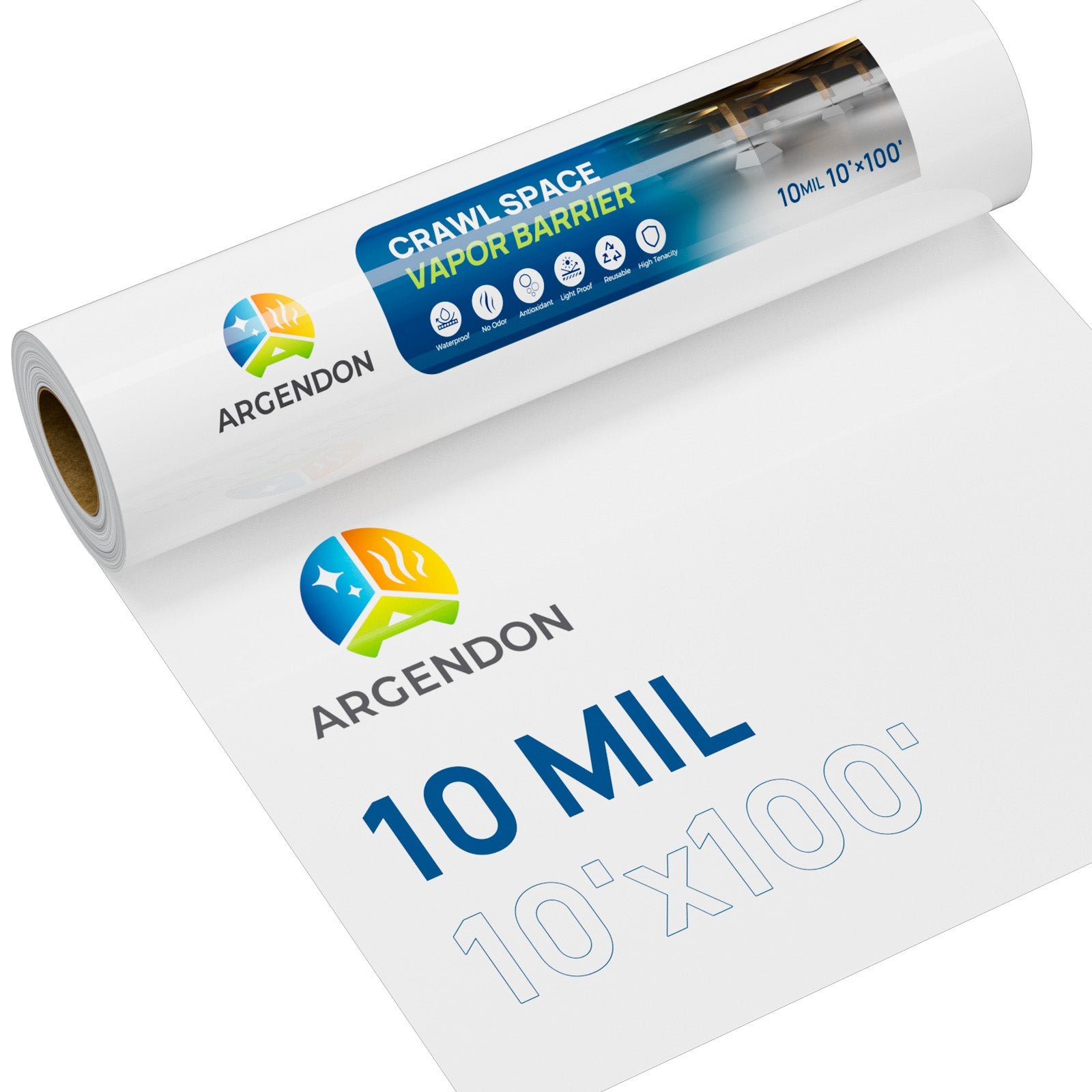
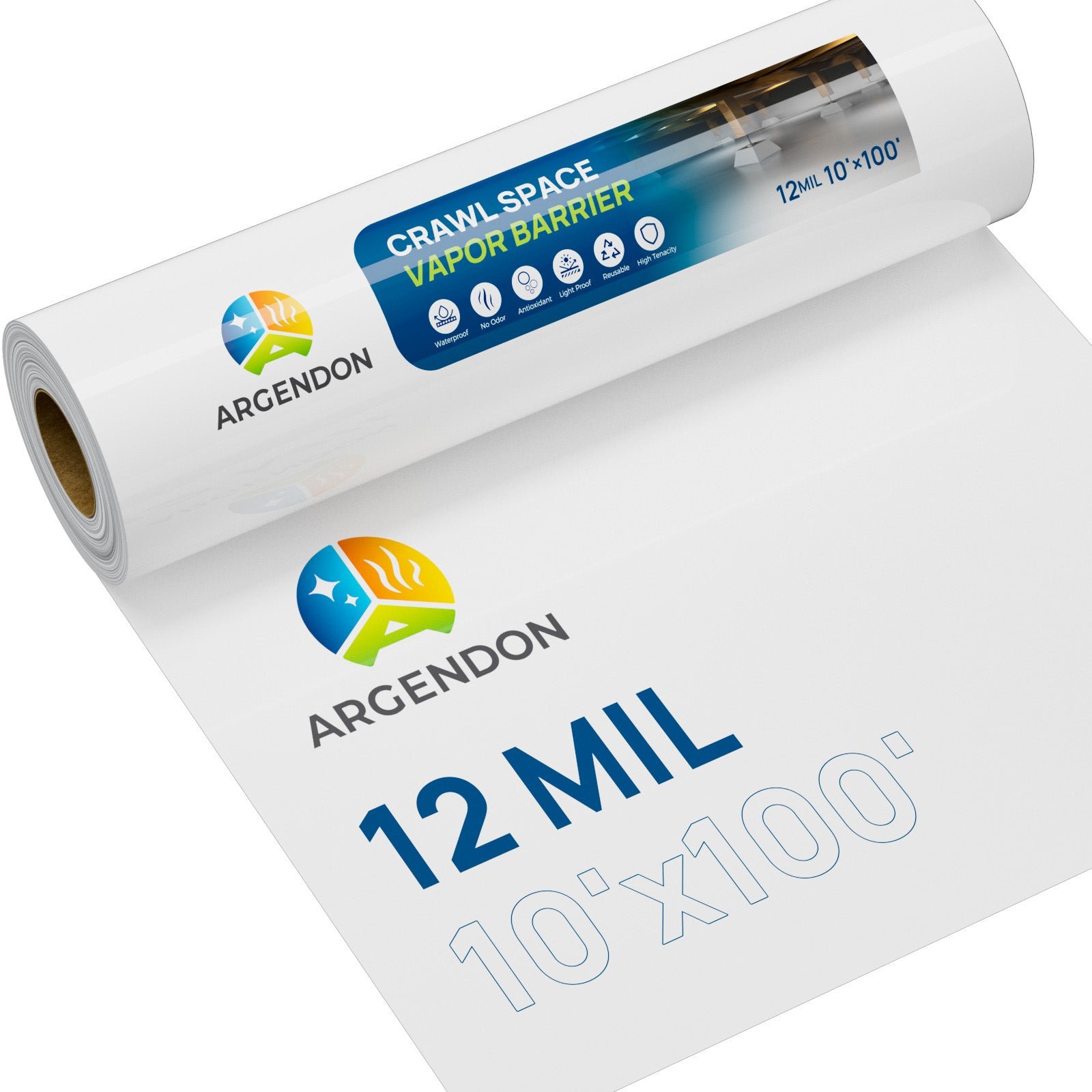
Dimensions and specifications
| Specification | Argendon 10 mil | Argendon 12 mil |
|---|---|---|
| Thickness | 10 mil (0.010 in) [1] | 12 mil (0.012 in) [2] |
| Width × length | 10 × 100 ft [3] | 10 × 100 ft [4] |
| Material area | 1000 ft² [3] | 1000 ft² [4] |
| Material | Polyethylene [1] | Polyethylene [2] |
| Faces | White and black [1] | White and black [2] |
Thickness is stated in mils: 1 mil = 0.001 inch.
Strength and service life
Argendon's 12 mil description emphasizes resistance to damage during installation and subsequent crawl space inspections. Puncture and tear resistance are also claimed for the 10 mil film. These product pages provide no comparative test results, so they do not establish how the two films differ in strength or service life. [1] [2]
Which blocks more water vapor?
The relevant measure is vapor permeance, expressed in perms. A lower value means less water vapor passes through the material under the same test conditions. Argendon's product pages and galleries give no perm rating for either the 10 mil or the 12 mil film, leaving no basis for choosing between them on this measure. [1] [2]
The U.S. Department of Energy (DOE) provides a material-selection benchmark in its installation job aid: a minimum thickness of 6 mil and a perm rating of 0.1 or less. Both Argendon films meet that thickness recommendation on their published specifications; their perm ratings remain unverified. [5]
How much material to buy
The stated 1,000 ft² is the area of material in a roll. Some of it goes into seam overlaps and up the walls and piers. The DOE job aid calls for overlaps of at least 12 in and extensions of at least 6 in up walls and piers. [5]
One roll will not cover a 20 × 50 ft crawl space, even though its floor area is also 1,000 ft². Two 50 ft lengths laid side by side with a 12 in overlap cover a width of 19 ft. That leaves a 1 × 50 ft strip of exposed soil along the edge, before allowing any material for walls and piers.
Installation and service-path protection
Remove debris and address standing water before laying the film. In an unvented crawl space, seal seams and pipe penetrations, and fasten and seal the film at walls and piers. Repair tears with tape designed for polyethylene. [5] [6]
To protect service paths to equipment, guidance from the U.S. national laboratory PNNL suggests laying a vinyl runner or an extra layer of plastic over the main ground cover. [6]
If water collects in the crawl space, the sequence for drainage and ground-cover work is explained in our Florida crawl space moisture guide.
Sources
Product pages, galleries and documents checked October 27, 2026.
- Argendon 10 mil: product page and gallery. Specifications, intended uses and product photograph.
- Argendon 12 mil: product page and gallery. Specifications, damage-resistance claims and product photograph.
- Argendon 10 mil: manufacturer's dimension graphic. 10 × 100 ft, 1000 ft².
- Argendon 12 mil: manufacturer's dimension graphic. 10 × 100 ft, 1000 ft².
- DOE, Install or Repair a Crawl Space Vapor Retarder (PDF), June 2024: page 1 covers thickness, perm rating and overlap dimensions; pages 2-3 cover sealing and installation checks.
- PNNL, Capillary Break at Crawlspace Floors. Ground preparation, sealing and repairs; service-path protection appears in Description, step 5.

