
Midea Cube vs Frigidaire: Two Answers to the Same 50-Pint Problem
Comparing the midea cube vs frigidaire comes down to two questions that the marketing on both boxes avoids: where does the water go, and what is the manufacturer willing to put in writing. On capacity the two are almost the same unit. The ENERGY STAR registry lists the Midea Cube MAD50PS1QWT at 49.67 pints per day and the Frigidaire FFAD5033W1 at 50.00 under the Appendix X1 procedure.
Disclosure: This article contains affiliate links, including links to Amazon, Sylvane, and other partners. If you purchase through these links, we may earn a small commission at no extra cost to you. As an Amazon Associate I earn from qualifying purchases. Full disclosure: Affiliate Disclosure.
Everything else about them diverges. This comparison draws on the federal registry, both manufacturers’ manuals and spec sheets, independent lab readings, and aggregate Amazon review data covering 1996 through 2023. Both units also appear in the broader dehumidifier guides that cover sizing and placement.
Capacity: 49.67 against 50.00
Both are certified, both sit at the top of the class, and the gap is a third of a pint per day.
The more useful fact sits in the same registry: across 511 portable models, nothing exceeds 50.0 pints per day under Appendix X1. A box printed with “70 pint” is quoting the 2012 test procedure rather than the current one. On this point both brands are straight with the buyer, since both sell a 50 and both measure as a 50.
Efficiency separates them. The integrated energy factor is 2.01 for the Cube against 1.8 for the Frigidaire, and the registry lists the Cube’s annual consumption directly at 515 kWh. The registry carries no matching line for the Frigidaire, and converting an efficiency factor into dollars is a separate calculation that depends on a local rate.
Measured draw is available for both from one lab running one test at 50% relative humidity: 512 watts for the Cube, 570 for the Frigidaire. Frigidaire has since released the FFAD5034W1, a 2024 update that drew 560 watts in the same test; the lab found no other meaningful difference between the two.
Drainage: the pump is an upcharge on both
Start with what both brands blur. Neither ships a pump in the base configuration.
Frigidaire sells the FFAD5033W1 without a pump and the FFAP5033W1 with one. Midea does the same thing through its model index, where the P marks the pump: the MAD50PS1QWT carries it, the MAD50S1QWT does not. The 35-pint tier repeats the pattern with the MAD35S1QWT and MAD35PS1QGR. The 20-pint tier has no pump version at all. Lift on the pump-equipped Cube is 14 feet.
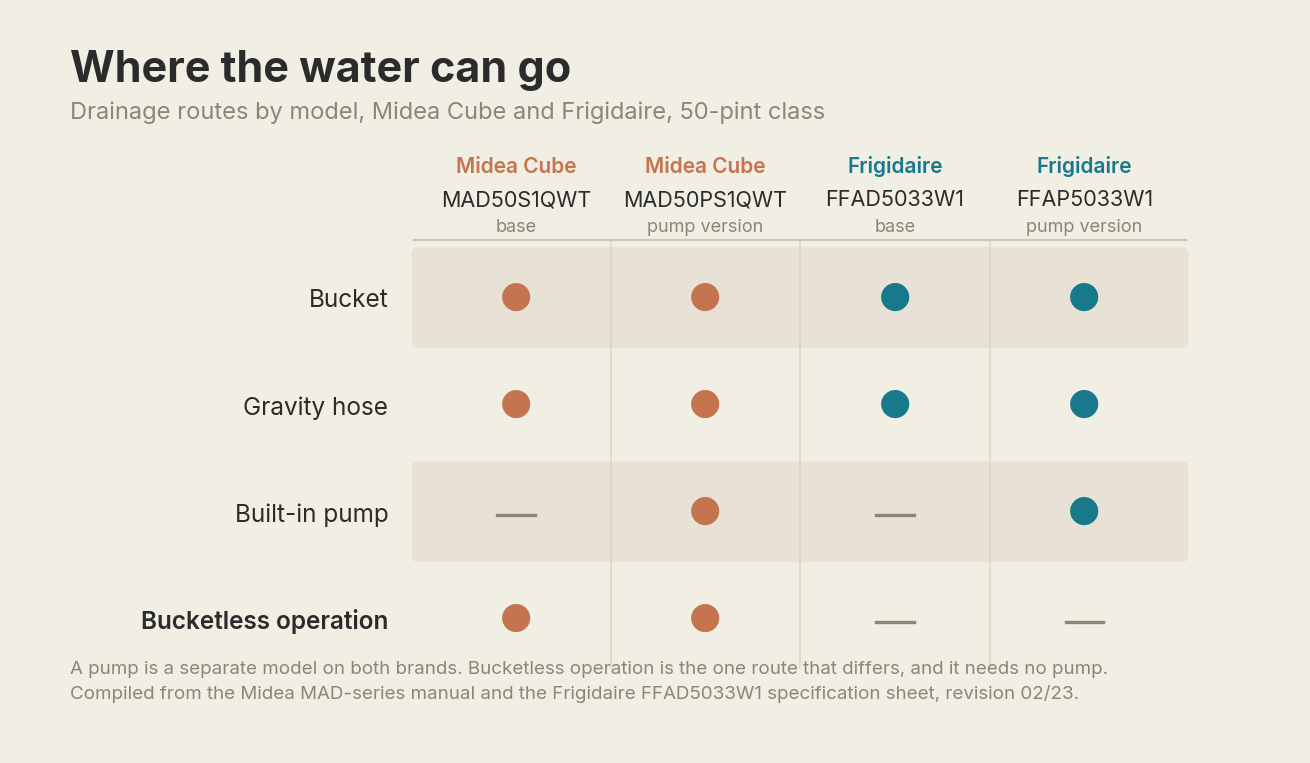
The real difference is what remains once the pump is off the table. A base Frigidaire offers two routes for the water: the bucket, or gravity through a hose. A base Cube offers three, because it also runs bucketless, sending condensate straight to the drain. That mode needs no pump, which is why the 35-pint version has it without one. Among the portable models covered in the build teardown, bucketless operation appears only in the MAD series.
None of this is abstract in a Florida house, where a dehumidifier runs year-round rather than for two months of a season. A pump removes the drainage question entirely, gravity draining needs both a slope and a drain within hose reach, and a bucket needs somebody home to empty it.
Shutoff levels on the Cube are documented individually at 2.25, 3.0, 3.75 and 4.25 gallons. Frigidaire publishes a bucket capacity but no shutoff scale, and ships no hose, though the housing takes a standard garden fitting.
Manufacturer bucket figures are not directly comparable, since the two companies measure and report them differently. The same third-party lab does measure them the same way, and by that measure the Cube holds 34 pints against 16.9 for the Frigidaire. That 34 pints works out to 4.25 gallons, matching the top shutoff level in the MAD-series manual. A bucket twice the size is also the reason bucket handling comes up so often in Cube reviews.
What gets published, and what does not
On disclosure Frigidaire is ahead.
Its spec sheet, revision 02/23, gives sound output at each fan speed at 47, 49 and 51 dBA, and airflow at 167, 194 and 229 CFM. Among the portable models covered in the build teardown, per-speed noise and airflow come from Frigidaire alone.
Midea publishes neither figure for the Cube. The 50-pint manual carries no dimensions table either. The unit with the more complicated architecture is documented more thinly than the simple one.
Noise: a spec and a measurement are not the same number
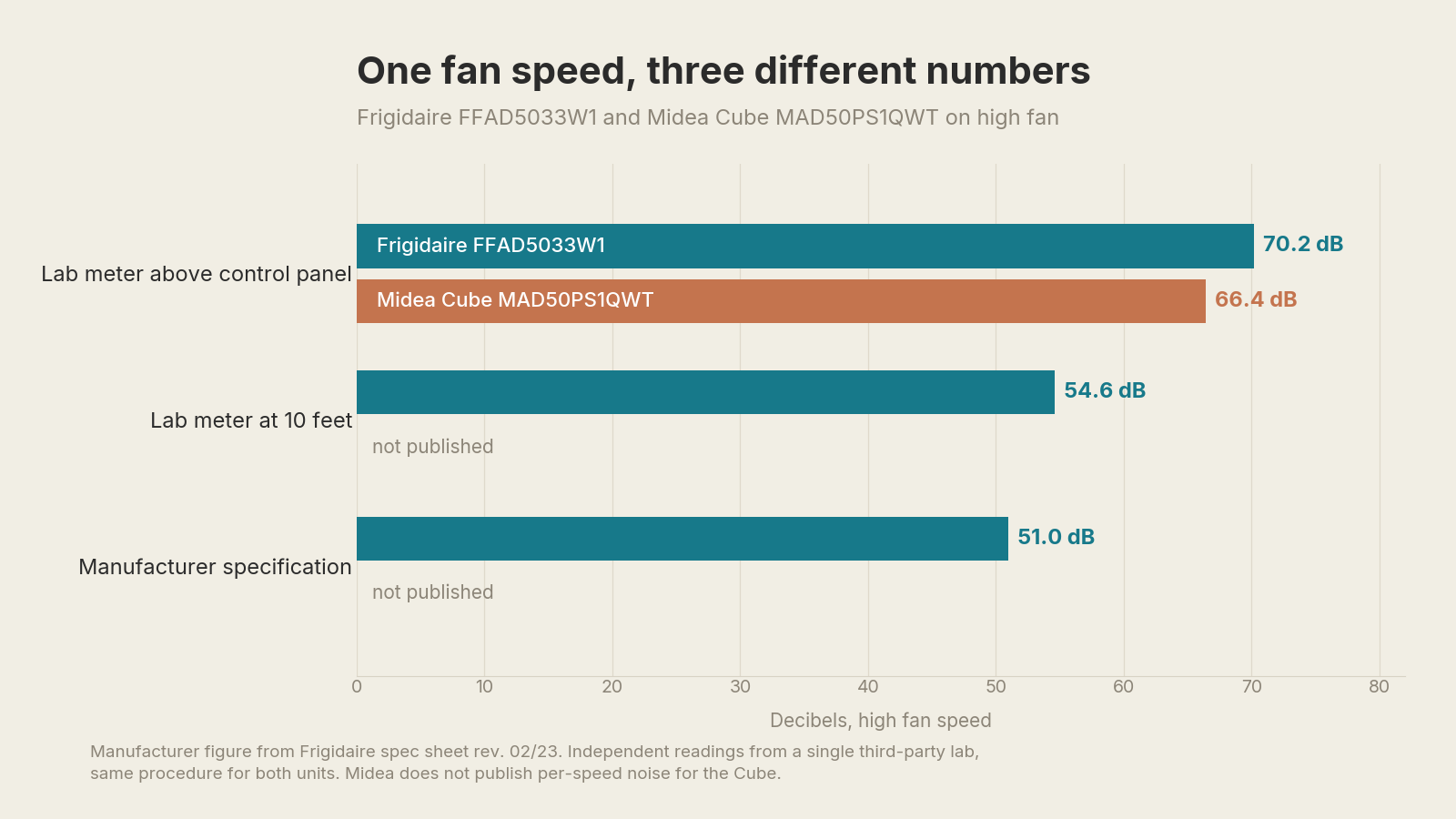
There is nothing to compare on the spec side, since Frigidaire publishes three speeds and Midea publishes none for the Cube.
Independent readings exist for both, taken by one lab under one procedure. With the meter above the control panel on high fan, the Cube reads 66.4 dB and the Frigidaire 70.2 dB. On low fan the Frigidaire reads 64.8 dB; the same lab does not report a low-fan figure for the Cube.
The distance between spec and measurement shows up immediately. Frigidaire’s sheet says 51 dBA on high, and the meter above the panel says 70.2 dB. That is a difference in where the microphone sits rather than a difference in honesty. The same lab also reads from ten feet away, and at that distance the FFAD5033W1 gives 54.6 dB on high and 49.8 on low. A published specification and a close-range reading should not be set against each other for either brand.
One more detail from the same testing: airflow on the Cube measured 430 CFM on high, against 229 CFM on the Frigidaire spec sheet. The Cube moves considerably more air and still reads about four decibels quieter under identical measurement conditions.
Reviews: 25.7% for the Cube, 31.7% for the Frigidaire
A core set of household compressor dehumidifiers was pulled from the Amazon review corpus. Brands enter the ranking at 700 reviews or more.
Frigidaire carries 4,002 reviews with 31.7% of them rated one or two stars. Among brands in the sample with 700 or more reviews, that is the second-highest share; only BLACK+DECKER sits above it at 36.4%.
Midea as a brand carries 2,365 reviews at 24.8%.
Those two lines have to be kept apart. The Midea row covers the entire lineup, including the rectangular cabinets of earlier years.
The Cube as its own cohort reaches 491 reviews, short of the 700 needed to enter the brand ranking, and carries a 25.7% low-rating share against 17.6% for the sample excluding it. Below that threshold the direction is visible and the second decimal is not.
Read as models rather than brands, the gap narrows: 25.7% for the Cube against 31.7% for the Frigidaire, on cohorts differing eightfold in size.
Time to failure
Frigidaire owners named a service life before breakdown in 445 reviews, with a median of 12 months. The Cube produced twelve such mentions, which is too thin to report.
The sampling bias here is severe and worth naming outright: people who state a duration are almost entirely people whose unit failed. This is not a service life and not a failure rate. It is the distribution of durations inside complaints. One thing follows from it, which is that the failures being described arrive early, and a one-year warranty covers roughly two-thirds of them.
Complaint profile in a humid climate
The Florida cohort diverges from the rest of the country on three themes.
| Theme | Florida, % | Rest of US, % |
|---|---|---|
| Noise | 15.6 | 9.9 |
| Full bucket and float shutoff | 13.8 | 8.8 |
| Coil frosting | 0.9 | 1.5 |
Share of reviews mentioning each theme, Amazon corpus 1996–2023, household compressor dehumidifiers.
Frosting, which drives a large share of northern coverage, runs lower here at 0.9% against 1.5%. A compressor dehumidifier frosts when the surrounding air is cold, and those conditions rarely assemble in a Florida house. Both units carry a 41 °F lower operating limit that has little practical weight in this climate.
Noise and bucket complaints move the other way. That reflects operating conditions rather than build quality: where a dehumidifier is switched on for two summer months, it accumulates two months of runtime a year. Here it does not switch off.
One line specific to the Cube: the bucket theme reaches 36.7% of its mentions against 18.6% for the category. Theme tagging does not separate praise from complaint, so the number cannot be read as a mark against the unit. It says one thing, which is that Cube owners bring up the bucket about twice as often as the category average.
Recall history
Frigidaire overlaps with brands that have appeared in CPSC recall campaigns. That is an observation about two lists intersecting rather than a claim about the cause of low ratings. The campaigns themselves are covered in the CPSC recall research.
Midea Cube vs Frigidaire: which one suits which house
The midea cube vs frigidaire choice resolves on layout more than on brand. The Cube earns its place where the drain is far away or absent. The pump version lifts condensate 14 feet, and bucketless operation works even on the base unit. The price is a thin specification, since neither the MAD-series manual nor the registry carries per-speed noise, leaving a buyer to rely on third-party measurement.
The Frigidaire earns its place where gravity draining is available and where knowing the sound output at each speed from the manufacturer matters before purchase. In exchange the buyer takes on a 31.7% low-rating share across the 1996-2023 corpus and a louder unit by independent reading. Detailed breakdowns for each sit in the Midea Cube review and the Frigidaire review, and both feed the broader Florida selection guide.
Current retail options: Midea MAD50S1QWT at Sylvane (optional pump kit available; this is not the built-in-pump model), Frigidaire FHDD5033Y1 at Sylvane (no pump), and Frigidaire FHDP5033Y1 at Sylvane (built-in pump). The Frigidaire units are current retail successors, not the FFAD5033W1 and FFAP5033W1 research models, so the earlier figures are not assigned to them.
Limits of this comparison
- I have not tested either unit, and there are no field measurements here.
- ENERGY STAR registry figures come from a 65 °F / 60% RH test and understate performance in Florida conditions.
- Noise and power readings come from a third-party lab whose conditions differ from manufacturer procedure.
- A low rating is not only about breakdowns; shipping complaints and awkward bucket handling land there too.
- The Cube share rests on 491 reviews, below the 700-review ranking threshold.
- The Amazon corpus ends in 2023 and excludes the 2024–2026 layer.
- ENERGY STAR certification is neither a guarantee of quality nor a recommendation.
- Manufacturer bucket figures are not equivalent across brands; the comparison here rests on one lab measuring both units the same way.
Frequently asked questions
Are the Midea Cube and the Frigidaire in the same capacity class?
By the ENERGY STAR registry, yes: 49.67 and 50.00 pints per day under Appendix X1. The gap is a third of a pint per day.
Which model has a built-in pump?
Both brands sell the pump as a separate variant. For Midea it is the MAD50PS1QWT with 14 feet of lift, while the base MAD50S1QWT has none. For Frigidaire it is the FFAP5033W1, with the base FFAD5033W1 unpumped.
Which of the two is quieter?
In one lab’s reading with the meter above the control panel on high fan, the Cube gave 66.4 dB and the Frigidaire 70.2 dB. The published specifications cannot be compared, because Midea does not release per-speed noise for the Cube.
Which one has more low ratings?
The Frigidaire cohort shows 31.7% one- and two-star ratings across 4,002 reviews; the Cube cohort shows 25.7% across 491. The Midea brand as a whole, covering older models too, sits at 24.8% across 2,365 reviews.
Why is there no separate figure for the Cube?
The Cube reaches 491 reviews against a 700-review inclusion threshold. A share calculated on that volume swings too easily to publish responsibly.
Sources
- ENERGY STAR Certified Dehumidifiers registry, Appendix X1 capacity and IEF values.
- Midea MAD-series owner’s manual; Frigidaire FFAD5033W1 specification sheet, revision 02/23.
- Independent bench readings for noise, airflow and power draw, single third-party lab.
- Amazon Reviews 2023 dataset, household compressor dehumidifier subset, 1996–2023.
- CPSC recall records via SaferProducts.gov.