
This page summarizes official public records (CPSC, DOJ) and publicly submitted consumer reports. Consumer reports are unverified. Nothing on this page states or implies that any brand currently sells unsafe products.
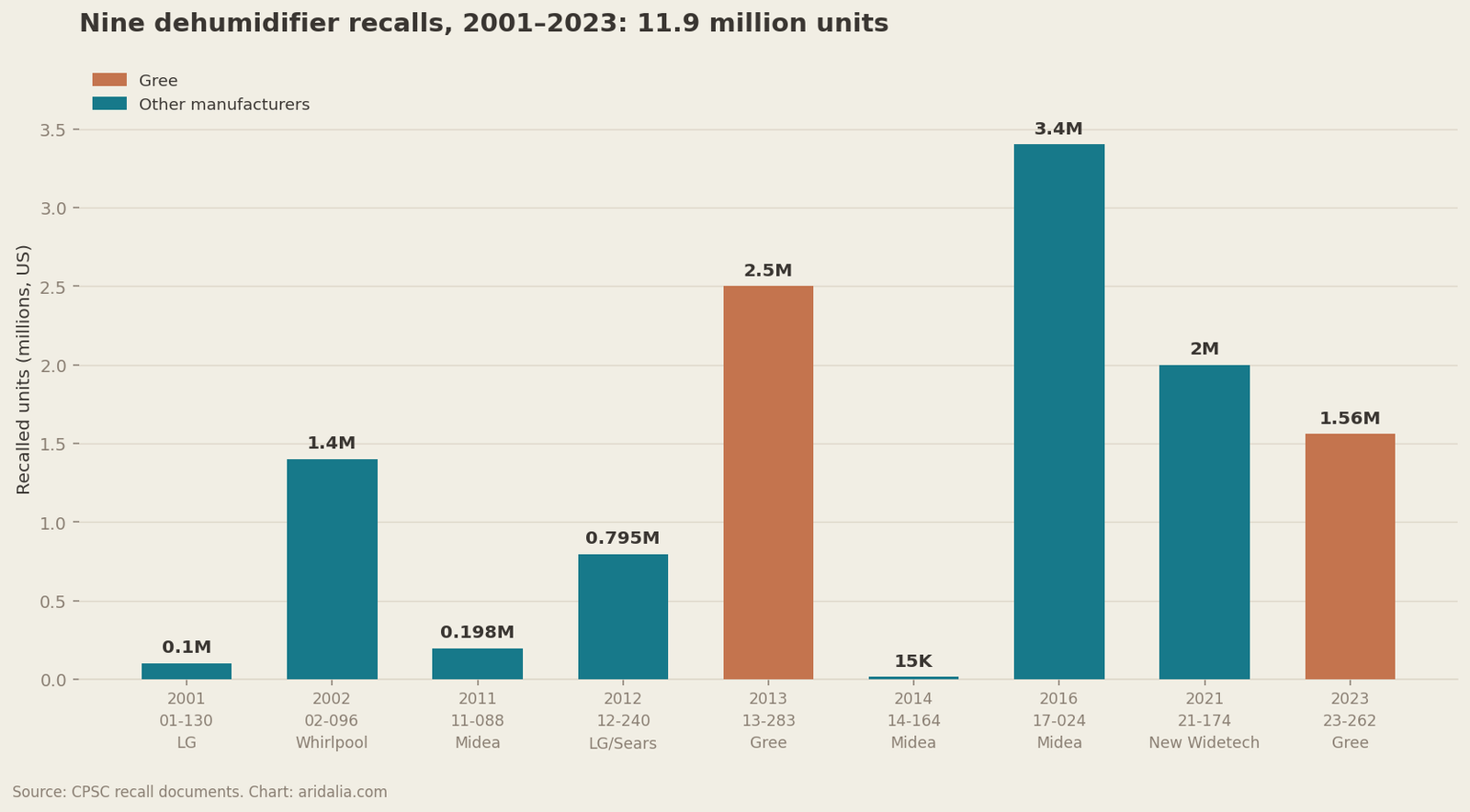
This page covers all US dehumidifier recalls from 2001 through 2026. Nine recall actions, roughly 11.9 million recalled units, and all nine share one hazard: overheating and fire risk.
The data comes from three places. Official recall documents of the Consumer Product Safety Commission (CPSC): every recall in the table below stands on its own document, with a number and a link. Press releases of the US Department of Justice on the Gree criminal case. And the public consumer-report database SaferProducts.gov, which we downloaded in full on July 23, 2026 and counted ourselves: 68,604 incident reports in the database, 471 of them about dehumidifiers.
The data is public; the analysis is ours. We built the recall table from CPSC primary sources, and every row checks out against its link. The SaferProducts reports we counted from the raw database dump; in the course of this work we never came across a ready breakdown of those filings by year, matched against recall dates, so we ran it from scratch.
What this page is for: checking your own unit takes two minutes, the steps are below. And if you are buying a used dehumidifier, this page explains why you check the model number first and pay second.
One thing before the first number. The reports in the SaferProducts database are submissions that people filed with the CPSC. The Commission does not verify them and does not guarantee their accuracy. So everywhere below, report counts are counts of filed submissions, not counts of confirmed defects. Recalls, penalties, and sentences are a different matter: those are official documents.
Nine recalls: the summary table
| Year | Recall # | Manufacturer | Units (US) | Brands | Reported to manufacturer/CPSC |
|---|---|---|---|---|---|
| 2001 | 01-130 | LG Electronics | ~100,000 | 3 | 7 overheating reports, 4 fires |
| 2002 | 02-096 | Whirlpool | ~1.4 million | 3 | 13 overheating reports |
| 2011 | 11-088 | GD Midea | ~198,000 | 2 | 14 smoke reports, 8 fires |
| 2012 | 12-240 | LG / Sears | ~795,000 | 1 (Kenmore) | 107 incidents, $7+ million in damage |
| 2013 | 13-283 | Gree | ~2.5 million | 13 | by 2023: ~450 fires, $19+ million in damage |
| 2014 | 14-164 | GD Midea | ~15,500 | 1 (GE) | 1 fire |
| 2016 | 17-024 | GD Midea | ~3.4 million | ~50 | 38 smoke/fire reports, $4.8 million |
| 2021 | 21-174 | New Widetech | ~2 million | 20 | 107 incidents, $17 million |
| 2023 | 23-262 | Gree | ~1.56 million | 5 | 23 fires, 688 overheating incidents |
Three numbers from this table worth holding on to.
11.9 million units: the combined volume of nine recalls over a quarter century.
Three factories account for 9.7 million of them. Gree, GD Midea, and New Widetech are contract manufacturers that built dehumidifiers for other companies’ brands. That is the next section, and it is the single most useful thing on this page.
Zero dehumidifier recalls since August 2023. No new recalls have been announced since. Worth keeping in mind only that a recall is not a fast process: in the Gree case, the DOJ found the reporting of fires was delayed by about six months. Consumer reports keep arriving in the CPSC database today.
One factory, many nameplates: why the brand tells you nothing
How does one recall cover 50 brands? Because those 50 brands did not build their dehumidifiers. One factory built them; the brands put their name on the case.
Recall 17-024 (2016): one manufacturer, GD Midea, and about 50 names on the units, from Frigidaire and GE to Sunbeam and Sylvania. Recall 21-174 (2021): New Widetech, and 20 brands, including Honeywell, Whirlpool, and De’Longhi.
Now the same table flipped, by brand: how many times a single name appeared in recalls across different factories.
Frigidaire: twice. In 2013, the units sold under that name came from the Gree factory; in 2016, from the Midea factory. Same nameplate, different factories, and both sets of units were recalled. (We look at the brand’s current lineup separately: Frigidaire dehumidifier review.)
GE: six recalls spanning three different manufacturers: LG (2001), Midea (2011, 2014, 2016), Gree (2013 expansion, 2023).
Kenmore: six recalls, across four manufacturers: LG, Whirlpool, Gree, Midea.
The conclusion this page exists for: the name on the case does not tell you who built the machine or how. You check the model number, not the brand. “It’s a Frigidaire, that’s a solid company” is not an argument, not at the store, and not for the unit already humming in your hallway.
Who actually builds dehumidifiers: three factories behind half the table
Gree, GD Midea, New Widetech. Three names that account for 9.7 of the 11.9 million recalled units, and that a shopper almost never sees on the shelf.
All three are contract manufacturers (the industry term is OEM, original equipment manufacturer). The scheme is simple. The factory has the assembly line and the unit cost. The brand has the name and the shelf space. The brand orders a production run, the factory prints someone else’s name on the case, and the shopper carries home a “Frigidaire” or a “Honeywell” built on the same line as a dozen of its shelf neighbors. Gree and Midea are not anonymous workshops, either: both rank among the largest climate-appliance makers in the world, and a large share of the dehumidifiers on the US market in the 2000s and 2010s came off their lines. The recall table above shows the scale.
For the buyer, there is nothing wrong with this scheme by default: most home appliances and electronics are built this way. What matters are two consequences.
First consequence: a defect scales with the assembly line. If the problem sits in the design or in a component, it ships out in every production run of every brand that line served. That is why a recall is issued by manufacturer and covers every nameplate at once: for Midea in 2016, about 50 names; for New Widetech in 2021, twenty. One defect, fifty “different” machines in different boxes.
Second consequence: the brand on the case is not the responsible party, and finding who is takes work. In CPSC recall documents, every product has three roles: the manufacturer (the factory), the importer (who brought it into the US), and the brands it sold under. Sometimes that is three different companies in three jurisdictions. When a unit starts smoking, the owner calls “Frigidaire,” and the recall hotline belongs to a factory the owner has never heard of. The Gree case shows the full structure: the factory in Zhuhai, sales through a Hong Kong entity, a US subsidiary in California. It was the US subsidiary and its executives who ultimately answered in an American court.
And the scheme did not retire with these recalls. It is visible in a completely separate federal record, one that has nothing to do with safety. The ENERGY STAR register of certified dehumidifiers lists 535 models, and each entry names both the brand and the company that filed the certification. Those 535 models carry 128 brand names between 75 filing companies. One filer accounts for thirteen separate brand names on its own. In 43 entries the manufacturer simply listed the brands together in a single field, four names to one model. Different decade, different agency, same structure. We took that register apart in full: the ENERGY STAR register analysis.
Which brings the practical conclusion back, the same one this whole page makes, but now with the mechanism visible. Checking a unit by brand is pointless not because brands hide anything, but because a brand is a label on a sales channel, while a defect lives on an assembly line. The model number is the only identifier that reaches the specific line and the specific production run. That is why CPSC’s recall tools work by model number only.
The Gree story: thirteen years of one defect
Of the nine rows in the table, the Gree story is the longest and the most instructive. From CPSC and Department of Justice documents, it runs like this.
September 2012. According to the case materials, executives of Gree’s US arm were already receiving reports that the units were defective and could catch fire. [DOJ, 2025]
September 2013. Recall 13-283: about 2.2 million dehumidifiers under 12 brands (GE was added in January 2014, making it 13 brands and roughly 2.5 million units). According to the DOJ, by that point the reporting of fires had been delayed by about six months, and of the defect itself by about nine. [CPSC 13-283; DOJ, 2021]
March 2016. A $15.45 million civil penalty, at the time the largest in CPSC history. The charges it settled: knowingly failing to report the defect; making misrepresentations to CPSC staff; selling units bearing the UL safety mark while knowing they did not meet UL flammability standards. Gree did not admit the charges. [CPSC, 2016]
November 2016. CPSC re-announces the recall: by then, about 450 reported fires and $19 million in reported property damage. The re-announcement itself is the point: agencies repeat a recall when recalled units remain in circulation. [CPSC, 2016]
October 2021. The Department of Justice announces a $91 million resolution: the first corporate criminal enforcement action in the history of the Consumer Product Safety Act. [DOJ, 2021]
April 2023. Sentencing of Gree USA, which had earlier pleaded guilty to a felony violation of the CPSA: a $500,000 fine. [DOJ, 2023]
August 2023. Two events in one month. CPSC issues a warning about the decade-old recall, under the agency’s own headline: “4 Deaths May be Tied to Recalled Units,” referring to fires from 2016 to 2022; the regulator’s wording is “may be tied.” [CPSC Warning, 2023] And in the same month, Gree’s second recall, 23-262: another 1.56 million units built in 2011–2014, with 23 reported fires and 688 reported overheating incidents. [CPSC 23-262]
June 2025. Two Gree USA executives receive federal prison sentences: 38 and 40 months. The first prison sentences in history for failure to report under the CPSA. [DOJ, 2025]
Thirteen years from the first signals to the sentencing. And the takeaway for an owner is not about Gree. It is that a dehumidifier lives in a house for ten years and more, outlives the news of its own recall, and keeps running until someone stops it. Nobody unplugs it but the owner.
471 reports in 15 years: what we counted in the SaferProducts database
CPSC press releases are the storefront. There is also a back door: SaferProducts.gov, the public database where anyone can file a report about a product incident. We downloaded the full database dump on July 23, 2026 and filtered for dehumidifiers. The frame again: these are unverified submissions, and the numbers below are about what people filed and when, not about proven defects.
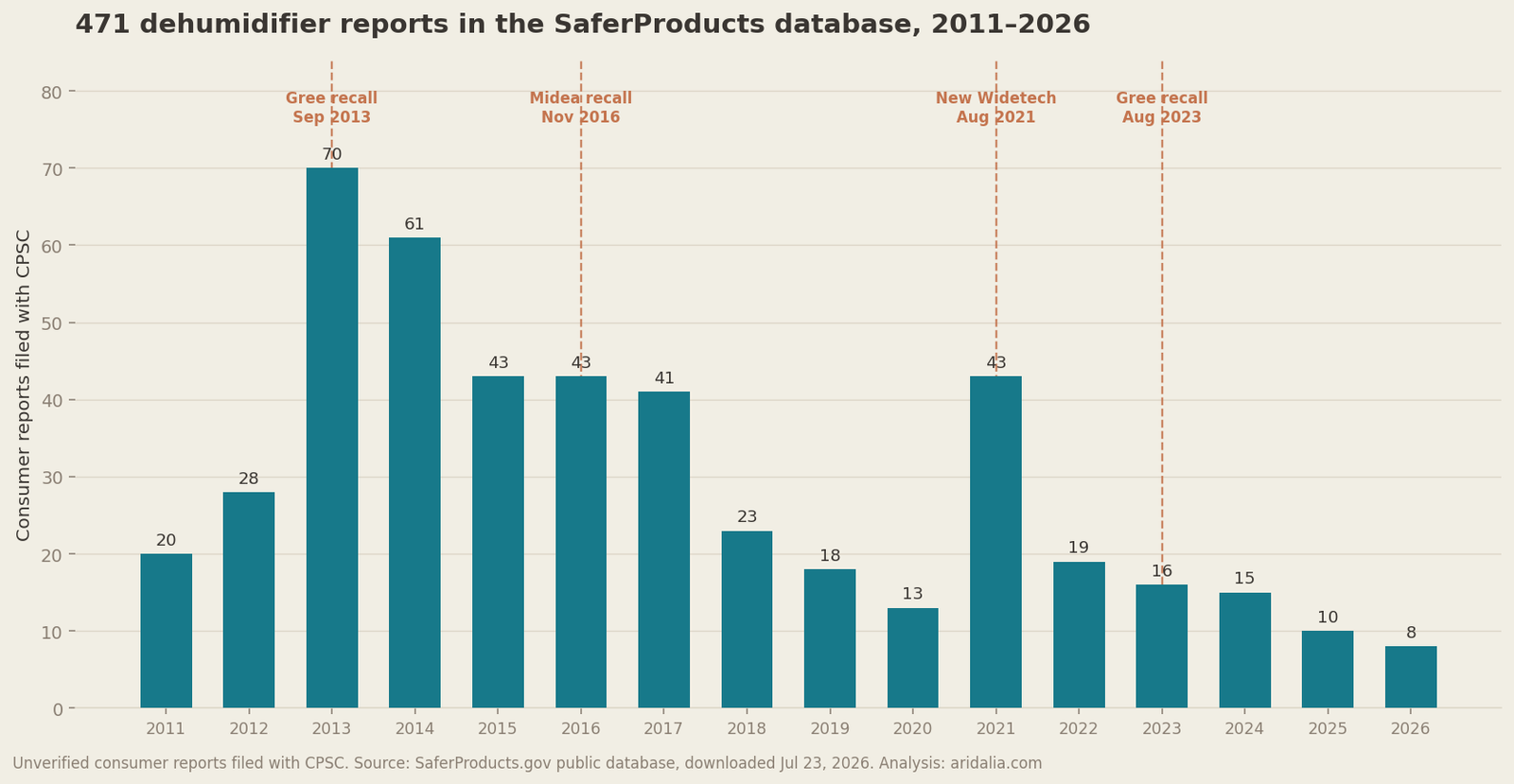
471 reports about dehumidifiers from March 2011 through July 2026.
397 of 471 (84%) mention fire, smoke, melting, or overheating. People rarely file reports about a dehumidifier that dries poorly; the filings overwhelmingly describe fire-safety concerns. That is the category’s profile.
Filing spikes line up with recall dates. A typical month in the database has two to four dehumidifier reports. September–October 2013: 47 reports; the Gree recall was announced September 12. August 2021: 27 reports; the New Widetech recall was announced August 4. The way to read it: a recall announcement makes people look closely at their unit for the first time. A spike in filings is a spike in attention, not necessarily a spike in incidents happening those same weeks.
The top brands in the filings mirror the recall lists. SoleusAir (116 reports), Frigidaire (69), Kenmore (50), GE (31), Whirlpool (27). All five appear in the recall waves. The filings and the recalls tell one story from two sides.
Filings about recall-wave brands did not stop after the recalls. After September 2013, another 253 reports were filed about the five main brands; after November 2016, another 127; after August 2023, 21. That squares with the Gree chronology: a recalled unit does not leave the house on its own.
Two cautious margin notes. Florida accounts for just 6 of the 471 reports; the top filing states are Wisconsin, Pennsylvania, and New York. That is the geography of filings, not a risk map: Florida has historically had fewer dehumidifiers per household, and “we’re safer here” does not follow from six reports.
The second note concerns the newer marketplace brands: Waykar, Yaufey, Kesnos, Vremi, hOmeLabs. Filing counts for them run from zero to three per brand, numbers far too small to support any conclusion, and we draw none. What can be said comes from the certification register rather than the complaint database: Waykar, Yaufey, Kesnos, and Fehom are certified by a single filing company, and in several ENERGY STAR entries all four names sit in one field on one model. That is a fact about paperwork, not about safety, and it proves nothing about how any of those units are built. It is worth knowing for a different reason: someone comparing Waykar against Yaufey to pick the more reliable one is comparing two labels on one filing. The old lesson of this page, brand is a sales channel, applies to the marketplace era too.
Check your dehumidifier: two minutes
The order is this.
1. Model number. The sticker on the back or side of the unit: model number, next to the serial number and manufacture date.
2. Run it through the official tools. The dehumidifier recalls page at cpsc.gov covers all nine actions. For the Gree wave: greedehumidifierrecall.com. For the 2016 Midea wave: recallrtr.com/dehumidifier. Both tools are referenced in the official recall notices: enter the model number, get the answer.
3. If your unit is on a list: turn it off and unplug it now. Not “after this season.” Then follow that recall’s instructions. The remedy depends on the recall: a refund, a replacement, or a repair. The reason for these recalls is the risk of overheating and fire, which is why CPSC’s instruction is to stop using the unit immediately, not to repair it yourself or keep an eye on it.
4. If it is not on any list: the unit has not been recalled. That is not a certificate of eternal safety, but the formal check is passed. From there, ordinary care: keep it clear of curtains and other fabric, and clean the filter.
Buying used: a separate conversation
A dehumidifier is a durable machine: it runs for ten years and more. The 2013–2016 waves are units that are now 10–15 years old, and CPSC was still reminding the public about those recalls in 2023, because the units were still in homes. On the used market, a unit like that gets checked before the money changes hands.
Two facts for that situation.
First: selling a recalled product is prohibited by federal law. The seller at a garage sale most likely doesn’t know that; the law applies anyway.
Second: CPSC re-announced the Gree recall in 2014, 2016, and 2023. Three reminders about one recall, because the units stayed in use. A recalled unit does not become safer because the news about it faded.
So the used-market rule is simple: first a photo of the nameplate with the model number, then the money. Running the number takes two minutes: the recall search at cpsc.gov, greedehumidifierrecall.com for the Gree wave, recallrtr.com/dehumidifier for the Midea wave. And if a seller won’t send the model number, walk away. (What to buy new instead is a separate page: best dehumidifiers for Florida.)
Methodology
Recalls: official CPSC recall documents, each with its number; for the 2001 recall, the full text of the CPSC release in an archival reprint. The legal section: press releases of the CPSC and the US Department of Justice. Consumer reports: the full public dump of the SaferProducts.gov database, downloaded July 23, 2026 (68,604 reports, March 2011 to July 2026), filtered by the Dehumidifiers product category, analyzed in Python/pandas. CPSC does not guarantee the accuracy, completeness, or adequacy of information submitted to the database by people outside of CPSC; every report figure on this page is a count of filed submissions, not of confirmed defects, and our conclusions rest on aggregates and distributions, not on individual reports. Brand and filing-company counts come from the ENERGY STAR certified products register for dehumidifiers, retrieved July 28, 2026; a shared filing company means a shared certification applicant and nothing more. How we work with data in general: our methodology.
Frequently asked questions
Which dehumidifiers have been recalled in the US?
From 2001 through 2023, nine recalls covered about 11.9 million units under dozens of brands, including Frigidaire, GE, Kenmore, SoleusAir, Danby, Honeywell, and Whirlpool. All nine involved overheating and fire risk. What gets checked is the specific model number, not the brand.
How do I check if my dehumidifier was recalled?
Find the model number on the sticker on the back or side of the unit and run it through the recall search at cpsc.gov and, for the Gree and Midea waves, through the official tools greedehumidifierrecall.com and recallrtr.com/dehumidifier.
What should I do if my dehumidifier is on a recall list?
Turn it off and unplug it immediately, then contact the manufacturer per that recall’s instructions. The remedy depends on the recall: a refund, a replacement, or a repair. CPSC’s instruction for these recalls is to stop using the unit, not to repair it yourself.
Is it safe to buy a used dehumidifier?
Only after checking the model number against the recall lists: selling a recalled product is prohibited by federal law, and units from the 2013–2016 waves are only 10–15 years old. No model number, no purchase.
Why does one recall cover dozens of brands?
Because most brands don’t build dehumidifiers themselves: a contract factory builds them, and the brand adds its name. A recall is issued by factory and covers every nameplate at once. For Midea in 2016, that was about 50 brands. The pattern is still current: the ENERGY STAR register lists 128 dehumidifier brand names filed by 75 companies.
Sources
CPSC recall documents 01-130 (archival reprint), 02-096, 11-088, 12-240, 13-283, 14-164, 17-024, 21-174, 23-262 · CPSC Warning, Aug 2023 · CPSC civil penalty release, 2016 · CPSC civil penalty release, 2015 · DOJ press releases: 2021, 2023, 2025 · SaferProducts.gov public database (downloaded Jul 23, 2026) · ENERGY STAR certified dehumidifiers register (retrieved Jul 28, 2026).