
Florida Tenant Mold Rights: What the Law Actually Gives You
Florida has no separate mold law for rented housing. No permitted spore levels, no mandatory testing, no deadline for removing mold specifically, and no statewide requirement to disclose mold when an ordinary lease is signed.
Florida tenant mold rights work through something else: the landlord’s ordinary duty to maintain the property, written notice, and the procedures in Chapter 83 of the Florida Statutes. Mold is not its own category there. It is evidence of a moisture or building problem.
The rest of the material on this subject sits in the mold guides. What follows comes from the statutes as published by the legislature, the Florida Department of Health, the EPA and the CDC. This is not legal advice: a lawyer assesses a particular situation.
Where Florida tenant mold rights actually come from
Section 83.51(1) requires one of two things: compliance with applicable building, housing and health codes, or, where no such codes apply, keeping the roof, windows, doors, floors, steps, porches, exterior walls, foundations and other structural components in good repair, and the plumbing in reasonable working order.
The word mold does not appear in that text. The claim is built around the source instead: a roof, window or plumbing leak, water-damaged drywall, a broken condensate drain, recurring moisture, structural deterioration, a local code violation.
Where mold results from a cause like that, it can support a claim that section 83.51 was not complied with. It is not an automatic rule that the landlord answers for mold in every case.
| Property | What applies | Can be varied |
|---|---|---|
| Single-family, duplex | 83.51(1) only | In writing |
| Other dwellings | 83.51(1) and (2) | Limited |
For a single-family home or duplex the statute expressly allows those duties to be altered or modified in writing, so the lease matters. Subsection (2) adds pest control, locks, clean common areas, rubbish removal, heat in winter and running water for other dwellings.
Section 83.51(4) removes the landlord’s responsibility for conditions created by the negligent or wrongful act of the tenant, a family member or a guest.
About the “seven days to remove mold”
The line circulating online is that a Florida landlord has seven days to deal with mold. That is not accurate.
Seven days is the cure period for material noncompliance after proper written notice, not a remediation deadline. And there are two different notices, for two different remedies.
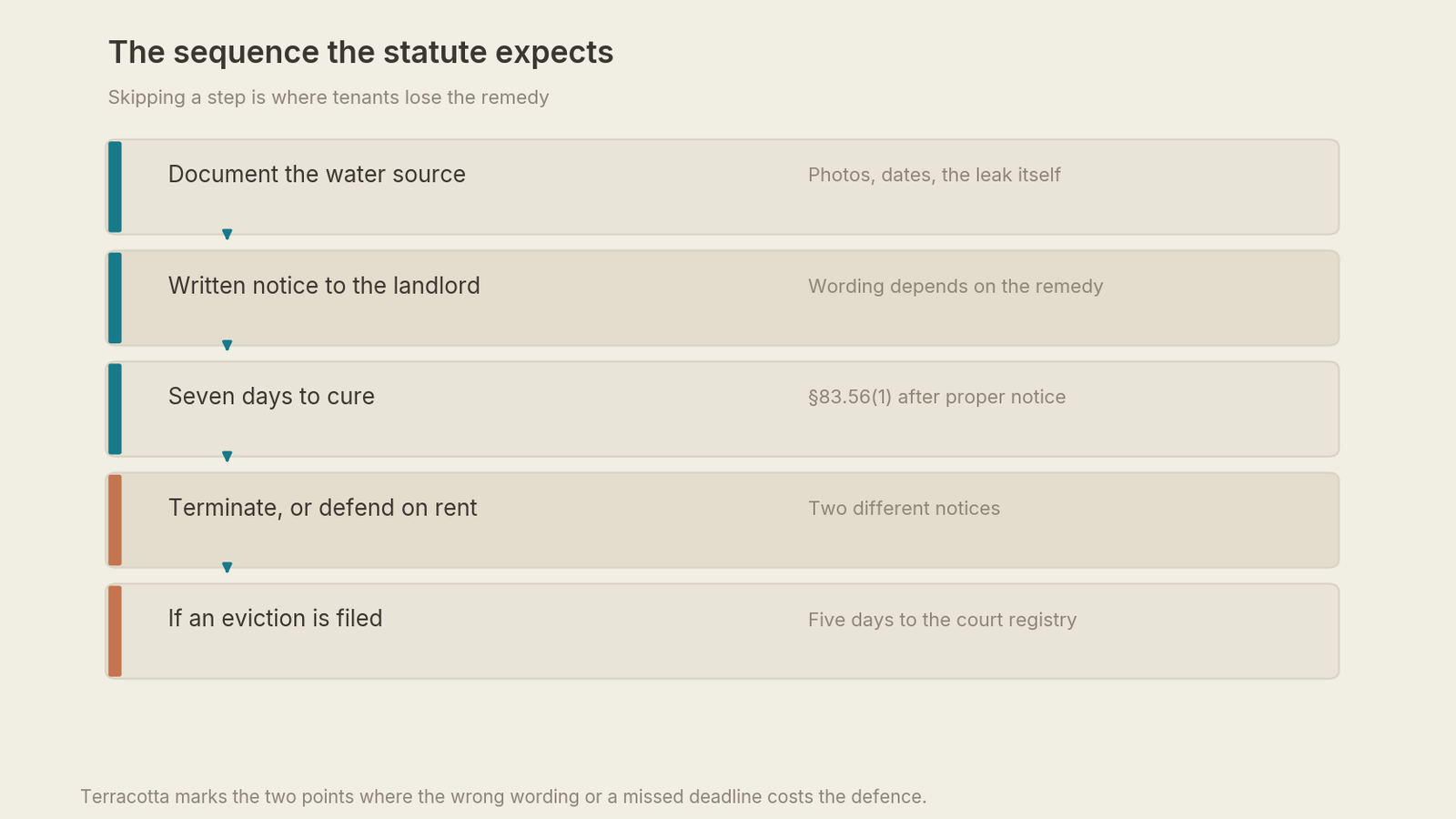
Termination, section 83.56(1). Written notice specifying the noncompliance and stating an intention to terminate the rental agreement. If it is not cured within seven days of delivery, the tenant may terminate.
A defence on rent, section 83.60(1)(b). Written notice specifying the noncompliance and stating an intention not to pay rent because of it. Seven days must pass after delivery before that defence is raised.
The content requirements differ because the remedies differ. The notice has to carry the statement of intention you plan to rely on: a notice of intention to terminate does not by itself support a rent defence, and the reverse holds too.
Section 83.56 also covers the case where the cause is beyond the landlord’s control and reasonable efforts are continuing: if the unit became untenantable and the tenant vacated, rent does not accrue for that period; if the tenant stays and the unit is tenantable, rent is reduced in proportion to the value lost.
What goes in the notice, and to whom
In the text: the specific noncompliance, a description of the moisture and the affected areas, and the intention — to terminate or not to pay rent, depending on the route chosen. Plus proof of delivery.
To whom: section 83.50 requires the landlord to disclose in writing the name and address of the person authorised to receive notices. That authority continues until the tenant is told otherwise.
Email matters here. Section 83.505 allows statutory notices to be delivered by email only where the parties have signed a separate addendum voluntarily agreeing to electronic delivery and each designated a valid address. An ordinary email or text remains good evidence that you reported the problem, but it is not automatically proper statutory delivery.
Can you stop paying rent
Not on your own initiative.
Section 83.60(1) provides a defence against an action for rent or possession where the landlord materially fails to comply with 83.51(1). The conditions: written notice delivered specifying the noncompliance, stating the intention not to pay rent because of it, and seven days elapsed. The court decides how far to reduce the rent for the period.
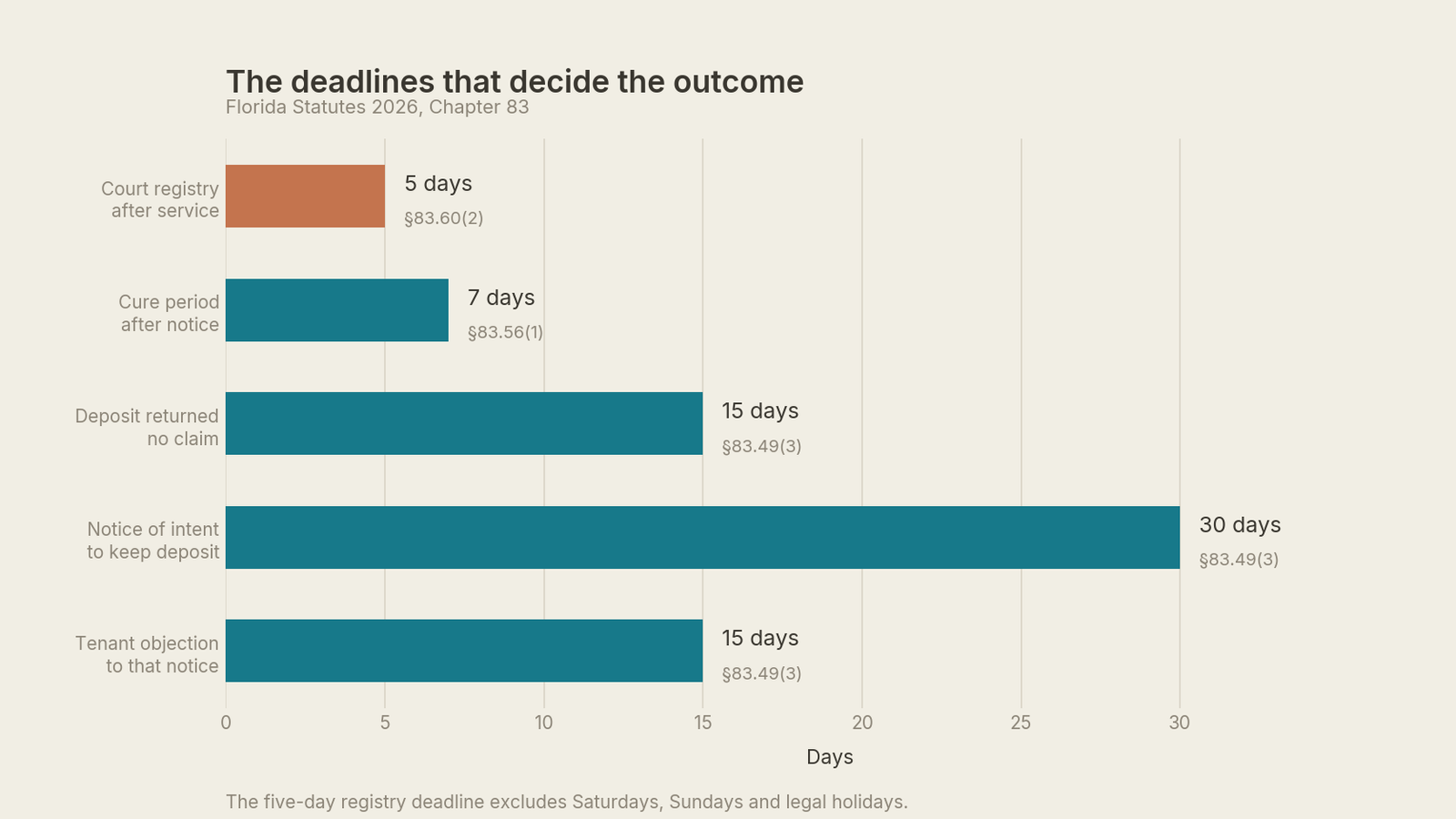
Then comes the point where cases are lost. If the landlord files for possession and the tenant raises any defence other than payment, the tenant must deposit the accrued and ongoing rent into the court registry, or file a motion to determine the amount. The deadline is five days after service of process, excluding Saturdays, Sundays and legal holidays. Missing it waives every defence except payment and produces a judgment for possession without a hearing.
Two more things. Florida residential law provides no general statutory repair-and-deduct remedy. And the twenty-day period from section 83.201, widely quoted online, sits in Part I of Chapter 83 and governs non-residential tenancies; it does not apply to a residential tenant.
If the premises were damaged
Section 83.63 is a separate route. Where the premises are damaged or destroyed other than by the tenant’s wrongful or negligent act, so that enjoyment is substantially impaired, the tenant may terminate and vacate immediately, or vacate the unusable part and have the rent reduced by its fair rental value.
The statute speaks of damage to the premises rather than of a water event as such. It should not be applied automatically to an ordinary damp-and-mold dispute: first establish that the situation really amounts to damage to the premises.
What the landlord cannot do during a dispute
Section 83.67 prohibits shutting off utilities including water and electricity, changing the locks or otherwise denying access, removing exterior doors, locks, roof, walls or windows other than for repair, and improperly removing the tenant’s property.
Section 83.64 prohibits retaliation: a rent increase, a reduction in services, an action for possession or the threat of one, where the primary reason is a good-faith complaint to an enforcement agency or a notice under section 83.56(1). Retaliation is raised as a defence in a possession action. It does not protect against eviction where the landlord shows good cause, including genuine non-payment.
Where to complain
| Body | What it does | Useful for |
|---|---|---|
| Local code enforcement | Inspects, cites | Leaks, structure |
| Florida DOH | Guidance only | General questions |
| DBPR | Licensing | Checking a contractor |
The Florida Department of Health does not carry out inspections. Local powers vary by city and county. Free legal help: Florida Law Help, Florida Legal Services, the regional Legal Aid organisations, and the Florida Bar lawyer referral service.
Local building and housing enforcement is the practical route for a leak, an unsafe ceiling, plumbing or a structural moisture condition. Those are the codes section 83.51 incorporates by reference, and a complaint to such an agency is what section 83.64 protects.
Do you need testing
The Florida Department of Health states that where mold is visible, sampling is generally unnecessary, and that no standards exist for interpreting a result.
The EPA says the same: there are no federal standards for airborne spores, so a sample cannot check compliance with them. The CDC adds that standards for an acceptable quantity of mold have not been established and that routine sampling is not recommended.
What usually carries more weight in a dispute: dated photographs and video, water marks and an active leak, maintenance requests and the replies to them, reports from a plumber, roofer or HVAC contractor, moisture meter readings, a local inspection report, the lease with every addendum, and proof that the notice was delivered.
A paid test can help, but it cannot be required before notice and it is not a condition for the landlord’s duties to exist. What testing does and does not show is on the page about mold testing.
If you hire someone yourself
Florida regulates professional mold assessment and remediation where the growth exceeds ten square feet. Anyone offering those services to the public must comply with the Part XVI licensing requirements of Chapter 468, subject to the exemptions in section 468.841, including for an owner working on their own property.
As a general rule assessment and remediation are not combined on the same structure within twelve months, and there are statutory exceptions here too. The point of the rule is simple: whoever assesses the scope of work should have no interest in selling that same work. For a tenant it means an independent licensed assessor’s report carries more weight, and the licence is worth checking on the DBPR register.
What the work itself costs is on the page about remediation cost in Florida.
When the questions point at the tenant
Florida tenant mold rights run both ways here. Section 83.52 requires the tenant to keep the occupied part clean and sanitary and to operate the electrical, plumbing, heating, ventilating and air conditioning facilities reasonably.
Tenant behaviour matters where the evidence shows unreasonable operation of equipment, a failure to report a known leak, or another breach of section 83.52. Drying laundry indoors or a non-functioning extractor cannot be written down to the tenant automatically: an extractor installed wrong is a question for the building. The cause gets established rather than assumed.
One note on the Florida climate: airing the place out works against you here. Summer outdoor air is more humid than the room, so an open window raises the humidity indoors. What dries the air is a running air conditioner, the bathroom and kitchen extractors, and dealing with the source of the water.
Health
The Florida Department of Health states that mold exposure can cause allergic responses and can trigger attacks in people with asthma, and that some groups are more susceptible.
Proving in court that a particular illness came from mold is hard: Florida applies the Daubert standard, under which the judge assesses the reliability of the expert’s methodology, and an expert on specific causation is required. The symptoms and what is known about them are on the page about mold health symptoms.
The deposit when you move out
Section 83.49 sets the deadlines. If the landlord intends to make no claim, the deposit is returned within fifteen days of the tenancy ending. If a claim is intended, written notice of the intention and the reason goes out within thirty days. The tenant then has fifteen days from receipt to object in writing.
Missing the thirty-day deadline costs the landlord the right to deduct from the deposit, though it does not close off a separate action for damages.
Condominiums
Where the source turns out to be a common element, such as a riser, the roof or an exterior wall, maintenance of common elements rests with the association under section 718.113(1), subject to the declaration and how that particular component is classified there. There is no automatic rule that the association answers for every shared pipe.
For the tenant the order does not change: notice goes to your own landlord, the unit owner, who then deals with the association.
What to do, in order
Find and document the source of the water, not just the stain. Photograph and film the mold, the marks, the leak, the ceiling and floor damage, with dates.
Read the lease: the repair clauses, the address for notices, whether an electronic delivery addendum exists.
Report the problem through the ordinary maintenance channel and keep the proof.
If you are taking a statutory route, send the notice that matches the remedy you have chosen — termination under 83.56 or a rent defence under 83.60.
Do not stop paying without understanding the court registry rules. If eviction papers arrive, the five-day deadline is critical and that is the moment for a lawyer or legal aid.
For a serious condition, contact local enforcement and keep the case number. Keep a timeline in case of retaliation: dates of complaints, rent increases, service reductions, threats of eviction.
Frequently asked questions
Is there a Florida mold law for rentals?
There is no separate statute. The landlord’s general maintenance duties and the procedures in Chapter 83 are what apply.
Does a landlord really have seven days to remove mold?
No. Seven days is the cure period for material noncompliance after proper written notice, not a separate remediation deadline.
Can I withhold rent?
Not on your own initiative. It requires notice under section 83.60(1)(b), and if the landlord files suit, the rent goes into the court registry within five working days of service.
Is an email to the landlord enough?
As evidence that you reported it, yes. It counts as proper statutory delivery only where the addendum under section 83.505 has been signed.
Will the health department come and test my apartment?
No. It provides guidance but does not carry out inspections. The practical route is local building and housing enforcement.
Do I need a mold test to make a claim?
No. No standards exist for interpreting a result; visible mold, moisture and the correspondence carry more weight.
Can the landlord cut the water off or change the locks?
No. Section 83.67 prohibits it.
Can I be evicted for complaining?
Retaliation for a good-faith complaint is prohibited by section 83.64. Eviction remains possible where there is good cause, including genuine non-payment.
Sources
- Florida Statutes 2026, Chapter 83: §83.49, §83.50, §83.51, §83.52, §83.53, §83.56, §83.60, §83.63, §83.64, §83.67, §83.201, §83.425, §83.505, as published by the Florida Legislature and the Florida Senate.
- Florida Statutes 2026, Chapter 468, Part XVI: §468.841, §468.8411, §468.8419, §468.8421.
- Florida Statutes 2026, §718.113, condominium common elements.
- Florida Department of Health: Mold FAQ; Indoor Air Quality programme.
- US EPA, Mold Course, Chapter 3; CDC, Basic Facts about Mold.
- Florida Statutes §90.702, expert testimony.
- Florida Bar, Rights and Duties of Tenants and Landlords, consumer pamphlet.