
Frigidaire vs GE: One Class, Two Kinds of Disclosure
Setting the frigidaire vs ge dehumidifier question side by side starts with how little separates them on paper. The ENERGY STAR registry puts the Frigidaire FFAD5033W1 at 50.00 pints per day and the GE APHL50LBW2 at 49.73 under Appendix X1, with an integrated energy factor of 1.8 for both. What separates them is what goes in the box and what the manufacturer is willing to print.
I have not tested either unit. This comparison draws on the registry, manufacturer spec sheets, bench readings from a third-party lab, and aggregate Amazon review data covering 1996 through 2023. Both brands also appear across the wider dehumidifier guides.
Which GE is even on the shelf
Frigidaire keeps two registry entries in the 50-pint class: the FFAD5033W1 and the pump version FFAP5033W1. GE has three, certified on different dates, and some of those models are already out of production.
GE APER50LZ measures 49.63 and stopped shipping in September 2022. GE ADYR50LC, together with APYR50LC and AWYR50LC, measures 49.99 and was certified on 14 October 2022. GE APHL50LBW2 measures 49.73 and was certified on 14 December 2023. All three sit under one certification applicant at the same 1.8 factor.
The unit used here is the GE APHL50LBW2, the most recent certification with a pump and the one the lab measured. Reviews of the APER50LZ still circulate online, four years after it left production.
GE and Haier dehumidifiers come from one company, GE Appliances, owned by China’s Haier. Recent years have seen new models arrive under the GE name, a shift covered in the Haier review.
Energy: same factor, different draw
The registry gives both an IEF of 1.8, and the similarity ends there.
In the lab’s test at 50% relative humidity the GE pulled 610 watts against 570 for the Frigidaire, a gap of about 7%. For a machine that runs for months without shutting off, that is not a rounding difference.
Frigidaire has since released the FFAD5034W1, which drew 560 watts in the same test. The lab found no other meaningful difference from the FFAD5033W1.
Speed of drying
In a 50-square-foot test room starting above 90% humidity, the Frigidaire reached 40% in 7 minutes 56 seconds and the GE in 8 minutes 56 seconds. Over the shorter run from 80% to 50% the gap narrows to 5 minutes 1 second against 5 minutes 8 seconds.
A 50-square-foot test room is smaller than a typical living space, and humidity above 90% does not hold in an occupied house.
Drainage: the pump costs extra on both
Neither brand includes a pump in the base configuration, and both encode it in a single letter of the model index.
For Frigidaire the pair is FFAD5033W1 and FFAP5033W1. GE runs the same pair inside one series: ADYR50LC without a pump, APYR50LC with one and a hose rated to 16 feet. The GE APHL50LBW2 the lab measured is a pump version as well. APYR50LC has already been superseded by the GE ADHE50PWF, running R32 refrigerant at the same 16 feet of lift with a narrower 30–70% humidity range.
That leads to a caveat on the bench figures. The lab tested a pump configuration on the GE and a bucket-only one on the Frigidaire, so the two cannot be set against each other on drainage.
On the Frigidaire the garden-hose fitting sits behind a cap, and while the cap is on, water goes to the bucket. No hose ships in the box. Bucket sizes are close: 16.9 pints on the Frigidaire against 15 on the GE by the lab’s measurement.
Frost: two different engineering answers
GE uses the conventional arrangement. The coil frosts, the compressor cuts out, and the fan runs until the ice clears. During that stretch the unit draws power without collecting water.
The Frigidaire has no defrost mode at all. Instead the refrigeration circuit is rated for lower temperatures and the fan pushes 229 CFM on high, against 188 CFM on the hOmeLabs HME020031N in the same lab’s testing. Frost does not get the chance to build.
In Florida this whole mechanism barely engages. Frosting needs cold ambient air, and the Florida cohort of reviews mentions it in 0.9% of cases against 1.5% nationally. The difference in approach matters less as a buying factor than as a sign of how differently two units in the same class are built.
Noise: one procedure, two figures
Frigidaire publishes noise at each fan speed at 47, 49 and 51 dBA, along with airflow at 167, 194 and 229 CFM. GE publishes neither for its 50-pint units.
The third-party lab measured both the same way, with the meter above the control panel. The GE read 71.2 dB on high and 65.7 on low, the Frigidaire 70.2 and 64.8. From ten feet the Frigidaire gave 54.6 and 49.8; the lab reports no ten-foot figure for the GE.
The distance between a published 51 dBA and a measured 70.2 dB comes from where the microphone sits, not from a difference in candour. A specification and a close-range reading should not be compared for either brand.
There is a qualitative difference the numbers miss. The lab notes a low compressor hum on the GE, audible on low fan and still discernible on high. On the Frigidaire the fan covers the compressor.
The humidistat
The GE’s built-in sensor read at least 4% higher than actual humidity in testing. The Frigidaire displays in 5% increments and the lab puts its accuracy within 2%.
GE reads the room as wetter than it is and therefore runs longer than needed. A 4% error at a 50% setting means the room sits at about 46%.
Reviews: both roughly twice as bad as the category
Frigidaire carries 4,002 reviews with 31.7% of them rated one or two stars. GE carries 606 reviews at 34.0%. The sample core excluding each of them sits at 16.7% and 17.5% respectively.
The 2.3-point gap between the two brands is smaller than the uncertainty on a 606-review sample, and reading it as one brand beating the other would be a stretch. Both landing at roughly double the category rate is the finding that holds.
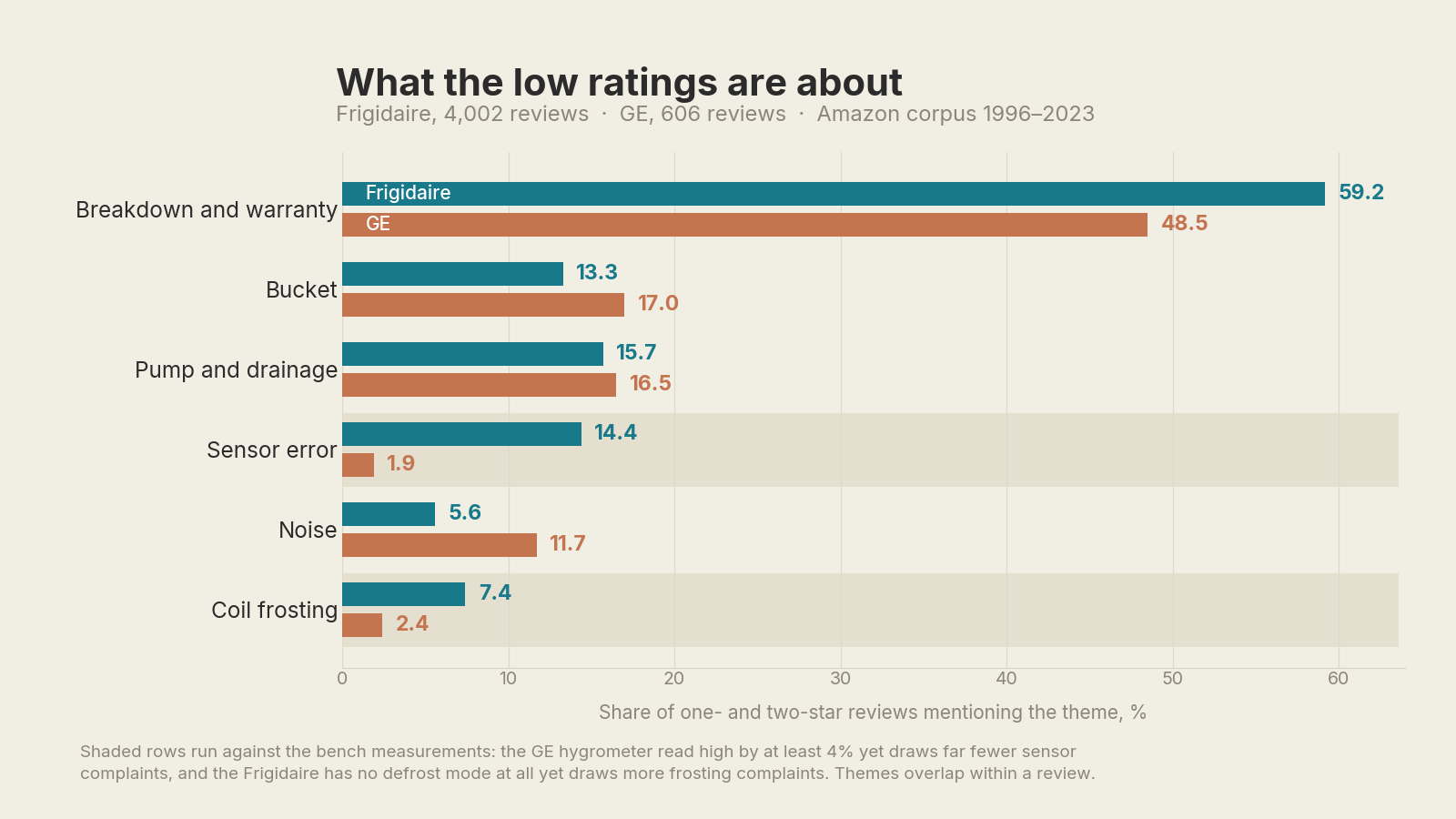
Inside the low ratings the two brands diverge on what the complaints are actually about, and two of those themes point the opposite way from the bench results.
The sensor is the first. GE’s humidistat read at least 4% high while the Frigidaire’s landed within 2%, yet sensor complaints appear seven times more often on the Frigidaire. The unit that measures more accurately collects far more grievance about measurement, and I have no explanation for it.
Frost is the second. The Frigidaire is built without a defrost mode and the GE has automatic defrost, yet frosting shows up three times as often inside Frigidaire’s low ratings.
Service life before breakdown was named in 445 Frigidaire reviews with a median of 12 months, and in 63 GE reviews with a median of 14 months. Both figures carry the same bias: people who state a duration are almost entirely people whose unit failed.
Frigidaire vs GE dehumidifier: which suits which house
The decision does not turn on the pump, since both brands sell it as a separate model.
Frigidaire prints noise at three speeds and airflow, drew 570 watts against 610, and reached the target humidity a minute sooner. Its humidistat is the more accurate of the two. Working against it: 59.2% of its low ratings concern breakdown and warranty, at a median of 12 months.
GE prints neither noise nor airflow, draws more, and reads humidity 4% high. In exchange its complaints spread more evenly, breakdown accounts for a smaller share of them, and the pump version lifts water 16 feet, the highest figure among the portable models covered in the build teardown.
Low-rating shares put both near the top of the list at 31.7% and 34.0% against roughly 17% for the category. Either brand is bought with an eye on the warranty. Full breakdowns sit in the Frigidaire review and the GE review, and both feed the Florida selection guide.
Limits of this comparison
- I have not tested either unit, and there are no field measurements here.
- Registry figures come from a 65 °F / 60% RH test and understate performance in Florida conditions.
- Noise, power and drying-speed readings come from a third-party lab whose conditions differ from manufacturer procedure.
- The lab measured a pump version of the GE and a bucket-only Frigidaire.
- A low rating is not only about breakdowns; shipping complaints and awkward bucket handling land there too.
- GE’s negative share rests on 606 reviews: the direction is visible, the second decimal is not.
- Review themes overlap within a single review, so the shares do not sum to 100.
- The Amazon corpus ends in 2023.
- ENERGY STAR certification is neither a guarantee of quality nor a recommendation.
Frequently asked questions
Are Frigidaire and GE in the same dehumidifier class?
By the ENERGY STAR registry, yes. The FFAD5033W1 measures 50.00 pints per day and the APHL50LBW2 49.73, both at an integrated energy factor of 1.8.
Which brand includes a built-in pump?
Neither includes one as standard. Frigidaire sells the FFAP5033W1 alongside the base FFAD5033W1, and GE sells the APYR50LC alongside the base ADYR50LC.
Which of the two is quieter?
With the meter above the control panel, the Frigidaire read 70.2 dB on high against 71.2 dB for the GE. The lab separately notes an audible compressor hum on the GE.
Which brand has more low ratings?
GE shows 34.0% across 606 reviews and Frigidaire 31.7% across 4,002. The gap is smaller than the uncertainty on GE’s smaller sample, and both run at roughly double the category average.
Which GE model is current?
The recent registry entries are ADYR50LC from 14 October 2022 and APHL50LBW2 from 14 December 2023. The APER50LZ that many online reviews still cover left production in September 2022.
Sources
- ENERGY STAR Certified Dehumidifiers registry, Appendix X1 capacity and IEF values.
- Frigidaire FFAD5033W1 specification sheet, revision 02/23; GE Appliances product documentation.
- Independent bench readings for noise, power draw, drying speed and humidistat accuracy, single third-party lab.
- Amazon Reviews 2023 dataset, household compressor dehumidifier subset, 1996–2023.