
Humidity and Sleep: What the Evidence Shows
Humidity and sleep get discussed as if a single correct number existed. It does not. What exists is three different humidity ranges that consumer articles blend into one, plus a narrow set of experiments where moisture in the air really did break sleep apart.
This page carries affiliate links. If you buy through them, the site earns a commission at no extra cost to you.
I did not test any equipment for this page. What follows comes from laboratory sleep studies, field measurements in occupied bedrooms, the EPA guidance on indoor moisture, and the manuals published by CPAP manufacturers.
The short answer
The EPA recommends keeping indoor relative humidity between 30 and 50 percent, and below 60 percent at all times. That is guidance for moisture and indoor air, not for sleep.
For a Florida bedroom, 45 to 50 percent is a workable target. It sits inside the EPA range and matches what is recommended for suppressing dust mites. Treat it as a moisture target rather than a proven physiological optimum for sleep, because no such optimum has been established.
If the reading stays above 60 percent overnight, that is a moisture problem in the house. Fix the cause before treating the symptom, and see the rest of the humidity guides for where to start looking.
Three ranges people confuse
| Range | What it is | Source |
|---|---|---|
| 30–50% | Indoor guidance | EPA |
| Under 60% | Moisture ceiling | EPA |
| 35–50% | Dust mites | Practice parameter |
| None | Sleep optimum | Not established |
The last row is the point of the table: in the studies I reviewed, no such range is singled out.
Three separate questions hide in here. What humidity is safe for the building. What feels comfortable. What has been shown to change sleep architecture. The answers are not the same, and neither are the numbers.
What the lab experiments on humidity and sleep found
Okamoto-Mizuno and colleagues (Sleep, 1999) had seven healthy men, average age 22.7, sleep from 23:00 to 07:00 in a climate chamber under four conditions: 84°F at 50% RH, 84°F at 75%, 95°F at 50%, and 95°F at 75%. The men wore shorts and lay on a cotton sheet. EEG, EOG and EMG ran all night, with rectal and skin temperature recorded continuously.
| Condition | °F | RH | Effect |
|---|---|---|---|
| Control | 84 | 50% | Reference |
| Damp | 84 | 75% | No change |
| Hot | 95 | 50% | Stages held |
| Hot and damp | 95 | 75% | Less deep sleep |
Okamoto-Mizuno et al., Sleep, 1999; seven men, one night per condition. At 95°F and 75% wakefulness rose, sleep efficiency fell, and stages S3–S4 and REM shrank.
Here is the part that matters. Raising humidity from 50 to 75 percent at 84°F produced no significant deterioration. Humidity did its damage in company with heat.
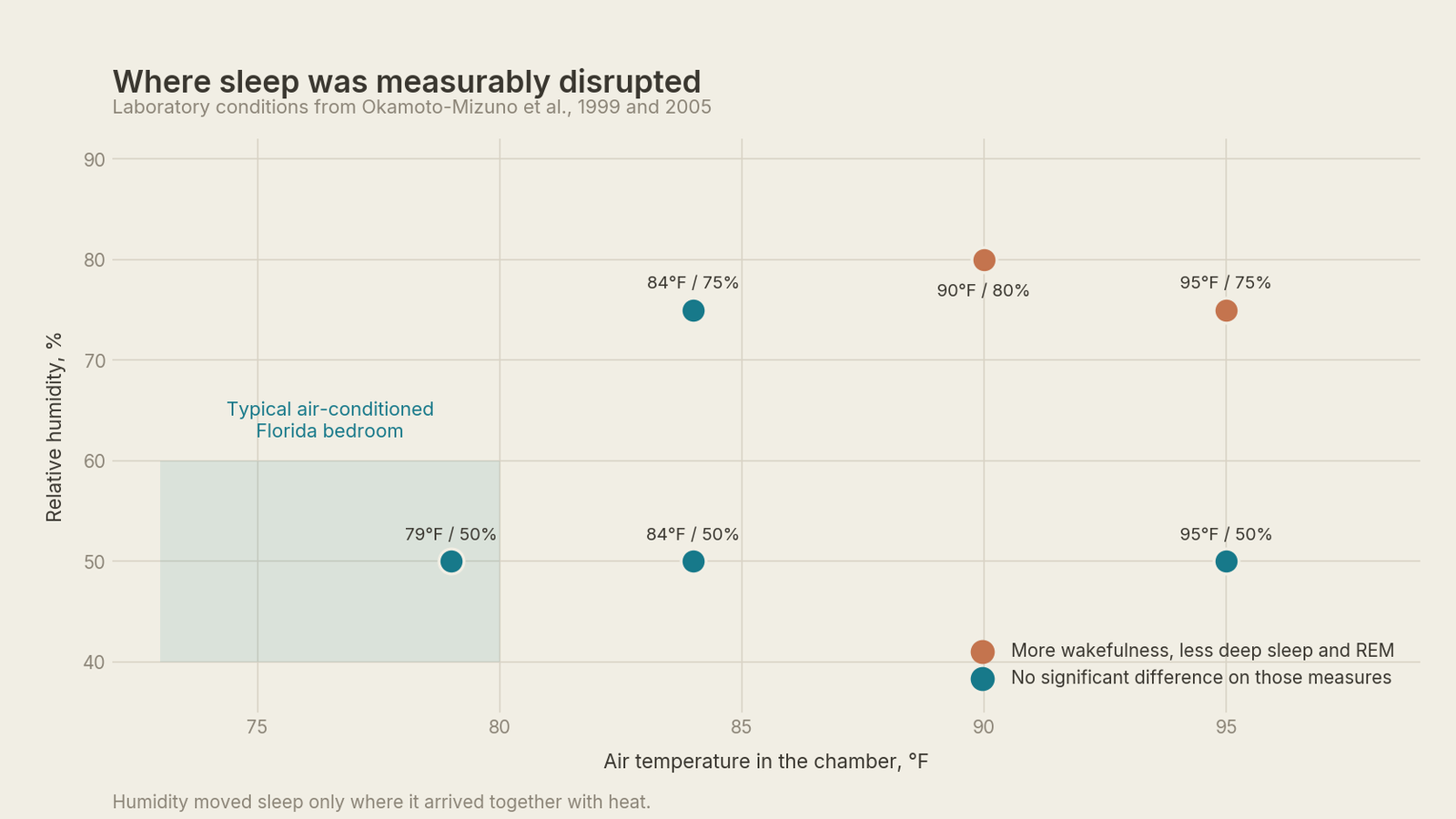
Ninety-five degrees is a bedroom with no air conditioning at all. That has nothing to do with a Florida house running its system. The experiment demonstrates the mechanism: warm damp air blocks evaporative heat loss from the skin, and the evening fall in core body temperature is what starts sleep.
A second study from the same group (Physiology & Behavior, 2005) delivered humid heat in segments, eight men, 79°F at 50% against a shift to 90°F at 80%. Wakefulness increased. Which half of the night is more vulnerable, the two experiments in that paper answer differently, and I am not going to pretend the question is settled.
What real bedrooms show
Field work paints a weaker picture than the chamber does.
| Study | People | RH | Finding |
|---|---|---|---|
| Actigraphy | 62 | 33–75% | No link |
| Shanghai rooms | 50 | 43–86% | Worse sleep |
| Shanghai homes | 41 | — | 77°F, 64% |
| Older adults | 104 | 32–93% | Both ends bad |
Occupied bedrooms, not chambers. Row three is the environment people rated most comfortable, not a sleep measurement; the dash marks a figure the source does not publish.
The 62-adult study carried sensors for particulates, temperature, humidity, CO₂, pressure and noise. Particulates, temperature, CO₂ and noise tracked sleep efficiency more clearly than moisture did. In the Shanghai bedrooms, ventilation dominated, and the effect was sharpest on nights shorter than six hours.
The 41-household figure is worth holding onto: the environment people rated most comfortable averaged 77°F and 64 percent relative humidity. That is a direct counterexample to the claim that anything above 50 percent is bad for sleep.
Put together: in an ordinary bedroom, humidity moves sleep less than temperature, ventilation and noise do, and the relationship is not a straight line.
Relative humidity depends on temperature
Relative humidity is a share of what the air could hold at its current temperature. Fifty percent in a warm bedroom is more water vapour than fifty percent in a cool one.
In Florida that has teeth. The outdoor dew point stays high overnight even as the temperature drops. Moisture does not leave the air just because things cooled off.
Why a Florida bedroom gets damper at night
An air conditioner removes moisture only while the compressor runs and the coil is cold. The Florida Solar Energy Center measured this in 1987, and later field monitoring confirmed it.
At night the solar load is gone, the outside is cooler, the house sheds heat. The thermostat is satisfied quickly and the compressor shuts down. Moisture keeps arriving all the while, from occupants, from infiltration, from mechanical ventilation where it exists. Equipment needs 10 to 15 minutes of continuous running before it starts removing much water. Short cycles never get there.
Monitoring of 43 homes in hot humid climates, Jacksonville, Fort Myers and Orlando among them, found that ordinary systems hold humidity below 60 percent at the peak of summer, while elevated readings arrive at low load. Houses with small cooling loads and mechanical ventilation ran the highest humidity of all, and their authors concluded that such homes need separate dehumidification in shoulder seasons and at night, once the thermostat is already satisfied.
One more detail: the fan setting. Left running continuously, the fan re-evaporates water off the wet coil back into the house after the compressor stops. On “auto” it does not.
A caveat on those measurements. Sensors in these studies sat in bedrooms among other rooms, but the published summaries were reported for the house as a whole. Separate figures for Florida bedrooms specifically, I did not find.
When the bedroom is too dry
Dry indoor air is linked with irritation of the eyes, nose, throat and skin. Direct evidence that low humidity by itself worsens objective sleep measures is considerably thinner than the evidence on humid heat.
In Florida this barely comes up in summer anyway. A parched bedroom here is a story about a heavily cooled house in winter, or about equipment behaving badly.
Why 50 percent still matters for a mattress
Bedding and mattresses are where dust mites live, and mites take their water from the air rather than from what they eat. Keeping relative humidity at or below 50 percent is the standard recommendation for holding their numbers down, which is the second reason the 45 to 50 percent target makes sense in a bedroom. The mechanism, the thresholds and what actually happens to mite populations are covered on the page about dust mites and humidity.
The honest boundary sits here. Cochrane, the organisation that pools the results of every trial on a question into one assessment, reviewed 55 randomised trials covering 3,121 people and found no significant effect of mite control measures on asthma. Lower humidity means fewer mites and less allergen. Whether that improves your sleep is not something the data supports promising.
CPAP: rainout comes from a temperature gap
People with sleep apnoea often sleep with a CPAP machine, which pushes warmed, humidified air through a hose into a mask. In a humid climate the question comes up constantly, so it is worth separating.
If you wake up to water in the mask, the cause is the temperature difference between the hose and the room. As ResMed explains it, warmed humidified air cools to room temperature inside the hose, its capacity to carry moisture drops, and the water condenses out. A bedroom chilled by air conditioning makes this more likely, not less.
The fixes the manufacturer names are a heated hose, a lower humidity setting on the machine, and a smaller temperature gap between hose and room. In automatic Climate Control mode ResMed presets 81°F and 85% RH at the outlet, with hose temperature adjustable from 61 to 86°F.
| Device | °F | RH | Hose |
|---|---|---|---|
| ResMed AirSense 10 | 41–95 | 10–95% | 61–86°F |
| Philips DreamStation | 63–95 | 15% | 106°F |
Operating range of the device, humidity at which the specification is stated, and heated-hose setting. The DreamStation figure is a cut-off, not a setting. From the manufacturers’ user guides.
A dehumidifier in the bedroom: noise comes first
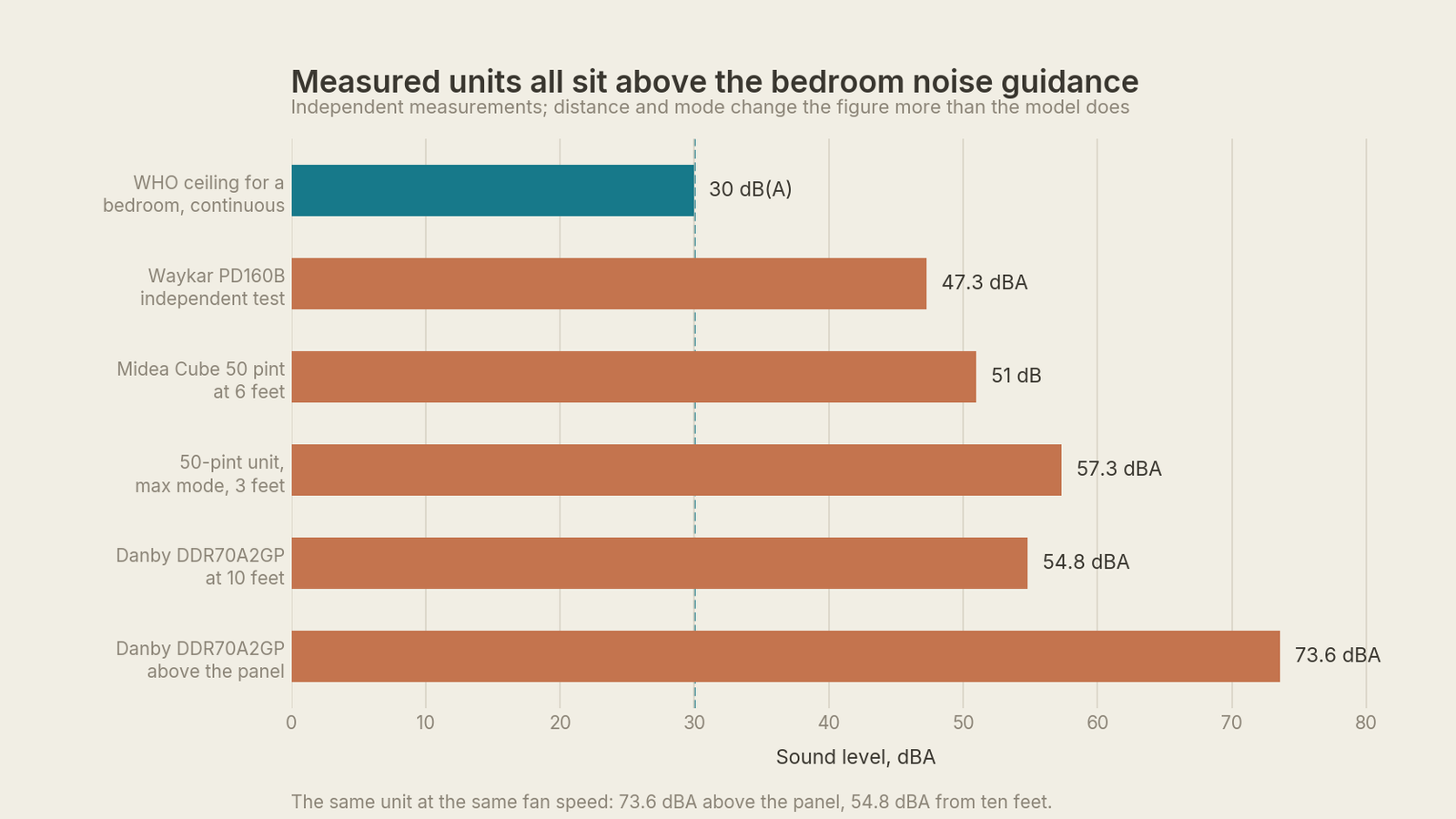
The WHO night noise guidance puts the ceiling for continuous noise in a bedroom at 30 dB(A) equivalent, with single events at 45 dB LAmax.
| Unit | dBA | Distance |
|---|---|---|
| Waykar PD160B | 47.3 | Test rig |
| Midea Cube 50 pint | 51 | 6 ft |
| 50-pint unit | 57.3 | 3 ft |
| Danby DDR70A2GP | 54.8 | 10 ft |
| Danby DDR70A2GP | 73.6 | At panel |
Independent measurements, compressor running. The last two rows are one unit at one fan speed, 18.8 dB apart on microphone position alone. The Waykar box claims 33 dB at the lowest fan with the compressor idle.
The ENERGY STAR registry carries no noise field at all, so there is nothing official to check against. Certification there is built on energy efficiency.
One practical point about drainage: without a continuous drain the tank fills and the unit stops, and that will happen in the middle of the night.
What to do
Put a hygrometer in the bedroom and read it overnight rather than during the day. The daytime number tells you about an air conditioner that is running.
If it holds between 45 and 55 percent overnight, leave things alone.
If it sits above 60 percent, look for the cause: air conditioner sizing, fan mode, ventilation, moisture arriving from adjacent rooms. A separate dehumidifier treats the symptom, which is sometimes the right call — see the models made for bedrooms and work out capacity with the sizing calculator.
If the room is hot and damp at once, deal with the temperature. That pair, not moisture on its own, is what broke sleep in the experiments.
Frequently asked questions
What is the best humidity for sleeping?
No optimum has been established. The EPA recommends 30 to 50 percent indoors, and 45 to 50 percent is a sensible target for a Florida bedroom. That is a moisture target, not a physiological one.
Is 60 percent humidity too high in a bedroom?
Sixty percent is the boundary the EPA recommends staying below for moisture control. Sleep studies have not shown harm at exactly that figure.
Does humidity affect deep sleep and REM?
In a chamber at 95°F and 75% relative humidity, deep sleep and REM fell and wakefulness rose. Those conditions do not transfer to a cool bedroom at 55 to 60 percent.
Can air that is too dry disturb sleep?
Dry air is associated with irritated eyes, nose and throat. Direct evidence that low humidity alone degrades objective sleep measures is limited.
Should I run a dehumidifier overnight?
If bedroom humidity stays above the target range, yes. Account for the noise: household units run at 47 to 57 dBA, while the WHO figure for a bedroom is 30 dB(A).
Sources
- Okamoto-Mizuno K. et al. Effects of humid heat exposure on human sleep stages and body temperature. Sleep, 1999;22(6):767–773.
- Okamoto-Mizuno K. et al. Effects of partial humid heat exposure during different segments of sleep. Physiology & Behavior, 2005;83(5):759–765.
- Okamoto-Mizuno K., Mizuno K. Effects of thermal environment on sleep and circadian rhythm. Journal of Physiological Anthropology, 2012;31:14.
- US EPA. A Brief Guide to Mold, Moisture and Your Home; Care for Your Air.
- Bedroom environment and sleep: 14-day actigraphy study of 62 adults, 2023.
- Summer bedroom environment and sleep quality in Shanghai. Building and Environment, 2024.
- Khattar M., Swami M., Ramanan N. Another aspect of duty cycling: effects on indoor humidity. FSEC-PF-118-87, ASHRAE Transactions, 1987.
- Rudd A., Henderson H. Monitored indoor moisture and temperature conditions in humid-climate US residences. ASHRAE Transactions, 2007.
- Gøtzsche P.C., Johansen H.K. House dust mite control measures for asthma. Cochrane Database of Systematic Reviews.
- ResMed. ClimateLineAir and CPAP rainout; AirSense 10 user guide. Philips Respironics. DreamStation heated humidifier manual.
- WHO Regional Office for Europe. Night Noise Guidelines for Europe, 2009.
- ENERGY STAR Certified Dehumidifiers dataset, data.energystar.gov.