
Oversized Air Conditioner: Why Bigger Is Not Better
Somebody told you to buy an air conditioner with a bit of extra capacity. To be safe. In Florida that advice is wrong, and an oversized air conditioner is one of the most common reasons a house stays humid.
Bigger does not mean better here. It usually means colder and clammier.
What “oversized” means
An oversized air conditioner has more cooling capacity than the space actually needs. Too many tons for the square footage and the real heat load. It happens a lot: a contractor rounds up to be safe, or replaces an old unit with a new one of the same tonnage without ever running the numbers.
The result is a unit that cools the room in a few minutes and then shuts off.
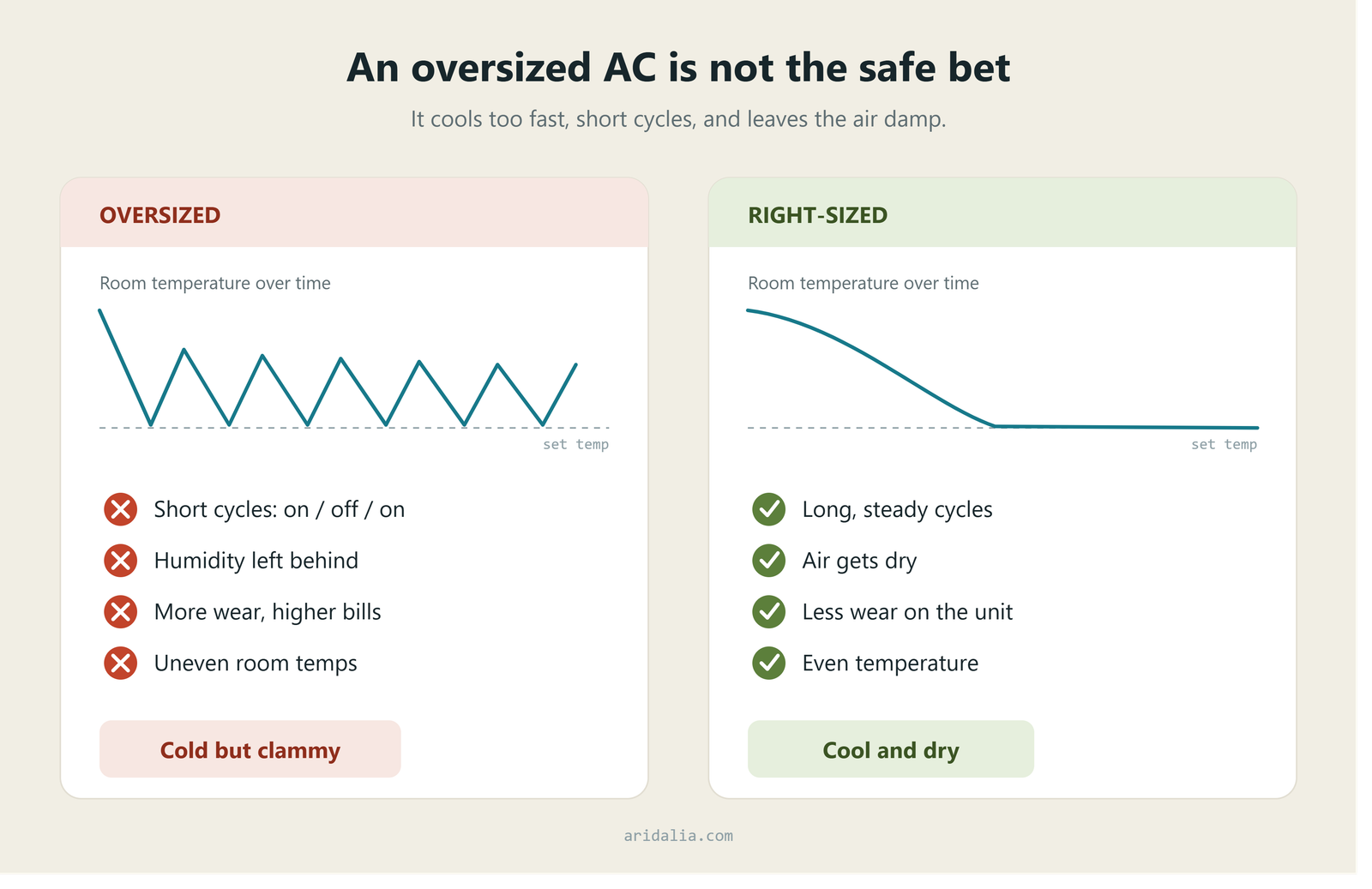
The main cause is simple. The AC is too powerful for the room. It sounds backwards. It is not.
Short cycling: the core problem
Here is the chain. The oversized unit blasts cold air and hits the set temperature fast. The thermostat is happy and cuts the compressor. A few minutes later the room warms up, the thermostat calls again, the compressor fires for another short burst, then stops. On, off, on, off, every few minutes. That is short cycling.
Two things go wrong when an AC short cycles.
First, humidity. An AC dries the air only while it runs, because the moisture has to condense on the cold coil and drain away, and that takes time. Short bursts never give it that time. Cold air, damp room. The full mechanism is here: an AC that cools but will not remove humidity.
Second, wear. Every start pulls a heavy surge of current. A compressor that starts and stops all day wears faster than one running long, even cycles, and it uses more power doing it. Higher bills, shorter life.
The other symptoms
An oversized air conditioner tends to show a cluster of signs:
- The house feels cold but sticky. The clearest tell in a humid climate.
- The unit runs in short spells, a few minutes on, a few minutes off, and rarely settles into a long run.
- Uneven temperatures. The room with the thermostat gets cold fast and shuts the system down before the far rooms catch up. Hot and cold spots.
- Higher energy bills than a correctly sized unit, from all the starting and stopping.
Why size gets it wrong
A correctly sized AC is matched to the building’s real heat load, not to a guess from square footage. The industry method for that is a Manual J load calculation, then Manual S to pick the equipment. It accounts for insulation, windows, orientation, and the local climate.
Skip that and round up “to be safe,” and you get the oversized unit that short cycles. The safe-sounding choice is the one that leaves you cold and damp. A smaller unit that runs longer, steadier cycles keeps the air drier and the temperature more even.
Can you fix it without replacing the whole system?
Sometimes, partly. A few things help before you rip anything out:
- Set the fan to Auto, not On. On On, moisture on the coil re-evaporates into the house between cooling cycles.
- Use the “Dry” mode on a mini-split or smart thermostat if you have it. It slows the fan so the coil runs colder and pulls more moisture. A patch, not a cure.
- Keep the filter and coil clean. Won’t fix oversizing, but a choked system dries even worse.
None of that changes the basic mismatch. In Florida the reliable fix is to stop asking the AC to handle the moisture at all, and hand that job to a dehumidifier. The right size is a quick calculation: use the dehumidifier size calculator. For a home already fighting an oversized AC, a whole-house dehumidifier ties into the ductwork and carries the humidity load on its own.
The short version
An oversized air conditioner cools fast, short cycles, and leaves the air humid, while wearing itself out and running up the bill. Bigger is not safer. When you replace, size to the load, not to the square footage. And in the humid season, take the moisture off the AC with a dehumidifier.
Sources: short cycling, oversizing, and load-based sizing (Manual J and S) come from the engineering consensus on HVAC (DOE, ACCA, InterNACHI, manufacturers). This is reference material, not engineering advice.
FAQ
Is a bigger air conditioner better?
No. A unit larger than the space needs cools too fast and shuts off before it can dry the air or run efficiently. A correctly sized AC that runs longer, steady cycles works better, especially in a humid climate.
What are the signs my AC is oversized?
The house feels cold but sticky, the unit runs in short spells and cuts off quickly, there are hot and cold spots between rooms, and the energy bills run higher than expected.
Why does an oversized AC cause humidity?
An AC removes moisture only while it runs, because water has to condense on the coil and drain. An oversized unit reaches the set temperature in short bursts and never runs long enough to dry the air.
Can you fix an oversized AC without replacing it?
Partly. Setting the fan to Auto, using Dry mode, and keeping the coil clean help. But they do not cure the size mismatch. In Florida the reliable fix is a separate dehumidifier to carry the moisture load.
How is the right AC size calculated?
By the building’s real heat load, using a Manual J calculation and Manual S for equipment selection, not by square footage alone. It accounts for insulation, windows, orientation, and climate.