
Boat Dehumidifiers for Florida: Power, Drainage and What Fits
Choosing boat dehumidifiers starts with three questions rather than with litres per day: does the berth have shore power, where will the water go, and are you aboard regularly. The answers decide whether you need an electric unit, a passive absorber or ventilation.
Florida gives the question weight. The state’s Fish and Wildlife Conservation Commission counted 1,027,742 registered vessels in 2025, first in the country. That figure includes boats with no cabin.
I have not tested these units. This draws on manufacturer manuals and product pages, ABYC standards, EPA and CPSC material, NOAA data, the Amazon review sample, and eighteen owner threads across twelve forums. Household options sit in the Florida selection guide, part of the wider dehumidifier guides.
Boat dehumidifiers: three different things under one name
Marine catalogues file three distinct products under “dehumidifier”.
A compressor or desiccant unit physically removes water from the air into a tank or out through a hose. This is the only class with a measurable litres-per-day figure.
An air dryer such as the Davis Air-Dryr 1000 runs at 130 watts and warms air by natural convection with no fan. Warm air holds more moisture, so condensation does not form on cold surfaces. It collects no water.
An absorber, silica gel or calcium chloride, takes up moisture until saturated. It needs no power and its capacity is finite.
The shared category name does not mean a shared function.
The bucketless theory does not hold
The logic looked sound: a unit with no tank never stops on a full bucket, so it can be left running. Reading the manual breaks it.
On the Midea Cube, automatic recovery after a power loss carries an exception for bucketless mode specifically. Midea support repeated that caveat for the MAD50PS1BQGR in July 2026. For a different variant, the MAD50PS1AQGR, support describes recovery with gravity drainage and the bucket fitted.
Bucketless operation and auto-restart are not two independent boxes to tick. They are checked together, against the exact part number and the exact manual revision.
The part number itself is a problem here: the current Midea listing has S1QWT-A in the title and PS1QWT-A in the model number field, with both 1,500 and 4,500 square feet quoted nearby. That page cannot serve as a specification.
What Florida owners actually do
Forum threads supply what no specification does: how this looks in practice. What follows is the experience of individual owners rather than a test result.
On a Ranger R-31 at Palmetto the owner measured around 80% humidity between air conditioning cycles with the fan running continuously. His arrangement: small units in the forward cabin and the head, a larger dehumidifier by the helm draining while he is away, and a fan for circulation. The result he reports is 40 to 50%. He does not separate the contribution of each element.
On a 2024 Ranger R-27 another owner reports the same morning peaks near 80% between cycles.
Storing a boat in Florida for two months, one owner used a unit with a two-litre tank and a hose: the boat on a lift with shore power, draining through the galley sink. He notes separately that mould on the exterior seating remained unsolved.
An owner in Jacksonville fitted a separate unit draining into the galley sink and accepted that the cabin stays hot; he saw no heat damage. On an Island Packet a large household unit sits in the shower draining to a sump, and that owner also notes the added heat.
One thing runs through all of these: air conditioning on its own does not hold humidity between cycles, and owners add a separate unit to it.
Units worth comparing
| Unit | Confirmed | Limitation |
|---|---|---|
| Midea Cube | 41–95 °F per the manual read; tank, gravity and pump across variants | Auto-recovery excludes bucketless mode; no marine certification established |
| Hisense HD3526 | up to 35 pints, operation from 38 °F | Listing carries references to a different model, HD3524; the HD3526 manual was not obtained |
| ElectroSea DryGenie | 120 V, 340 W; up to 3 l/day at 80% RH; 40–110 °F; ≤45 dB; gravity drain, no tank, tip-over cutoff | Test temperature for the capacity figure is not stated; no independent readings |
| Freedom Marine Dry-Pal | 110 and 220 V; 12 pints at 80 °F / 60%; 385 W; 304 stainless; hose drain; 250–350 cu ft | No time period attached to the 12-pint figure; electrical values differ within the page |
| Eva-Dry EDV-4000 | rotary desiccant; 7 l/day at 68 °F / 60%; 2 l tank; 34–104 °F; auto-restart | Figures from the previous manual; the current listing calls the hose both optional and included |
| Davis Air-Dryr 1000 | 130 W, natural convection | Collects no water: this is condensation control |
| Meaco DD8L Junior | 3.5 l/day at 330 W at 20 °C / 60% on low | UK version at 220–240 V, not a direct fit for a US boat |
Capacity is quoted in the conditions each source used. The columns are not ranked against each other.
Auto-restart is checked together with how it shuts down
The Cube caveat is not the only case where the automation is more complicated than a bullet point.
With an Arida unit, one owner verified auto-restart at home and it worked. He then found a manual requirement to let the unit cool down after switching off, and the manufacturer’s support warned of possible internal damage from repeated power interruptions. Revision 5 of that manual prohibits an external timer that cuts power.
Three things need checking separately: recovery after mains loss, behaviour after a shutdown on temperature protection, and whether the manual permits routine power interruption at all.
Another owner reports his unit stopping near freezing and requiring a manual restart. He did not name the version, but the scenario is worth holding onto.
What it costs in electricity
Take a unit drawing 340 watts continuously. That figure comes from the DryGenie listing; actual running hours have to be measured.
Over 24 hours that is 8.16 kilowatt-hours, and 244.8 over thirty days. At twenty cents per kilowatt-hour, 48.96 dollars for a month of continuous running. At twelve hours a day, half that.
The tariff is an example; a marina charges its own.
The formula is straightforward: kilowatt-hours equal watts divided by a thousand, multiplied by hours of running.
From a battery it looks different
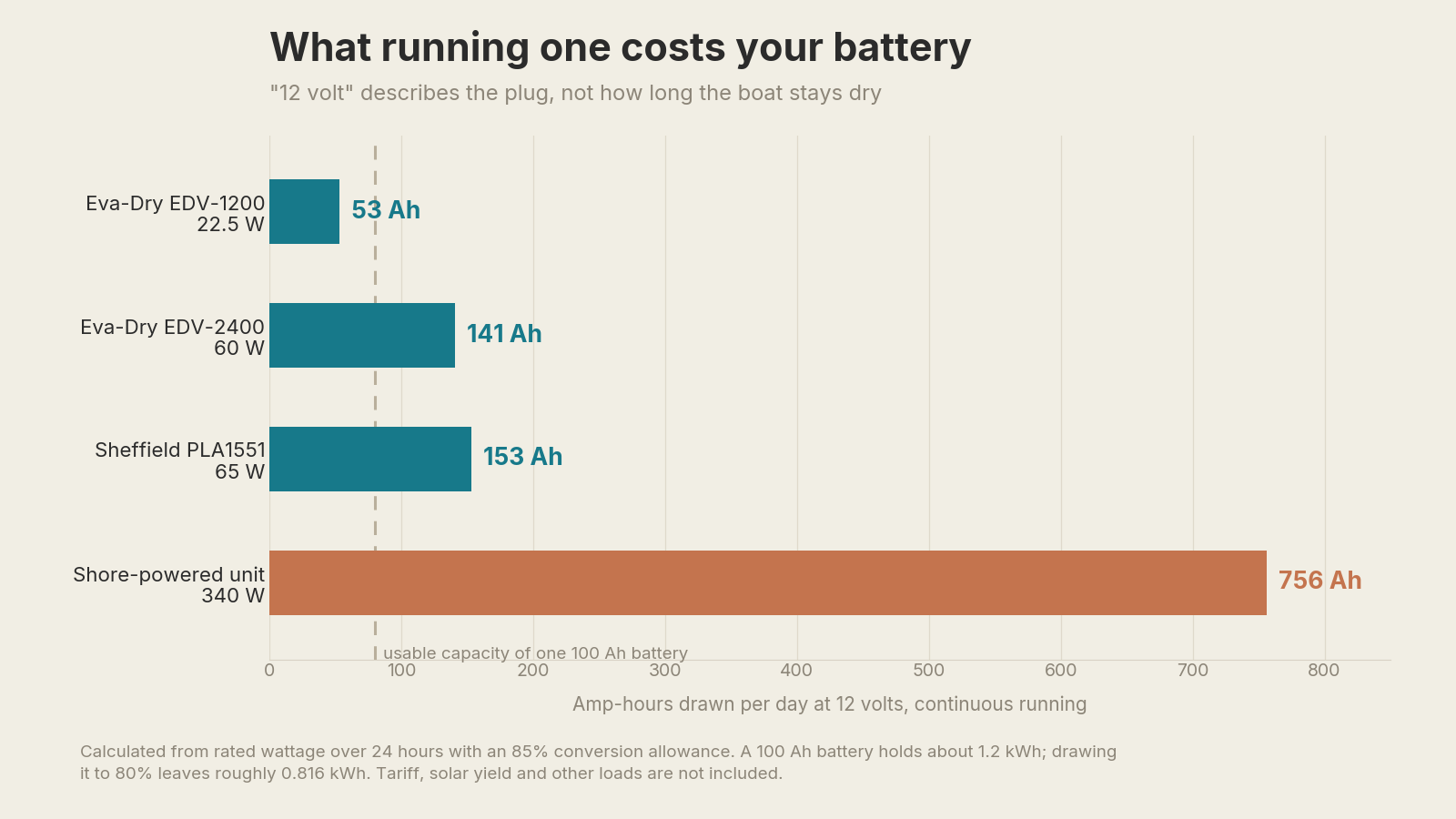
That same 340-watt unit, run from a 12-volt battery through an inverter at 90% efficiency, needs about 756 amp-hours a day.
A 100 amp-hour battery nominally holds 1.2 kilowatt-hours. Allow yourself 80% of it and set aside 15% for conversion and wiring, and roughly 0.816 kilowatt-hours remain.
That gives the scale: a 22.5-watt unit runs about 36 hours on such a battery, a 60-watt unit about 13.6.
“12 V” describes the socket, not the endurance.
A working example exists. An owner of a C-Dory 22 powers a unit through a 12-to-9-volt converter at roughly 22 watts and collects about a pint a day, with variation. Calculated at that wattage running continuously, it comes to 528 watt-hours a day, around 44 amp-hours at 12 volts before losses, and 15.84 kilowatt-hours over thirty days.
The same owner notes that at high humidity around 60 °F the unit frosts and stops collecting. Running below the temperature stated in the manual was his own experiment, not a rated mode.
Passive absorbers
| Product | Capacity and interval | Regeneration | Limitation |
|---|---|---|---|
| Eva-Dry E-333 | 4–6 oz per cycle, up to 333 cu ft | 10–12 hours from a socket | The current listing contradicts this with 13 oz |
| Eva-Dry E-500 | 6–8 oz per the catalogue, up to 500 cu ft | 10–16 hours | Current listings appear with 20 oz |
| H2Out SD303 / SD306 / SD309 | 300, 600 and 900 cu ft; 4–6 weeks between cycles | 2–3 hours in an electric oven at 250–300 °F | A gas oven is not recommended: combustion produces water vapour |
| DRI-Z-AIR | one unit per 10 by 10 feet; 3–4 for a 35-foot boat in winter storage; refill lasts 30–60 days | consumable, not regenerated | Produces brine; the container needs securing against motion |
| Star brite No Damp | 12 oz for cabins, 16 oz hanging bags | consumable | Brine damages wood and leather |
Claimed cubic feet are a marketing ceiling rather than a promise to hold a target humidity.
The stated interval is worth checking on your own boat. A liveaboard owner recharges an E-333 every week or two against the three to five weeks claimed, and another reports his unit’s tank filling in five or six days.
Active 12-volt units
| Unit | Draw | Water at 86 °F / 80% | Drainage | Daily load |
|---|---|---|---|---|
| Eva-Dry EDV-1200 with the EDV-12V cord | 22.5 W | 237 ml | tank only | 0.54 kWh, about 53 Ah |
| Eva-Dry EDV-2400 with the same cord | 60 W | 739 ml | tank, humidistat 40–80%, 3-foot hose | 1.44 kWh, about 141 Ah |
| Euromarine 002216 | 22–22.5 W | 300 ml at 30 °C / 80% | 650 ml tank, auto shutoff | 0.54 kWh, about 53 Ah |
| Sheffield PLA1551 | 65 W | 500 ml at 30 °C / 80% | 2 l tank and a tube | 1.56 kWh, about 153 Ah |
Manufacturer maxima at warm, humid conditions. A cooler cabin yields less.
To offset that load from solar at four equivalent sun hours and 75% system efficiency takes roughly 180 watts of panel for the first unit and about 480 for the second. That covers the average daily draw with no allowance for cloudy days.
An electrical caveat: the EDV-1200 and EDV-2400 ship with mains adapters that are not 12 volts, yet Eva-Dry sells the EDV-12V cord as compatible. Only the manufacturer’s cord with the right part number applies. For a 24-volt boat the manufacturer requires a step-down converter.
Solar vents are not dehumidifiers
The YIS Marine SV002 runs from a 1.8-watt panel with a 2,400 mAh battery and keeps ventilating for up to 22 hours after sunset. The LALIZAS 24 Hours Vent has a reversible fan and water ingress protection. The Marinco Nicro MiniVent 1000 extracts around 700 cubic feet per hour in daylight and works passively at night.
Service life varies sharply in owner reports. One owner heard noise after four weeks and the motor stopped a week later. Another has a pair running for nearly seven years, with battery replacement in the fifth. A third had a warranty replacement at eighteen months. These reports concern earlier generations and do not give a failure rate for current models.
Ventilation of this kind helps when the outside air is drier than the cabin air.
In Florida that condition does not always hold. NOAA data for 2015–2024 puts the pre-dawn dew point in Miami during July and August at 75.1 °F against 74.2 °F in the afternoon: moisture content outdoors does not fall overnight.
Where the water goes
The Cube manual requires level installation and a fall on the gravity hose. Pump mode and bucketless operation are separate configurations, not interchangeable ones.
On the Dry-Pal the manufacturer provides for discharge through a through-hull or a sump pump, and the manual addresses pan overflow from a blockage. No tank does not mean no leak.
There is no universal “run a hose to the sink and drive away” here. The final path of the water, the possibility of overflow, the dependence on an electric pump and safe operation of through-hull fittings all need working out from the boat’s own documentation and with a marine professional.
Eight problems that come up repeatedly
Owner discussions produce a recurring set of situations.
Dry in the saloon, damp in a locker or under a mattress. The problem area needs its own measurement and an understanding of how air moves; a sensor near the unit’s warm outlet reads too optimistically.
Water in the tank but the target humidity unmet. Collected water confirms the unit runs, not that its capacity suffices.
The tank fills before the next visit. The usual answer is continuous drainage, and the water has to actually leave the space being dried.
After a mains loss or a temperature-protection shutdown, drying did not resume.
A small unit draws little at any moment but runs continuously. Compare watt-hours per day at the humidity you want to hold, not the watts on the label.
Brine spilled under way. A hanging bag is not immune to leaking, and containers need securing.
The unit gets in the way of walking and sleeping. For a portable, that means installed dimensions with the hose, a way to secure it, somewhere to stow it before departure, and noise at night.
“Close the vents” read literally. Restricting outside exchange on an empty boat in storage does not suspend mandatory ventilation of fuel and gas spaces.
Fuel vapours
ABYC requires ignition protection for potential sources of ignition in certain spaces with gasoline systems, where they are not isolated from the fuel source.
What gets checked is the marking, such as UL 1500, SAE J1171 or ISO 8846, and the specific installation zone. The words “spark-free”, “marine” or “no compressor” prove none of it.
None of the active units covered here carries confirmed ignition protection. They do not go into an engine space with possible fuel vapours.
Fire warnings: what holds and what does not
Owners have circulated a notice from Lymington Harbour about fire and overheating in household units. The Yacht Havens group requires a suitable low-temperature desiccant unit rated for that use at its own sites.
Past that, the generalisations run beyond the evidence. “All compressor units are dangerous below 18 °C” and “dehumidifiers are the leading cause of boat fires” are not supported by these sources: no denominator and no rate by technology appears anywhere. Practical Boat Owner publishes a manufacturer’s response that working compressor units include a defrost function, plus an insurer’s comment naming no single mandatory type.
A marina’s own rule applies regardless of what any statistic shows.
Unattended operation
Automatic recovery after a power loss is useful, and it does not cover a blocked hose, a failed pump, a shore supply going down or the unit itself failing.
Neither “every marina bans compressor units” nor “any dehumidifier can safely run for months” is a claim the evidence supports.
CPSC publishes lists of recalled models with date codes. No model is given a clean status here on the strength of an empty search: the exact number and production range are what get checked.
No salt-spray testing was found for any of these units. A stainless housing or marine positioning does not establish corrosion resistance of the internal parts.
What owner reviews show
The Amazon sample holds no boat-specific cohort: it is tagged by mentions of an enclosed space, which covers closets, storage rooms, heads, safes and RVs. Closet-scale problems are covered in the closet humidity guide.
In the Florida cut that mention appears in 30.1% of reviews of mini units against 11.3% for compressor units. Ratings in the same cut: mini units 4.36 with a 13.4% low-rating share across 1,042 reviews, compressor units 4.66 with 5.4% across 998.
That describes enclosed spaces in general rather than cabins. It does not transfer directly. The class itself is covered in the mini dehumidifier review.
Choosing by scenario
| Scenario | Start with | Watch for |
|---|---|---|
| Cabin at a dock with shore power | Actual water removal, full temperature range, space, gravity or matched pump | Check the whole chain: socket, unit, hose, final destination for the water |
| Owner away for a long stretch | Behaviour after power loss and after drainage failure | Auto-restart guarantees nothing against a blockage or a leak |
| Boat on a lift or ashore | Whether power is permitted and how drainage works in that attitude | The angle changes; a scheme from the water does not transfer |
| Locker with no power | Passive absorber, indicator, ability to regenerate | No promise of a dry cabin or a fixed interval on one charge |
| Boat with no shore power | The daily energy budget | “12 V” and an inverter do not add up to capacity |
| Engine space with fuel vapours | Confirmed ignition protection | No household unit and no air dryer belongs there |
An editorial synthesis of the parameters above, not a substitute for the unit’s manual or an assessment of your boat.
What humidity to hold
The EPA benchmark for indoor spaces is below 60%, preferably 30 to 50%. The physics in a cabin is the same as in a house: mould grows from humidity and temperature at a surface. But the humidity of the air in the middle of a cabin does not describe what happens under a mattress against a cold hull or inside a closed locker, so the hygrometer goes where it is damp rather than where it is convenient.
A sensible starting setpoint is around 50%, adjusted by result. Drying the air does not replace fixing a leak or drying out materials that are already wet. Sizing basics sit in the dehumidifier size calculator, with the caveat that it was not built for cabins.
Leaving hatches permanently open for drying is not the answer in Florida. The EPA distinguishes ventilating with dry outside air from dehumidifying when the outside air is warm and humid; in the second case fresh air adds moisture. Mandatory ventilation of fuel spaces and systems is a separate matter and stands.
Limits of this guide
- I have not tested these units, and there are no cabin measurements here.
- Real capacity and noise in a specific Florida cabin have not been established.
- Long-term reliability of the marine-specific units has not been verified.
- No comparable salt-spray testing was found.
- No winner on energy at matched humidity and temperature has been determined.
- The DryGenie capacity figure states humidity but not temperature.
- No time period is attached to the Dry-Pal 12-pint figure.
- EDV-4000 figures come from the previous manual; current contents need confirming.
- The older Hisense family manual has not been tied to the HD3526 specifically.
- Energy calculations use chosen assumptions for tariff and efficiency and are not an electrical design.
- Owner reports are self-described, unstandardised, and repeated posts by one author are not independent confirmations.
- Arida and Ecor reports come mainly from Europe and do not establish US availability.
- Review data covers enclosed spaces generally rather than cabins.
Frequently asked questions
Can I use a household dehumidifier on a boat?
Conditionally, where the manual, the location, the power supply and the drainage all suit. A household model does not acquire marine approvals automatically, and a space with fuel vapours needs confirmed ignition protection under ABYC.
Can I leave a dehumidifier running while I am away?
Only after checking the specific setup. Auto-recovery and continuous drainage do not address a blocked hose, a failed pump, a shore supply going down or the unit failing.
Does the Midea Cube restart in bucketless mode?
The documentation checked carries an exception for that mode specifically, confirmed by a Midea support response. That cannot be extended to every generation and part number.
Will a 12-volt unit dry a whole cabin?
That comes down to capacity and the energy budget rather than voltage. A 60-watt unit needs about 141 amp-hours a day; a 100 amp-hour battery covers roughly 13.6 hours of it.
Does an air dryer remove water?
No. The Davis Air-Dryr keeps moisture in the air by warming it, and collects nothing.
Is silica gel enough?
For a locker, a cupboard or a safe, yes, given the capacity per cycle and regular regeneration. For a whole cabin the claimed cubic feet guarantee no result.
Sources
- Florida Fish and Wildlife Conservation Commission, 2025 Boating Accident Statistical Report.
- Manufacturer manuals and product pages for Midea, Hisense, ElectroSea, Freedom Marine Solutions, Eva-Dry, Davis Instruments, Meaco, Arida, H2Out, DRI-Z-AIR and Star brite.
- Midea customer support responses on power recovery, July 2026.
- ABYC ignition protection guidance; CPSC recall database.
- EPA guidance on mould and moisture, and on ventilation against dehumidification.
- NOAA Local Climatological Data, hourly dew point, Florida stations, 2015–2024.
- Amazon Reviews 2023 dataset, enclosed-space cohort.
- Eighteen owner threads across twelve boating forums, September 2026.