
Dust Mites and Humidity: Why 50% Is Not a Switch
The dust mites humidity figure everyone quotes is 50 percent. It is a control target for managing moisture, not a line beyond which mites disappear, and the difference between those two things is what this page is about.
I took no measurements myself. What follows comes from laboratory work on mite water balance, a seventeen-month field study in occupied homes, dust surveys in Tampa and Delray Beach, and the guidance published by the allergy practice parameter and the EPA.
The short answer
The practice parameter for dust mite exposure control names 35 to 50 percent relative humidity. The EPA gives 30 to 50 percent for a home generally.
| Range | What it is | Source |
|---|---|---|
| 35–50% | Mite exposure control | Practice parameter |
| 30–50% | Indoor guidance | EPA |
| Under 51% | Held in field study | Arlian, 2001 |
Three different framings of the same rough band. None of them is a biological threshold at which mites die.
Holding below 50 percent steadily makes a home unsuitable for population growth. The word “steadily” carries the weight: mites survive dry spells, and a few humid hours a day restore their water balance. Elsewhere in the humidity guides the same principle applies to mould, but the numbers differ and should not be mixed.
Separately: when mites die, their allergen stays behind. That has to be removed by hand.
Why the dust mites humidity target exists at all
A mite’s body is 70 to 75 percent water. There is no free water in a mattress, and it does not drink. It takes water from the air: the supracoxal glands secrete a hygroscopic salt solution which travels along a canal towards the mouthparts, absorbing water vapour on the way, and the mite swallows it. In D. farinae a significant component of that solution is potassium chloride.
Below a certain humidity the mechanism stops working and the solution dries into a salt plug. That boundary is called the critical equilibrium humidity, and it moves with temperature.
| Air temperature | Critical humidity |
|---|---|
| 59°F | 52% |
| 77°F | 58% |
| 86°F | 63% |
| 95°F | 69% |
Adult female D. farinae. The warmer the room, the damper the air a mite needs — and the higher the bar you have to push it under.
For D. pteronyssinus the published figures disagree: 73 percent at 77°F in one study, 58 to 60 percent at 68°F in another, and a review considers the higher values mistaken. I am not going to average them; the spread stands as it is.
Why 50 percent does not kill mites overnight
How fast they dry out depends on the species. These are the periods over which half a population died, measured at 70 to 72°F.
| Species | At 45% RH | At 50% RH |
|---|---|---|
| D. farinae | 11.5 weeks | 86.3 weeks |
| D. pteronyssinus | 1.2 weeks | 4.0 weeks |
Half-life of desiccation, unlimited food. The gap between the two species is wider than the gap between the two humidity levels.
A review by the same author gives 6 to 11 days for active mites at 50 percent and below. The numbers sit badly together and I do not know what explains the difference — probably different experimental conditions. The figures worth leaning on are the ones that state species and temperature.
There is also the resting protonymph. It survives months of dry air, uses nearly thirty times less oxygen, and is glued to the substrate firmly enough that vacuuming will not lift it.
A few humid hours a day change the result
Partly dehydrated D. pteronyssinus were kept in dry air and given short humid windows. Body mass began recovering at an hour and a half a day. With food available, egg laying resumed from three hours a day.
D. farinae were cycled between 75 and 35 percent humidity. At four humid hours a day the full life cycle still completed, but it took 82 days against 41 days at a constant 75 percent. At two humid hours and twenty-two dry ones, the population died out.
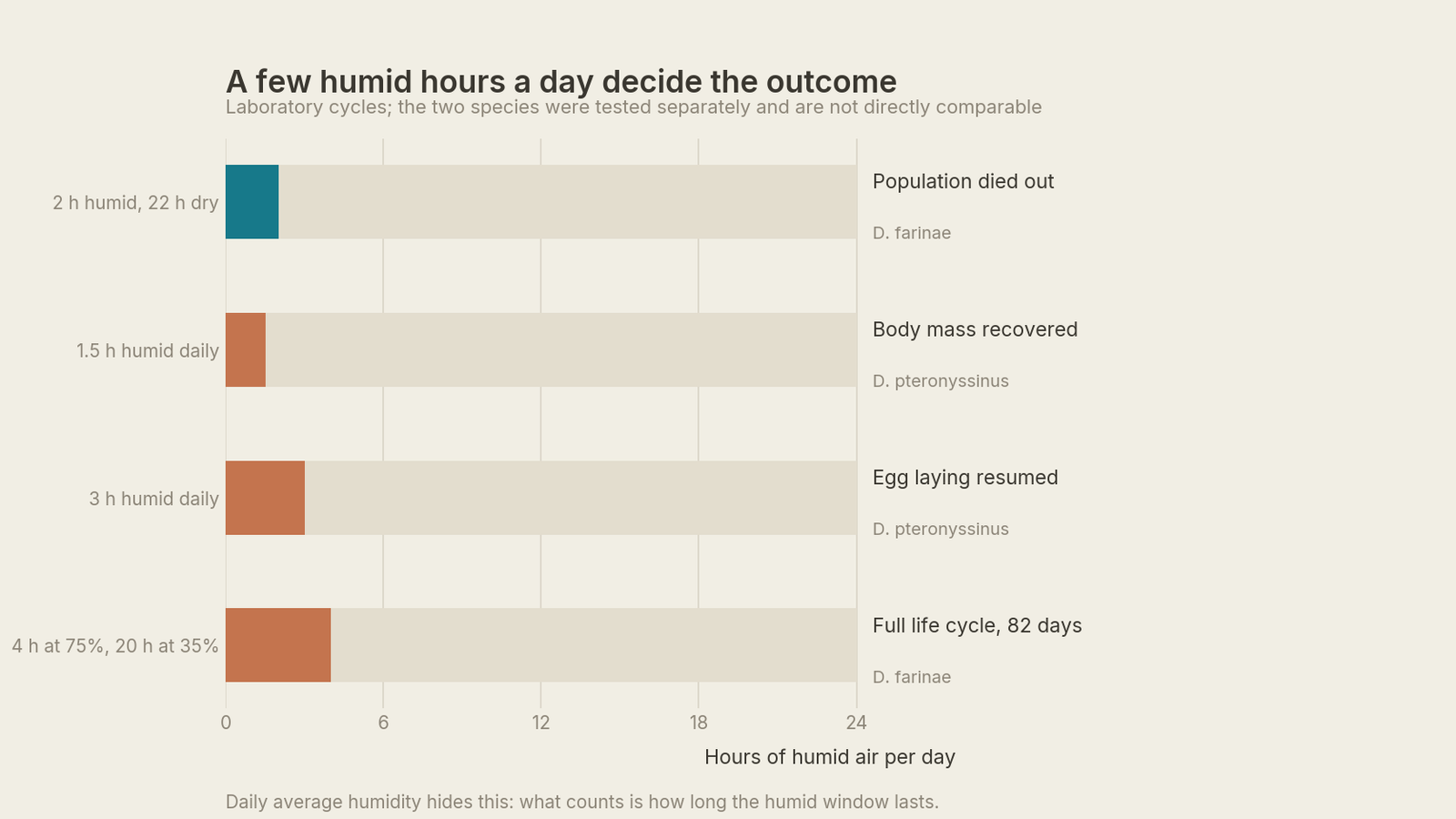
The practical consequence: a daily average misleads, which is why a single dust mites humidity reading proves very little. What matters is how long the humid window lasts, not the number you get by averaging across the day.
Mattresses and carpets keep their own humidity
Direct measurements in mite microhabitats found humidity at the base of a carpet running higher than the room.
A mattress is more complicated. A sleeping body adds moisture and heat at the same time, and the rise in humidity inside the mattress does not hand mites the advantage you might expect. The familiar line about a sleeper turning the bed into a paradise for mites is not supported in that simple form.
For measuring, this means one hygrometer in the middle of the room describes the room, not the bed.
What happened in real homes
A field study ran for seventeen months across two humid summers. Twenty-three homes held humidity below 51 percent using effective dehumidifiers alongside air conditioning. Others ran air conditioning or dehumidification without holding the level, and a third group aired the house through open windows.
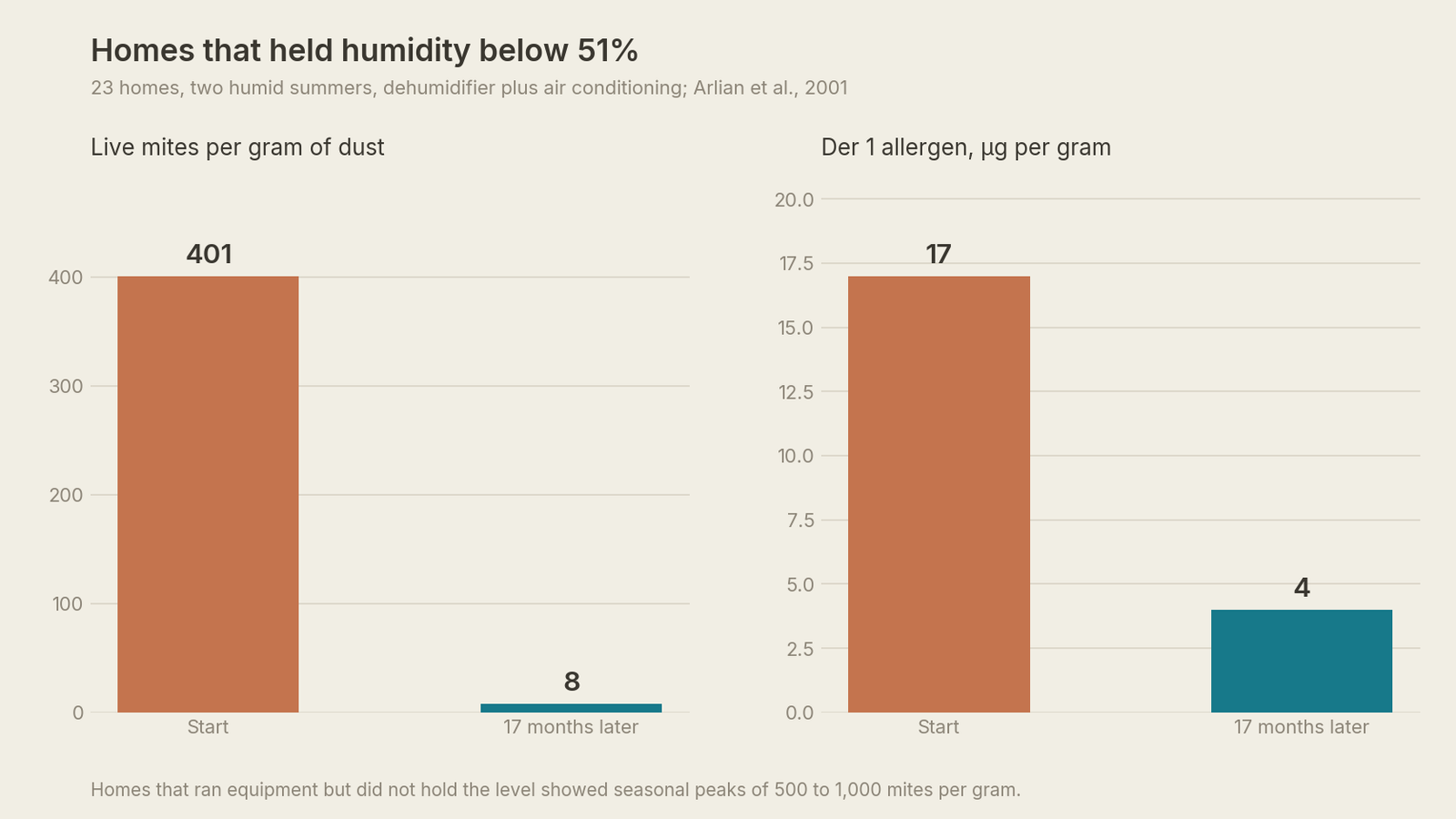
In the homes that held it, live mites fell from 401 to 8 per gram of dust and Der 1 allergen from 17 to 4 micrograms per gram. After seventeen months the allergen level was more than ten times lower than in the other homes, where seasonal peaks reached 500 to 1,000 mites and 40 to 70 micrograms of Der 1 per gram.
Air conditioning on its own did not deliver the result. The score is kept in humidity actually held, not in appliances present. Why a Florida bedroom gets damper overnight even with the system running is covered on the page about humidity and sleep.
The allergen outlives the mite
After mites were killed, levels of Der p I and of Der p II with Der f II showed no significant decline over eighteen months across nine combinations of temperature and humidity.
Another experiment measured the decay of Der f 1 in mattress dust distributed through eight occupied homes: a median half-life of roughly ten years. The authors put it plainly — natural decay has no practical value for reducing exposure, and the allergen has to be actively removed.
The mechanics are simple. The allergen sits in faecal pellets about 20 micrometres across, which accumulate in the mattress, the pillow, the carpet and upholstered furniture. Drying the air stops new production. The old material stays where it is.
Species matter, and in Florida especially
D. farinae tolerates dryness better; D. pteronyssinus depends more on damp surroundings. In Tampa the tropical Blomia tropicalis joins them.
| Measure | Tampa result |
|---|---|
| Dust samples with mites | 53 of 60 |
| Mites per gram, mattress | 110–6,200 |
| Mites per gram, carpet | 120–5,500 |
| Species identified | 11 |
| Samples with B. tropicalis | 30% |
Sixty samples from forty homes of mite-allergic people. Skin tests in the same area: 62% reacted to D. pteronyssinus, 60% to D. farinae, 38% to B. tropicalis.
In a national survey of 252 homes across eight US areas, Delray Beach among them, most homes carried at least 500 mites per gram of dust, and B. tropicalis turned up in the warm cities at low densities.
Both studies share one limitation: the households were those of people already allergic to mites or asthmatic. This is not a cross-section of Florida homes, and the percentages do not transfer to the neighbours.
What to do
Put a hygrometer in the bedroom and read it at different times of day rather than once in the afternoon. The target is 35 to 50 percent, held continuously rather than touched briefly. General figures for the rest of the house are on the page about normal indoor humidity.
If the reading climbs past 50 percent at night, work on the cause: an air conditioner running at low load, ventilation, moisture arriving from adjacent rooms. Size any dehumidifier with the capacity calculator, and the models made for bedrooms are covered separately.
In parallel, remove the allergen already there: wash the bedding, encase mattress and pillow, keep less textile in the room. Water at 131°F and above kills mites in the wash; warm and cold water does not kill them but carries off more than 90 percent of the allergen.
What this will not do
Lowering humidity does not clear the allergen quickly. That runs in months, and in a mattress longer.
A review of 55 randomised trials covering 3,121 patients found no improvement in asthma from mite control measures. A large trial of mattress covers in adults with asthma, and an equivalent one in allergic rhinitis, both cut allergen levels without a clinical effect. The argument is not settled: critics point out that the review pooled measures which never reduced exposure in the first place.
So the honest version is this. Humidity below 50 percent demonstrably shrinks mite populations and allergen levels. That it will make a particular person feel better is not demonstrated.
Frequently asked questions
What humidity kills dust mites?
There is no instant threshold. The 35 to 50 percent band suppresses population growth, but mites survive dry spells and short humid windows restore their water balance.
Can dust mites live at 50 percent humidity?
Yes, D. farinae especially: at 50 percent and 70 to 72°F half the population takes about 86 weeks to die, against four weeks for D. pteronyssinus.
Does a dehumidifier kill dust mites?
It helps if it actually holds humidity low for long enough. In the field study the fall from 401 to 8 mites per gram took seventeen months.
Are dead dust mites still a problem?
The allergen persists after the mites die: no significant decline over eighteen months. Drying the air is paired with cleaning out the reservoirs.
Are dust mites worse in Florida?
In Tampa homes mites were found in 53 of 60 dust samples, including tropical Blomia tropicalis in 30 percent of them. Those were homes of allergic people, so the figures are not statewide statistics.
Sources
- Arlian LG. Water balance and humidity requirements of house dust mites. Experimental and Applied Acarology, 1992;16:15–35.
- Arlian LG, Veselica MM. Reevaluation of the humidity requirements of the house dust mite. Journal of Medical Entomology, 1981;18:351–352.
- Arlian LG et al. Population dynamics of house dust mites at specific relative humidities. Journal of Medical Entomology, 1998;35:46–53.
- de Boer R, Kuller K, Kahl O. Water balance of D. pteronyssinus maintained by brief daily spells of elevated air humidity, 1998.
- Arlian LG et al. Fluctuating hydrating and dehydrating relative humidities and the life cycle of D. farinae. Journal of Medical Entomology, 1999;36:457–461.
- Arlian LG, Neal JS, Vyszenski-Moher DL. Reducing relative humidity to control D. farinae. Journal of Allergy and Clinical Immunology, 1999;104:852–856.
- Arlian LG et al. Reducing relative humidity is a practical way to control dust mites and their allergens in homes. JACI, 2001;107:99–104.
- Sidenius KE et al. Decay of house dust mite allergen Der f 1 at indoor climatic conditions. Annals of Allergy, Asthma and Immunology, 2002;89:34–37.
- Portnoy J et al. Environmental assessment and exposure control of dust mites: a practice parameter. 2013.
- Fernández-Caldas E et al. House dust mite allergy in Florida, Tampa Bay. Allergy Proceedings, 1990.
- Arlian LG, Bernstein D, Bernstein IL et al. Prevalence of dust mites in the homes of people with asthma in eight US areas. JACI, 1992;90:292–300.
- McDonald LG, Tovey E. The role of water temperature and laundry procedures in reducing house dust mite populations and allergens. JACI, 1992;90:599–608.
- Gøtzsche PC, Johansen HK. House dust mite control measures for asthma. Cochrane Database of Systematic Reviews.
- US EPA. Care for Your Air; Biological Pollutants in Your Home.