
Does Homeowners Insurance Cover Mold in Florida?
Does homeowners insurance cover mold in Florida? The short answer is sometimes.
Finding mold in the house does not create coverage. What matters first is where the water came from. After that: what the particular policy says, whether it carries a fungi endorsement, and what limit sits on it.
So the question to ask is not whether mold is covered. It is: what caused the water, is that cause covered by my policy, and what mold limit appears in my endorsements? The rest of the material on this subject is in the mold guides.
What follows draws on the Florida statutes as published by the legislature, the material from the Insurance Consumer Advocate at the Department of Financial Services, the official Citizens forms, the FEMA commentary on the federal flood policy, and the ISO forms. This is not legal advice: the contract decides the outcome.
Florida has no law requiring mold coverage
Worth starting here, because the opposite circulates online.
You will see it claimed that statute 627.7073 requires insurers to offer mold coverage. That is wrong. Section 627.7073 is titled Sinkhole reports and governs the reports engineers and geologists file on sinkhole claims. It has nothing to do with mold.
Nor is there any statute setting a single mold coverage or a single limit for every Florida policy. The limit comes from the policy form and the endorsement, not from state law.
What the limits actually look like
The Insurance Consumer Advocate at the Department of Financial Services describes a mold endorsement that raises the property limit to $25,000 or $50,000, and notes that insurers may offer other amounts. A separate endorsement covers liability.
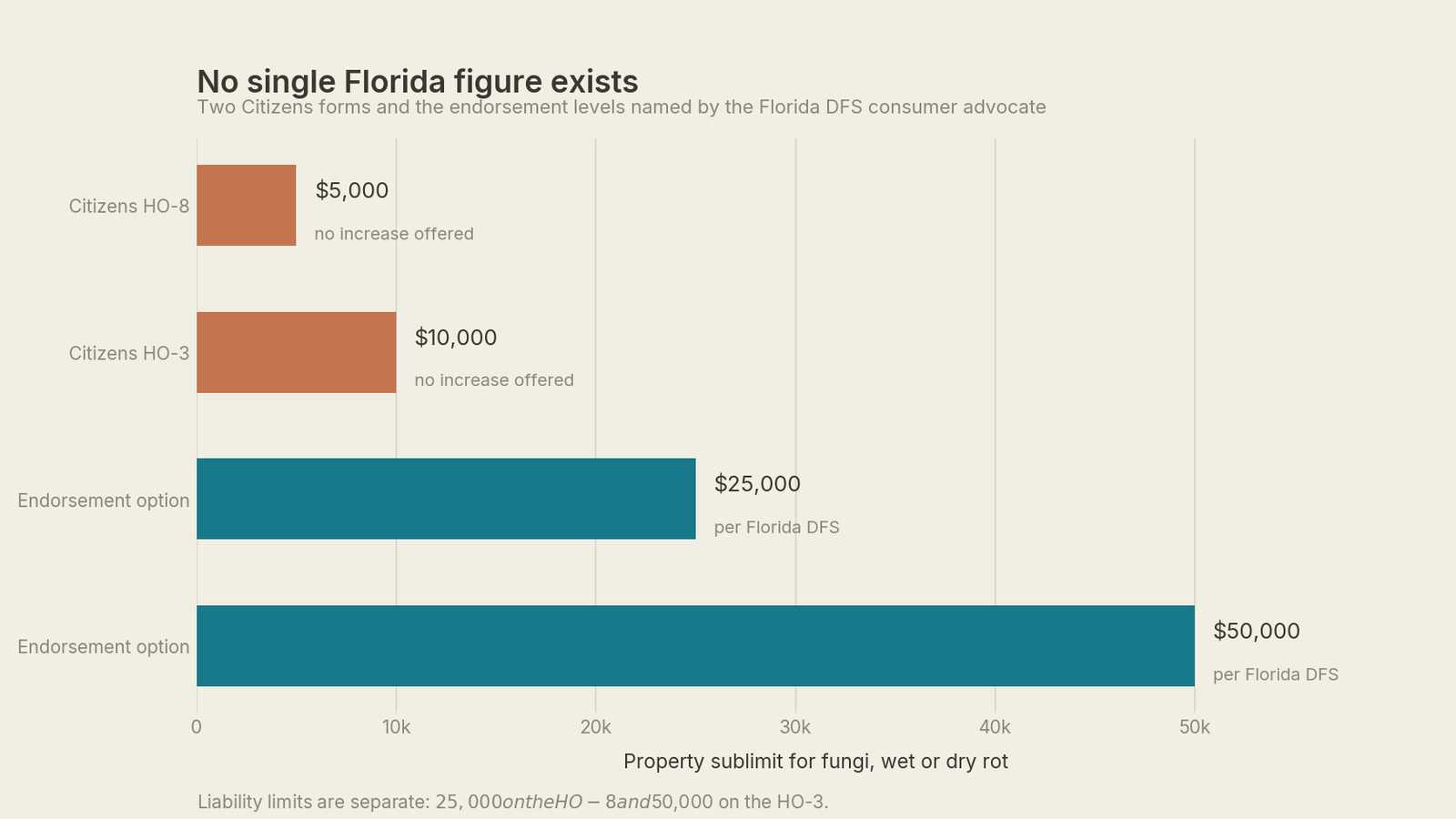
How much the form matters shows up at the insurer of last resort. On the official Citizens coverage worksheet, the HO-3 form carries $10,000 of property coverage for fungi, wet or dry rot and $50,000 of liability, with no increase offered. On the HO-8 form from the same insurer it is $5,000 property and $25,000 liability.
One insurer, two forms, two sets of numbers. Ten thousand dollars is a common market figure, not Florida law.
Whether insurance will cover mold in Florida starts with the water
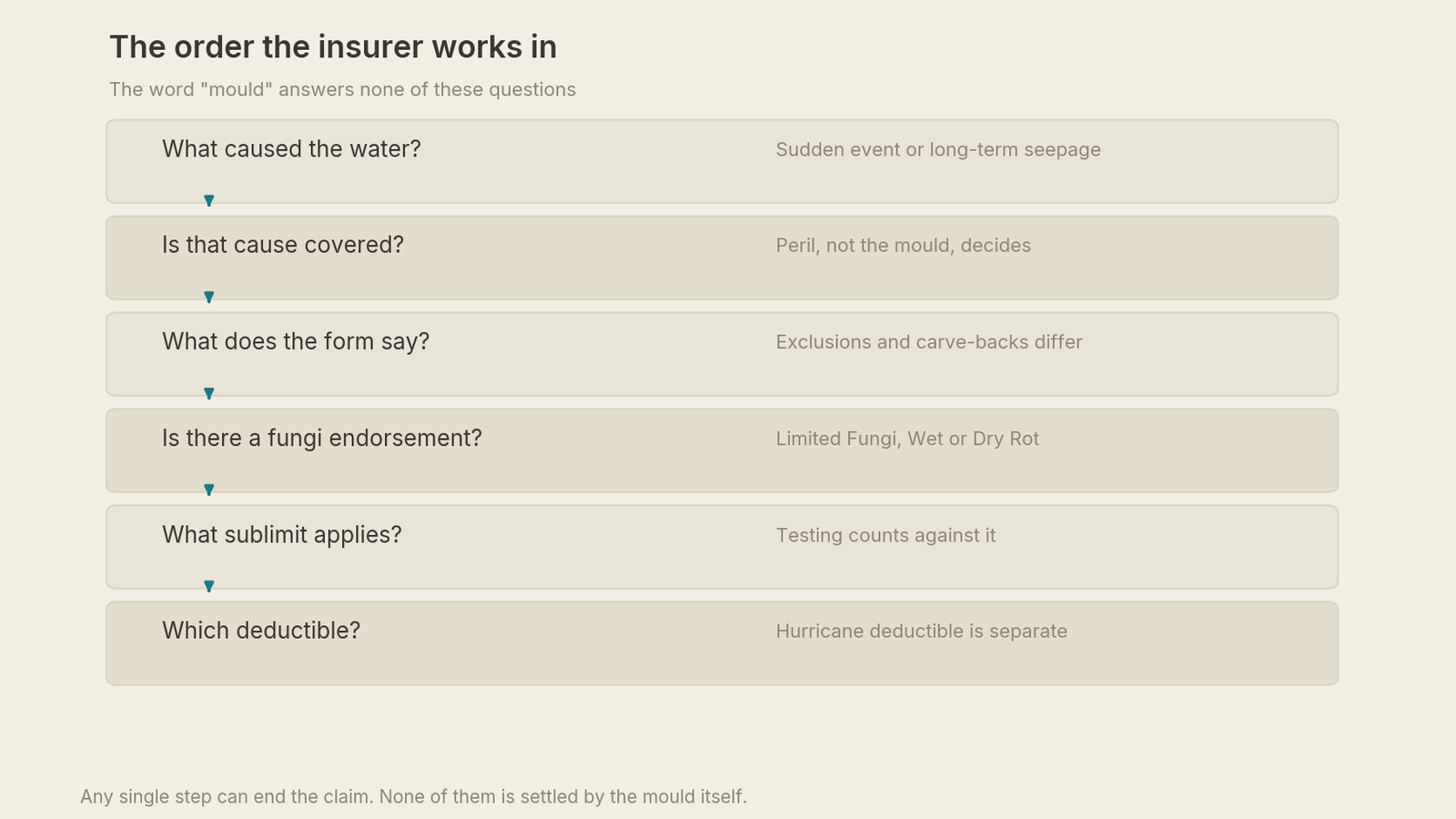
The word mold in a claim does not answer the coverage question. The insurer looks at the chain of causation.
A pipe bursts, water goes into the wall, mold follows: that is one thing. A pipe seeps for eight months, the framing stays wet, mold follows: that is another. For insurance these are two different cases, however similar the stain looks.
The first has a sudden water event that may be a covered peril. The second runs into exclusions for repeated seepage, deterioration and failure to maintain.
Typical ISO HO-3 forms and fungi endorsements carry this construction. The policy excludes constant or repeated seepage running over weeks, months or years, along with the resulting rot and fungi. And it separately restores coverage for mold hidden within walls, ceilings or beneath floors when it arose from an accidental discharge of water or steam from plumbing, heating, air conditioning or a household appliance. The particular version of the form and the endorsements attached to it change that construction; HO 04 27, for instance, introduces its own fungi sublimit. There is no universal rule here that fits every Florida policy.
How the water reached the wall in the first place is covered on the page about mold after a water leak.
Four typical scenarios
| Scenario | Case for coverage | What decides it |
|---|---|---|
| Burst pipe | Strongest | Sublimit, deductible |
| Slow hidden leak | Weak | When it started |
| Humidity, condensation | Weakest | No sudden event |
| Hurricane | Depends | Wind or flood |
A strong case is not a payment. Even after a burst pipe the amount is limited by the form, the deductible and the fungi sublimit.
A burst pipe. Of the four this gives the firmest ground. Still no promise: what gets checked is whether the water event itself is covered, which form applies, whether there is a fungi limitation, whether an endorsement exists, what the sublimit is, whether testing counts against it, and which deductible applies.
A slow hidden leak. A dispute here is close to inevitable. Policies generally exclude repeated seepage, deterioration and the consequences of failing to maintain. Even where the owner never saw water, the argument will be about when the leak started and whether it was sudden. A plumber’s report, photographs, moisture readings, the date of discovery and the condition of the pipe all help.
Humidity and condensation. An oversized air conditioner, sweating ducts, poor ventilation, damp under the floor. There is no sudden event, and the claim is weaker than the others. A blanket “condensation is never covered” would also be too strong; the contract decides.
A hurricane. Two kinds of water have to be separated. If wind created an opening in the roof or wall and rain came through it, the chain may run from a covered event, but the hurricane deductible applies. If water arrived from below as flooding or storm surge, the homeowners policy does not cover that loss: flood insurance is a separate contract. So “mold after a hurricane is covered” is too coarse. First establish whether it was wind or water.
Flood and mold: separate federal rules
The standard flood policy runs on its own rules.
Under the FEMA commentary on that policy from June 2025, damage from water, moisture and mold is excluded where prompt cleanup could have prevented it. The exception is narrow: where the policyholder was reasonably prevented from reaching the property and that delay itself caused additional damage beyond their control, part of it may be treated differently. Documentation is required.
That is the accurate way to put it, rather than “flood insurance covers mold”.
What a sublimit is, and why testing eats it
Say the dwelling is insured for $400,000. It does not follow that the same amount is available for mold remediation. The policy may carry a separate fungi sublimit, say $10,000.
Depending on the form, that same limit can absorb the inspection, air sampling, laboratory analysis, tear-out for access, the remediation itself and the replacement of materials. On a large contamination the sublimit runs out before the work does.
What to look at is not only the figure but whether it applies per loss or in aggregate across the policy period, and whether property and liability limits differ. The cost of the work itself is on the page about remediation cost in Florida.
A hurricane deductible is not the mold sublimit
These get confused.
Say roof damage is covered, the hurricane deductible is $12,000 and the fungi sublimit is $10,000. Two different figures. The deductible sets the share of a covered loss that stays with the owner. The sublimit separately caps one category of cost. Hurricane deductibles are governed by section 627.701; the actual figure comes off the declarations page.
Where to find this in the policy
Open the declarations page and the list of endorsements. Search the text for: Fungi, Mold, Wet or Dry Rot, Yeast or Bacteria, Water Damage, Accidental Discharge or Overflow, Repeated Seepage or Leakage, Flood, Surface Water, Hurricane Deductible, Duties After Loss.
The document to find is called Limited Fungi, Wet or Dry Rot, or Bacteria. In the ISO forms that is HO 04 26 for the Broad Form, HO 04 27 for Special and Comprehensive, and DL 24 71 in the dwelling line.
Seeing the word mold under exclusions does not mean there is no coverage: part of it comes back through the endorsement.
Deadlines that cannot be missed
| Step | Deadline | Statute |
|---|---|---|
| New or reopened claim | 1 year | 627.70132 |
| Supplemental claim | 18 months | 627.70132 |
| Insurer acknowledges | 7 days | 627.70131 |
| Physical inspection | 30 days | 627.70131 |
| Pay or deny | 60 days | 627.70131 |
Claim deadlines run from the date of loss. Insurer deadlines run from notice or from the proof of loss, and the statute allows for exceptions and circumstances beyond the insurer’s control.
For mold that first row matters most. It surfaces weeks after the water event, but the clock does not start on the day the owner sees the stain. It starts at the date of loss.
Sixty days is a deadline for a decision, not a promise of payment.
What to document before everything gets dried out
The claim and the physical drying run in parallel. Leaving materials wet so an adjuster can see them is wrong; destroying the evidence is also wrong.
Stop the active water where that is safe. Photograph and film the source, the path of the water and the wet materials. Notify the insurer. Begin reasonable emergency drying. Keep invoices and receipts, the reports from the plumber, roofer or HVAC contractor on the cause, and the moisture logs. Keep removed sections where practical. Ask the insurer for the exact policy form, the declarations page and every endorsement.
The whole chain has to be evidenced: what happened, when, where the water came from, what got wet, and what was done after it was found.
Why claims are denied, and who proves what
The usual grounds: repeated seepage, a long-running leak, wear and tear, failure to maintain, excluded flood, pre-existing damage, late notice, inadequate mitigation, an exhausted sublimit.
A denial has to name the policy provision it rests on. What gets compared is the actual facts against the text of the exclusion the insurer is relying on.
Florida all-risk policies carry a general framework from the case law: the policyholder shows a direct physical loss during the policy period, after which the burden of proving that an exclusion applies shifts to the insurer. The leading decision is Fayad v. Clarendon National Insurance Company, 899 So. 2d 1082, Florida Supreme Court, 2005. That is a framework for proof, not a guarantee of any outcome.
If it goes into dispute
Start with the written explanation: the coverage letter, the denial or partial denial, the policy provisions, the estimate, the adjuster’s findings.
After that there are several routes. Pre-suit mediation through the Department of Financial Services is provided for by section 627.7015; the insurer bears the cost of the conference, except in particular situations such as the policyholder failing to appear and the conference having to be rescheduled. Where the dispute is about the amount of loss rather than the existence of coverage, the policy may contain an appraisal provision. A public adjuster represents the owner in the valuation; the fee is capped by section 626.854. The general ceiling is twenty percent of the payment. Ten percent applies to claims arising from an event that was the subject of a governor’s state of emergency declaration, where the claim is made within a year of that declaration. The statute also provides for particular cases with smaller shares.
How heavily Florida litigates shows in the Office of Insurance Regulation figures: in 2022 the state accounted for around 14.9 percent of the country’s insurance claims and roughly 70.9 percent of its lawsuits. In the 2025 report the shares were about 4.9 and 41.3 percent.
Mold-specific statistics are not published by the Office of Insurance Regulation, neither the share of claims nor the average payment. There is nowhere to take a figure like “the average Florida mold payout” from.
Condominiums are a separate story
For a unit owner the logic gets more complicated. The water may originate with the neighbour above, a common pipe, the roof or an exterior wall. Then the association policy, the unit owner’s policy and the allocation of responsibility in the condominium documents all apply at once. Section 627.4025 separates the types of residential policy: homeowner, mobile home owner, tenant, unit owner. The forms differ between them. Single-family logic does not transfer.
What to do before anything happens
Open the policy now and find the fungi limit. Ask the insurer or the agent: what is the property limit, is there an endorsement to raise it, what does it cost, does testing count against the limit, does it apply in aggregate or per loss, what is the liability limit, and how does the policy treat a hidden long-term leak.
Frequently asked questions
Does homeowners insurance cover mold in Florida?
Sometimes. Coverage depends on the cause of the water and on the particular fungi endorsement. Mold following a sudden covered event has far stronger grounds than mold from chronic humidity.
Is there a mandatory $10,000 mold limit in Florida?
No. There is no statewide limit. That figure appears in a number of forms, including the Citizens HO-3, while the HO-8 from the same insurer carries $5,000 of property coverage.
Will mold after a burst pipe be covered?
Possibly, if the water event itself is covered and the endorsement applies. The amount is limited by the policy terms, the deductible and the sublimit.
Will mold from a slow leak be covered?
That is harder. Policies generally exclude repeated seepage, long-running leaks and the consequences of failing to maintain.
Is mold after a hurricane covered?
First establish the source of the water. Rain through wind-created damage and flooding or storm surge are different events under different policies.
Does flood insurance cover mold?
Not where prompt cleanup could have prevented it. A narrow exception may apply where access to the property was reasonably impossible.
How long do I have to file a claim in Florida?
One year from the date of loss for a new or reopened claim, eighteen months for a supplemental one.
Which comes first, calling the insurer or drying the house?
Both, quickly. Document the damage and notify the insurer while taking reasonable steps to stop further loss.
Sources
- Florida Statutes §627.7073 (Sinkhole reports), §627.70131, §627.70132, §627.701, §627.7015, §627.4025, §626.854, as published by the Florida Legislature and the Florida Senate.
- Florida Department of Financial Services, Office of the Insurance Consumer Advocate: homeowners policy endorsements, mold coverage.
- Citizens Property Insurance Corporation: HO-3 coverage worksheet; HO-8 fungi coverage FAQ, updated 26 August 2026; basic residential coverages.
- FEMA, National Flood Insurance Program: Standard Flood Insurance Policy Commentary, June 2025.
- ISO forms HO 00 03; HO 04 26, HO 04 27 and DL 24 71, Limited Fungi, Wet or Dry Rot, or Bacteria Coverage.
- Fayad v. Clarendon National Insurance Co., 899 So. 2d 1082 (Fla. 2005).
- Florida Office of Insurance Regulation: Property Claims and Litigation Report, January 2024; Property Insurance Stability Report, 2025.