
hOmeLabs vs Midea Cube: Ratings, Bench Data and Drainage
The homelabs vs midea comparison starts with two units the registry treats as near-identical. Both lines hold the 50-pint class: the hOmeLabs HME020031N measures 49.93 pints per day under Appendix X1, the Midea Cube MAD50PS1QWT 49.67.
Disclosure: This article contains affiliate links, including links to Amazon, Sylvane, and other partners. If you purchase through these links, we may earn a small commission at no extra cost to you. As an Amazon Associate I earn from qualifying purchases. Full disclosure: Affiliate Disclosure.
Both also sell the pump as a separate model: MAD50PS1QWT against the base MAD50S1QWT at Midea, HME020391N against HME020031N at hOmeLabs. What sets them apart is elsewhere: the Cube splits in half, takes commands from a phone, and runs with no bucket at all, sending condensate straight to the drain.
Review counts are wildly uneven at 11,535 against 491, and they point in opposite directions.
I have not tested either unit. This draws on the ENERGY STAR registry, manufacturer manuals, bench readings from a third-party lab, and the Amazon Reviews 2023 dataset. Both lines also appear across the wider dehumidifier guides.
Which units the figures actually describe
Model indexes shift through this piece because the sources describe different members of each line.
The registry entry for hOmeLabs comes from the HME020031N. The bench readings were taken on the later HME1003. Reviews were gathered across four product listings for the brand, one of them an 8-pint unit, and no breakdown by capacity exists within that cohort.
On the Midea side the registry gives the MAD50PS1QWT, the lab measured that same model, and reviews come from the MAD50C1ZWS listings and their relatives, with 481 of the 491 falling on the 50-pint unit.
Ratings: 13.2% against 25.7%
One- and two-star reviews account for 13.2% of the hOmeLabs cohort, against 18.6% across the rest of the sample. Five-star reviews run at 71.4%.
In the Cube cohort the figure is 25.7%, against 17.6% for the sample excluding it.
The two brands land on opposite sides of the average: hOmeLabs below the category, the Cube about one and a half times above it.
Caution is warranted both ways. The Cube cohort holds 491 reviews, and a share drawn from that many entries moves easily. The hOmeLabs cohort was assembled from listings whose reviews start in 2017, while the Cube arrived in 2021 and caught only two full years of the dataset.
What each brand attracts complaints about
Review text is tagged by theme, and the share counts every review in the cohort that raises a theme, praise included.
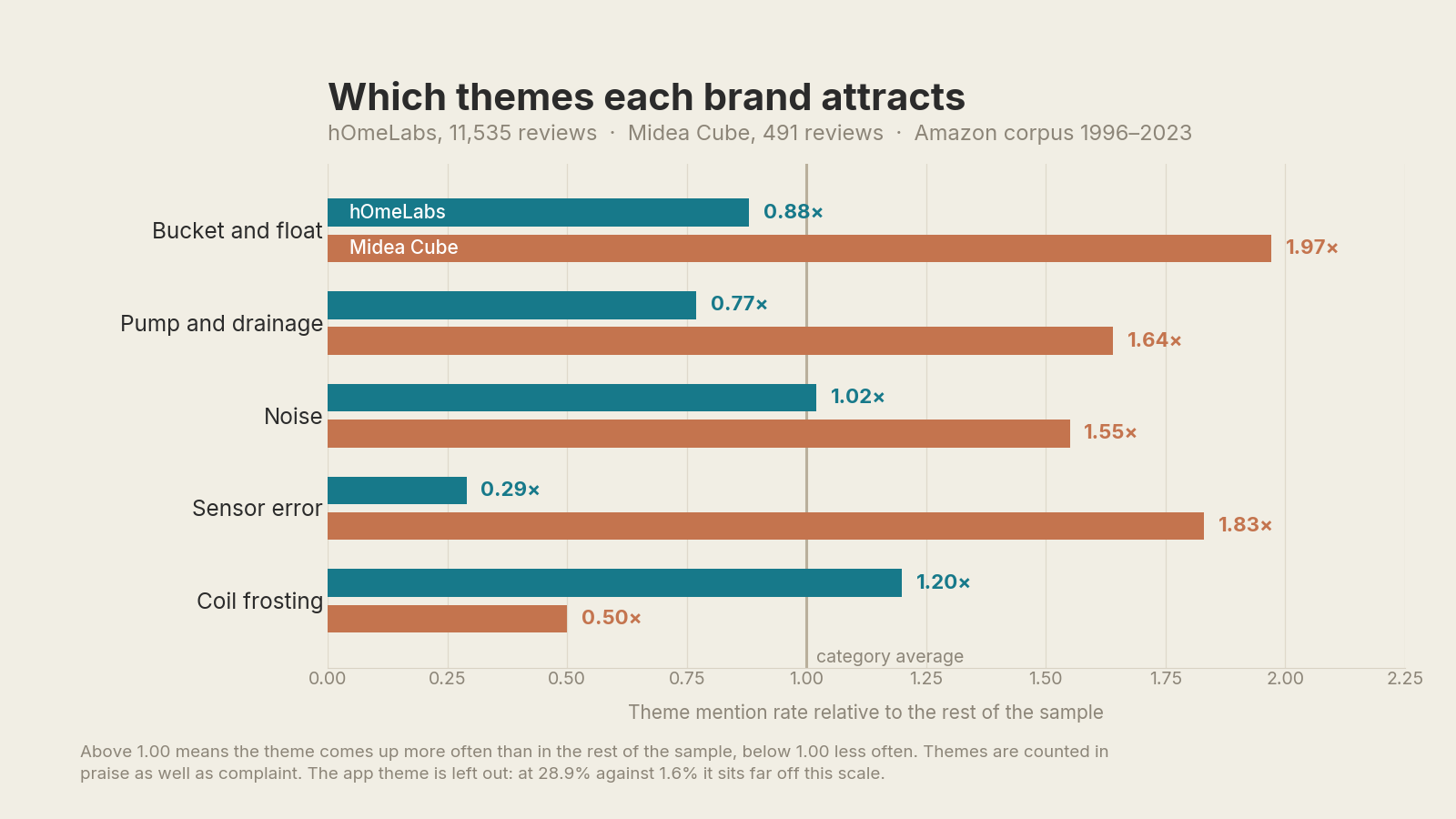
| Theme | hOmeLabs | Sample excl. hOmeLabs | Midea Cube | Sample excl. Cube |
|---|---|---|---|---|
| Bucket, float, shutoff | 16.9 | 19.1 | 36.7 | 18.6 |
| Pump, drainage, hose | 16.0 | 20.8 | 32.4 | 19.8 |
| App and Wi-Fi | not tagged | n/a | 28.9 | 1.6 |
| Noise | 13.3 | 13.0 | 20.2 | 13.0 |
| Breakdown and warranty | 11.1 | 15.2 | not tagged | n/a |
| Support and returns | 6.0 | 10.8 | not tagged | n/a |
| Sensor error | 0.6 | 2.1 | 3.3 | 1.8 |
| Coil frosting | 1.8 | 1.5 | 0.8 | 1.6 |
Share of reviews raising each theme, %. The comparison sample excludes the brand being examined, which is why the two reference columns differ slightly. “Not tagged” means the theme was outside that run’s tagging scheme, not that a figure is being withheld.
Five of seven themes run below the category for hOmeLabs; only noise and frosting sit above, and by tenths of a point. For the Cube everything runs above the category except frosting.
The app line deserves its own note at 28.9% against 1.6%. That gap reflects what is on the market rather than the quality of the software: the connected-capable flag in the registry covers 40 units out of 535, so for most of the sample there is no app to mention.
Theme tagging does not separate praise from complaint. Inside the low ratings themselves, the Cube leads with the bucket at 28.6% and drainage at 26.2%, while hOmeLabs leads with breakdown and warranty at 36.8% and support at 19.4%.
The substance of the dissatisfaction differs. On the Cube it collects around the parts that make it distinctive: bucket, pump, app. On hOmeLabs it collects around breakage and what happens afterwards.
Bench readings: quieter is not the same as calmer
The lab measured both units under one procedure and compared them directly.
With the meter above the control panel at high fan speed, the hOmeLabs HME1003 read 60.7 dB and the Cube MAD50PS1QWT 66.4 dB. Across all four of the lab’s noise tests the HME1003 came in lower.
Then comes the caveat the lab raises itself. Compressor buzz on the HME1003 is louder than on the Cube. The Cube’s fan pushes 430 CFM against 218 on the HME1003 and exhausts upward rather than sideways, and the noise of that airflow covers the buzz. The unit with the higher meter reading turned out to be the smoother of the two to listen to.
Power draw at 50% relative humidity: 512 watts for the Cube, 552 for the HME1003. The earlier HME020031N pulled 610 watts in the same test. The rating plate’s 8.5 amps at 115 volts works out to 978 watts, but that is a ceiling at extreme humidity rather than a working figure.
Drainage
The Cube offers four routes for the water: the bucket, gravity through a hose, bucketless operation, and a pump that comes in the MAD50PS1QWT and lifts 14 feet. Bucket shutoff levels are documented individually at 2.25, 3.0, 3.75 and 4.25 gallons.
hOmeLabs offers two: the bucket, or gravity through a threaded outlet. The pump version, HME020391N, makes three.
Bucketless operation is the one route hOmeLabs has in no version.
The lab measured the Cube’s bucket at 34 pints against 12 to 13 on a typical unit in the class. That is why the bucket theme reaches 36.7% of its mentions: a larger vessel gets talked about more.
The numbers on the product listing
The HME020031N listing reads “50 Pint (MAX 120 Pint at 95°F, 90% RH)” for a unit measured at 49.93 pints under Appendix X1. The second figure comes from 95 degrees and 90% humidity, conditions that do not occur in a lived-in room.
Coverage on that same listing grew from 4,500 to 7,000 square feet over its sales life without any change to the model index.
Built-in humidistat accuracy across the hOmeLabs line is stated as ±5%, with the setting adjustable in 5% steps. A target of 50% under that tolerance means anywhere from forty-five to fifty-five.
Who owns the brand
On 27 April 2026 Aterian agreed to sell hOmeLabs to Trademark Global for 18 million dollars as part of a package of brands, with closing expected in the second quarter of 2026.
For a buyer this is a warranty question rather than a logo question. Sources disagree on the hOmeLabs warranty term: some state two years, while the lab reports one and notes that registering the product for an extra year no longer applies. Worth checking the terms at the point of purchase.
Midea’s warranty runs one year, and ownership of that brand has not changed.
hOmeLabs vs Midea: which suits which house
The Cube is bought for what the other line does not offer: bucketless running and phone control, plus the lower draw of the pair at 512 watts against 552. The cost is a 25.7% low-rating share and the fact that dissatisfaction gathers on exactly those features.
hOmeLabs is bought for the ratings: 13.2% low across 11,535 reviews, most themes below the category, and a lower meter reading. In exchange comes a humidistat with up to five points of error and a brand that has changed hands.
There is no comparing the two on service life. hOmeLabs has 392 reviews naming a duration, at a median of 12 months, with 60% of those durations falling inside the first year. The Cube has twelve such mentions, and I am not quoting a figure from them. Full breakdowns sit in the hOmeLabs review and the Midea Cube review, and both feed the Florida selection guide.
Current retail options: Midea MAD50S1QWT at Sylvane. This current base model accepts an optional pump kit; it is not the MAD50PS1QWT built-in-pump model measured in this comparison.
Limits of this comparison
- I have not tested either unit, and there are no field measurements here.
- Bench readings were taken on the hOmeLabs HME1003, while the registry entry and the reviews describe the HME020031N and related listings.
- A pump version was measured on the Midea side and a bucket-only unit on the hOmeLabs side.
- Both review cohorts run wider than the 50-pint class, and no capacity breakdown exists within the hOmeLabs cohort.
- Registry figures come from a 65 °F / 60% RH test and understate performance in Florida conditions.
- The Cube share rests on 491 reviews: the direction is visible, the second decimal is not.
- A low rating is not only about breakdowns; shipping complaints and awkward bucket handling land there too.
- Theme tagging does not separate praise from complaint, and themes overlap within a single review.
- The Amazon corpus ends in 2023.
- ENERGY STAR certification is neither a guarantee of quality nor a recommendation.
Frequently asked questions
Are the hOmeLabs HME020031N and Midea Cube MAD50PS1QWT in the same class?
By the ENERGY STAR registry, yes: 49.93 and 49.67 pints per day under Appendix X1. The difference falls inside a third of a pint.
Which brand has fewer low ratings?
The hOmeLabs cohort shows 13.2% across 11,535 reviews against 25.7% for the Cube across 491. hOmeLabs sits below the category average and the Cube above it.
Which unit is quieter?
By one lab’s measurement the hOmeLabs HME1003 was lower in all four noise tests, at 60.7 dB against 66.4 for the Cube on high fan above the panel. That same lab notes louder compressor buzz on the HME1003, less well covered by its fan.
Which one has a pump?
Both lines sell the pump as a separate model: the MAD50PS1QWT at Midea, lifting 14 feet, and the HME020391N at hOmeLabs. Bucketless operation exists only on the Cube.
What does “MAX 120 Pint” mean on the hOmeLabs listing?
It is the figure at 95 °F and 90% relative humidity, conditions that do not occur in a lived-in room. Under the current Appendix X1 procedure the unit measures 49.93 pints per day.
Sources
- ENERGY STAR Certified Dehumidifiers registry, Appendix X1 capacity values and the connected-capable flag.
- Midea MAD-series owner’s manual; hOmeLabs product documentation and Amazon listings.
- Independent bench readings for noise, airflow, power draw and bucket capacity, single third-party lab.
- Amazon Reviews 2023 dataset, household compressor dehumidifier subset, 1996–2023.
- Aterian Group filings on the sale of the hOmeLabs brand, April 2026.