
Kesnos Dehumidifier Review: 3,513 Owner Reviews
Kesnos, Waykar and yaufey are certified through one company, JHS INC. This kesnos dehumidifier review closes out that group of three. I did not test the unit.
The share of low ratings here is 9.7 percent, third lowest in the sample. And one claim in a product description does not survive arithmetic.
Disclosure: This article contains affiliate links, including links to Amazon and other partners. If you purchase through these links, we may earn a small commission at no extra cost to you. As an Amazon Associate I earn from qualifying purchases. Full disclosure: Affiliate Disclosure.
Where the numbers come from
The core sample is 62,317 reviews of 711 compressor household dehumidifiers written between 2002 and 2023, drawn from the open Amazon Reviews 2023 dataset. The selection method is described on a separate page.
Kesnos accounts for 3,513 of those reviews across six listings. They peak at 1,902 in 2021 and fall to 106 in 2023.
What this kesnos dehumidifier review found in the ratings
The share of one and two star reviews is 9.7 percent. Across the rest of the core sample it is 18.1 percent, and five star reviews here make up 76.6 percent.
Among the nineteen brands in this sample with at least 700 reviews, Kesnos has the third lowest share of low ratings. Only yaufey at 6.2 percent and Vellgoo at 6.8 sit below it.
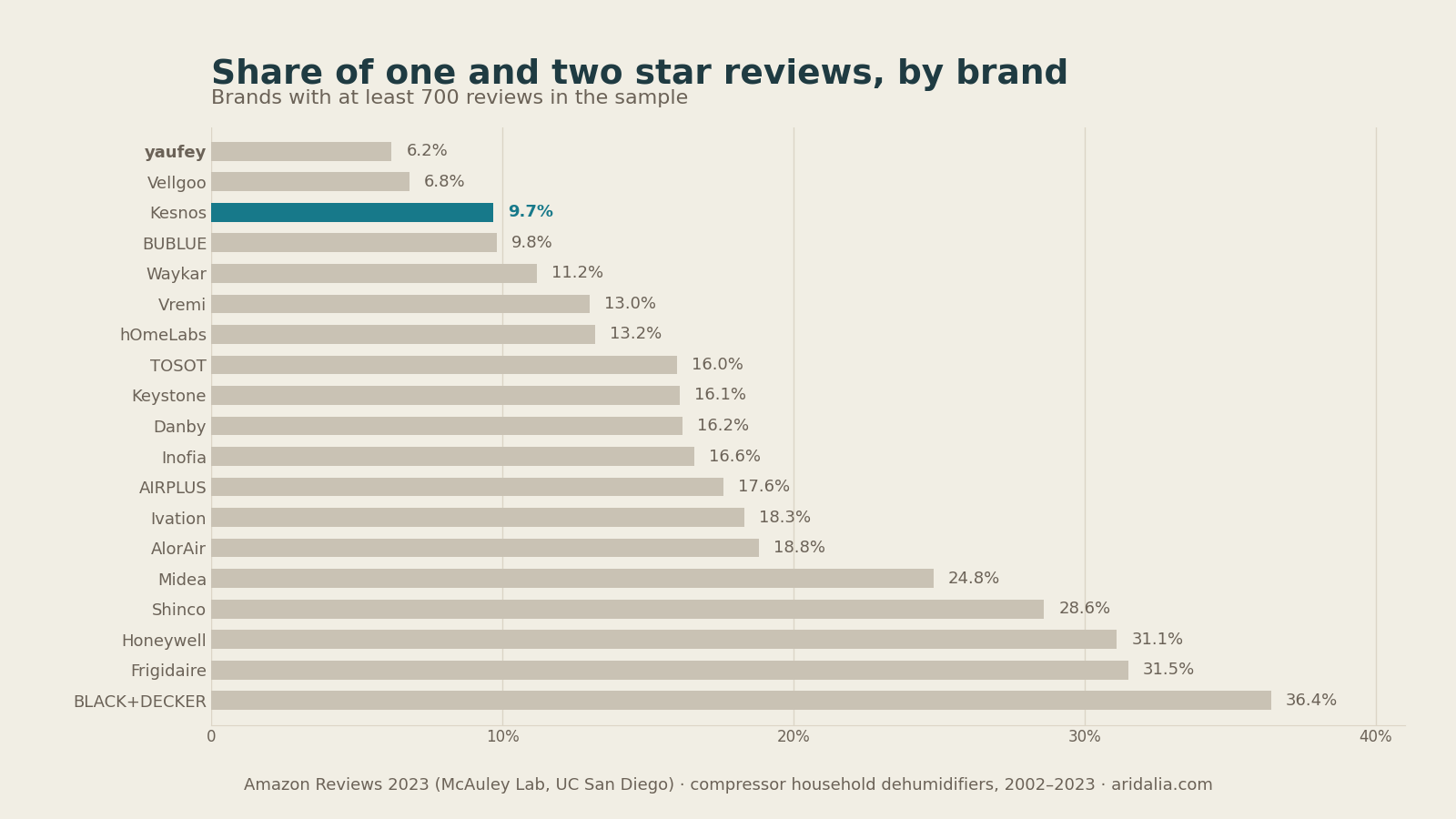
The figure describes owner experience rather than build quality. The age of the listings, the price of entry, who buys these machines: any of that explains a gap like this, and none of it can be tested on our sample.
Support runs at twice the category level
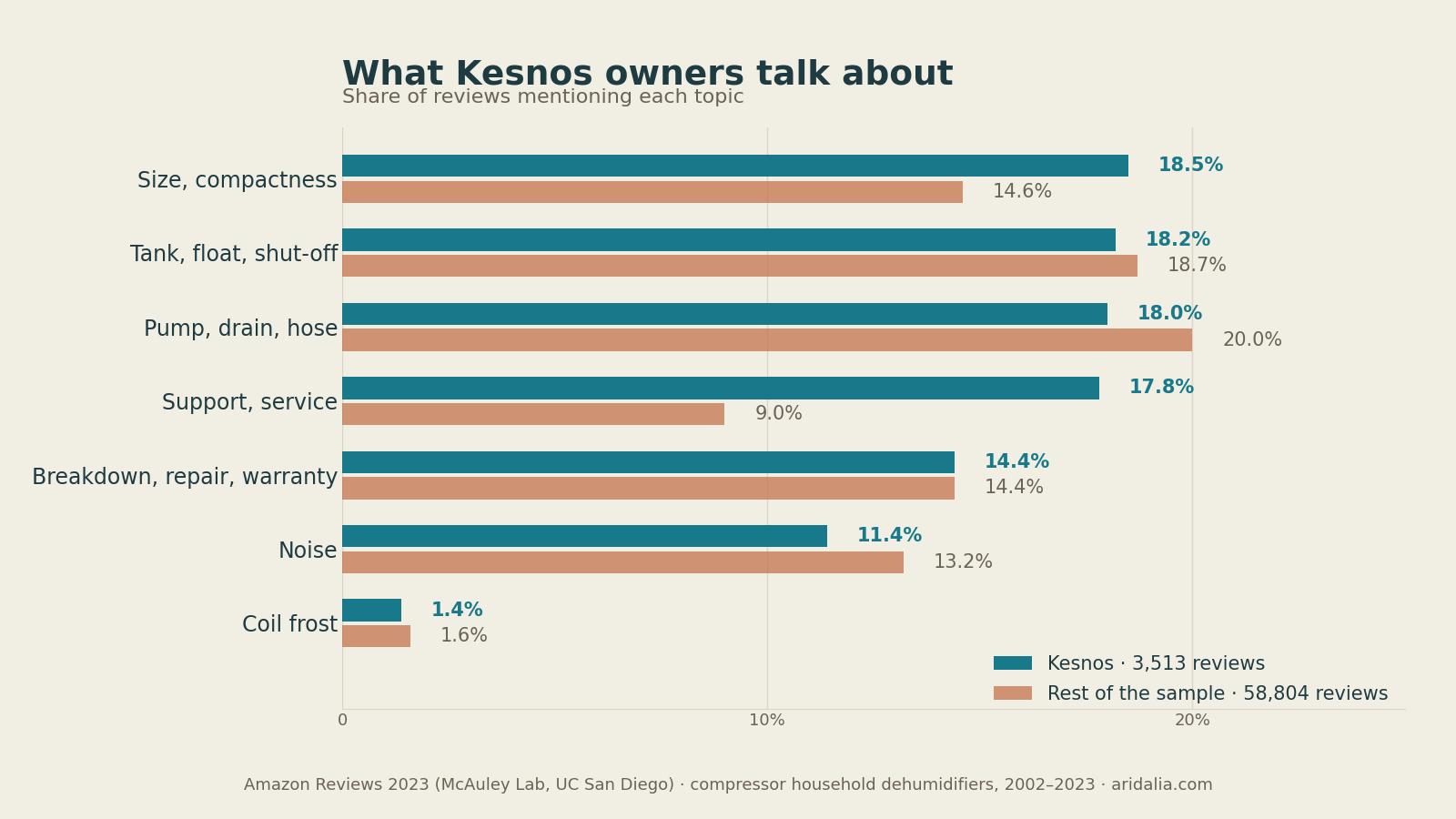
Review texts are tagged by topic. The figure is the share of reviews where a topic comes up at all, in praise as well as in complaint.
| Topic | Kesnos | Rest of the sample |
|---|---|---|
| Size, compactness | 18.5% | 14.6% |
| Tank, float, shut-off | 18.2% | 18.7% |
| Pump, drainage, hose | 18.0% | 20.0% |
| Support, service | 17.8% | 9.0% |
| Breakdown, repair, warranty | 14.4% | 14.4% |
| Noise | 11.4% | 13.2% |
| Coil frost | 1.4% | 1.6% |
Denominators: 3,513 Kesnos reviews and 58,804 reviews of the rest of the core sample, 2002 to 2023. Shares are counted against all reviews in each group, positive ones included.
Support and service reaches 17.8 percent against 9.0 across the category. Inside low ratings it reaches 28.4 percent, second only to breakdown at 39.5.
What sits behind that, the tagging does not separate: thanks for a fast replacement and an account of how hard the replacement was to obtain both land in the same group. All that can be said is that the topic comes up twice as often as in the category, and that it turns up in low ratings.
The same pattern appears at Waykar, at 18.7 percent against 8.7. Both brands are certified by the same company.
Six months
In 110 reviews the owner names how long the unit ran before it failed. The median, meaning the middle value of that list rather than the average, is 6 months, and 80 percent of the figures fall inside the first year.
Counted the same way: Waykar 5 months across 138 mentions, yaufey 6 across 36, Hisense 8 across 70, Frigidaire 12 across 445.
The caveat stands: a length of service gets named by owners whose unit died, so this is the distribution inside failure stories rather than an average service life.
One thousand two hundred and sixty-eight dollars
The description of the 80 pint model claims savings of up to 1,268.57 dollars a year on electricity bills, running around the clock.
Check the arithmetic. In the federal register a 50 pint class machine consumes on the order of 525 kilowatt hours a year. At United States residential rates of 13 to 17 cents per kilowatt hour that is 68 to 89 dollars: the entire annual running cost of the machine.
To save 1,268.57 dollars, consumption would have to fall by 7,500 to 9,800 kilowatt hours a year, roughly fifteen times more than the machine uses in the first place.
There may be a comparison with some other equipment behind that number, or a different accounting method. As presented to a buyer, it does not add up.
Three brands, one applicant
Kesnos, Waykar and yaufey file their models for certification through a single legal entity, JHS INC.
How close the three sit shows in the details: Waykar sells a PD160B, yaufey a PD161D. The complaint profiles rhyme as well, with size and support at the top for each of the three.
A shared applicant does not mean identical machines. One difference is worth knowing before buying, though: neither Kesnos nor Waykar offers a pump anywhere in its household line, while yaufey builds one into its largest model.
The numbers on the boxes
The line is sold as 30, 80, 120 and 150 pints.
Those capacities are measured at 95 degrees Fahrenheit and 90 percent relative humidity. The federal Appendix X1 test runs at 65 degrees and 60 percent, and no portable unit exceeds 50.0 pints on that scale. Our page on pint ratings covers how the scales came apart.
The exact Appendix X1 figure for the Kesnos models was not pulled from the register, so no class is formally assigned to them here.
One tank, two capacities
The 80 pint and 120 pint models carry the same 1.06 gallon tank, while the listed coverage rises from 5,500 to 7,000 square feet. More water goes into the same container.
yaufey does the same thing: 1.06 gallons on both its 80 and 120 pint models.
What matters in Florida
A dehumidifier here runs most of the year, and the tank fills constantly. To avoid carrying it to a sink you need a hose sloping down to a drain. There is no built-in pump anywhere in the Kesnos line, and a built-in pump cannot be added later; an external condensate pump is a separate appliance with its own price and its own place on the floor.
The flagship model ships with a 6.6 foot hose and a garden hose thread, so the line can be extended.
Coil frost appears in 1.4 percent of Kesnos reviews against 1.6 across the category.
The models on sale
The coverage figure on a listing is the manufacturer’s number for its own test conditions. What a unit will actually pull in your rooms depends on how damp it is now, how much outside air the space draws in, and what the space is used for. For a real match, our sizing calculator does the arithmetic.
Kesnos 30 pint, for a bedroom or small room
Listed for 2,500 square feet with a 0.39 gallon tank and a published noise figure of 36 dB. The tank here is smaller than on the larger models, so a hose matters more.
View on AmazonKesnos 80 pint, for a floor
Listed for 5,500 square feet with a 1.06 gallon tank and a humidity display on the front panel. Gravity drainage through the supplied hose.
View on AmazonKesnos 120 pint, for a whole house
Listed for 7,000 square feet and sharing the 1.06 gallon tank with the 80 pint model above. Connect the hose or expect to empty it more often.
View on AmazonKesnos 150 pint, for a large space
Listed for 7,500 square feet with a 2.11 gallon tank, the largest in the line. Still no pump at this size, so plan the drain run before it arrives.
View on AmazonWhat this analysis does not show
I did not test the unit. The findings come from owner reviews, the ENERGY STAR register and product descriptions.
Reviews are not a random sample of owners: they are written by people who decided to write. The share of low ratings is not the share of failures.
The reviews describe models from 2020 to 2022, while a different line is on sale today.
The Appendix X1 figure for the Kesnos models was not pulled from the register.
The electricity calculation uses typical residential rates and the consumption figure from the register. What method sits behind the manufacturer’s number, I do not know.
Topic tagging works on words. It sees that a topic was raised, but it does not separate praise from complaint except through the rating attached to the review.
Frequently asked questions
Is Kesnos a good dehumidifier brand?
On 3,513 reviews, 9.7 percent carry one or two stars against 18.1 percent across the category, the third lowest share among brands with at least 700 reviews here. That measures owner experience rather than a tested failure rate.
Does any Kesnos dehumidifier have a pump?
No. Every model in the household line drains by gravity or into the tank, and a built-in pump cannot be added afterwards.
Are Kesnos, Waykar and yaufey the same company?
They are separate brands certified through the same legal entity, JHS INC. Shared certification does not make the machines identical, but they are not independent choices either.
How much does a Kesnos dehumidifier save on electricity?
A product description claims up to 1,268.57 dollars a year. A 50 pint class machine consumes about 525 kilowatt hours a year, which costs 68 to 89 dollars at typical rates, so the claimed saving exceeds the machine’s entire running cost many times over.
How big is the Kesnos water tank?
0.39 gallons on the 30 pint model, 1.06 gallons on both the 80 and 120 pint models, and 2.11 gallons on the 150 pint version.
Sources
- Amazon Reviews 2023, McAuley Lab, UC San Diego
- ENERGY STAR Certified Dehumidifiers register
- U.S. DOE, Appendix X1 to 10 CFR 430
- Kesnos product listings, August 2026