
Mold Removal DIY or Professional: The 10-Square-Foot Rule
Mold removal, DIY or professional? There is one short answer, and it comes down to area. A small patch on a hard surface you clean yourself in an hour; anything large, hidden, or in porous materials is a job for a specialist. Here is exactly where the line falls, and how to read it.
You find black growth along a bathroom seam or a patch on the wall and wonder: can I handle this myself, or do I need someone? There is a clear rule of thumb for this, and I did not invent it. In its guidance, the US Environmental Protection Agency (EPA) draws the line by area: about 10 square feet, roughly one square meter, a patch around three feet by three feet. Less than that is usually within reach on your own. More than that, call a pro. Everything else here refines that rule.
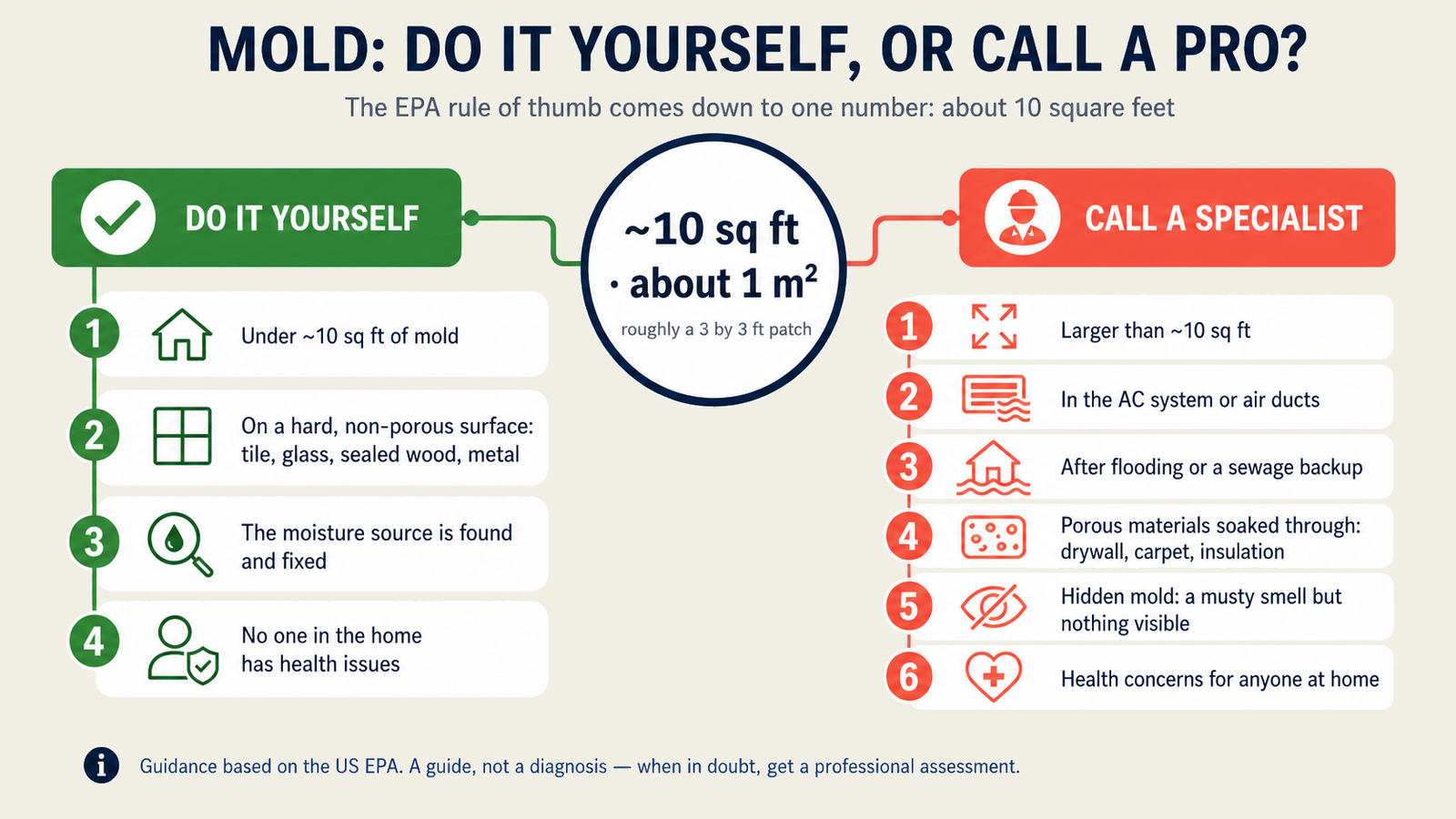
The 10-Square-Foot Rule
Where the number comes from. The EPA states that if the mold covers less than about 10 square feet, a homeowner can generally handle it with a few simple precautions. If it is larger, it is worth hiring a professional, because the risk of spreading spores through the house and of missing the source both go up.
Estimating the area is easy. Ten square feet is a patch about three feet by three feet, roughly a meter square. A spot the size of your hand, or a line along the grout, is well under that, so the question is settled in your favor. Half a wall, or a corner of the ceiling, is over the line.
But area is not the only test. Even a small patch is sometimes better left to a specialist, and sometimes a larger one can be handled at home. Here is what else to look at.
When You Can Clean It Yourself
Doing it yourself makes sense when four things line up:
- The area is under about 10 square feet.
- The surface is hard and non-porous: tile, glass, painted wall, metal, sealed wood. Mold lifts off these without soaking in.
- The moisture source is found and fixed, whether a leak, condensation, or a drip. Otherwise the mold comes back no matter how hard you scrub.
- No one in the home has health issues that cleaning mold could aggravate.
How to clean it. Wear gloves and a mask (an N95 respirator). Scrub the surface with water and a household detergent, mechanically, with a sponge or brush, and dry it fully; dryness matters more than any chemical. The EPA notes specifically that bleach is not required for routine mold cleanup, that soap and water do the job, and that bleach on porous material only masks the problem. What not to do: do not brush dry mold while it is dry (that throws spores into the air), do not paint over live growth, and do not soak drywall or carpet with bleach hoping to burn it out.
When It Is Definitely a Specialist
Here doing it yourself does harm. Call a professional if any one of these is true:
- The area is larger than about 10 square feet.
- The mold is in the air conditioning or ductwork, where spores get distributed through the whole house and cleaning has to be done properly.
- It follows flooding, a burst pipe, or a sewage backup, where you are dealing not just with mold but with contaminated water and a soaked structure.
- Porous materials are soaked through: drywall, carpet, insulation, ceiling tile. These are usually cut out and replaced, not cleaned.
- The mold is hidden: a musty smell with nothing visible, behind a wall, under the floor, in the structure. Finding and opening that up is a specialist’s job.
- Someone in the home has health concerns: asthma, allergies, a weakened immune system. Then even a small job is better not done yourself.
The Grey Zone
Between “clearly yourself” and “clearly a pro” there is a middle: a patch near 10 square feet, a semi-porous surface, a cause that seems clear but is not certain. The sensible rule is simple, when in doubt, lean toward a specialist. Mold that is left half-cleaned, or whose source is not fixed, comes back, and the second round costs more than the first. Many companies do an inspection separately from the work, so you can get an assessment before deciding who does the job.
Why This Comes Up More Often in Florida
In a dry state a “small patch” stays small. In Florida it does not. The humid air here keeps surfaces damp most of the year, and mold grows faster and spreads wider, so a spot that was the size of your hand crosses that 10-foot line a month or two later. Humidity is the fuel: as long as the indoor air stays high in relative humidity, any spot left half-cleaned returns. That is why the DIY-versus-pro line runs tighter here than the general guidance suggests, and why keeping humidity in check matters more than almost anywhere else.
What a Specialist Costs, and Where to Find One
Professional remediation is not cheap, and the price depends on the area, the materials, and the cause. The range across the state is covered separately: how much mold removal costs in Florida. To find a company in your city: mold removal in Key West, Miami, Orlando, Tampa, and Jacksonville.
Frequently Asked Questions
How much mold can I clean myself?
By the EPA’s rule of thumb, up to about 10 square feet (roughly a square meter) on a hard, non-porous surface, as long as the moisture source has been fixed. Larger than that, it is worth hiring a specialist.
Do I need bleach to clean mold?
No. The EPA notes that water and a household detergent are enough for routine cleanup. Bleach is not required, and on porous materials it does not solve the problem.
When should mold never be cleaned yourself?
When it is larger than 10 square feet, in ductwork or the AC, follows flooding or sewage, has soaked through porous materials, is hidden in the structure, or when someone in the home has health issues.
Why does mold keep coming back after I clean it?
Usually because the moisture source was not fixed. As long as the surface gets damp again, the mold regrows. Fix the cause first, the leak, condensation, or humidity, then clean the growth.
Is mold dangerous to your health?
It can cause respiratory irritation and allergic reactions and can aggravate asthma, especially in sensitive people. That is a topic of its own; if you have symptoms, see a doctor.