
Mold in a Dehumidifier: Why the Tank Is Not the Problem
Finding mold in dehumidifier parts usually starts in the wrong place. The owner washes the tank, the smell comes back within a week, and the machine gets written off as faulty. The water in that tank is close to distilled: the machine condenses it out of the air, so it carries almost no minerals. The food for microbes arrives from the other direction, as dust, spores and organic film settling on the coil. Which is why cleaning the tank alone never settles it.
What mold in dehumidifier parts actually is
One caveat belongs up front: there is very little published microbiology on mold in dehumidifier interiors specifically. There is a great deal on the cooling coils of air conditioners, which is the same cold wet heat exchanger sitting in a stream of room air.
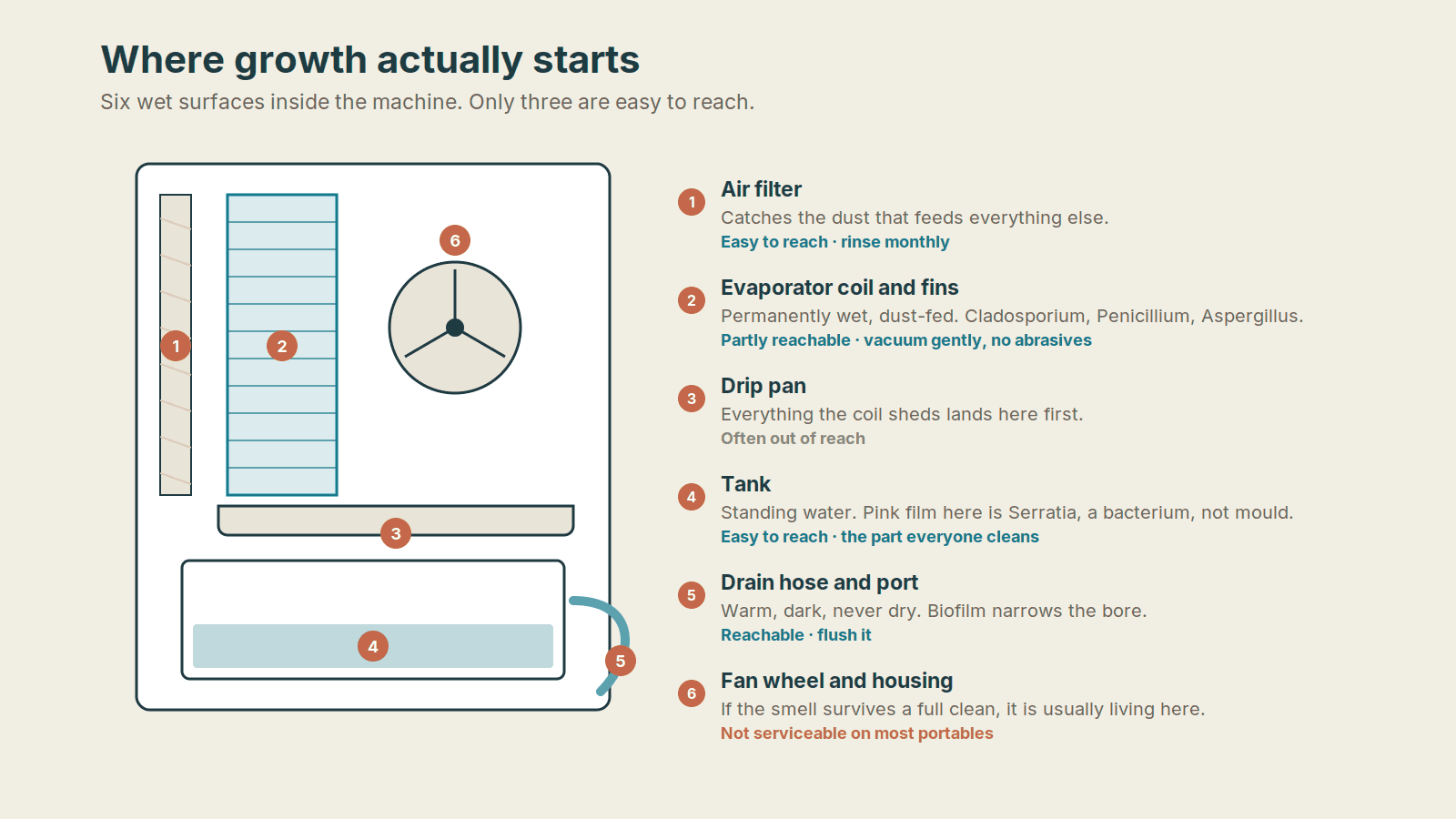
What turns up on those coils: the fungi Cladosporium, Penicillium, Aspergillus and Aureobasidium, and the bacteria Sphingomonas, Pseudomonas and Mycobacterium. Separately there is Serratia marcescens, the pink film familiar from bathrooms. That one is a bacterium rather than a mould, it needs very little to live on, and it washes off, but in a tank that stays wet it comes back, because the organism is common in the environment and recolonises damp surfaces.
The scale has been measured. A study across 40 units found a median loading of 1.2 × 10⁷ bacterial cells and 7.6 × 10⁵ fungal spore-equivalents per square metre of coil. The part that matters here: fungal loading tracked dew point, so the more humid the climate, the heavier the growth. Florida sits at the top of that scale.
From the same work: units running lower-efficiency filters carried noticeably more pathogenic bacteria and medically relevant fungi. The filter is not cosmetic.
Why it happens so fast
Three numbers explain why cleaning once a season does not hold.
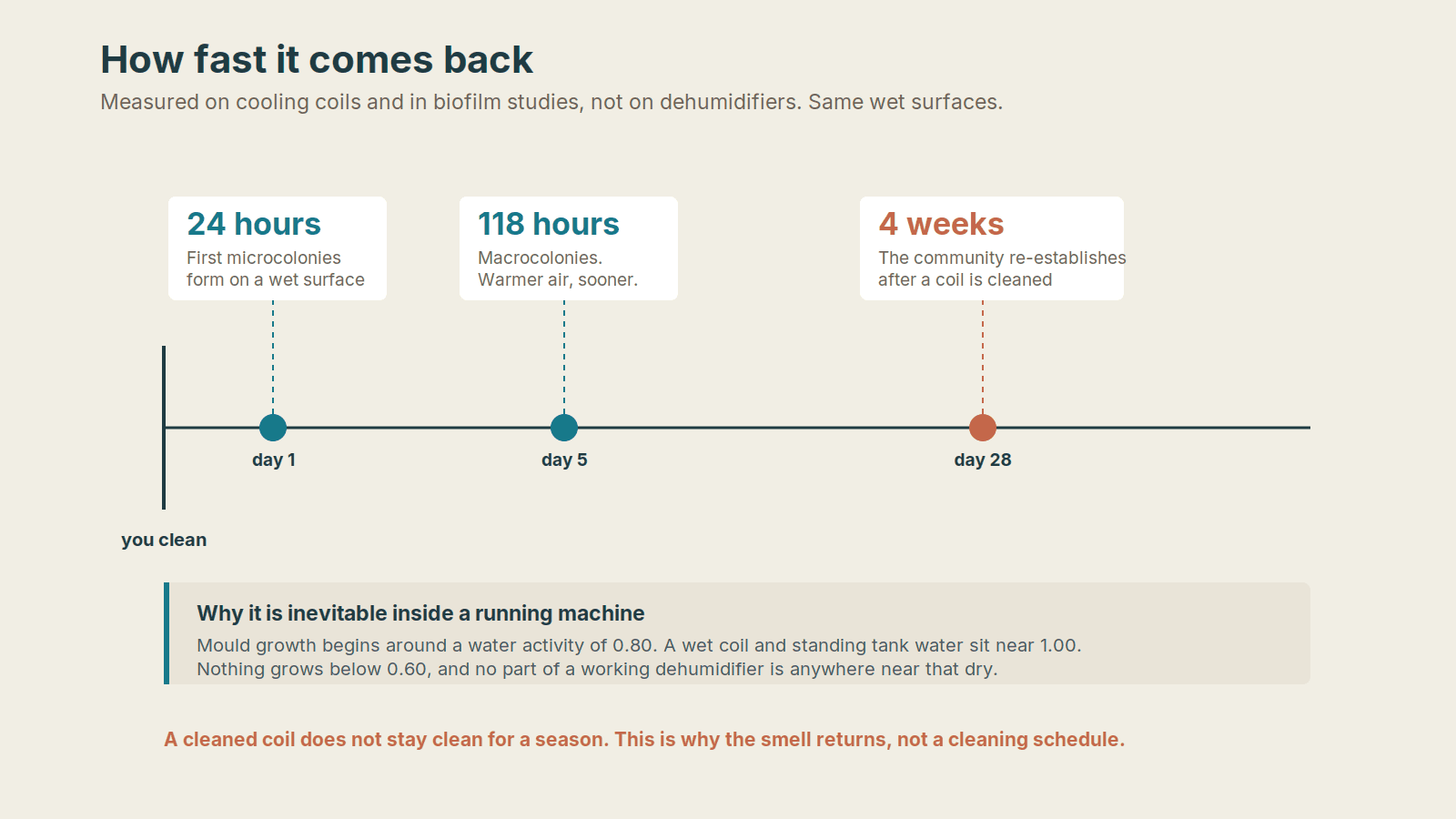
Mould growth begins at a water activity of about 0.80, which is roughly 80% humidity right at the surface. Inside a running machine the coil and the standing tank water sit near 1.00. The conditions are not close to the threshold, they are far past it.
Biofilm forms within a day. In laboratory observation, Pseudomonas microcolonies are visible at 24 hours and larger colonies at around 118 hours, sooner in warmer air.
After a coil is cleaned, the microbial community re-establishes over about four weeks, which is what a tropical coil study recorded. That is the answer to the most common complaint about this whole subject: the smell returns because the surface repopulates, not because the cleaning was done badly.
Why it smells
The smell is specific compounds rather than generic damp. Microbes release volatile organic compounds: geosmin gives the earthy note, 2-methylisoborneol the musty one, 1-octen-3-ol the mushroom one.
What matters is the sensitivity of the human nose. Geosmin is detectable at a few parts per trillion. A colony too small to see produces a smell that fills a room.
The trade calls this dirty sock syndrome: growth dries on the coil while the machine sits idle, then releases when it starts. Hence the recognisable complaint that a unit stinks for the first few minutes after switching on and then settles.
A dirty coil can add spores rather than trap them
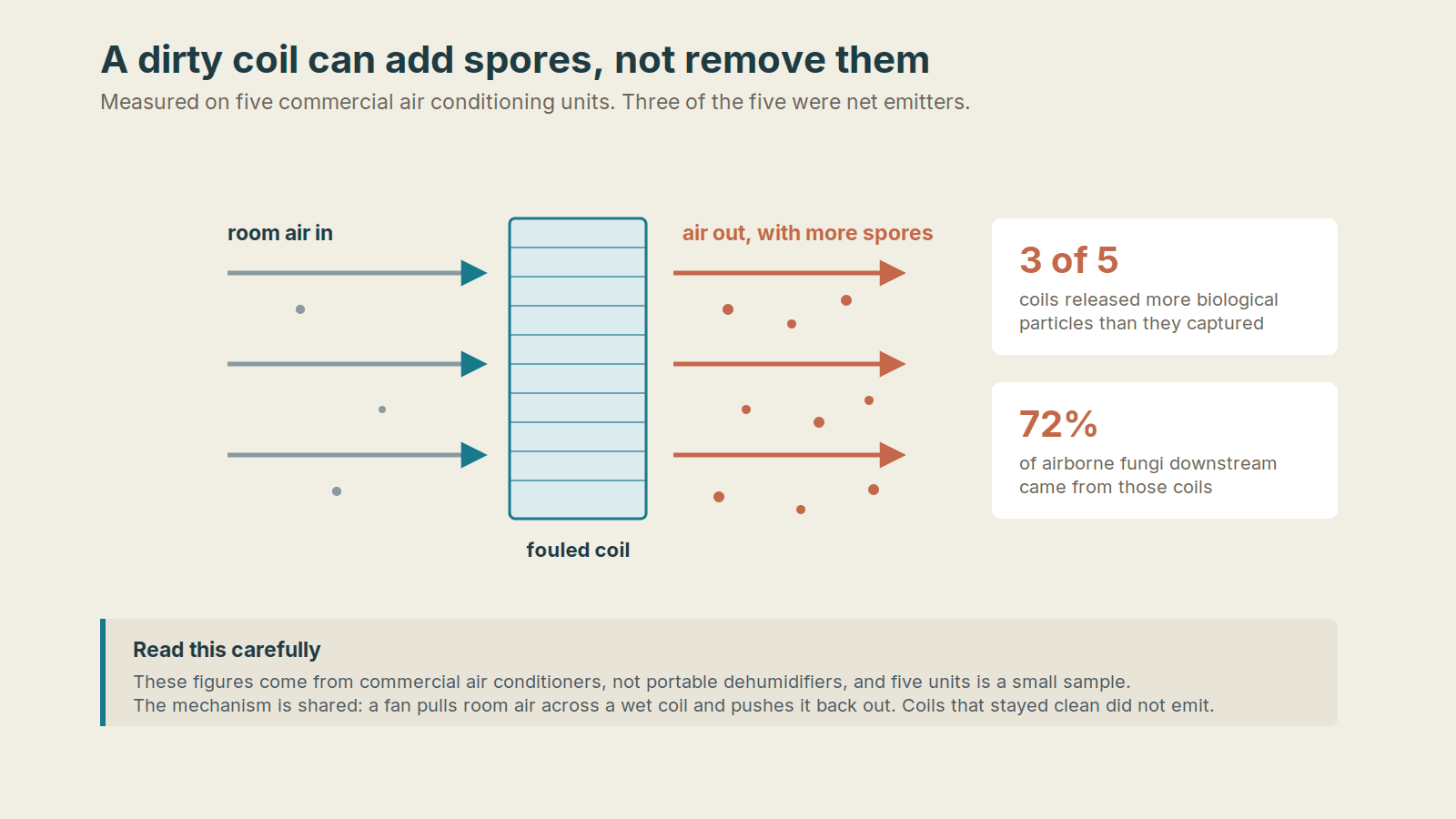
This is the least intuitive measurement in the subject. Across five commercial air conditioning units, the coils captured aerosols overall, yet three of the five were net emitters of bioaerosols: they released more biological particles than they caught.
The magnitudes were 5.6 × 10⁷ to 7.2 × 10⁷ biological particles per hour. Counting only the measurements where the coil was a source, those coils accounted for roughly 72% of the airborne fungi in the air leaving the unit. The emitting coils were rich in Cladosporium, Penicillium and Aspergillus; the two that added nothing carried a different community.
Read that carefully: these were air conditioners rather than portable dehumidifiers, and five units is a small sample. The mechanism is shared, though. A fan pulls room air across a wet coil and pushes it back into the room.
Health, without the scare
Two device types get confused here, and the difference decides the answer.
The documented illnesses, humidifier fever and hypersensitivity pneumonitis, are associated with humidifiers. Those aerosolise water, which is a direct route of exposure. In a 2020 case report a man fell ill after two months of running an ultrasonic humidifier; the water held bacteria, fungi and a high concentration of endotoxin, and his symptoms resolved once he stopped using it.
A dehumidifier collects water rather than misting it. Publications describing illness tied specifically to dehumidifiers could not be found; the documented cases involve humidifiers.
What remains is the fan, which does push room air across the coil, and the emission measurements above suggest a fouled coil can add spores to that air. Alongside that sits the EPA’s position that dead mould still causes allergic reactions, so killing it is not enough and it has to be physically removed.
A reasonable frame: for a healthy adult a musty machine is a nuisance and a source of allergens. The risk runs higher for infants, the elderly and anyone immunocompromised.
What to clean it with, and where the manufacturers disagree
Safety warning
Never mix bleach with vinegar or any acid. The reaction releases chlorine gas. Never mix bleach with ammonia-based cleaners either. In 2021 American poison centres logged 4,800 exposure calls involving chlorine gas from mixed household products.
Use one product at a time and rinse thoroughly between them. Ventilate the room while you work.
With that established, the instructions themselves are not consistent.
GE states in one support document that the tank can be cleaned with a solution of 90% water and 10% bleach, and in another that you should not use abrasives or bleach. One manufacturer, two positions.
Frigidaire calls for mild soap and water, with no bleach and no ammonia. hOmeLabs specifies cleaning the bucket every two weeks and the filter at least every 30 days, and says not to use bleach or abrasives. Midea says mild detergent every few weeks and not in a dishwasher.
The regulator settles the argument. EPA does not recommend biocides or chlorine bleach as routine practice in mould cleanup, and directs people to scrub hard surfaces with detergent and water.
The order of work
Switch the machine off and unplug it.
Tank. Wash with mild detergent, rinse, dry completely. Pink film is Serratia and comes off with scrubbing.
Filter. Rinse with water and dry fully before it goes back in. Never run the machine without it: dust goes straight to the coil, and dust on the coil is the food supply for everything above.
Coil and fins. Vacuum with a soft attachment or brush gently. Fins bend under pressure and abrasives are out. Dedicated coil cleaners are used according to your own model’s instructions.
Drain hose and port. Flush them and check for slime, as covered on the drainage setup page.
Dry everything before reassembly. Putting it back together wet returns you to the start.
EPA’s protective advice for handling mould applies: gloves, eye protection, and a mask if you are sensitive.
What actually prevents it
Continuous drainage instead of the tank. No standing water, no primary breeding site. This is the single most effective change available.
The filter on schedule. Most manufacturers say every 30 days, or when the 250-hour indicator lights. The filter protects the coil, and the coil is the bottleneck.
Drying after operation. A fan-only run or a built-in dry cycle stops growth drying onto the coil and reactivating at startup, which is the dirty sock mechanism exactly.
Enough space around the machine and a position away from heavy dust sources, so less of it reaches the filter in the first place.
When the machine is past saving
There is no consumer standard for this, but the principle from commercial HVAC maintenance transfers directly: if a coil cannot be restored by cleaning, it gets replaced.
The practical test: you have cleaned the tank, the filter, the reachable face of the coil and the drain path, and the musty smell is back within days. That means growth is living somewhere you cannot reach, usually the fan wheel or the space behind the coil. Manufacturers do not publish teardown procedures for those assemblies. On an inexpensive unit, replacement is the honest answer rather than an endless fight. If a mould problem extends beyond the machine into the room itself, that is a different job, set out on the DIY versus professional page.
For choosing the replacement, review data and recall history by brand are in the Florida scorecard.
Frequently asked questions
Why does my dehumidifier smell musty even after cleaning the tank?
Because the source is usually the coil, the filter or the fan housing rather than the tank. The water in the tank is close to distilled; the food for microbes is the dust settling on the coil.
Can I use bleach to clean mold in a dehumidifier?
Manufacturers disagree: some allow a dilute solution in the tank, others prohibit bleach entirely. EPA recommends detergent and water. Never mix bleach with vinegar or with ammonia-based cleaners under any circumstances.
Is mold inside a dehumidifier dangerous?
The documented illnesses involve humidifiers, which aerosolise water; publications tied specifically to dehumidifiers could not be found. Dead mould still causes allergic reactions, so it needs to be physically removed rather than just killed.
What is the pink slime in my dehumidifier tank?
Serratia marcescens, a bacterium rather than a mould. It lives on traces of soap and dust, washes off with scrubbing, and returns in a tank that stays wet.
How often should I clean a dehumidifier filter?
Most manufacturers say every 30 days, or when the 250-hour service indicator lights on models that count running hours.
Sources
- US EPA, A Brief Guide to Mold, Moisture and Your Home, and Should I use bleach to clean up mold. epa.gov
- Bakker et al., Indoor Air, 2020: bacterial and fungal loading on air conditioning cooling coils across 40 units. pubmed.ncbi.nlm.nih.gov
- Acerbi et al., Indoor Air, 2017: ecological succession of microbial communities on a cooling coil in the tropics. pubmed.ncbi.nlm.nih.gov
- Luhung et al., Indoor Environments, 2026: bioaerosol emission from air conditioning coils.
- Shimoda et al., Respiratory Medicine Case Reports, 2020: hypersensitivity pneumonitis from an ultrasonic humidifier. pmc.ncbi.nlm.nih.gov
- Manufacturer service instructions: GE Appliances, Frigidaire, hOmeLabs, Midea, Kenmore.
- America’s Poison Centers: chlorine gas exposure calls from mixed household products, 2021.
- Method notes: /methodology/