
Palmetto Bugs and Humidity: What Actually Brings Them In
There is no palmetto bugs humidity number that kills them. Dust mites have a threshold; Florida’s large cockroaches do not, and that is worth knowing before buying a dehumidifier to deal with insects.
What follows comes from university entomology publications, laboratory work on cockroach water balance, and wood moisture data. I made no measurements myself, and the rest of the humidity guides cover the household side of the same problem.
“Palmetto bug” is not a species
At least four different cockroaches answer to the name in Florida. UF/IFAS applies it to the Florida woods cockroach Eurycotis floridana and notes in the same profile that it is also used for the large Periplaneta species, the American and the smokybrown. The university’s general guide adds the Australian and the brown cockroach to the same group.
The distinction is not academic. What a sighting means depends on the species.
| Species | Where it lives | Found indoors |
|---|---|---|
| American | Sewers, drains, damp shade | Migrant |
| Smokybrown | Tree holes, attics, sheds | Damp harborage |
| Florida woods | Leaf litter, stumps, bark | Carried in |
| German | Kitchens, bathrooms | True infestation |
The German cockroach is not a palmetto bug. It is small, about 16 mm, with two dark stripes on the pronotum, and people bring it in themselves.
The American cockroach is the largest of the common ones, about 1.5 inches, reddish brown with a pale border around the pronotum. The smokybrown is darker and glossy with no pale border, and it flies well. The Florida woods cockroach is large, dark, effectively wingless and slow, and releases a foul defensive secretion when threatened. On that last one UF/IFAS is blunt: it does not normally reproduce inside houses, because it needs the same consistently moist conditions it has outdoors.
What the palmetto bugs humidity question really asks
A cockroach loses water constantly, and the main route is through the cuticle. In one experiment on the American cockroach the respiratory route accounted for about 3.8 percent of total loss.
Of ten cockroach species measured in one study, the American had the most permeable cuticle: 53.7 µg per square centimetre per hour per mm Hg, against 14.3 for Leucophaea maderae. Body water runs from 62.7 to 71.8 percent of mass.
The animal defends itself, though. After dehydration the cuticle becomes less permeable as pore structures partly close, and further loss slows down.
A dehydrated cockroach goes looking for damp
Adult males of the American and the smokybrown were offered arenas with different combinations of temperature and humidity. Hydrated American cockroaches could pick the warmer, drier side. After 14 days without water the preference shifted towards cool and humid. In the smokybrown the shift appeared after 7 days. Time to death shortened as the saturation deficit rose.
A separate experiment on the American cockroach adds a twist. Solitary individuals chose the humid shelter — 92 percent against 42.5 percent relative humidity, with 0.65 of them picking it. Groups of sixteen chose the dry one, 0.61. The authors tie this to weaker group cohesion in the humid shelter.
Both experiments point the same way: a cockroach’s humidity preference is not fixed. It moves with the animal’s condition, the temperature and the company.
Free water counts for more than the hygrometer
UF/IFAS puts it plainly: water is the most important factor in cockroach survival, which is where the palmetto bugs humidity question usually goes wrong.
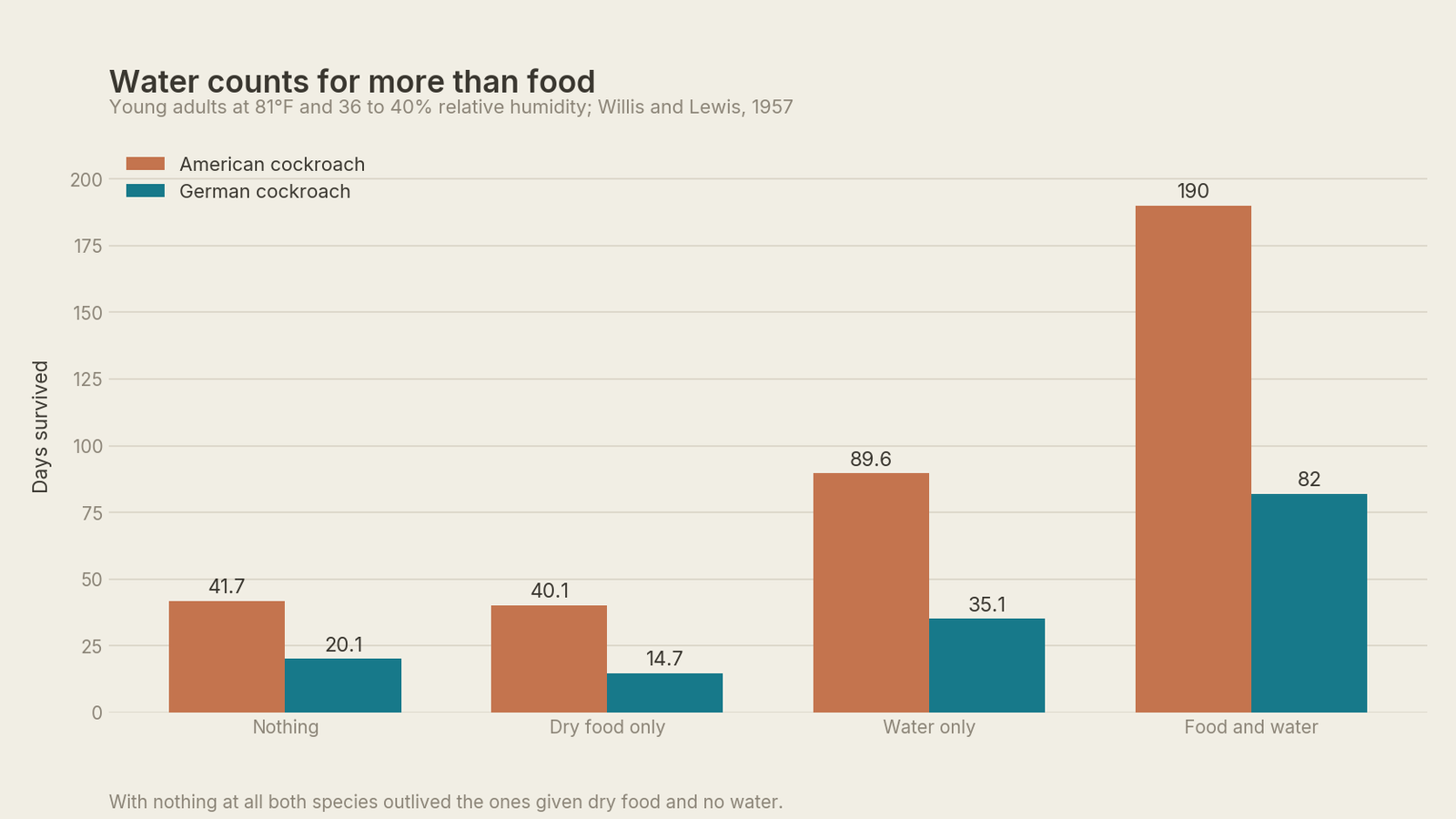
| Provided | American | German |
|---|---|---|
| Nothing | 41.7 | 20.1 |
| Dry food only | 40.1 | 14.7 |
| Water only | 89.6 | 35.1 |
| Food and water | 190 | 82 |
Days survived, young adults at 81°F and 36 to 40% relative humidity. Willis and Lewis, 1957.
A bead of condensate under the sink, the dog’s bowl, the drip pan under the fridge or a plant saucer therefore matter more to a cockroach than the average figure on a hygrometer in the living room.
More of them after heavy rain, and not because of indoor air
UF/IFAS notes specifically that house infestations by the American cockroach often follow heavy rain. More than 5,000 individuals have been recorded in a single sewer manhole.
The mechanism is not the one people assume. Rain floods and disturbs the outdoor and sewer harborages, and the cockroaches move out of them — towards buildings, and along pipes. Indoor humidity has nothing to do with it.
Their development is slow, incidentally: roughly 600 days from egg to adult, another 400 or so as an adult, and 6 to 14 moults. Egg case incubation runs 57.4 days at 76°F and 31.8 days at 86°F.
Who else in the house depends on moisture
| Species | Humidity | What it means |
|---|---|---|
| Common silverfish | 75–97% | Drying works |
| Grey silverfish | 55–60% | Drying barely works |
| Pillbugs | Damp soil | Wet perimeter |
| Fungus gnats | Wet potting soil | Overwatering |
The common silverfish figure is for development and breeding at 72 to 81°F. Grey silverfish tolerate ordinary room conditions, so lowering humidity will not push them out.
Pillbugs are land crustaceans and need damp. Indoors they die within days, and they arrive after heavy rain — finding them at the door or in the garage points at damp mulch and a wet foundation line. Millipedes live in damp litter and come in during mass migrations after long rains. Fungus gnats breed in wet potting soil; the UF/IFAS advice is to let the top couple of inches dry between waterings.
Termites: where the humidity lever works and where it does not
Here the split is fundamental.
Subterranean termites — the Formosan Coptotermes formosanus, the native Reticulitermes, the invasive Coptotermes gestroi — are tied to soil and moisture and build mud tubes a quarter to half an inch across. A Formosan colony can hold several million individuals and forage up to 300 feet through soil.
Drywood termites — Cryptotermes brevis, Incisitermes snyderi — need no soil contact at all and live on metabolic water. The review literature puts their survival in wood at moisture content around 3 percent.
Dampwood termites of the genus Neotermes need high moisture and contact with free water, but they do not forage in soil.
Carpenter ants nest in damp and decaying wood and prefer moisture content above roughly 15 percent. They do not eat wood, they excavate it, and finding them indoors marks hidden moisture.
Wood moisture, not air
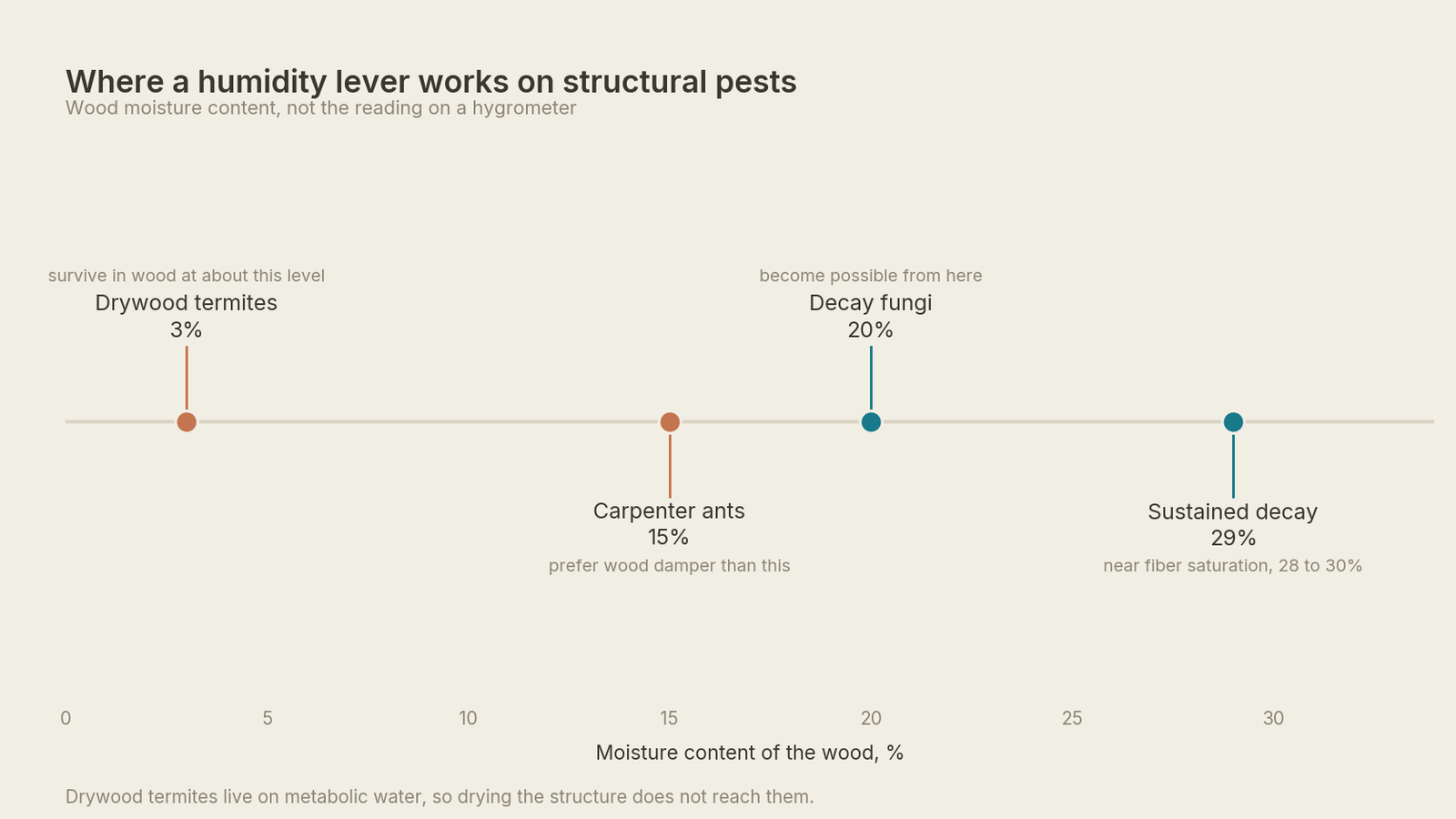
For structural pests the number that matters is the moisture content of the wood itself. Decay fungi become possible from 20 percent, and sustained decay wants something near fiber saturation, 28 to 30 percent.
Wood takes up moisture from the air until it reaches an equilibrium value set by humidity and temperature. The USDA Forest Products Laboratory publishes monthly equilibrium figures for 262 US locations; in a humid subtropical climate they sit high. The household signs that the air is carrying too much moisture are covered on the page about signs of high humidity.
What to do
Start with water rather than air. Leaks, condensate on pipes, water in saucers, pet bowls left out overnight, water collecting outside — that list is the one UF/IFAS puts first.
Then the perimeter: keep irrigation off the walls, pull mulch back about a foot from the foundation and keep it thin, clear plant debris, cut back branches touching the house. UF/IFAS notes that large outdoor cockroaches breed heavily in pine bark mulch and poorly in gravel or bare soil, and puts the reduction achievable with an integrated approach to outdoor cockroaches at 80 percent or better.
Then the entry routes: door and garage seals, vent and soffit screens, sealed pipe penetrations. Pour water into rarely used drains from time to time so the trap does not dry out and turn into a doorway.
Only then the air. The EPA target for a house is 30 to 50 percent and no higher than 60. If humidity stays high after the leaks are fixed, that is a separate job, and capacity comes from the sizing calculator.
What a dehumidifier will not do
It will not fix a leak, condensate, a saucer of water or a pet bowl. It will not close the gap under the garage door, a pipe penetration or a dried-out drain trap. It will not dry the mulch at the foundation or the tree hole in the yard. It will not stop cockroaches pushed out of the sewer by a downpour. And it does nothing to drywood termites.
On ultrasonic repellers: an extended test at Kansas State University found some devices affected crickets while the effect on cockroaches was slight. The Federal Trade Commission has written to manufacturers demanding scientific support for their claims.
Frequently asked questions
What humidity keeps palmetto bugs away?
No household threshold has been established for Florida’s large cockroaches. Dry air increases water loss, but access to a droplet or a damp void in a wall matters more than the hygrometer.
Will a dehumidifier get rid of cockroaches?
Not on its own. It removes one favourable condition, not the leak, the sewer route or the harborage outside.
Why do they come indoors after rain?
UF/IFAS links house infestations by the American cockroach to heavy rain, which floods and disturbs the outdoor and sewer harborages.
Does one cockroach mean an infestation?
Not necessarily. The Florida woods cockroach does not normally breed indoors. Repeated sightings of one species, nymphs, egg cases and faecal spotting are the concerning signs.
Is a palmetto bug the same as an American cockroach?
Not exactly. UF/IFAS applies the name to the American cockroach, to the Florida woods cockroach and to other large species.
Sources
- UF/IFAS. Cockroaches and Their Management, ENY-214/IG082.
- UF/IFAS. American Cockroach, Periplaneta americana, EENY-141/IN298.
- UF/IFAS. Florida Woods Cockroach, Eurycotis floridana, EENY-514/IN915; UF/IFAS IPM fact sheet on the Florida woods roach.
- Willis ER, Lewis NA. The longevity of starved cockroaches. Journal of Economic Entomology, 1957;50:438–440.
- Appel AG, Reierson DA, Rust MK. Comparative water relations and temperature sensitivity of cockroaches. Comparative Biochemistry and Physiology, 1983.
- Appel AG, Smith LM. Preferred temperature and relative humidity of two sympatric Periplaneta cockroaches denied access to water. Environmental Entomology, 1999;28:935–942.
- Noble-Nesbitt J, Appel AG, Croghan PC. Water and carbon dioxide loss from the American cockroach, 1995.
- Calvo Martín M, Nicolis SC, Planas-Sitjà I, Deneubourg JL. Conflictual influence of humidity during shelter selection of the American cockroach. Scientific Reports, 2019;9:20331.
- Gould GE, Deay HO. The biology of the American cockroach. Annals of the Entomological Society of America, 1940;33:263–267.
- Rust MK et al. Seasonal activity of adult American cockroaches in sewers. Journal of Medical Entomology, 1991;28:210–213.
- Sweetman HL. Physical ecology of the firebrat and the silverfish, 1938–39; University of Arkansas Arthropod Museum.
- UF/IFAS. Formosan Subterranean Termite EENY-121; West Indian Drywood Termite IN236; Florida Dampwood Termites EENY-122.
- Hansen LD, Klotz JH. Carpenter Ants of the United States and Canada, 2005.
- USDA Forest Products Laboratory. Wood Handbook, Chapter 4; Simpson WT. Equilibrium Moisture Content of Wood in Outdoor Locations, FPL-RN-0268, 1998.
- US EPA. Care for Your Air; Integrated Pest Management Principles.
- Kansas State University, ultrasonic pest device testing, 2002; US Federal Trade Commission warning letters.