
Window Condensation in Florida: Inside vs Outside
The window is wet in the morning. Up north that means the house is damp, open a window. In Florida it usually means the opposite: everything is working as it should.

The difference is which side of the glass the water sits on. That is the only clue you need for the diagnosis, and window condensation is read the same way every time.
One Rule
Condensation forms where warm, humid air touches a surface colder than its dew point. That is it. The only question left is which air is touching the glass, the room air or the outdoor air.
The inner face meets room air. The outer face meets street air. In Florida those are two different worlds.
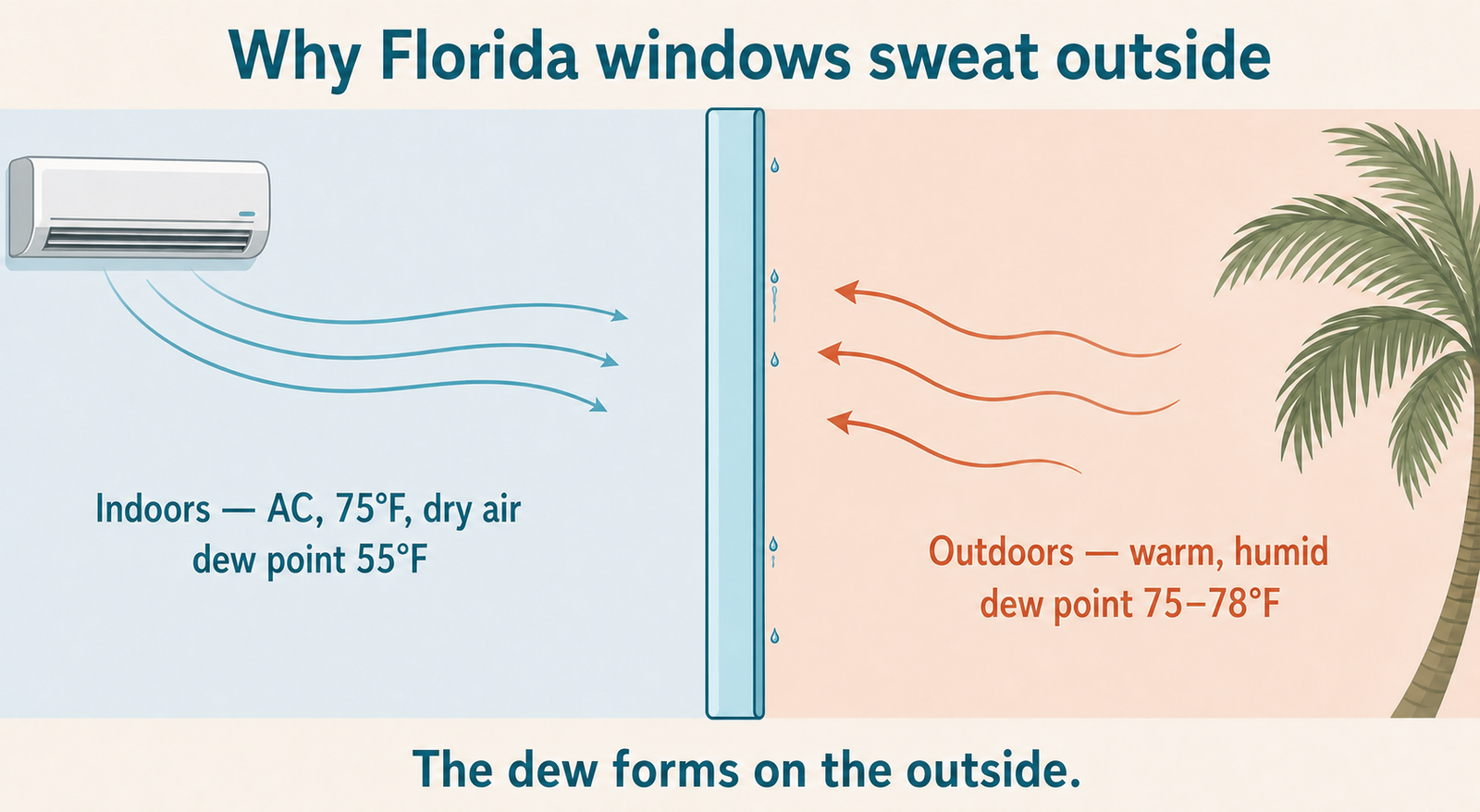
Why the Water Is on the Outside Here
Inside, the AC holds the house at 75°F. The glass sits against that cool room and goes cold itself. Outside at the same moment stands warm, humid air: the summer dew point in Miami runs 75 to 78°F, and before dawn the air drops to 79 or 80°F, a couple of degrees from saturation.
From there it is simple. The outer face of the glass only has to be slightly colder than the outdoor air, and it is wet.
A second mechanism works too, with no AC involved. At night under a clear sky the glass radiates heat upward and cools below the air temperature on its own. That is why the dew usually turns up early in the morning, after a still, clear night. Same process as dew on grass and on a car hood.
Nothing to do about it. The sun comes up and dries it off.
The Paradox of Good Windows
Here is another thing that breaks the logic. Energy-efficient units with Low-E coating sweat on the outside just as much, and at night more.
The reason is that they hold heat well. The outer pane gets no warmth from inside, so at night it cools more freely. Window manufacturers say it plainly: outdoor condensation is a sign the unit is doing its job.
When the Drops Are Inside, Then You Think
Inside condensation is rare in Florida, and here is why. For the glass to fog on the inner face, it has to be colder than the room air. With the AC running, the outdoors is rarely colder than the room, and there is nothing else to chill it.
But if the drops really are on the inside, that is a diagnosis, and the list is short:
- The house is genuinely damp. The AC cools but does not dry, running short cycles. If the humidity has crept to 65 or 70%, any cool spot on the glass collects water. That is an AC not removing humidity.
- A supply vent blows straight at the glass. Air off the register runs 55 to 58°F and chills one patch locally. A wet spot right opposite the vent makes the diagnosis obvious.
- A local source of steam. Bathroom with no exhaust, pots with no lids, laundry drying in the room. One window near the source fogs, not all of them.
- A winter cold front. A few nights a year, mostly in the north of the state. The temperature falls to 35 or 40°F, people turn on the heat, and single panes honestly fog on the inside. For Miami that is an oddity for a night or two, if it happens at all.
The Third Case: Between the Panes
If the fog sits between the glass panels and wipes off on neither side, the window has failed. The seal on the insulated unit is dead and moisture has got into the cavity. The only fix is a new glass unit.
Florida speeds that failure up: a good sealed unit lasts 15 to 25 years, but ultraviolet, humidity, and salt air near the coast wear the seal faster. South and west windows go first, they take the most sun.
Run a Finger Across It
The fastest test there is.
- Wipes off on the outside, it is dew. Nothing to do.
- Wipes off on the inside, it is humidity in the house. Hygrometer, AC cycle, dehumidifier.
- Wipes off on neither, the seal is dead, replace the glass unit.
The Same Thing on Your Car
A familiar Florida picture: evening in a parking lot, the windshield is wet on the outside, though there was no rain and the thermometer reads 80°F. That is the same radiant cooling. The glass faces a clear sky and drops below the air temperature, and the air is sitting a couple of degrees from its dew point.
The detail that gives it away: the side windows stay dry. They are vertical and they see warm ground, not cold sky. A car under a carport stays dry too.
The second scenario is driving with the AC on, when the windshield fogs on the outside at speed. The cabin is chilled, the vents blow at the glass from inside, and the outer face drops below the outdoor dew point. Wipers do not help here, the fog is back within a minute. What helps is easing off the AC and letting the glass warm up.
The physics is exactly the physics of a window at home. The cabin is the house with the AC, the windshield is the pane, the street is Florida.
What to Do About Your Windows
Back to the house. If the drops are on the outside of the glass, do nothing. That is dew, and a sign the AC and the windows are working.
If the drops are on the inside, dry the air in the house. Check it with a hygrometer, sort out the AC cycle, run a dehumidifier. For the size, the dehumidifier size calculator works it out, and for models, the best dehumidifiers for Florida. Take a look at the other signs of high humidity while you are at it, inside condensation rarely travels alone.
If the fog is between the panes, call a window company. That one has nothing to do with the humidity in your home.
Frequently Asked Questions
Why do my windows sweat on the outside?
The glass is colder than the outdoor air: the AC chills it from inside, and at night under a clear sky it radiates heat upward as well. Warm, humid outdoor air touches the cold pane and settles as dew. It is normal and it dries by mid-morning.
Is window condensation bad?
On the outside, no, it is dew, like on grass. On the inside, yes, it means there is too much moisture in the house. Between the panes, the sealed glass unit has failed.
Why do new energy-efficient windows have more condensation?
They hold heat well, so the outer pane gets no warmth from inside and cools more at night. Outdoor dew on those windows is a sign the unit is working as designed.
How do I tell which side the condensation is on?
Run a finger across it. Wipes off outside, it is dew. Wipes off inside, it is humidity in the house. Wipes off on neither side, the moisture is between the panes and the unit needs replacing.
Why do Florida windows rarely fog on the inside?
For the inner face to fog, the glass has to be colder than the room. With the AC running the outdoors is rarely colder than inside, so inside condensation is uncommon here, mostly during rare winter cold snaps in the north of the state.