
AC Vent Condensation: Why Vents Sweat and What It Means
Droplets on the AC grille, a damp ring on the ceiling around it. AC vent condensation looks like a malfunction, and the first instinct is that something broke. Usually nothing did: the system is running, and the vent is honestly reporting the state of the air in your house.
The physics in two paragraphs
Supply air comes out at 55–58°F. The metal of the grille and the drywall right around it cool down close to that — the coldest surfaces in the room.
From there, the same rule as a glass of ice water: when the dew point of the room air is higher than the surface temperature, water lands on the surface. The room side of the grille sweats — the side you see from below. The moisture is not coming out of the duct. It is coming out of the room air touching cold metal.
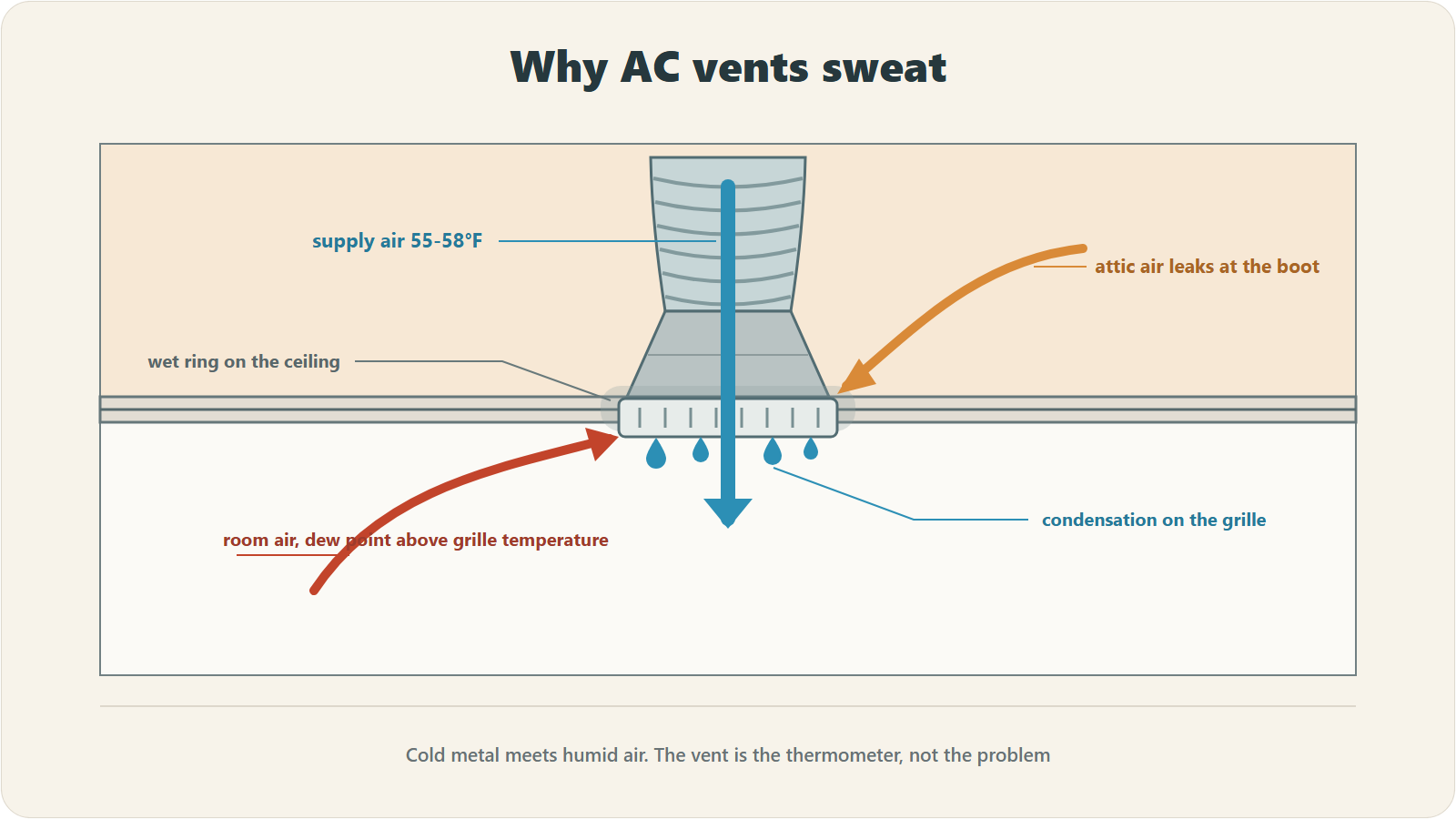
The vent is a thermometer, not a failure
AC vent condensation reports one thing: the dew point in the house is too high for the supply temperature. That is a measurement, not a malfunction. Replacing the grille is pointless — the new one cools to the same temperature and sweats the same way.
The right question is not “what is wrong with the vent”. It is “why is the air in this house so humid”.
Where the moisture comes from, by frequency
The house is under-dried. The most common cause, and behind it usually stands an AC too powerful for the house: it cools fast and shuts off before it has pulled the water out. The full breakdown: oversized AC and short cycling.
The fan is set to ON instead of AUTO. On ON, the fan runs constantly, including between cooling cycles. The coil sits wet through those pauses, and the airflow picks moisture off it and carries it back into the house. The AC dries the air on the cycle — then hands part of the water right back.
A leaky duct boot behind the grille. The ducts run through the attic, and attic air in summer is the heaviest air in the house: hotter than outside, with a high dew point. If the joint between the duct boot and the ceiling is loose, that air gets pulled straight onto the cold metal from the back side. The picture: a wet ring on the ceiling around the grille.
The thermostat is set very low. The lower you set it, the longer and colder the supply runs, the colder the grille gets — and the less room humidity it takes to start condensation.
Reading the picture
The grille itself is evenly wet — the moisture is from the room. Check the house humidity.
A ring on the ceiling, the grille drier — the moisture is from the attic side. Check the duct boot joint.
It only sweats on the most humid days — a borderline case: the house rides near the edge, and peak season pushes it over. Same cause, smaller margin.
What to do, in order
Measure. Put a hygrometer in the room with the sweating vent. Above 60% RH — the cause has a name, and the work is house humidity.
Fan to AUTO. Free and instant. If it was on ON, a real share of the problem leaves with one button.
Humidity down. Target below 60% RH, working range 45–50% RH. If the AC cannot get there on its own, size a dehumidifier to the space: dehumidifier size calculator.
The duct boot. If the picture points to the attic — the ring on the ceiling — the joint between the boot and the drywall gets sealed. Attic work, simple for a contractor.
What not to do: do not close or tape over supply vents. The system needs the airflow; a blocked grille means pressure in the ducts and new air leaks at the joints.
And the border of this topic: if there is already black growth on the grille, that is not ac vent condensation anymore — that is its consequence. Separate breakdown: mold on AC vents.
FAQ
Why do AC vents sweat?
Supply air at 55–58°F cools the grille, and when the dew point of the room air is higher than the metal temperature, water condenses on it. The moisture comes from the room air.
Is a sweating AC vent a malfunction?
Usually not. A sweating grille is an indicator of high humidity in the house, not a system failure. Check the humidity, not the vent.
Should the fan be on ON or AUTO?
AUTO. On ON, airflow between cooling cycles picks moisture off the wet coil and returns it to the house.
Can vent condensation lead to mold?
It can: damp drywall around the grille is a ready surface. If black growth has already appeared, that is a separate topic — mold on AC vents.
How do you stop condensation on AC vents?
Bring house humidity below 60% RH, set the fan to AUTO, and if the picture points to the attic, seal the duct boot joint. Replacing the grille itself does nothing.