
Midea Cube Review: 491 Owner Reviews and the Federal Register
This midea cube review is built on 491 owner reviews and on lines from the federal ENERGY STAR register, not on unboxing a machine. I have not handled the unit myself.
The Cube comes apart in two pieces: the top holds the compressor, the bottom serves as the tank. The question this page answers is how the line behaves in Florida, where a dehumidifier gets no off season.
Disclosure: This article contains affiliate links, including links to Amazon, Sylvane, and other partners. If you purchase through these links, we may earn a small commission at no extra cost to you. As an Amazon Associate I earn from qualifying purchases. Full disclosure: Affiliate Disclosure.
Where the numbers come from
Amazon Reviews 2023 is an open archive of Amazon reviews compiled by the McAuley Lab at the University of California San Diego. It holds 571.54 million reviews written between May 1996 and September 2023.
From that archive I pulled a core sample: 62,317 reviews covering 711 compressor household dehumidifiers from 184 brands, written between 2002 and 2023. The selection method is described on a separate page.
Inside that core, the Cube accounts for 491 reviews across four listings. The main one is the 50 pint model with 481 reviews. Another ten came from three Amazon Renewed listings, where refurbished units are sold.
By year: 137 reviews in 2021, 284 in 2022, 70 in 2023. The dataset ends in September 2023, so the whole cohort describes the MAD20C1ZWS, MAD35C1ZWS and MAD50C1ZWS index generation.
What this midea cube review found in 491 reviews
The share of one and two star reviews for the Cube is 25.7 percent. Across the rest of the core sample, 61,826 reviews, it is 17.6 percent.
That is a gap of eight points: the Cube draws a low rating roughly one and a half times as often as a compressor dehumidifier in general.
The number measures owner experience, not hardware reliability. Several explanations fit a gap like this: the count of parts that can disappoint, a different price of entry and different expectations, a different age profile of the model lines. The data does not let me choose between them.
One version I tested directly. If the cause is the number of parts, then within a single brand the models with a pump should collect more low ratings than the models without one. Inside brands the difference came out within a couple of points and pointed both ways, while the gap between brands is sixfold. That version did not hold up.
What owners actually raise is visible in the table below.
Complaints gather on the drainage and control parts
Review texts are tagged by topic: the figure shows the share of reviews in which a topic comes up at all, in praise as well as in complaint.
| Topic | Cube | Rest of the sample |
|---|---|---|
| Tank, float, shut-off on full | 36.7% | 18.6% |
| Pump, drainage, hose | 32.4% | 19.8% |
| Wi-Fi and app | 28.9% | 1.6% |
| Noise | 20.2% | 13.0% |
| Error code, sensor | 3.3% | 1.8% |
| Coil frost | 0.8% | 1.6% |
Denominators: 491 Cube reviews and 61,826 reviews of the other 710 models in the core sample, 2002 to 2023. Shares are counted against all reviews in each group, positive ones included.
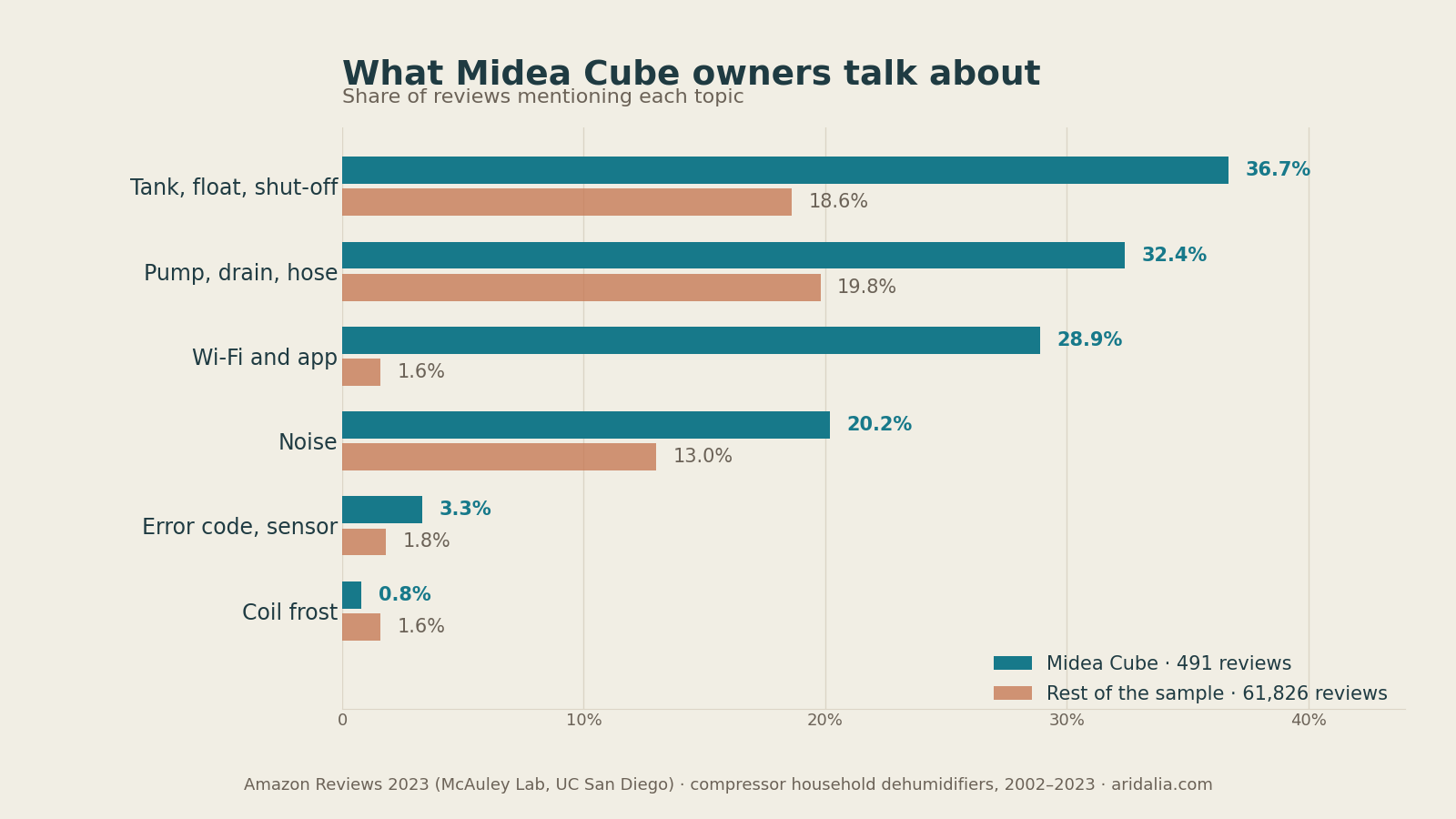
The top three rows are not about capacity. They are about how water leaves the machine and how the machine is controlled: where it goes, when the shut-off trips, whether the app answers.
Among one and two star reviews the order holds: the tank appears in 28.6 percent of them, pump and drainage in 26.2 percent, the app in 25.4 percent. Noise drops to 13.5 percent, so it irritates owners without pulling the rating down as often.
The app gap, 28.9 percent against 1.6 percent, follows from what the market offers: 40 units out of 535 in the ENERGY STAR register carry the connected capable flag, and the rest have no app to mention.
Coil frost is not a Florida story
Coil frost comes up in 0.8 percent of Cube reviews against 1.6 percent across the sample.
That matches the wider result from the dataset: frost accompanies work in a cold room, not in a Florida house.
The practical consequence for a Florida buyer is a reordered checklist. Frost drops off it, while the tank and the drain move to the top. A dehumidifier here gets no dead season, and the question of where the water goes does not wait for a change of weather.
What the federal register says
The ENERGY STAR certified product register lists 49 dehumidifier models under GD Midea Air-Conditioning, carried by two brand names: Midea and Pelonis. One applicant, two labels on the shelf.
| Class | Pints per day, Appendix X1 | Efficiency, L/kWh | kWh per year |
|---|---|---|---|
| 20 pint | 20.16 | 1.70 | 249 |
| 22 pint | 22.31 | 1.70 | 278 |
| 35 pint | 36.71 | 2.01 | 388 |
| 50 pint | 49.74 | 2.01 | 525 |
Source: ENERGY STAR certified dehumidifiers register, current Cube line indexes. Refrigerant across the line is HFC-32, global warming potential 675.
A word about the number on the box. Since 13 June 2019 dehumidifiers have been tested under Appendix X1, which lowered the test temperature from 80 to 65 degrees Fahrenheit and shifted the familiar market classes from 30, 50 and 70 pints down to 20, 30 and 50. No portable unit in the register exceeds 50.0 pints at all. Every figure in the table above sits on that scale, and the Cube rating lands close to its label: 49.74 against fifty.
Midea does not hide this. The listing for the 35 pint Cube states that it matches 50 pints under the earlier 2012 DOE test.
Within a single class the models do not differ: same efficiency, same rating, same refrigerant. There is no best model of the Cube to pick. You pick a size.
How the Cube is built
The housing separates: the compressor section lifts off, and the lower section serves as the tank. The manual describes four drainage modes, with the tank in place, with gravity drainage through a hose, with the built-in pump on pump versions, and with no tank at all, where the upper section stands on the floor and water leaves through the hose.
The pump lifts water up to 14 feet, which reaches a sink or a window above the unit. A garden hose threads onto the continuous drain port.
The shut-off level is adjustable. On the 50 pint model the four settings are 2.25, 3, 3.75 and 4.25 gallons; on the 20 pint model they run from 1.5 to 3. The 4.2 gallon figure on the retail listing describes the tank itself, not the point at which the machine stops.
Lowest working temperature is 41 degrees Fahrenheit, auto defrost is present, the filter is washable with cleaning every two weeks, and the warranty runs one year.
Which size to buy in Florida
The coverage figures on manufacturer listings are a starting point, not a calculation. For a real match, our sizing calculator accounts for humidity and how the room is used. The line differs only by capacity: efficiency and refrigerant are identical within each class.
Cube 20 pint, for a bedroom or study
20.16 pints per day under Appendix X1 and 249 kWh per year. The tank design is the same across the line, but on the smallest unit it fills sooner, and the tank is the topic owners raise most often.
View at Sylvane View on AmazonCube 35 pint, for a floor or open plan
36.71 pints per day and 388 kWh per year. The manufacturer notes that this unit matches 50 pints on the earlier 2012 DOE scale, which is the class shift of 2019 stated in the seller’s own words.
View at Sylvane View on AmazonCube 50 pint without a pump, for gravity drainage
49.74 pints per day and 525 kWh per year. This is the version for a spot where the hose can run downhill: a floor drain, a window below the unit, a sink nearby.
The MAD50S1QWT accepts an optional pump kit; the pump is not built in.
View at Sylvane View on AmazonCube 50 pint with a built-in pump, the Florida default
Same output, but the water leaves upward or out of a window without the owner lifting anything. A dehumidifier here gets no dead season, and the pump removes the daily task that comes up in 36.7 percent of reviews.
View on AmazonThe generation has changed
The reviews above were written about the C1ZWS indexes. Those are absent from the current register export, which lists MAD22C1AWS, MAD35C1AWS-A, MAD50C1AWS-A and their relatives.
So this analysis describes the previous generation. Whether the tank and pump complaints carried over is not something the data says: no reviews of the new units exist in the open dataset.
What did carry over is the applicant: the same legal entity files the certification.
What this analysis does not show
The unit was not tested here. Every conclusion comes from owner reviews and federal tables.
Reviews are not a random sample of owners: they are written by people who decided to write. The share of low ratings is not the share of failures.
Florida and humid climate reviews inside the Cube cohort number 29. That is too few to build on, so no separate Florida figures appear here.
Mentions of time to failure number twelve. Also below the threshold, and left out of the text.
Topic tagging works on words. It sees that a topic was raised, but it does not separate praise from complaint except through the rating attached to the review.
Frequently asked questions
Is the Midea Cube worth it?
It depends on whether you need drainage that runs without you. The share of low ratings for the Cube sits above the category average, and complaints gather on the tank, the pump and the app. If water can leave by gravity into a nearby drain, there is little reason to pay for a pump and an app.
Why do so many Midea Cube reviews mention the tank?
The tank comes up in 36.7 percent of Cube reviews against 18.6 percent across the rest of the category. It also serves as the housing, so any story about filling, floats and shut-off runs through it.
Does the Midea Cube freeze up in Florida?
By the review data, frost is mentioned rarely: 0.8 percent against 1.6 percent across the category. It is a cold room problem rather than a Florida room problem.
What size Midea Cube do I need for a Florida home?
A bedroom takes 20 pints, a floor takes 35, a whole house or garage takes 50 with a pump. For an exact match, use the sizing calculator.
Is the Midea Cube the same as a Pelonis dehumidifier?
Both brands are certified by one legal entity, GD Midea Air-Conditioning, across 49 models and two brand names. A shared applicant does not mean the machines are identical in construction.
Sources
- Amazon Reviews 2023, McAuley Lab, UC San Diego
- ENERGY STAR Certified Dehumidifiers register
- U.S. DOE, Appendix X1 to 10 CFR 430
- Midea MAD series owner’s manual