
I pulled hourly NOAA records for five Florida stations and counted every day. Not “hot and humid.” Actual numbers: how many days a year the air is genuinely oppressive, from the Keys to the Georgia line.
Florida humidity is famous. The question is how bad it actually is, and for how long. I took hourly observations from NOAA weather stations at three big metros, Miami, Tampa and Orlando, then added the two ends of the state: Key West at the southern tip and Jacksonville up north. Then I counted. In Key West the air is oppressive on 193 days in an average year, more than half the calendar. In Miami, the most humid of the big metros, the figure is 153 days. Five months. That is not a feeling. That is arithmetic on the station records.
This matters for practical reasons. The amount of water in your air decides whether your AC can keep up, whether mold grows in the bathroom, whether doors swell shut in September. Before deciding what to do about humidity, it helps to know its actual size. So I started with the numbers.
Why I Measure Dew Point, Not Percentages
Most people know humidity as a percentage. Relative humidity, the number in every weather app. It is familiar, and it is misleading.
Here is the problem. Relative humidity depends on temperature. Warm air can hold far more water than cool air. So 90% on a cool morning and 90% on an August afternoon describe two very different amounts of moisture. Same number, different air. Every morning the percentage reads high, every afternoon it drops, and the actual water in the air barely changed. The percentage moved because the temperature moved.
The dew point does not play this game. It is the temperature at which air gives its water back as dew. More moisture in the air means a higher dew point, and heat does not distort it. A dew point of 75°F means the same sticky air at 7 AM and at 4 PM.
A rough scale for reading it:
- Below 60°F: dry, comfortable air
- 60 to 65°F: noticeable moisture, still fine
- 65 to 70°F: humid, the air starts to feel thick
- 70 to 75°F: sticky and uncomfortable
- 75°F and above: oppressive, the air feels like a wet blanket
Florida summers live in the last two bands. That is the whole story of this state’s climate, and it is why I use dew point for every count below. Percentages get their own section near the end, for readers who want them.
Dew Point by Month: Where the Cities Split
Summer flattens the map. From June through September, the average dew point in all five stations sits between 72 and 76°F. In August they are within a couple of degrees of each other. The whole state is sticky, north included.
Winter is where geography shows up, and the further apart the cities, the wider the gap. In January, Key West still averages 64°F, humid air in the dead of winter. Miami is about 60°F. Tampa and Orlando drop to 52°F. Jacksonville falls to 47°F, genuinely dry air by Florida standards. That is a 17 degree spread across one state in the same month. The south end barely has a dry season; the north end gets a real one.
The chart shows it at a glance: five lines converge in summer, then fan apart toward winter, with Key West holding highest and Jacksonville dropping away at the bottom.
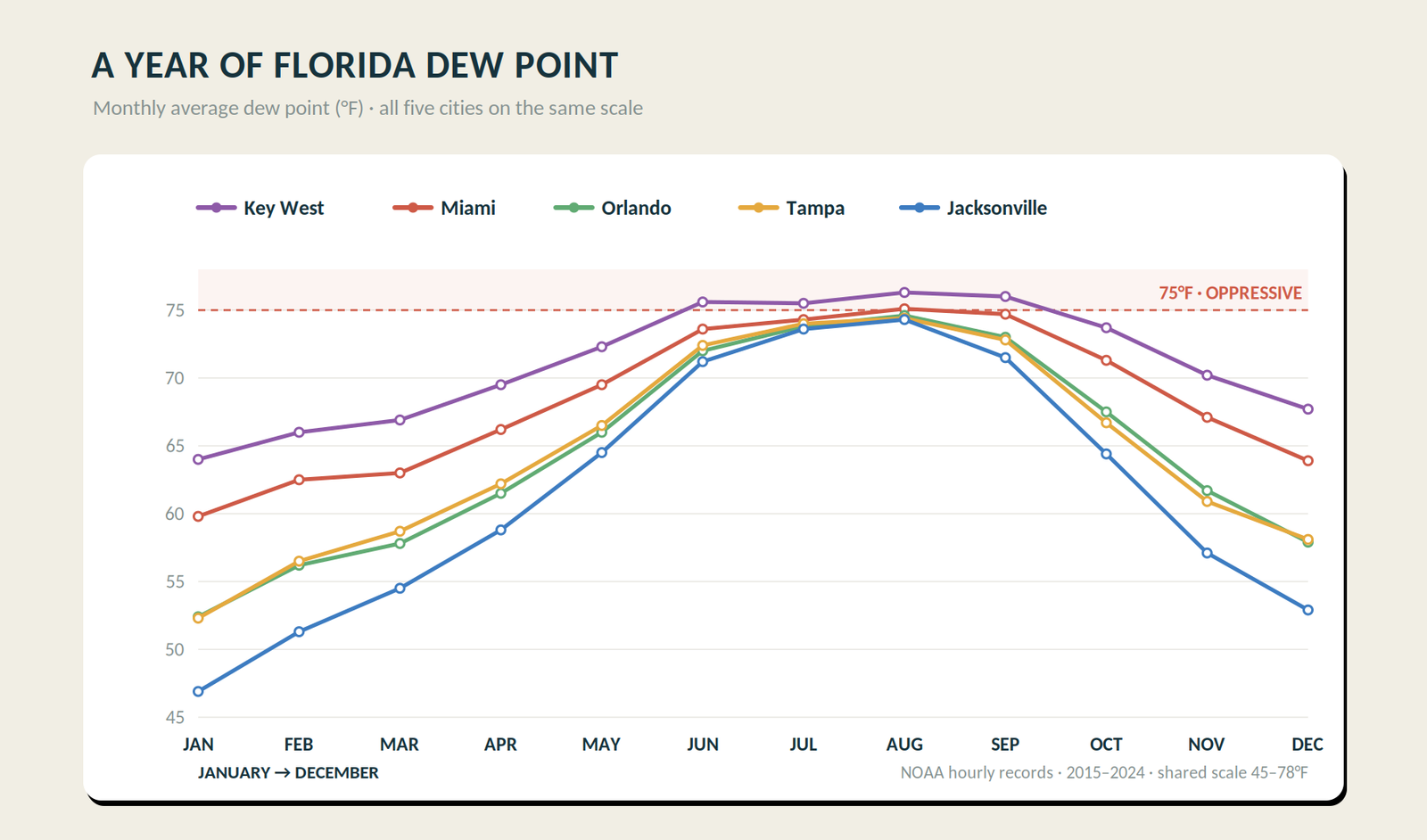
Note what this means for the phrase “Florida humidity.” There is no single Florida humidity. There is a Keys pattern (humid almost year-round), a south and central pattern (humid summer, mild winter break), and a north pattern (humid summer, dry winter). The summer is shared. The rest of the year is not.
Counting the Days: A Year Split in Three
Averages hide the texture of a year, so I counted individual days. For each day in the records, I took the day’s peak dew point and sorted it into one of three bands. Oppressive: the dew point reached 75°F. Humid: it reached 70°F but not 75. Comfortable: it stayed below 70°F all day.
The three bands cover the whole calendar, no overlap and no double counting. Here is Miami’s average year, 2015 to 2024:
- 153 days oppressive (dew point hit 75°F or higher)
- 103 days humid (70 to 74°F)
- 109 days comfortable (below 70°F)
That adds to 365. Five months of oppressive air, a little over three months of comfortable air, the rest in between. Now look at Key West, and it gets brutal: 193 oppressive days, 100 humid, and only 72 comfortable. The Keys get roughly two and a half months of pleasant air in a year. The rest is some shade of sticky.
The same split for all five stations:
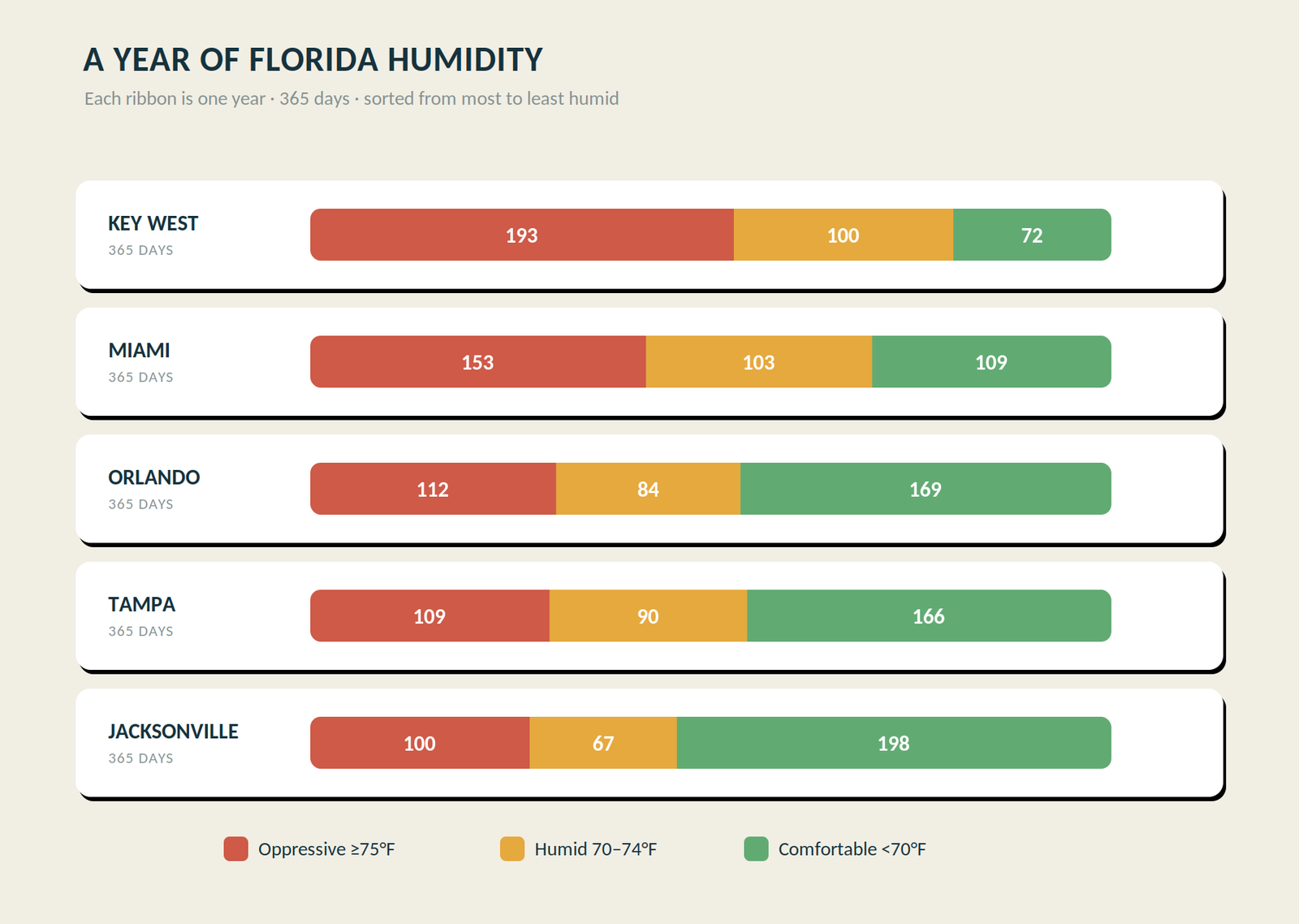
Read the green segments. Key West gets 72 comfortable days a year. Jacksonville gets 198, nearly three times as many. Miami sits at 109, the metros in the middle. Move down the peninsula and you trade comfortable days for oppressive ones, one for one, until in the Keys the comfortable days almost run out. The trade is invisible on a summer visit, because in July everywhere feels the same. It shows up across the calendar.
The Two Ends of Florida: Key West and Jacksonville
I added Key West and Jacksonville on purpose, as bookends. Key West is the southern tip of the state, an island surrounded by warm water. Jacksonville is the largest city in the far north, 500 miles up the coast. Between them sit the metros where most Floridians actually live. Bracketing the middle with the two extremes shows the full range, and it settles a common argument about which part of Florida is worst.
Here is the answer the records give. Key West is the most humid place in the state by a wide margin: 193 oppressive days a year against Jacksonville’s 100. That is a three month difference in oppressive air between the two ends of one state. In peak summer they nearly match, both averaging dew points in the mid 70s in August, but Key West never lets go afterward while Jacksonville drops into a long, comfortable off-season.
The full comparison, averages for 2015 to 2024:
| Station | Summer dew pt | Days ≥75°F | Days ≥70°F | Days <70°F |
|---|---|---|---|---|
| Key West | 76°F | 193 | 293 | 72 |
| Miami | 74°F | 153 | 256 | 109 |
| Orlando | 73°F | 112 | 196 | 169 |
| Tampa | 73°F | 109 | 199 | 166 |
| Jacksonville | 73°F | 100 | 167 | 198 |
One detail worth a second look: by the oppressive count, the three big metros are closer to Jacksonville than to Key West. Miami, the most humid of them, still gets 40 fewer oppressive days a year than the Keys. If you only compare places by their worst month, you will conclude Florida is uniform. Compare them across the calendar and the state stretches into distinct humidity climates, from an almost year-round Keys to a north that genuinely dries out.
The Nights Are Part of the Problem
One more thing hourly records show that daily summaries hide: what happens after sunset.
In most climates, evening brings relief. Temperature falls, the air turns pleasant, you open a window. Florida summers cancel this. The dew point does not drop at night. In Miami in July and August, the overnight dew point typically stays in the low to mid 70s, the same oppressive band as the afternoon. In Key West it is worse, since the surrounding water holds heat and moisture through the night. The temperature eases a few degrees; the moisture stays.
This is why summer nights here feel heavy, why an evening walk leaves your shirt damp, and why opening windows at night pulls a swamp into the house instead of freshness. It is also why moisture problems indoors do not pause at night: the load on your walls, closets and AC runs around the clock for months. Ventilating “when it cools down” does not work in a Florida July, because the water in the air never left.
Thirty Years: Does the Picture Hold?
Ten years of daily counts could be a fluke of a warm or cool stretch. So for the three big metros I extended the record back to 1995, thirty years of hourly observations per station, and ran the same counts. The two bookends, Key West and Jacksonville, I kept to the most recent ten years, since their job here is to mark the north and south edges of the range, not to carry the long history.
The structure holds. Summer dew points average 73 to 74°F across the full 30 years in the metros. The ranking does not move: Miami first among the three, Tampa and Orlando close together behind it. Over 1995 to 2024, Miami averaged 137 oppressive days a year, Tampa 102, Orlando 100.
Put those numbers next to the recent decade and one difference stands out. Miami’s 30-year average is 137 oppressive days; its 2015 to 2024 average is 153. Tampa: 102 against 109. Orlando: 100 against 112. The recent decade runs above the long-term average in all three cities.
I am not going to dress that up as a trend. Ten years against thirty is a short window, and year-to-year swings in these counts are large (Miami’s annual count ranged from 113 to 186 within a single decade). Whether this is a lasting shift or a warm stretch is a question for climatologists with longer tools than mine. What I can say is narrower and still useful: the counts in this article are, if anything, conservative. If you plan for the 30-year average, the recent years have been running worse.
The Percentages, For Those Who Want Them
Relative humidity from the same stations and the same period, 2015 to 2024. Morning readings (6 to 7 AM) average 80 to 88% across the state. Afternoon readings (3 to 4 PM) average 60 to 65%.
Notice the daily swing: 20 points and more between morning and afternoon, driven mostly by temperature, not by moisture coming and going. That swing is exactly why this article runs on dew point. The percentage tells you a lot about what time it is and less about how much water you are breathing. But if you have grown up on percentages: Florida mornings sit in the 80s essentially year-round, and that is the number your bathroom mirror already knew.
What the Numbers Mean for a House
This is a data page, not a shopping page, so I will keep this short and general.
Indoor humidity problems scale with outdoor moisture and its duration. The further south you live, the longer the load runs and the shorter your off-season. A Key West or Miami home faces oppressive outdoor air for five to six months and humid air for most of the rest; whatever setup keeps it dry has to run most of the calendar, not just survive August. A Jacksonville house faces the same August but gets a real six-month off-season in which walls, closets and crawl spaces can actually dry out. Same state, different problem sizes.
Two practical consequences follow directly from the charts above. First, in south Florida and the Keys, sizing a dehumidifier for “summer use” is a category error; the humid season is most of the year. Second, night ventilation, the free cooling trick that works in dry climates, does not work here in summer, because the outdoor dew point stays oppressive after dark. If you want to translate your own city’s numbers into equipment sizing, the dehumidifier size calculator does that arithmetic.
Method
Data: hourly surface observations from NOAA’s Local Climatological Data (LCD), stations Key West International Airport (WBAN 12836), Miami International Airport (WBAN 12839), Tampa International Airport (WBAN 12842), Orlando International Airport (WBAN 12815) and Jacksonville International Airport (WBAN 13889).
Periods: the five-station comparison, monthly averages and the year-split counts use 2015 to 2024. The long-term counts for Miami, Tampa and Orlando use 1995 to 2024; for Orlando, 2015 had insufficient station data and the long-term averages there rest on 29 complete years. Key West and Jacksonville use 2015 to 2024 only, as north and south reference points. Only years with at least 360 days of observations were counted.
Definitions: a day’s band is set by its peak dew point. “Oppressive” means the dew point reached 75°F at least once that day; “humid” means it reached 70°F but not 75; “comfortable” means it stayed below 70°F. Monthly figures are means of all hourly dew point readings in that month. Morning and afternoon relative humidity are means of readings at 6 to 7 AM and 3 to 4 PM local time.
The data is public. The filtering, counting and charts are mine. More on how I work with datasets: methodology.
Frequently asked questions
What is the average humidity in Florida?
In summer the dew point in every major Florida metro averages 73 to 75°F, which feels oppressive. Relative humidity averages 80 to 88% in the morning and 60 to 65% in the afternoon.
Why is dew point better than relative humidity?
Relative humidity depends on temperature, so the same percentage can describe very different air. Dew point directly reflects how much water is in the air and does not swing with daytime heat.
Which Florida city is the most humid?
Key West is the most humid place in Florida: the dew point reaches an oppressive 75°F on about 193 days a year. Among the big metros Miami leads with about 153 such days, versus 100 in Jacksonville up north.
Is Florida humid in winter?
South Florida is: Miami’s January dew point averages about 60°F. Tampa and Orlando drop to about 52°F, and Jacksonville to 47°F, so central and north Florida get a real winter break.
How many days a year is Florida oppressive?
By NOAA hourly records for 2015 to 2024, the dew point reaches 75°F on about 193 days a year in Key West, 153 in Miami, 112 in Orlando, 109 in Tampa and 100 in Jacksonville.
Data source: NOAA / NCEI Local Climatological Data, hourly observations, stations Key West Intl (WBAN 12836), Miami Intl (12839), Tampa Intl (12842), Orlando Intl (12815), Jacksonville Intl (13889). Metros 1995–2024; Key West and Jacksonville 2015–2024. The data is public; the analysis and charts are mine.