
Humidity Sensor Basics: How to Measure Home Humidity Right
You cannot judge humidity by feel. By the time a room feels muggy, the problem has been running for a while. And the decisions are not cheap: a dehumidifier is $200–300, AC work starts at a few hundred and goes into thousands. Making those calls by feel is guessing. A humidity sensor turns it into arithmetic.
The tool itself is simple. A $10–15 hygrometer answers the main questions about as well as an expensive one. The instrument is not the hard part. Where you hang it and how you read it is.
Cheap hygrometers are off by a few percent. That is fine
A consumer hygrometer misses by a few percent RH in either direction. Sounds bad. In practice it does not matter, because home decisions are not made at 52% RH versus 55% RH. They are made at “the house sits around 50% RH” versus “the house sits near 65% RH”. Any working unit shows that difference.
What actually matters is repeatability. Same room, same conditions, same number. Then the sensor shows movement, and movement is what you act on: it read 63% RH, the dehumidifier ran a day, now it reads 52% RH. That change is real even if the absolute number drifts a little.
Where to hang it
A hygrometer honestly measures the spot where it hangs. So the spot decides everything.
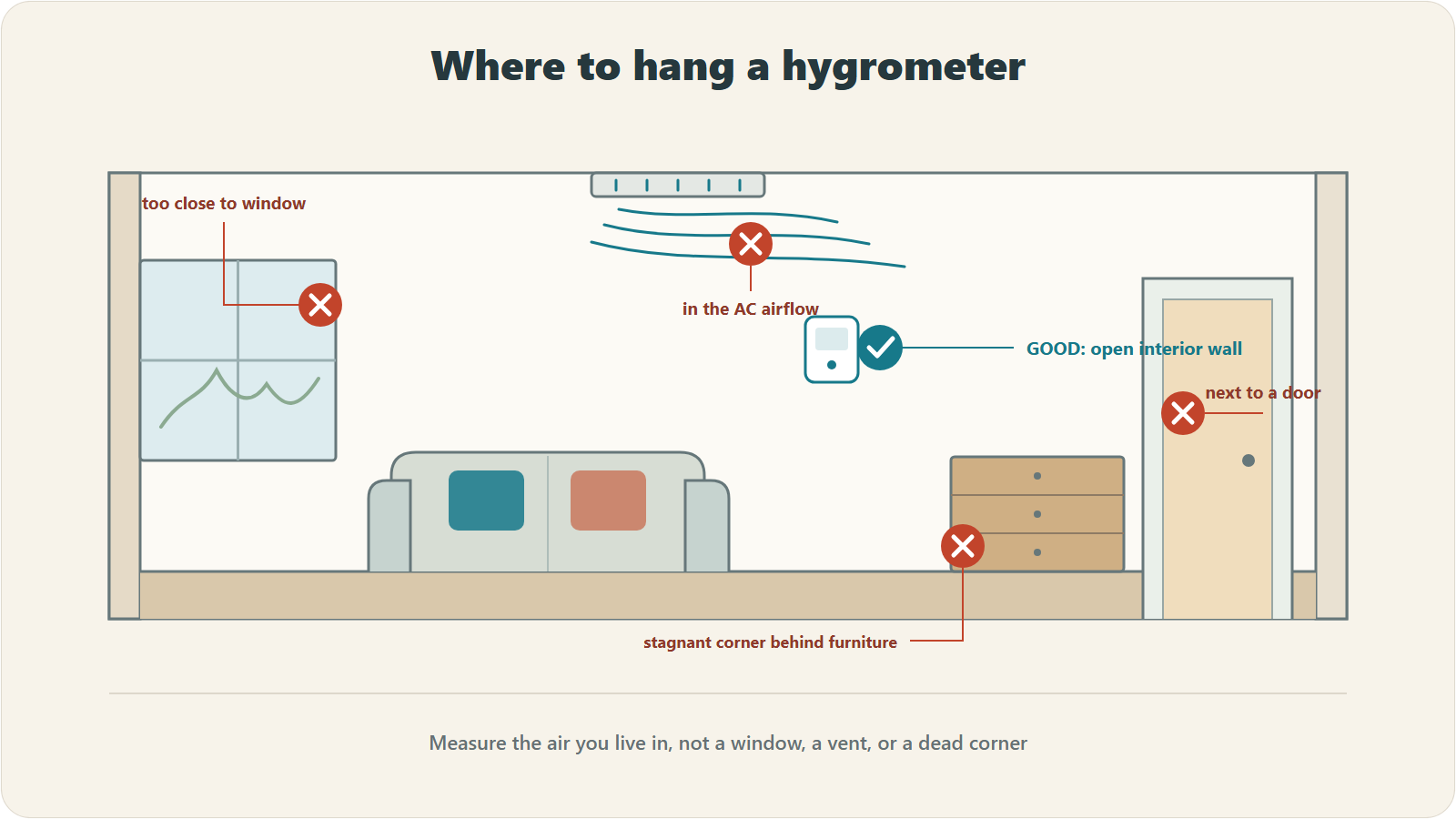
The main spot: an open interior wall in the middle of the living area, eye level. Where the air you actually breathe moves through.
Not by a window. Glass is the border with the outside. The air next to it is not the air of the room.
Not in the AC airflow. Supply air comes out at 55–58°F, colder and drier than the room. A sensor in that stream reports the weather inside your ductwork, not inside your house.
Not over the stove, not in the bathroom. Cooking and showers make spikes that mean nothing. A half-hour spike is not a problem. A number that holds for days is.
Not by an exterior door. Every opening pushes outdoor air at the sensor and the number jumps.
Not in a dead corner behind furniture — as the main spot. But that is exactly where you move the sensor for a day when you check a suspect spot. Where air sits still, humidity at the surface runs higher than the room reading, and a one-day check of those pockets is its own method. The full logic is in what humidity level mold grows at.
One sensor or several
A second cheap hygrometer is worth more than one expensive one. The main unit stays on the living-area wall. The second one travels: the storage closet, the corner behind the dresser, the room that smells wrong. A day per spot, and you have a map of the house instead of one number.
A smart humidity sensor with logging is the next step up, and it earns its price. A single reading says little. A week of graph says a lot: you see humidity creep up in the evening, you see what rain does to the house, you see whether the AC keeps up through the afternoon. If the line crosses 60% RH at the same hours every day, that is a diagnosis, not a suspicion.
What to do with the number
Measuring for its own sake is pointless. The number exists to drive a decision.
What indoor humidity should be, and what to lower it with, in what order — that is covered in ideal home humidity. If it comes down to a dehumidifier, size it by the room, not by eye: dehumidifier size calculator.
FAQ
Are cheap hygrometers accurate?
They miss by a few percent RH, and for home decisions that is enough. Any working unit shows the difference between 50% RH and 65% RH.
Where should you hang a hygrometer?
On an open interior wall in the middle of the living area, at eye level. Not by a window, not in the AC airflow, not over the stove, not by an exterior door.
How many hygrometers do you need?
One permanent unit in the living area. A second cheap one as a traveler for checking closets and dead corners, a day per spot.
What should indoor humidity be?
Below 60% relative humidity, with a working target of 30–50% RH. The full breakdown is in our ideal home humidity guide.