

Argendon range
Argendon dehumidifier review: the range
This article contains affiliate links. If you buy through them, I may earn a commission. Read the affiliate disclosure.
This Argendon dehumidifier review covers 17 models for crawl spaces, basements and work across different sites. The first difference between the series is their design:
- Shield, Guardian, and Sandidry 55C: horizontal units for permanent installation.
- Sandidry Pro and Elite: upright units on wheels.
- XStorm: commercial models with a telescoping handle for transport.
Water removal capacity and drainage options depend on the model. You can find them in the comparison table. Below, we look at the differences between the series and the warranty terms.
For other brands, see our dehumidifier guides.
What AHAM, DOE, and saturation mean
Capacity tells you how much water a dehumidifier removes in a day. The result depends on temperature and humidity: the same unit usually collects more water in warm, humid air. A test procedure defines the conditions, duration, and method used to measure capacity.
AHAM (Association of Home Appliance Manufacturers) represents appliance manufacturers and develops test standards. The 80°F and 60% humidity conditions come from the older DH-1-2008 edition. In DH-1-2017, the association lowered the test temperature for portable dehumidifiers to 65°F while keeping the same humidity. This change is described in the U.S. Department of Energy document revising the test procedure.
Argendon still uses the label AHAM for results at the older 80°F/60% conditions, according to the manufacturer's explanation. DOE (U.S. Department of Energy) incorporates some requirements from the newer AHAM DH-1-2022 standard into its test procedure (Appendix X1). An AHAM label on an Argendon product page and the current DOE procedure therefore do not mean the same test conditions.
Saturation is Argendon's label for capacity in very warm, humid air.
| Rating | Temperature | Relative humidity |
|---|---|---|
| AHAM as used by Argendon: older test conditions | 80°F | 60% |
| DOE: current procedure for portable dehumidifiers | 65°F | 60% |
| Saturation in Argendon's general guide | 90°F | 90–100% |
The AHAM and saturation conditions come from Argendon's explanation. In the cooler air used for DOE testing, a dehumidifier usually collects less water. This difference is explained by ENERGY STAR, the U.S. certification program for energy-efficient products.
Compare results measured with the same procedure and under the same conditions. Saturation figures cannot be compared directly with DOE results. This article uses U.S. liquid pints.
Pro35C: an example of the different ratings
Sandidry Pro35C is listed as a portable dehumidifier in the ENERGY STAR certified product directory. The diagram shows its ratings from ENERGY STAR and the Argendon specification sheet:
To compare Pro35C with other portable dehumidifiers under the current DOE procedure, use the ENERGY STAR figure.
ENERGY STAR also lists an IEF (Integrated Energy Factor) of 1.90 L/kWh. This measures how many liters of water the unit removes per kilowatt-hour of electricity under the test conditions. The calculation also includes electricity used between dehumidification cycles.
The ENERGY STAR directory names the program partner for Pro35C as AlorAir Solutions Inc. It does not identify the brand owner or the factory that makes the unit.
For the trademark records, component comparisons and separate warranty terms, see how Argendon is connected to AlorAir and TOOVEM.
For AlorAir's range, see the AlorAir dehumidifier review.
How the series differ
Shield and Guardian: crawl spaces and basements
Shield and Guardian have horizontal bodies. Versions with a P in the name have a built-in pump. For Shield 60, Shield 60P, Guardian 60, and Guardian 60P, the manufacturer claims the same capacity: 60 pints/day AHAM.

The table compares drainage, weight, and airflow. CFM (cubic feet per minute) measures the volume of air that passes through the unit.
| Model | Drainage | Airflow | Weight |
|---|---|---|---|
| Shield 60 | Gravity | 185 CFM | 46.5 lb |
| Shield 60P | Pump and gravity | 165 CFM | 46.5 lb |
| Guardian 60 | Gravity | 165 CFM | 47.5 lb |
| Guardian 60P | Pump and gravity | 165 CFM | 47.5 lb |
The versions without pumps differ in size. Length × width × height for Shield 60: 21.3 × 12.8 × 14.6 in; Guardian 60: 21.3 × 11.7 × 14.1 in. Guardian 60 is 1.1 inches narrower and 0.5 inches shorter. Shield 60 has higher airflow, but the claimed water removal capacity is the same.
Shield and Guardian 60/60P comparison.
Sandidry 55C and Pro: different body designs
Sandidry 55C has a horizontal body. Pro35C and Pro55C stand upright on four small wheels. All three have a built-in pump.

Shield 35M, Shield 35P, and Sandidry Pro35C comparison.
Sandidry Elite: a handle and large wheels
The Elite series has three models: 50C, 60C, and 80C. They have upright bodies with a handle and large wheels. Water drains by gravity or is pumped out, as described in the shared Elite manual.

Sandidry Elite 50C, 60C, and 80C comparison.
XStorm: transport and storage
XStorm Pro, Plus, and Max have wheels, a telescoping handle, and a built-in pump. The units can be stacked for storage.
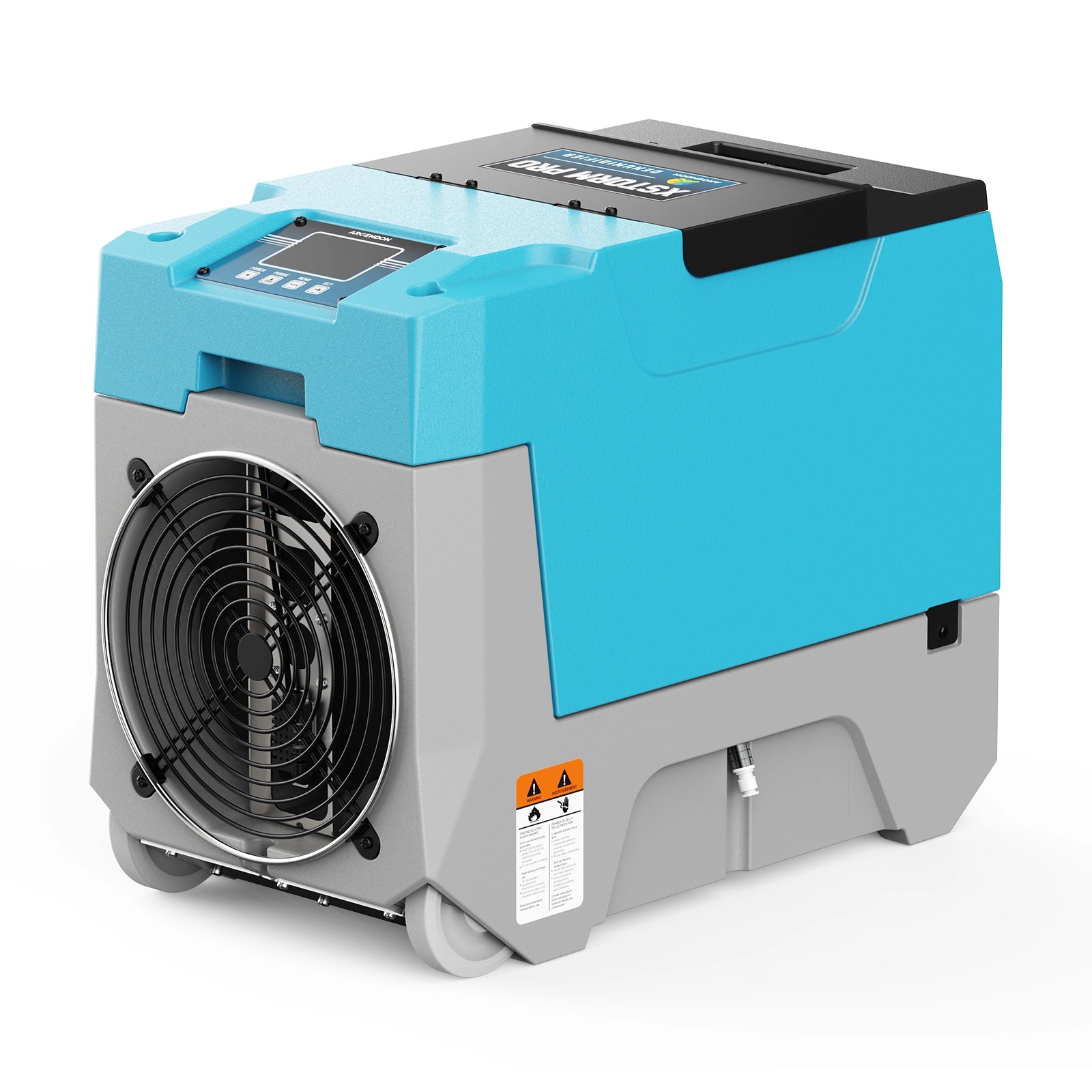
The published specifications for Pro, Plus, and Max list the same capacity, airflow, weight, dimensions, and operating features. Their appearance differs in body color, fan grille, and control panel design.
In its Argendon model review, the manufacturer specifically recommends XStorm Max for drying after flooding. It describes durable internal components, a reinforced body, and continuous operation. The article does not explain how those components or the body differ from Pro and Plus.
| Model | Body color | Argendon store |
|---|---|---|
| XStorm Pro | Blue | Check price |
| XStorm Plus | Red | Check price |
| XStorm Max | Blue | Check price |
All 17 models in one table
Capacity figures come from Argendon product pages and specification sheets. Model names link to the manufacturer's product pages. An asterisk marks figures that differ between the manufacturer's documents.
| Series and model | AHAM, as listed by Argendon pints/day | Saturation, as listed by Argendon pints/day | Drainage | Design and notes |
|---|---|---|---|---|
| Shield 35M | 35 | 70 | Gravity | Horizontal. |
| Shield 35P | 35 | 70 | Pump and gravity | Horizontal. |
| Shield 60 | 60 | 145 | Gravity | 21.3 × 12.8 × 14.6 in; 46.5 lb. |
| Shield 60P | 60 | 145 | Pump and gravity | Horizontal; 46.5 lb. |
| Shield 85P | 85 | 180 | Pump and gravity | Horizontal. |
| Guardian 60 | 60 | 145* | Gravity | 21.3 × 11.7 × 14.1 in; 47.5 lb. |
| Guardian 60P | 60 | 145 | Pump and gravity | Horizontal; 47.5 lb. |
| Guardian 85P | 85* | 180 | Pump and gravity | Horizontal. |
| Sandidry 55C | 55 | 120 | Pump and gravity | Horizontal. |
| Sandidry Pro35C | 35 | 70 | Pump and gravity | Upright, four small wheels. |
| Sandidry Pro55C | 55* | 120 | Pump and gravity | Upright, four small wheels. |
| Sandidry Elite50C | 50 | 110 | Pump and gravity | Upright, handle and large wheels. |
| Sandidry Elite60C | 60 | 145 | Pump and gravity | Upright, handle and large wheels. |
| Sandidry Elite80C | 80 | 170 | Pump and gravity | Upright, handle and large wheels. |
| XStorm Pro | 85* | 180 | Pump | Telescoping handle, wheels; round fan guard. |
| XStorm Plus | 85* | 180 | Pump | Telescoping handle, wheels; red body. |
| XStorm Max | 85* | 180 | Pump | Telescoping handle, wheels; grille with elongated slots. |
Where the documents give different specifications
The main table uses figures from Argendon's product pages and specification sheets. The table below shows where these differ from other manufacturer information. Links go to the documents themselves; PDF references include the file's page number.
| Model | Where the figures differ | Used in this review |
|---|---|---|
| Guardian 60 | The specification sheet, p. 1: 145 pints/day at saturation in the specifications table, 120 in the text below under Function and Application. | 145 from the specifications table, p. 1. |
| Sandidry Pro55C | The product page: 55 pints/day AHAM in the description, 70 AHAM in the Product Specifications table. The specification sheet, p. 1 lists 55 AHAM. | 55 from the product description and specification sheet, p. 1. |
| XStorm Pro, Plus, and Max | The same discrepancy appears for each of the three models. Product pages (Pro, Plus, Max) and specification sheets (Pro, p. 1, Plus, p. 1, Max, p. 1): 85 pints/day AHAM, 210 CFM, 63 lb. The Specifications tables in the manuals (Pro, p. 5, Plus, p. 5, Max, p. 5): 72.3 pints/day AHAM, 310 CFM, 58.8 lb. | Figures from the product pages and specification sheets: 85 AHAM, 210 CFM, 63 lb. |
| Guardian 85P | The product page: 85 pints/day AHAM and a current draw of 5.9 A. The specification sheet, p. 1: 85 AHAM and 5.3 A. On p. 2 of the same PDF: 60 AHAM and 4.5 A. | 85 AHAM from the product page and p. 1 of the specification sheet. |
| Sandidry Elite50C | The Specification Sheet link on the Elite50C product page opens the Shield 35P specification sheet, p. 1. The User Guide link opens the Elite series manual, p. 1. | Specifications from the Elite50C product page. Drainage is covered in the Elite manual: pump on p. 11, gravity drainage on p. 12. |
Product pages and document links were checked again on October 24, 2026.
Gravity drainage or a pump
For gravity drainage, route the hose downhill to the drain. A pump is needed when water must be lifted above the dehumidifier outlet. The model's manual specifies how high its pump can lift water.
Leave the clearance required by the manual for airflow and access to the filter. Hose routing is covered in the drainage setup guide. Ground preparation and protection against moisture are covered in the crawl space dehumidification guide.
Accessories and replacement parts
The Argendon catalog includes:
- Replacement filters for Shield, Guardian, Sandidry, and XStorm.
- Installation and control accessories: remote controllers, hanging kits, and risers.
- Replacement parts: drain pumps, control boards, temperature sensors, and float switches.
Product pages list compatible models and available options.
The filter protects the dehumidifier's internal parts from dust. MERV (Minimum Efficiency Reporting Value) indicates how well a filter captures particles. The specifications for XStorm Pro, Plus, and Max list MERV-8; the store also sells a compatible MERV-1 replacement filter with a lower filtration rating. MERV describes air filtration, not the amount of water collected.
Find the filter size, pack options, and compatible accessories for your model in the Argendon filters and replacement parts guide.
What the five-year warranty covers
Under Argendon's terms, the warranty lasts five years. Coverage for parts, labor, and shipping changes over that period:
How coverage changes over five years
Parts and labor
Argendon pays to ship replacement parts or the unit.
Parts and labor
Argendon does not pay to ship the faulty unit to the service center.
Refrigeration system only
Parts and labor: compressor, condenser, and evaporator.
Argendon does not pay shipping.
Refrigeration system parts only
Compressor, condenser, and evaporator. Argendon does not pay for labor.
Argendon does not pay shipping.
Contact support with proof of purchase and obtain authorization for repair or replacement. Argendon decides which option to offer. There is no in-home service. The manufacturer recommends keeping the original packaging for shipping.
Returns to the Argendon store
Under the store policy, products can be returned within 30 days of purchase. For a defect that is Argendon's responsibility, the company offers a full refund or a replacement. Argendon pays shipping in either case.
For other reasons, only unopened, unused products can be returned. The buyer pays return shipping. The store may charge a 20% restocking fee. Contact support for instructions before any return. These rules apply to purchases from the Argendon store; other sellers have their own terms.
How to narrow your choice
- Limited installation space: Guardian 60 is narrower and shorter than Shield 60. Neither model has a pump, and their claimed capacity is the same.
- Moving the unit: Sandidry Pro has small wheels, Elite has a handle and large wheels, and XStorm has a telescoping handle. XStorm units can be stacked for storage.
The capacity you need depends on the space and how much moisture enters it. For an approximate estimate for a living space, use the Aridalia calculator. Its result follows the current DOE procedure for portable dehumidifiers. You can compare it with the Pro35C rating in this review: 21.27 pints/day.
For buying several units, compare quantities, spare filters, and cost per unit in our Argendon commercial packages guide.
Sources
Sources were checked on October 19-24, 2026. The discrepancies table was updated on October 24.
Argendon models and series
- Shield: 35M, 35P, 60, 60P, 85P.
- Guardian: 60, 60P, 85P.
- Sandidry: 55C, Pro35C, Pro55C.
- Sandidry Elite: 50C, 60C, 80C.
- XStorm: Pro, Plus, Max.
Argendon: model recommendations, including XStorm Max for drying after flooding.
Specification sheets and manuals
- Shield 35P: specification sheet (PDF).
- Shield 60: specification sheet (PDF).
- Guardian 60: specification sheet (PDF).
- Guardian 85P: specification sheet (PDF).
- Sandidry Pro35C: specification sheet (PDF).
- Sandidry Pro55C: specification sheet (PDF).
- XStorm Pro: specification sheet (PDF).
- XStorm Plus: specification sheet (PDF).
- XStorm Max: specification sheet (PDF).
- Sandidry Pro35C / Pro55C: manual (PDF).
- Sandidry Elite: manual (PDF).
- XStorm Pro: manual (PDF).
- XStorm Plus: manual (PDF).
- XStorm Max: manual (PDF).
Test procedures and certification
- ENERGY STAR: Sandidry Pro35C listing, capacity, and IEF.
- ENERGY STAR: test conditions and changes to capacity ratings.
- AHAM: list of appliance standards.
- DOE, Federal Register, July 26, 2023: DH-1 and test procedure changes.
- DOE, Appendix X1: current dehumidifier test procedure.
- Argendon: explanation of AHAM and saturation conditions.
- EPA: what a MERV filter rating means.
Accessories, parts, warranty, and returns
- Argendon: warranty terms.
- Argendon: return policy.
- Argendon: replacement filters.
- Argendon: installation and control accessories.
- Argendon: replacement parts.
- Argendon: MERV-1 replacement filter for XStorm Pro/Plus/Max.


