
Best Dehumidifier for Florida: A Data-Backed Scorecard
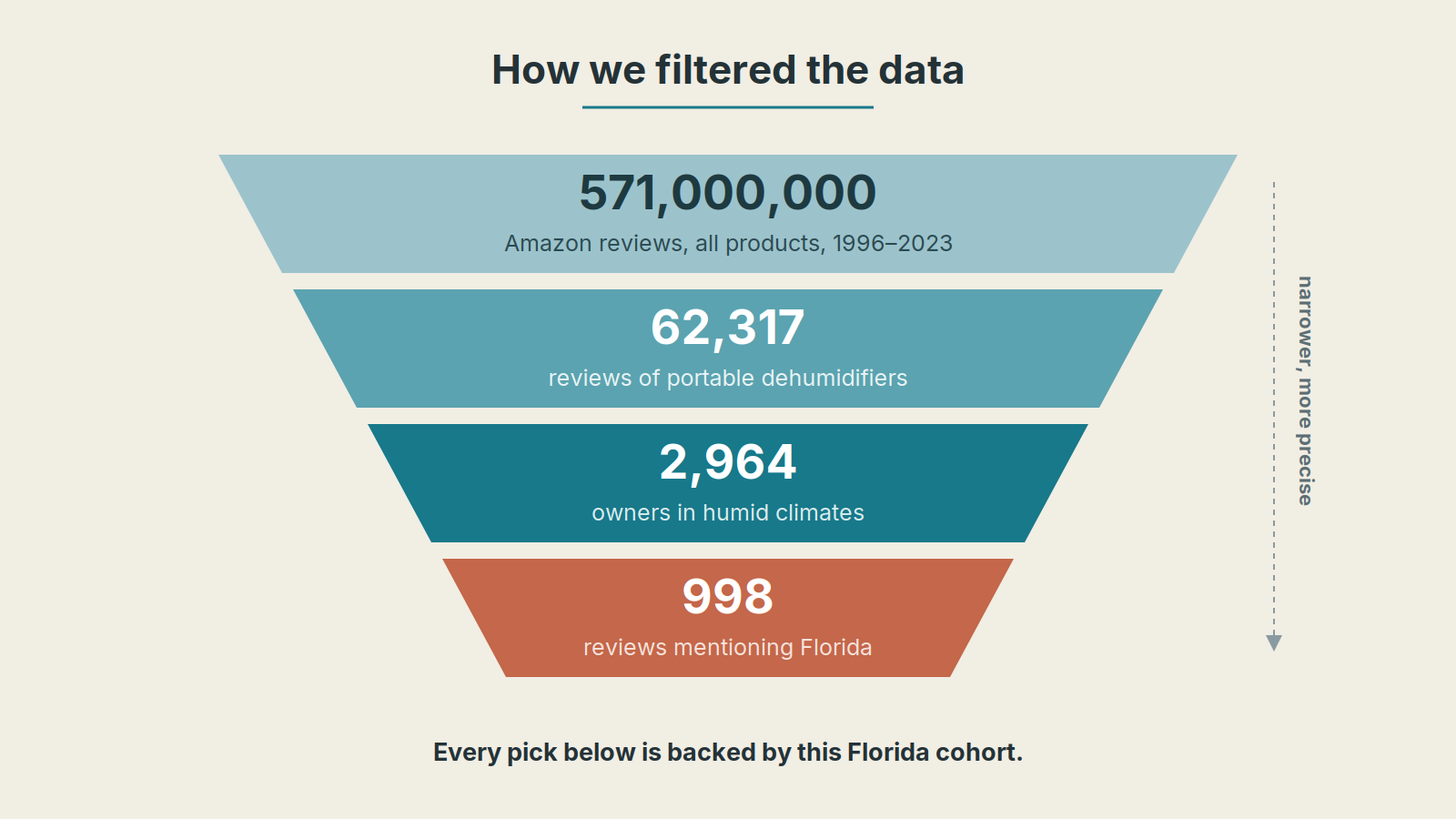
The best dehumidifier for Florida is rarely the one at the top of a national roundup. A unit here runs year round, against outdoor air that sits near saturation for months at a time. So instead of rewriting other people’s reviews, we built a scorecard from public data: 62,317 Amazon reviews of dehumidifiers, the federal ENERGY STAR registry of 535 certified models, and CPSC recall records going back to 2001. We did not test anything. We matched open datasets, and every number below can be checked.
Disclosure: This article contains affiliate links, including links to Amazon, Sylvane, and other partners. If you purchase through these links, we may earn a small commission at no extra cost to you. As an Amazon Associate I earn from qualifying purchases. Full disclosure: Affiliate Disclosure.
There are no affiliate links on this page.
How this scorecard was built
Three sources, three axes.
Reviews. From the Amazon Reviews 2023 research dataset (571 million reviews, 1996–2023) we filtered 62,317 reviews covering 711 compressor dehumidifier models, then pulled 2,964 reviews from owners in humid climates, of which 998 mention Florida directly. Humid climate here means the owner said so in the review text. It is not buyer geolocation, so the count is a floor, not a headcount. We publish aggregates only: review volume and the share of 1–2 star ratings. Brand averages stay out, because customer ratings are opinions, not reliability measurements.
The ENERGY STAR registry. Export dated 28 July 2026: 535 certified models, 511 of them portable. The registry carries what an Amazon listing never shows, namely the tested capacity under the DOE procedure in Appendix X1 and the company that filed the certification. Certification is an efficiency threshold. It is not a quality rating and not a recommendation. Full breakdown sits on our ENERGY STAR registry page.
CPSC. Nine recall actions on dehumidifiers between 2001 and 2023, roughly 11.9 million units in the United States, every one of them for overheating or fire. On top of that we ran our own slice of the SaferProducts.gov complaint dump: 471 reports filed between 2011 and 2026. Those are consumer reports filed with CPSC, not confirmed defects. The recall history with model numbers lives on our CPSC recalls page.
Method notes are on our methodology page. The full review analysis is in the Amazon review study.
The scorecard
There is no single best dehumidifier for Florida, so the table splits by job. Ranking runs on DOE capacity and review statistics. Never on the pint number printed on the box. More on that below, because it is the single biggest reason Florida buyers pick wrong.
| Job | DOE class, pints/day | Pick | Reviews | 1–2 star, % | ENERGY STAR certifier | Recall history |
|---|---|---|---|---|---|---|
| Open plan, living room plus kitchen | 40–50 | JHS/Waykar group: yaufey, Kesnos, Waykar | 11,437 | 6.2 / 9.7 / 11.2 | one filer: JHS INC / Waykar | none |
| Open plan, alternative | 40–50 | hOmeLabs | 11,512 | 13.2 | Aterian Group | none |
| Bedroom, condo, two rooms | 20–35 | Vellgoo | 1,159 | 6.8 | Invitop, seven brands | none |
| Closet, bathroom, RV | mini, 200–800 ml/day | device class, not a brand | 1,042 | 13.4 | — | none |
| Crawl space, whole house | whole-home, median 65 | Aprilaire, Healthy Climate, Carrier; AlorAir group | 746 | 18.8 | Research Products; AlorAir Solutions, four brands | none |
Review counts and star shares from 62,317 core reviews, 1996–2023; brands shown had 700+ reviews. Mini row uses the Florida slice of a separate 63,907-review cohort. Capacities are DOE Appendix X1 values at 65 °F / 60% RH. Registry export 28 July 2026.
Size the unit with the Florida dehumidifier calculator, not with the square footage claim on the carton.
The picks, one at a time
Open plan: the JHS/Waykar group, with a caveat nobody prints
The three brands with the lowest share of bad ratings in our slice are yaufey (6.2% of 3,098 reviews at 1–2 stars), Kesnos (9.7% of 3,513) and Waykar (11.2% of 4,826). All three are certified by the same legal entity. In 43 registry records the brands are listed together inside a single filing, in the form “Waykar; KESNOS; YAUFEY; Fehom”. That is not our reconstruction. That is how the manufacturer filled out the paperwork.
What it means at the shelf: comparing yaufey against Kesnos and picking the more reliable one means comparing two labels. Pick on the configuration you need, a pump above all, and on whatever the price is that day.
No recalls have been announced on these brands. Three reports on Waykar units sit in the SaferProducts database, all filed in June 2026, describing an R-32 refrigerant leak with error code E3. Those are unverified consumer reports, and the shared filing date suggests one household with several units. Three reports prove nothing about a product line. We log it as a fact of the database and leave it there.
Open plan, alternative: hOmeLabs
The largest single-brand review base in the whole core set, 11,512 reviews, with 13.2% at 1–2 stars. Middle of the pack. Certifier is Aterian Group, no recalls. This is the pick if you would rather buy one brand with a long sales history than a label inside a multi-brand family.
Bedroom and condo: Vellgoo, and the noise problem
Noise is the number one complaint from Florida owners of compressor units. The topic shows up in 15.6% of Florida reviews against 9.9% everywhere else. A machine that never shuts off becomes part of the sound of the house.
Vellgoo sits at 6.8% of 1,159 reviews at 1–2 stars. Its certifier, Invitop, holds six other brands, so the same rule applies. The label is not the axis of choice. For a bedroom, look at the 20–35 pint DOE class and plan on putting the unit outside the door if you sleep light. A compressor is a compressor.
One condo caveat. If your supply grilles are dripping, read the sweating AC vents breakdown first. A dehumidifier is not always the first move there.
Enclosed spaces: mini units do one thing honestly
Thermoelectric minis, the Peltier plate kind with no compressor, we counted as a separate cohort: 63,907 reviews across 600 models. In Florida their rating averages 4.36 against 4.66 for compressor units, and their share of 1–2 star ratings runs two and a half times higher, 13.4% against 5.4%.
The trade is exactly one thing. Minis get praised for silence (26.2% of Florida reviews mention it, against 19.9% for compressors) and get hammered on water. Complaints that the unit barely collects anything run about twice as often. Physics is on their side only in small volumes: 200–800 ml a day against 20 litres and up from a 50-pint compressor.
Florida owners seem to know this. Enclosed spaces such as a closet, a bathroom, an RV or a gun safe come up in 30.1% of Florida mini reviews against 11.3% for compressor units. That is where they belong. Do not buy one for a room.
Crawl space and whole house: the premium tier repeats the same trick
The whole-home class in the registry holds 24 models with a median tested capacity of 65.0 pints per day. Rebadging is here too. Aprilaire E080/E100/E130, Healthy Climate HCWHD-080/100/130 and Carrier DEHXXCDA1080/1100 all carry an identical integrated energy factor of 2.35 L/kWh at different capacities, which is OEM sharing in plain sight.
AlorAir Solutions certifies four brands: AlorAir, Abestorm, Argendon and BaseAire. AlorAir sits at 18.8% of 746 core reviews at 1–2 stars, on a small base in a specialist class. For a crawl space the form factor is close to mandatory, and the details are in the crawl space guide and on the 50-pint page.
Current retail options: Aprilaire E080, Aprilaire E100, Aprilaire E130
Who is not on the list
Numbers here, conclusions yours.
| Brand | Reviews | 1–2 star, % | Recall or complaint history |
|---|---|---|---|
| Midea | 2,365 | 24.8 | GD Midea plant named in three CPSC recalls: 2011, 2014, 2016 |
| Shinco | 1,192 | 28.6 | certifier HONGKONG YOAU, also holds UHOME and Yoau |
| Honeywell | 1,576 | 31.1 | certifier JMA North America |
| Frigidaire | 3,976 | 31.7 | Frigidaire-branded units were part of the 2013 Gree recall |
| BLACK+DECKER | 755 | 36.4 | certifier W Appliance Company |
Same 62,317-review base, brands with 700+ reviews. Recall column summarises CPSC releases 2001–2023.
SoleusAir, Kenmore and GE deserve their own line. They top the SaferProducts complaint list with 116, 50 and 31 reports out of 471, and they show up again and again in the recall waves of 2001 to 2023. Those complaint counts are filed consumer reports, not confirmed defects. Check any secondhand unit against the model numbers on our recalls page before money changes hands. Midea gets a longer look of its own in the Midea Cube review.
One honest caveat about the whole list. The 1–2 star share catches everything: noise, shipping damage, an awkward tank. It is a measure of dissatisfaction, not a verdict on the engineering. And a plant’s recall history does not mean the current models under that badge are defective.
The pint number on the box
Here is the part that costs Florida buyers the most.
Among the 511 portable dehumidifiers in the federal ENERGY STAR registry, not one is rated above 50.0 pints per day under the DOE test. Above that line the list is empty.
Meanwhile Amazon sells “70 Pint”, “155 Pint” and even “296 Pint” machines. Those numbers come from a different test point, 95 °F and 90% RH, and manufacturers say so in the fine print on their own sites. Take the Waykar PD160B-PRO. It is sold as 34 pints, measured at 95 °F / 90% RH. Its registry entry lists 10.16 pints/day under the DOE test at 65 °F / 60% RH, with an integrated energy factor of 1.91 L/kWh. That is a 3.3x spread on the same machine. The unit meets every applicable standard. The problem is not the hardware. It is which number the buyer sees.
For Florida the gap cuts both ways, and this is the part missing from every roundup we read. Air at 95 °F and 90% RH is a closed garage in August, not a living room, so the marketing figure runs high. But 65 °F and 60% RH is cooler and drier than a Florida house in July, which sits at 74–78 °F with dew points in the seventies. There is more water in that air than in the test condition, so real collection runs above the DOE figure.
The practical rule: compare models by the DOE number, because it is the only figure put on a common basis, and size the machine with the calculator. Both test methods are explained on the pint ratings page.
Three Florida corrections
Coil frost is not your problem. It is a staple of dehumidifier advice. In Florida reviews it comes up less often than in the rest of the country, 0.9% against 1.5%. A compressor frosts when the surrounding air is cold, and that condition barely occurs inside a Florida house.
The tank is your problem. Florida owners complain about a full tank twice as often as owners in other states, 13.0% of reviews against 6.5%. A machine running year round fills a tank fast, and a built-in pump is the feature that ends the argument. It is also the feature Florida reviews mention least, 0.9% against 1.4%. Setup options are covered on the drainage page.
Year-round runtime explains the rest. Noise, heat added to the room, wear. All of it follows from a machine that never shuts off. And yet ratings in humid climates run higher than the national average, 4.66 in the Florida slice against 4.13 across the whole sample. People forgive the side effects when the machine solves a problem they can see. In practice the best dehumidifier for Florida is the one you can drain without thinking about it and can stand to listen to.
Frequently asked questions
What size dehumidifier do I need in Florida?
Size by the DOE tested capacity, not the number on the box, and assume the unit runs year round. Our calculator uses Florida conditions and returns a class in pints per day for your square footage.
Why does my 50-pint dehumidifier collect less water than promised?
Marketing pints are usually measured at 95 °F and 90% RH, conditions that do not occur in a living room. The DOE tested figure at 65 °F / 60% RH is far lower. Compare models by the DOE number.
Are yaufey, Kesnos and Waykar different brands?
They are three labels certified by the same legal entity, and in part of the ENERGY STAR registry they appear inside a single filing. Choose on configuration and drainage, not on the name.
How do I check whether my dehumidifier was recalled?
Between 2001 and 2023 CPSC announced nine recalls covering roughly 11.9 million dehumidifiers, all of them for fire risk. Check your model against the list on our recalls page, especially before buying used.
Should I buy a compressor or a mini dehumidifier in Florida?
For rooms, a compressor. Florida reviews of mini units carry two and a half times the share of low ratings, and minis collect 200–800 ml a day. Minis earn their place in a closet, a bathroom or an RV, where silence matters more than volume.
Sources
- Amazon Reviews 2023, McAuley Lab, UC San Diego. 571 million reviews, 1996–2023, research dataset. Citation: Hou et al., arXiv:2403.03952. amazon-reviews-2023.github.io
- ENERGY STAR Certified Dehumidifiers, EPA and DOE. Export dated 28 July 2026, entry for Waykar PD160B-PRO verified 30 July 2026. data.energystar.gov
- DOE test procedure: 10 CFR Part 430, Subpart B, Appendix X1.
- CPSC recall releases, 2001–2023. cpsc.gov
- SaferProducts.gov public database dump, 23 July 2026. Reports in that database are submitted by consumers; CPSC does not guarantee their accuracy and publication does not mean CPSC has confirmed them.
- Our own analysis and filtering code notes: /methodology/. Affiliate policy: /affiliate-disclosure/.